
How the Brain Builds Sentences Neuron by Neuron
By tracking the electrical activity of individual brain cells in real time, researchers have discovered that specific neurons act as highly specialized linguistic building blocks during conversation.
By Factlen Editorial Team
- Neuroscience Researchers
- Focuses on the paradigm shift from a diffuse network model to single-neuron specificity.
- Clinical Neurologists
- Focuses on the immediate implications for mapping speech disorders and surgical safety.
- Brain-Computer Interface Developers
- Focuses on the 75 percent decoding accuracy and the roadmap to building real-time speech prosthetics.
What's not represented
- · Linguists and Grammarians
- · Patients with Speech Impairments
Why this matters
For decades, the biological mechanics of human language remained a mystery, hindering treatments for severe speech disorders. By mapping the exact cellular sequence of how sentences are built, scientists have laid the groundwork for brain-computer interfaces that could soon restore natural, real-time speech to patients with paralysis, ALS, or locked-in syndrome.
Key points
- Researchers tracked the electrical activity of individual brain cells during unscripted conversation in real time.
- Individual neurons in the frontotemporal cortex act as highly specialized linguistic building blocks.
- The brain plans speech in a strict sequence: morphemes at 400ms, phonemes at 200ms, and syllables at 70ms before vocalization.
- Speaking and listening utilize entirely different cellular hardware in the brain.
- Software can predict the phonemes a person is about to articulate with roughly 75 percent accuracy.
- The findings pave the way for brain-computer interfaces that could restore speech to paralyzed patients.
Human speech is a biological miracle hiding in plain sight. In the course of a casual conversation, a person effortlessly produces about three words per second. To achieve this, the brain must retrieve the correct vocabulary, apply complex grammatical rules, and orchestrate the precise muscle movements of the lungs, vocal cords, lips, and tongue. For decades, the sheer speed and seamlessness of this process baffled scientists. While functional MRI scans could show broad regions of the brain lighting up during speech, the exact cellular mechanics remained a black box. Researchers knew where language happened, but not exactly how the biological hardware executed the code.[5]
The prevailing consensus in neuroscience was that language must be a diffuse, whole-network phenomenon. The assumption was that abstract concepts like grammar and syntax were too complex to be handled by individual cells, requiring instead the simultaneous hum of millions of neurons working in concert. However, a landmark breakthrough published in the journal Nature has fundamentally shattered this view. By tracking the electrical crackle of individual brain cells in real time, researchers have revealed that the brain actually builds sentences neuron by neuron.[1][5]
The evidence comes from a pioneering study led by researchers at Massachusetts General Hospital (MGH). The team successfully tracked the action potentials of single neurons during unscripted, natural conversations. Their findings demonstrate that individual brain cells act as highly specialized linguistic building blocks. Rather than relying on a generalized wave of activity across the cortex, speech production relies on specific neurons executing hyper-specific jobs in the fraction of a second before a word is ever vocalized by the speaker.[1][2]
By observing these neurons in the frontotemporal cortex—a region located near the front and sides of the brain—scientists discovered an astonishing division of labor. "We used to think language was this diffuse, whole-network phenomenon," noted Dr. Ziv Williams, a neurosurgeon at MGH and co-author of the study. "But it turns out you have specific neurons that only care if a word is a noun, or only care if a phrase is ending." This level of grammatical specificity at the single-cell level was previously entirely theoretical.[1][2]

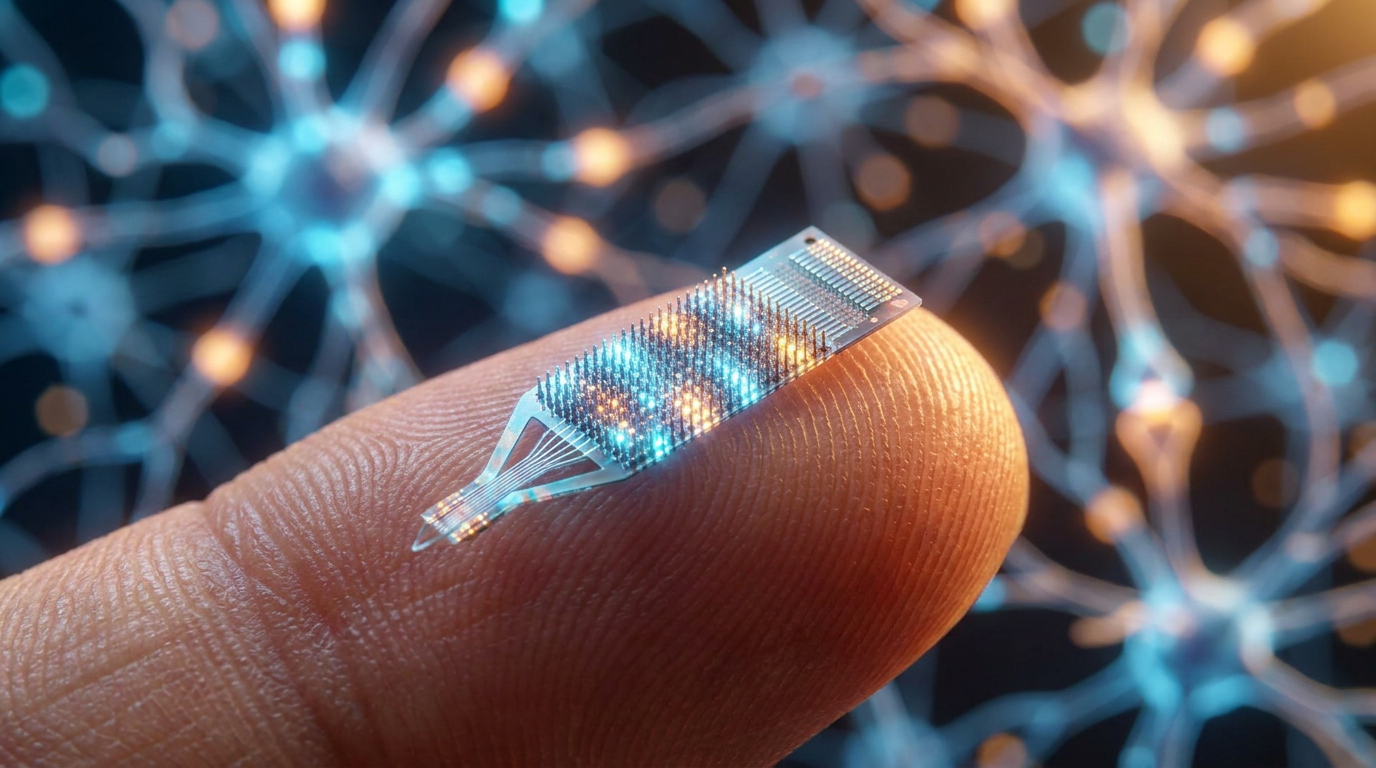
The mechanism that made this discovery possible is a marvel of modern bioengineering. The research team utilized Neuropixels probes, which represent the absolute bleeding edge of neural recording technology. These state-of-the-art devices are smaller than the width of a human eyelash, yet a single probe packs nearly 1,000 individual electrode sensors along its microscopic shaft. When inserted into the cortex, these sensors can isolate the electrical firing of dozens or hundreds of individual neurons simultaneously.[4][5]
Because implanting electrodes into the brain is highly invasive, the researchers relied on patients who were already undergoing neurosurgery for clinical reasons, such as the placement of deep brain stimulation devices for movement disorders or epilepsy monitoring. During these procedures, the patients volunteered to perform speaking and listening tasks while the Neuropixels probes temporarily recorded their cortical activity. This provided a rare, high-resolution window into the awake, behaving human brain.[3][4]
The data generated by these high-density probes allowed the NIH-funded research team to map a precise, millisecond-by-millisecond timeline of cellular activation. They discovered that the brain plans speech in a strict, highly ordered sequence, assembling the various components of a word long before the vocal cords ever begin to vibrate. This sequential firing provides the first concrete physical evidence of how abstract thought translates into physical sound, revealing a biological assembly line operating at blinding speed beneath the surface of the skull.[3]
The assembly line begins roughly 400 milliseconds before vocalization. At this stage, specialized 'morpheme' neurons fire. Morphemes are the smallest structural units of meaning in a language, such as root words, prefixes, or suffixes. The activation of these specific cells indicates that the brain is laying down the foundational meaning and grammatical structure of the upcoming word before it even considers how that word will sound to the listener. It is the conceptual blueprint of the sentence taking physical form.[3][5]
Next, at approximately 200 milliseconds before speech, a different set of cells known as 'phoneme' neurons springs into action. These neurons are tuned to the specific acoustic components of the word. For instance, the researchers found that certain neurons become highly active only when the patient is about to speak 'p' or 'b' sounds, which require stopping airflow at the lips. A completely different cluster of neurons fires in preparation for 'k' or 'g' sounds, which are formed by pressing the tongue against the soft palate.[3][4]

Next, at approximately 200 milliseconds before speech, a different set of cells known as 'phoneme' neurons springs into action.
Finally, just 70 milliseconds before the person actually speaks, a distinct class of 'syllable' neurons activates. These cells take the previously selected phonemes and assemble them into their final ordered sequence, essentially packaging the raw sounds into pronounceable chunks. Crucially, these neurons do not respond to phonemes presented out of order; they only fire when the specific sequence of the syllable is perfectly arranged and ready for immediate motor execution by the mouth, tongue, and vocal cords.[3]
Beyond the timeline of speech production, the study revealed another profound structural reality: speaking and listening utilize entirely different cellular hardware. The researchers found that the neurons that fire when a person speaks a specific sound are completely distinct from the neurons that fire when they hear that exact same sound. The brain maintains separate, dedicated circuits for auditory input and vocal output, ensuring that the two systems do not interfere with one another during rapid, back-and-forth conversation.[2][3]
This strict separation of cellular hardware helps explain complex clinical phenomena that have puzzled neurologists for centuries. For example, patients who suffer a stroke in specific frontal regions of the brain often develop expressive aphasia. These individuals can perfectly understand spoken language and know exactly what they want to say, but they are physically unable to produce the words. The Neuropixels data confirms that their 'listening' neurons remain intact while their 'speaking' neurons have been compromised.[2][5]
The most profound technological takeaway from the research is the newfound ability to predict speech. Because the neuronal firing sequence is so incredibly reliable, the research team found that they could use software to predict the phonemes a person was about to articulate with roughly 75 percent accuracy. By simply reading the electrical crackle of the frontotemporal cortex, the computer algorithms knew exactly what the patient was going to say before they even opened their mouth to speak.[4]
This predictive capability opens a revolutionary frontier for medical technology. For individuals suffering from locked-in syndrome, advanced amyotrophic lateral sclerosis (ALS), or severe brain-stem strokes, the cognitive ability to generate language often remains perfectly intact. Their morpheme, phoneme, and syllable neurons are still firing in precise sequences, but the signals cannot reach the paralyzed muscles of the mouth and throat.[2][5]

If engineers can successfully integrate these single-neuron signals into next-generation brain-computer interfaces (BCIs), the implications are life-changing. A BCI could theoretically read the sequential firing of the speech-planning neurons, decode the intended phonemes and syllables in real-time, and translate those signals directly into a synthetic voice. This would restore natural, conversational speech to patients who have been silenced for years.[2][4]
Despite the massive leap forward, researchers maintain transparent uncertainty about the broader mechanics of human language. The frontotemporal cortex is clearly a critical hub for grammatical assembly and phoneme selection, but language is deeply intertwined with other cognitive processes. It remains entirely unknown how these highly specialized single neurons interact with deeper brain structures, such as the amygdala or hippocampus, which govern the emotional resonance and memory retrieval associated with speech.[4][5]
Furthermore, the current dataset relies exclusively on native English speakers. While the fundamental biological mechanics of morpheme and phoneme assembly are presumed to be universal, it is not yet proven whether the exact same neuronal sequencing applies to structurally distinct languages. Tonal languages like Mandarin, or heavily agglutinative languages like Turkish and Finnish, may exhibit different firing timelines or require entirely different classes of specialized neurons.[3][5]
On the engineering front, the physical longevity of Neuropixels implants remains a significant hurdle. Currently, these ultra-fine probes are used temporarily during existing surgical procedures. For permanent brain-computer interface applications, the hardware must be made durable enough to survive in the human brain's corrosive, immune-active environment for decades without degrading, breaking, or causing excessive scar tissue that would eventually block the delicate electrical signals from reaching the sensors. Materials science must catch up to the neuroscience to make this a reality.[4]
Even with these engineering and linguistic questions remaining, the conceptual leap provided by this research is permanent. The abstract, almost philosophical concept of 'language' has been successfully mapped down to the biological firing of individual cells. The human brain's dictionary and grammar rulebook are no longer just psychological metaphors; they are physical, readable circuits that can be observed in real-time as a person thinks and speaks. This demystifies one of the most fundamental traits of our entire species.[1][5]
As the neuroscience community digests these findings, the focus is rapidly shifting from basic discovery to clinical application. The ability to predict vocalization before it happens fundamentally changes our understanding of human cognition. By proving that the brain builds sentences neuron by neuron, scientists have not only solved a core mystery of human biology but have also laid the groundwork for technologies that could one day give a voice back to the voiceless.[1][4]
How we got here
Dec 2023
Initial studies using Neuropixels reveal that individual neurons in the auditory cortex tune to specific speech sounds during listening.
Jan 2024
Researchers publish findings showing that neurons also encode specific phonemes and syllables during speech production.
Jun 2026
New data confirms that individual neurons act as specialized linguistic building blocks, tracking grammar and sentence structure in real-time.
Viewpoints in depth
Neuroscience Researchers
Focuses on the paradigm shift from a diffuse network model to single-neuron specificity.
For decades, the prevailing theory in neuroscience was that language was too complex to be handled by individual cells, requiring instead the simultaneous activity of millions of neurons. This camp views the Neuropixels data as a fundamental paradigm shift. By proving that individual neurons act as highly specialized linguistic building blocks—tracking specific phonemes, syllables, and even grammatical rules—researchers can now map the brain's dictionary at the microscopic level. This fundamentally changes the biological understanding of human cognition.
Clinical Neurologists
Focuses on the immediate implications for mapping speech disorders and surgical safety.
Clinicians view these findings through the lens of pathology and patient care. The discovery that speaking and listening utilize entirely different cellular hardware perfectly explains conditions like expressive aphasia, where stroke patients can understand speech but cannot produce it. However, this camp also emphasizes the invasive nature of the research. Because gathering this data requires implanting high-density probes deep into the cortex, neurologists stress that such research must remain piggybacked on necessary clinical surgeries until the safety profile of long-term implants improves.
Brain-Computer Interface Developers
Focuses on the 75 percent decoding accuracy and the roadmap to building real-time speech prosthetics.
For neuro-engineers and BCI developers, the most critical finding is the ability to predict intended speech before vocalization. Because the firing sequence of morpheme, phoneme, and syllable neurons is so reliable, algorithms can decode the intended sounds with roughly 75 percent accuracy. This camp is actively working to translate these single-neuron signals into real-time synthetic voice prosthetics, which could restore natural, conversational speech to patients suffering from locked-in syndrome, ALS, or severe paralysis.
What we don't know
- Whether the exact same neuronal sequencing and timing applies to tonal languages like Mandarin or highly structurally different languages.
- How these single-neuron language centers interact with deeper brain regions responsible for raw emotion and memory retrieval.
- How to manufacture high-density probes that can safely remain in the human brain for decades without degrading or causing scarring.
Key terms
- Morpheme
- The smallest structural unit of meaning in a language, such as a root word, a prefix, or a suffix.
- Phoneme
- A distinct unit of sound in a specified language that distinguishes one word from another, such as the 'p' sound in 'pat'.
- Frontotemporal Cortex
- A region of the brain located near the front and sides that is heavily involved in language production, grammar, and executive function.
- Action Potential
- The brief electrical impulse by which information is transmitted along the axon of a neuron.
- Brain-Computer Interface (BCI)
- A system that connects the brain's electrical signals directly to an external device, such as a computer or a synthetic speech generator.
Frequently asked
How fast does the human brain process speech?
In natural conversation, humans produce about three words per second. To achieve this, the brain must plan morphemes, phonemes, and syllables in a fraction of a second before vocalization.
What are Neuropixels probes?
Neuropixels are advanced neural recording devices, smaller than a human hair, that contain hundreds of sensors capable of tracking the electrical activity of individual brain cells simultaneously.
Can scientists read my thoughts?
No. The current technology can only decode intended speech in patients with surgically implanted electrodes, and it specifically tracks the motor-planning of words, not abstract inner monologues.
Will this help people who cannot speak?
Yes. By understanding exactly which neurons fire to produce specific sounds, engineers can design brain-computer interfaces that translate intended speech into a synthetic voice for paralyzed patients.
Sources
Source coverage
5 outlets
3 viewpoints surfaced





[1]NatureNeuroscience Researchers
Daily briefing: The brain builds a sentence neuron by neuron
Read on Nature →[2]Massachusetts General HospitalClinical Neurologists
Researchers Discover How Neurons in the Human Brain Map Word Meanings
Read on Massachusetts General Hospital →[3]National Institutes of HealthNeuroscience Researchers
How the brain plans and produces speech
Read on National Institutes of Health →[4]The TransmitterBrain-Computer Interface Developers
Individual neurons tune to complex speech sounds and cues
Read on The Transmitter →[5]Factlen Editorial TeamBrain-Computer Interface Developers
Synthesis by Factlen editorial team
Read on Factlen Editorial Team →


Every angle. Every day.
Get science stories with full source coverage and perspective breakdowns delivered to your inbox.