
How Specialty Robusta is Saving the Future of Coffee
Faced with a climate crisis that threatens traditional Arabica beans, the coffee industry is elevating Robusta—once considered a cheap filler—into a premium, specialty brew.
By Factlen Editorial Team
- Specialty Coffee Producers
- Farmers elevating Robusta through meticulous processing to secure premium market prices.
- Climate Scientists & Agronomists
- Researchers viewing Robusta as a necessary genetic adaptation to preserve global coffee supply.
- Coffee Industry Evaluators
- Institutions updating sensory standards to formally recognize and score high-quality Robusta.
What's not represented
- · Instant coffee manufacturers facing higher raw material costs
- · Small-scale Arabica farmers struggling to transition their crops
Why this matters
Climate change is rapidly shrinking the land suitable for growing the Arabica coffee most consumers drink daily. The elevation of Robusta from a bitter commodity to a delicious specialty bean ensures that high-quality coffee remains accessible and affordable, while providing a vital economic lifeline to farmers adapting to a warmer world.
Key points
- Climate change is projected to eliminate up to 50% of land suitable for Arabica coffee by 2050.
- Robusta beans thrive in warmer climates and naturally resist pests due to their high caffeine content.
- Farmers are applying specialty processing techniques to Robusta, replacing its bitter reputation with notes of chocolate and spice.
- The Specialty Coffee Association is updating its global flavor lexicon to officially recognize and score high-quality Robusta.
- Vietnam's coffee export revenue surged to $8.92 billion in 2025, driven heavily by the premiumization of Robusta.
For decades, the global coffee industry has operated on a strict hierarchy: Arabica was the prized bean for specialty cafes, while Robusta was relegated to the bottom shelf. Arabica offered complex acidity, floral notes, and natural sweetness. Robusta, true to its name, was hardy and highly caffeinated, but widely dismissed as bitter and rubbery—suitable only for instant coffee crystals and cheap espresso blends.[2][6]
But that hierarchy is rapidly collapsing under the weight of environmental reality. Climate change is fundamentally redrawing the map of the global "Coffee Belt." According to World Coffee Research, rising temperatures and erratic rainfall are projected to wipe out up to 50% of the land currently suitable for growing Arabica by the year 2050. As droughts intensify and pests multiply in warmer climates, the delicate Arabica plant is struggling to survive.[1][5]
Enter Coffea canephora, the botanical name for Robusta. Historically viewed as a fallback option, Robusta is now undergoing a radical premiumization. Farmers, roasters, and scientists are collaborating to apply specialty-grade care to this resilient species, proving that when treated with respect, Robusta can produce a complex, delicious cup that rivals its fragile cousin.[2][3]
The biological differences between the two species explain both Robusta's historical bad reputation and its current climate advantage. Robusta beans contain nearly twice the caffeine of Arabica—averaging 2.7% compared to Arabica's 1.5%. In the wild, this massive dose of caffeine acts as a potent natural pesticide, protecting the plant from devastating threats like the coffee berry borer and coffee leaf rust.[1][6]

However, that chemical defense mechanism comes with a sensory trade-off. Caffeine is inherently bitter. Furthermore, Robusta contains significantly fewer natural sugars and lipids (fats) than Arabica, and higher levels of chlorogenic acids. When mass-produced and poorly roasted, this chemical makeup results in the harsh, astringent flavors that consumers have long associated with the bean.[2][6]
The breakthrough has come not from changing the plant, but from changing how it is handled. For generations, Robusta was treated purely as a volume commodity. Farmers would "strip-pick" the branches, harvesting ripe, unripe, and overripe cherries all at once, before drying them haphazardly on concrete patios. This careless processing baked in the defective flavors.[6][7]
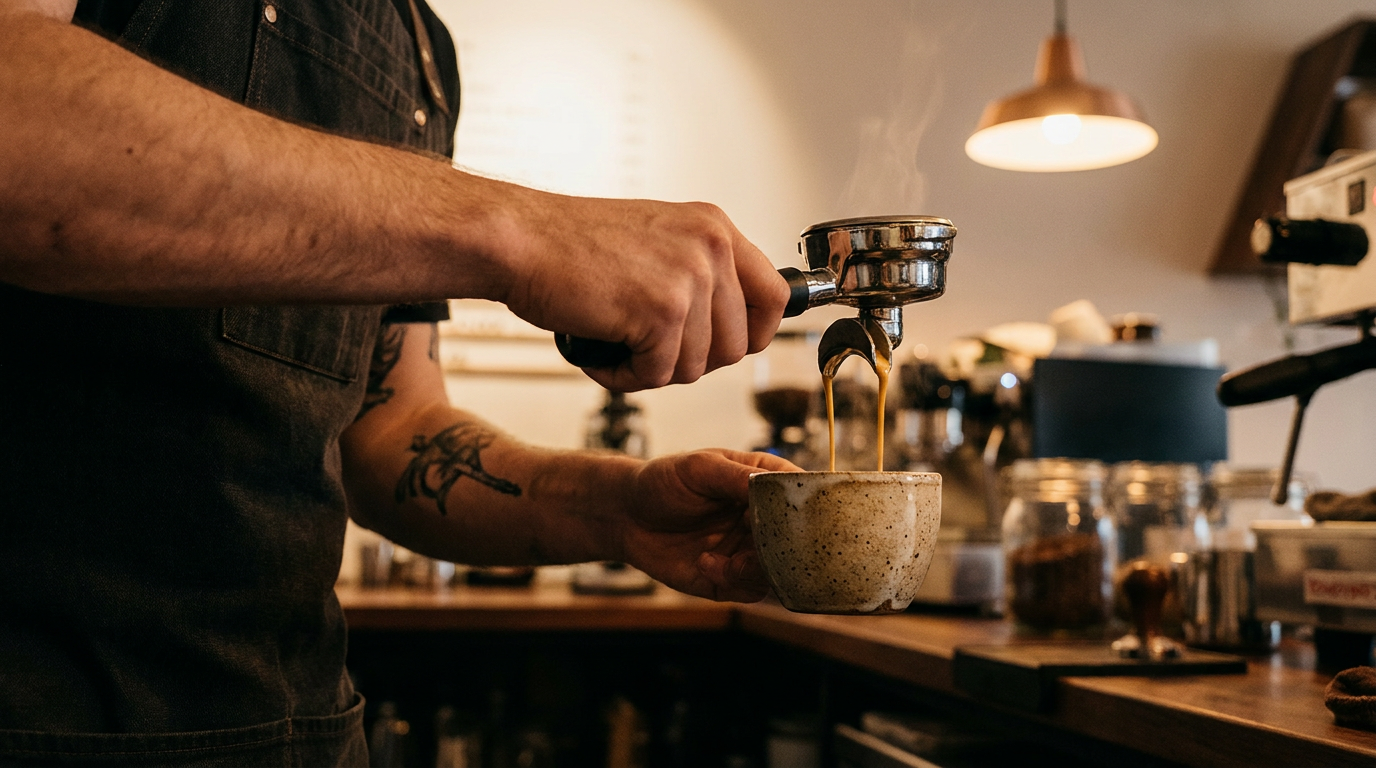
Today, a new generation of producers in countries like Vietnam and Brazil are applying the meticulous techniques once reserved exclusively for Arabica. Farm workers are selectively hand-picking only the perfectly ripe, deep-red cherries. They are utilizing advanced post-harvest methods like wet processing and honey processing, which carefully control fermentation to enhance the bean's natural sweetness and tame its harsh acids.[5][7]

Today, a new generation of producers in countries like Vietnam and Brazil are applying the meticulous techniques once reserved exclusively for Arabica.
The resulting "Fine Robusta" is a revelation to traditional coffee purists. Instead of burnt rubber, these carefully processed beans yield a heavy, syrupy body with a remarkably rich crema. Flavor profiles are expanding to include notes of dark chocolate, aromatic spices, roasted nuts, and even subtle dark fruit, fundamentally challenging the assumption that Robusta cannot be complex.[3][6]
The specialty coffee establishment is officially recognizing this shift. For years, the industry's quality standards—such as the rigorous Q Grader certification—were designed exclusively around Arabica's flavor profile. Robusta literally did not have a vocabulary in high-end coffee. That changed in May 2025 with the launch of the Canephora Flavor Wheel, the first open-access sensory lexicon developed exclusively for Robusta.[2]
Following suit, the Specialty Coffee Association (SCA) revised its evaluation courses to train assessors to score top-notch coffee regardless of species. In 2026, the SCA is officially updating its global flavor descriptor lexicon to include attributes specific to fine Robusta. In Brazil, the Brazil Specialty Coffee Association (BSCA) has adopted the new Coffee Value Assessment protocol to standardize how these premium Robustas are graded and traded.[3][4]
The economic ripple effects are massive, particularly for the world's largest Robusta producers. Vietnam, which supplies over 40% of the global Robusta market, saw its coffee export revenue surge by nearly 60% to $8.92 billion in 2025. This boom is driven both by rising baseline prices and the increasing premium that buyers are willing to pay for high-quality, carefully processed lots.[3]

In Brazil, the world's second-largest Robusta producer, farmers in regions like Espirito Santo are aggressively pivoting toward quality. The state has set an ambitious target to produce 1.5 million bags of specialty-grade Robusta by 2032. By securing premium prices, these farmers are building financial resilience against the very climate shocks that are making agriculture more difficult.[4][5]
Despite its hardiness, Robusta is not a magic bullet for the climate crisis. Agronomists warn that while it tolerates heat better than Arabica, it still requires substantial rainfall. Extreme weather events continue to pose a threat; a severe drought in Vietnam in early 2024 led to projections of a 20% drop in national yield, proving that no crop is entirely immune to a warming planet.[1]
Furthermore, consumer perception remains a hurdle. Decades of marketing have trained coffee drinkers to look for "100% Arabica" on packaging as a proxy for quality. Roasters and cafes face the challenge of re-educating their customers, convincing them that a well-crafted Robusta blend—or even a single-origin Robusta—is not a downgrade, but a different, equally valid culinary experience.[6]

Ultimately, the rise of specialty Robusta represents a necessary evolution in global food systems. As environmental realities intersect with agricultural economics, taste preferences must adapt. By embracing the bold, spicy, and heavy-bodied profile of Fine Robusta, the coffee industry is ensuring that the world's favorite morning ritual can survive the century.[2][5]
How we got here
Early 1990s
Robusta accounts for roughly 28% of total global coffee production, used almost exclusively for instant coffee and cheap blends.
2010
The Coffee Quality Institute introduces the first 'Fine Robusta' protocols, a very early step toward recognizing the bean's potential.
2023
Robusta's share of global coffee production reaches 44% as climate pressures on Arabica mount.
May 2025
The Canephora Flavor Wheel is launched, providing the first open-access sensory lexicon developed exclusively for Robusta.
2026
The Specialty Coffee Association revises its official flavor descriptor lexicon to include attributes specific to fine Robusta.
Viewpoints in depth
Specialty Coffee Producers
Farmers and processors focused on elevating Robusta to secure premium market prices.
For producers in regions like Vietnam and Brazil, the specialty Robusta movement is an economic lifeline. By investing in selective harvesting and controlled fermentation, they can break free from the volatile, low-margin commodity market. These producers argue that Robusta's historical bitterness was a result of poor handling, not poor genetics, and that premium prices are necessary to fund sustainable farming practices.
Climate Scientists & Agronomists
Researchers who view Robusta as a necessary genetic adaptation for the future of coffee.
Agricultural scientists emphasize that Arabica's narrow genetic base makes it dangerously susceptible to a warming planet. They view the widespread adoption of Coffea canephora (Robusta) as a critical climate adaptation strategy. While acknowledging that Robusta still faces risks from extreme drought, they argue its natural resistance to heat and pests makes it the most viable foundation for the coffee industry's survival through 2050.
Traditional Coffee Purists
Consumers and roasters historically loyal to Arabica's complex, acidic flavor profile.
Many veteran specialty roasters and consumers remain cautious about the shift. They value the bright, floral, and highly acidic notes that are biologically unique to Arabica. While this camp is beginning to accept Fine Robusta as a valid ingredient for adding body and crema to espresso blends, they often argue it provides a fundamentally different culinary experience and cannot serve as a direct 1:1 flavor replacement for high-altitude Arabica.
What we don't know
- How quickly mainstream consumers will abandon the '100% Arabica' quality proxy and embrace premium Robusta.
- Whether Robusta yields can remain stable if extreme, prolonged droughts become more frequent in top producing countries like Vietnam.
- How the pricing dynamics between commodity Arabica and specialty Robusta will settle over the next decade.
Key terms
- Coffea canephora
- The botanical name for the Robusta coffee species, known for its hardiness, high caffeine content, and resistance to pests.
- Coffea arabica
- The coffee species that currently dominates the specialty market, prized for its complex acidity and sweetness but highly vulnerable to climate change.
- Honey processing
- A post-harvest method where coffee cherries are depulped but dried with the sticky, sugar-rich mucilage still attached to the bean, enhancing sweetness.
- Crema
- The flavorful, aromatic froth that rests on top of a shot of espresso, which is naturally thicker and more stable when brewing with Robusta.
- Chlorogenic acids
- Antioxidant compounds found in high concentrations in Robusta beans that can contribute to a bitter or astringent taste if not roasted properly.
Frequently asked
Does Robusta have more caffeine than Arabica?
Yes. Robusta beans contain an average of 2.7% caffeine, which is nearly double the 1.5% average found in Arabica beans.
Why does Robusta usually taste bitter?
Robusta has naturally lower levels of sugars and lipids, and higher levels of caffeine and chlorogenic acids. Historically, poor harvesting and processing methods exacerbated these bitter traits.
Will Arabica coffee go extinct?
It is unlikely to go entirely extinct, but experts project that up to 50% of the land currently suitable for growing Arabica will become unviable by 2050 due to climate change.
What is specialty Robusta?
Specialty Robusta refers to beans that are selectively hand-picked at peak ripeness and carefully processed to highlight complex flavors like chocolate and spice, rather than being mass-produced for cheap blends.
Sources
Source coverage
7 outlets
3 viewpoints surfaced







[1]World Coffee ResearchClimate Scientists & Agronomists
The story of a species: Robusta
Read on World Coffee Research →[2]Fresh Cup MagazineCoffee Industry Evaluators
A new coffee sensory tool just dropped—and it doesn't speak arabica
Read on Fresh Cup Magazine →[3]Market Research VietnamSpecialty Coffee Producers
Vietnam's Specialty Robusta Coffee Boom: A Bold Premium Shift
Read on Market Research Vietnam →[4]Daily Coffee NewsCoffee Industry Evaluators
Classifying and Quantifying 'Specialty' in Brazil
Read on Daily Coffee News →[5]The GuardianClimate Scientists & Agronomists
Demand for coffee continues to rise, yet research shows land will decline
Read on The Guardian →[6]Zest Specialty Coffee RoastersCoffee Industry Evaluators
Future of Fine Robusta
Read on Zest Specialty Coffee Roasters →[7]RitaSpecialty Coffee Producers
Vietnam's Robusta Coffee Sector
Read on Rita →
Every angle. Every day.
Get lifestyle stories with full source coverage and perspective breakdowns delivered to your inbox.