
How Smart Electrical Panels Are Solving the Home Electrification Bottleneck
Smart electrical panels use dynamic load management to help older homes support EVs and heat pumps without requiring a $10,000 utility service upgrade.
By Factlen Editorial Team
- Electrification Advocates
- Smart panels are the key to rapidly decarbonizing the residential sector.
- Electrical Contractors
- Smart panels are a powerful tool, but they cannot defy the laws of physics.
- Cost-Conscious Homeowners
- The decision to install a smart panel comes down to a strict return-on-investment calculation.
- Policymakers & Regulators
- Focused on distributing federal funds to accelerate residential energy efficiency and grid resilience.
What's not represented
- · Utility Companies
- · Grid Operators
Why this matters
Upgrading to electric vehicles and heat pumps often triggers a hidden $10,000+ utility bill to expand a home's electrical capacity. Smart panels use software to bypass this bottleneck, allowing homeowners to fully electrify on their existing wiring while unlocking thousands in federal rebates.
Key points
- Older homes with 100-amp panels often cannot support the simultaneous demand of EVs, heat pumps, and induction stoves.
- Traditional utility service upgrades can cost between $2,000 and $25,000 and require extensive yard trenching.
- Smart electrical panels use dynamic load management to automatically pause non-essential circuits during peak demand.
- This software optimization keeps total power draw under the home's physical limit, avoiding the need for a utility upgrade.
- The Inflation Reduction Act provides up to $4,000 in upfront rebates for low-income households installing new panels.
The transition to an electrified home is accelerating. Across the country, homeowners are swapping gas-guzzling cars for electric vehicles, replacing aging furnaces with hyper-efficient heat pumps, and trading gas ranges for sleek induction cooktops.[1]
But this green revolution is colliding with a decidedly unglamorous bottleneck: the gray metal box sitting in the garage or basement. The traditional electrical panel, which has remained largely unchanged for decades, is suddenly being asked to handle a massive surge in power demand.[2]
Most homes built between 1960 and 1990 were wired for 100-amp service, a capacity perfectly adequate for a household running a refrigerator, a few televisions, and standard lighting. Today, plugging in a Level 2 EV charger alone can draw 40 to 50 amps, instantly consuming half of the home's total available power.[3]
When a homeowner attempts to add modern electric appliances to an older panel, the math simply does not work. The traditional solution has always been a "service upgrade," a brute-force physical expansion of the home's electrical capacity from 100 amps to 200 amps or more.[4]

A service upgrade is rarely simple. It often requires the local utility company to run thicker copper wires from the street to the house, which can involve digging up mature landscaping, cutting through driveways, and navigating months of municipal permitting.[5]
The financial toll of a service upgrade can be staggering. While a straightforward panel swap might cost a few thousand dollars, a full utility service upgrade can easily escalate to $10,000, and in complex residential layouts, it can reach as high as $25,000. For many homeowners, this hidden infrastructure cost kills the dream of electrification before it even begins.[7]
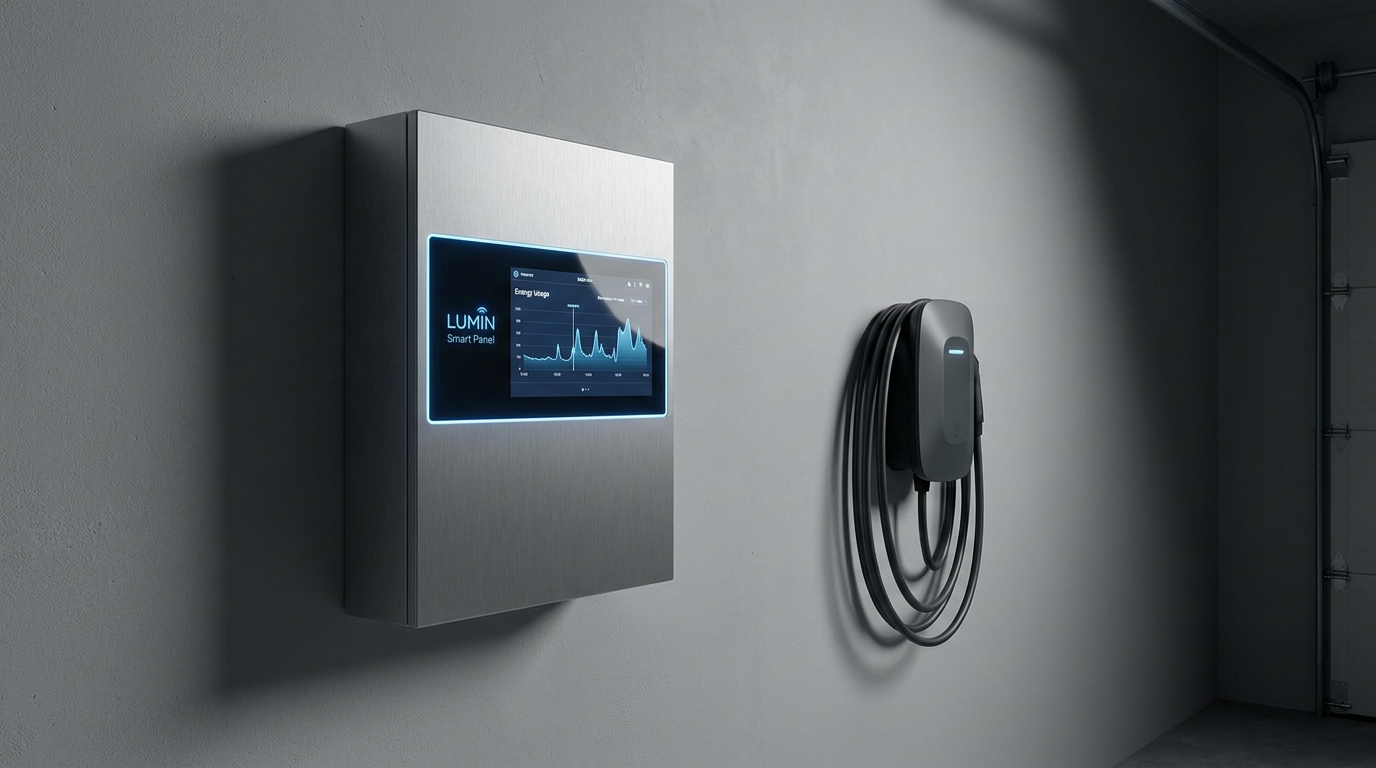
Enter the smart electrical panel. Companies like Span, Lumin, Schneider Electric, and Leviton have reimagined the breaker box, transforming it from a passive safety device into an internet-connected, software-driven energy manager.[2]
Unlike a traditional panel, which blindly allows electricity to flow until a circuit overloads and physically trips, a smart panel acts as an intelligent traffic cop. It monitors the power draw of every individual circuit in real-time, communicating via Wi-Fi to a central processor.[5]
The true breakthrough of the smart panel is a feature known as dynamic load management. Rather than physically increasing the amount of power coming into the house, the smart panel optimizes how the existing power is used, ensuring the total draw never exceeds the home's physical limit.[4]
The true breakthrough of the smart panel is a feature known as dynamic load management.
Consider a typical evening scenario: The heat pump is running, the induction stove is cooking dinner, and the homeowner plugs in their electric vehicle. In a traditional 100-amp home, this simultaneous demand would trip the main breaker, plunging the house into darkness.[3]

With a smart panel, the software intervenes. It recognizes that the home is approaching its maximum capacity and automatically pauses the lowest-priority circuit—often the EV charger or the electric dryer.[3]
Once the induction stove is turned off after dinner, the smart panel detects the drop in overall demand and instantly resumes sending power to the car. The homeowner wakes up to a fully charged vehicle, entirely unaware of the micro-adjustments that happened overnight.[3]
By actively managing these infrequent instances of overlapping peak demand, a smart panel allows a home to fully electrify while remaining safely within its original 100-amp or 150-amp limit. This software-based "panel optimization" effectively bypasses the need for a costly utility service upgrade.[3][4]
The hardware itself is not cheap. A smart panel installation typically ranges from $2,000 to $5,000, representing a significant premium over a standard $500 breaker box. However, when weighed against the five-figure cost of trenching a new utility line, the return on investment becomes immediately apparent.[5][7]

Furthermore, federal incentives are making the technology more accessible. Under the Inflation Reduction Act (IRA), the Home Electrification and Appliance Rebate (HEAR) program provides substantial upfront discounts for panel upgrades.[6]
Low-income households can qualify for up to $4,000 to cover the cost of a smart panel installation, while moderate-income households can receive up to $2,000. For those who do not qualify for income-based rebates, the IRA still offers a 30% tax credit for electrical panel upgrades when combined with other qualifying energy improvements.[6]
Despite the enthusiasm, electrical contractors caution that smart panels are not a universal magic bullet. If a home's continuous baseline load—such as running multiple air conditioning units and two EV chargers simultaneously all night—genuinely exceeds the panel's capacity, a physical service upgrade remains mandatory under electrical code.[4]
A smart panel cannot create energy out of thin air; it can only shift demand. If there is simply not enough power to go around, homeowners will find their lower-priority appliances constantly paused, leading to frustration and uncharged vehicles.[5]

Beyond load management, smart panels offer unprecedented visibility into household energy consumption. Through smartphone apps, homeowners can track exactly how much electricity their water heater or air conditioner is using, identifying inefficiencies and phantom drains that drive up monthly utility bills.[2]
As the grid becomes more volatile, this intelligence extends to resilience. When paired with a home battery system or a bidirectional EV charger, a smart panel allows homeowners to remotely shut down energy hogs during a blackout, stretching their backup power from a few hours to several days. The humble breaker box has finally joined the 21st century.[1][2]
How we got here
1960s–1990s
The 100-amp electrical panel becomes the standard capacity for American homes.
2018
Span introduces one of the first mainstream smart electrical panels, bringing software to the breaker box.
August 2022
The Inflation Reduction Act passes, allocating billions for home electrification rebates.
2024–2025
States begin rolling out the HEAR rebate programs, offering up to $4,000 for panel upgrades.
2026
Smart panels become a standard recommendation for homes adding EV chargers and heat pumps.
Viewpoints in depth
Electrification Advocates
Smart panels are the key to rapidly decarbonizing the residential sector.
Advocates argue that waiting for utility companies to physically upgrade the grid to support neighborhood-wide electrification will take decades. By installing smart panels, millions of homes can immediately adopt EVs and heat pumps without triggering local grid failures. They view software-defined energy management as the only scalable way to meet aggressive climate targets while keeping infrastructure costs manageable.
Electrical Contractors
Smart panels are a powerful tool, but they cannot defy the laws of physics.
Electricians emphasize that while dynamic load management is brilliant for handling overlapping peak loads—like an oven and an EV charger running at the same time—it is not a cure-all. If a large home requires a massive continuous baseline of power to operate multiple air conditioners and medical equipment, a physical service upgrade is still required by code. They caution homeowners against using smart panels as a band-aid for genuinely undersized electrical systems.
Cost-Conscious Homeowners
The decision to install a smart panel comes down to a strict return-on-investment calculation.
For the average homeowner, the appeal of a smart panel has little to do with smart-home novelty and everything to do with avoiding a five-figure utility bill. While the $2,000 to $5,000 upfront cost is steep compared to a traditional breaker box, it becomes highly attractive when it bypasses a $15,000 trenching project. The availability of the $4,000 HEAR rebate often tips the scales, making the smart panel the most financially viable path to home electrification.
Policymakers & Regulators
Government agencies are using financial incentives to steer homeowners toward grid-friendly technologies.
State and federal regulators view smart panels as a critical buffer for the aging national power grid. By subsidizing these installations through the Inflation Reduction Act, policymakers hope to create a distributed network of homes that can automatically manage their own peak loads. This reduces the immediate need for trillions of dollars in macro-grid infrastructure upgrades while ensuring lower-income households aren't left behind in the transition to clean energy.
What we don't know
- Whether utility companies will eventually mandate smart panels to help manage neighborhood-level grid strain.
- How long the current pool of IRA HEAR rebate funding will last in each individual state.
Key terms
- Dynamic Load Management
- The process of automatically balancing electrical demand by temporarily pausing certain circuits to prevent overloading the main system.
- Service Upgrade
- A physical upgrade to the wires and equipment connecting a home to the utility grid, increasing the total amperage available.
- HEAR Program
- The Home Electrification and Appliance Rebate, a federal initiative providing upfront discounts for energy-efficient home upgrades.
- Amperage (Amps)
- The measure of electrical current flowing through a circuit; most older homes have 100-amp service, while modern homes typically have 200-amp.
Frequently asked
Do I still need a utility service upgrade if I get a smart panel?
Often, no. By automatically pausing non-essential circuits during peak demand, a smart panel can keep your total usage under your existing limit, bypassing the need for a utility upgrade.
How much does a smart electrical panel cost?
The hardware and installation typically range from $2,000 to $5,000, though federal rebates and tax credits can significantly offset this upfront cost.
What happens to a smart panel during a power outage?
It functions like a normal breaker box, but if paired with a home battery backup, the app allows you to remotely turn off heavy appliances to make your battery power last for days.
Do smart panels work with any brand of breaker?
It depends on the brand. Systems like Span replace your entire box and use standard breakers, while add-on systems like Lumin wire into your existing panel to add smart controls.
Sources
Source coverage
7 outlets
4 viewpoints surfaced







[1]Factlen Editorial TeamElectrification Advocates
Synthesis by Factlen editorial team
Read on Factlen Editorial Team →[2]Solar United NeighborsElectrification Advocates
Smart panels, the next generation of electrical panels
Read on Solar United Neighbors →[3]Elemental GreenElectrification Advocates
Panel optimization for home electrification
Read on Elemental Green →[4]Platinum Power SolutionsElectrical Contractors
Smart Panel Vs Traditional Panel Upgrade
Read on Platinum Power Solutions →[5]Huntley ElectricalElectrical Contractors
Smart Panel vs. Traditional Panel Upgrade: What's the Difference?
Read on Huntley Electrical →[6]New York State GovernmentPolicymakers & Regulators
Inflation Reduction Act Rebates
Read on New York State Government →[7]Amp My HomeCost-Conscious Homeowners
Smart electrical panel or not?
Read on Amp My Home →

Every angle. Every day.
Get home stories with full source coverage and perspective breakdowns delivered to your inbox.