
How Small Language Models Are Moving AI Offline and Onto Your Phone
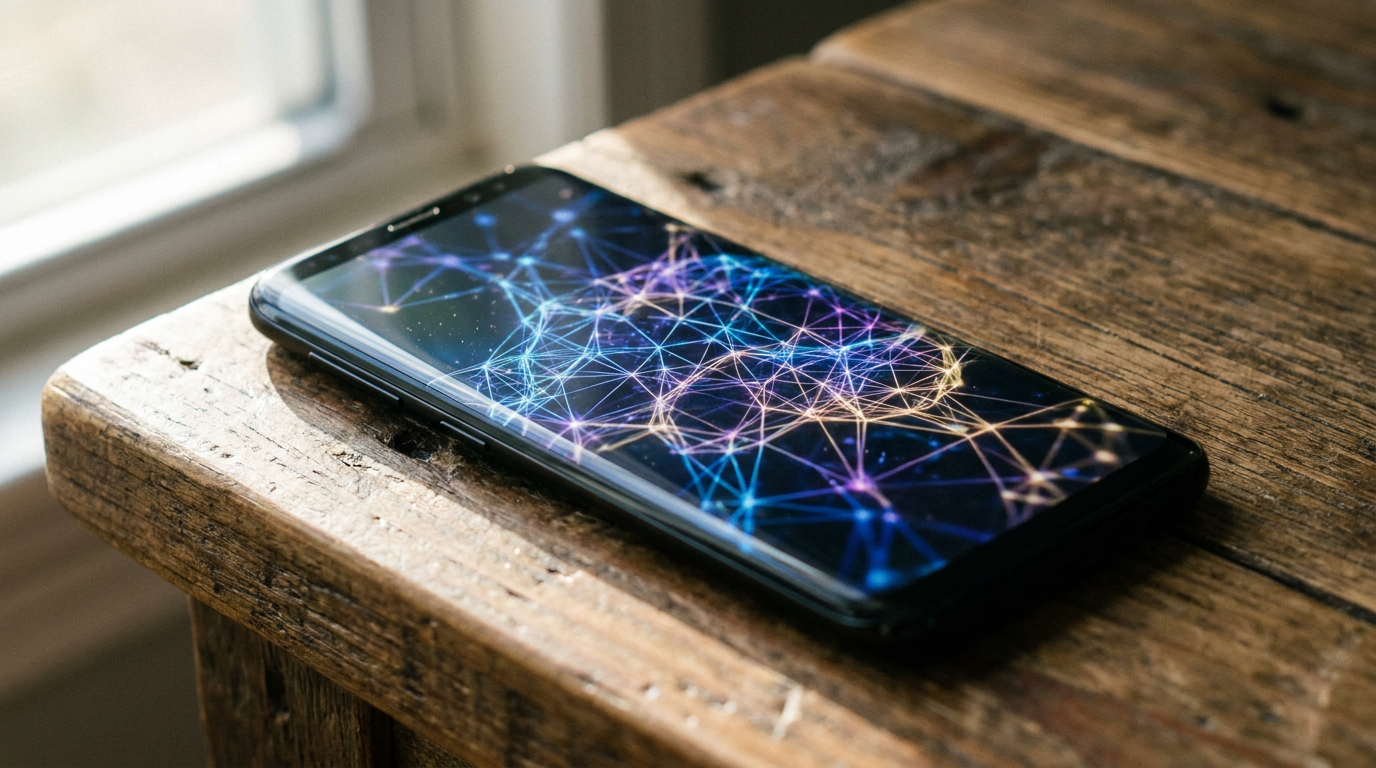
A new generation of compact AI models is running directly on smartphones and laptops, offering zero-latency responses and absolute data privacy without relying on the cloud.
By Factlen Editorial Team
- Mobile & Software Developers
- Prioritize zero-cost inference and OS-level integration, while managing hardware limits.
- Privacy & Security Advocates
- Focus on data sovereignty and the necessity of keeping sensitive information off the cloud.
- Enterprise AI Strategists
- Synthesize the broader shift from general-purpose cloud AI to fit-for-purpose local intelligence.
What's not represented
- · Hardware Manufacturers
- · Cloud Service Providers
Why this matters
By processing data locally rather than in the cloud, on-device AI guarantees that sensitive information—like private messages, health queries, and smart home commands—never leaves your hardware. This shift also eliminates subscription fees and allows AI tools to function seamlessly without an internet connection.
Key points
- Small Language Models (SLMs) typically contain under 7 billion parameters, allowing them to run on consumer hardware.
- On-device processing ensures that user data never leaves the phone or laptop, guaranteeing absolute privacy.
- Local AI operates with zero network latency and functions completely offline, even in airplane mode.
- Developers are adopting SLMs to eliminate recurring cloud API costs for AI features.
- Apple and Google have integrated SLM frameworks directly into iOS 26 and Android, simplifying deployment.
- SLMs struggle with complex reasoning, leading developers to use hybrid approaches for difficult tasks.
The artificial intelligence revolution of the early 2020s was defined by massive scale. Trillion-parameter behemoths housed in remote data centers dazzled the world, but they came with a catch: every prompt required an internet connection, a round-trip to a server, and a surrender of personal data. In 2026, a quiet counter-revolution is reshaping the landscape. The era of the Small Language Model (SLM) has arrived, moving artificial intelligence out of the cloud and directly onto the devices in our pockets.[1][9]
Small Language Models flip the fundamental architecture of modern AI. Instead of relying on vast server farms, these compact neural networks are designed to run locally on consumer hardware—smartphones, laptops, and smart home hubs. By shrinking the model's footprint, developers are unlocking a new paradigm of "edge AI" that prioritizes user privacy, zero-latency responses, and complete offline functionality.[4][8]
To understand the shift, one must look at the numbers. A frontier model like GPT-4 is estimated to operate with over a trillion parameters—the internal numeric weights that represent its learned knowledge. SLMs, by contrast, typically range from 1 million to roughly 7 billion parameters. Models like Microsoft's Phi-4 Mini, Google's Gemma 3, and Alibaba's Qwen 3.5 fit comfortably within this lightweight category.[4][6]
Fitting a highly capable AI into a smartphone requires aggressive engineering. The secret lies in a technique called quantization. Researchers shrink the model's weights from high-precision 16-bit floating-point numbers down to 4-bit or even 2-bit precision. This mathematical compression drastically reduces the memory footprint, allowing a 3-billion parameter model to run on just 2 gigabytes of RAM.[4][8]

Alongside quantization, modern devices are now equipped with dedicated hardware to handle the load. Neural Processing Units (NPUs) built into the latest Apple Silicon and Android chipsets are specifically optimized for the matrix math required by transformers. This hardware acceleration prevents the AI from draining the device's battery or overheating the processor, a major hurdle in earlier mobile AI attempts.[2][7]
The most immediate benefit for users is absolute data privacy. In a cloud-based paradigm, asking an AI to summarize a sensitive medical document or draft a confidential email requires transmitting that text to a third-party server. With an on-device SLM, the data never leaves the volatile memory of the phone or laptop. This "data sovereignty" is becoming a non-negotiable requirement for enterprise applications and privacy-conscious consumers.[2][9]
Speed is another transformative factor. Cloud inference is inherently bottlenecked by network latency; a request must travel to a server, be processed, and return. On-device SLMs eliminate this round-trip entirely. Inference latency drops to between 50 and 150 milliseconds, enabling near-instantaneous interactions. This speed is critical for real-time applications like live translation, voice assistants, and predictive typing.[1][8]
Cloud inference is inherently bottlenecked by network latency; a request must travel to a server, be processed, and return.
Furthermore, local models are completely immune to internet outages. Whether a user is on a remote hike, in a subway tunnel, or on an airplane, the AI remains fully functional. This offline capability is particularly crucial for smart home infrastructure. A local SLM can process voice commands to unlock doors or adjust thermostats without relying on a fragile cloud connection, ensuring the home remains smart even when the Wi-Fi drops.[8]

For software developers, the economics of SLMs are equally compelling. Integrating cloud-based AI into an application incurs recurring API costs for every token generated. If an app goes viral, the developer's server bills skyrocket. On-device inference costs the developer exactly zero dollars. The computational burden is shifted to the user's hardware, enabling developers to offer powerful AI features without subscription fees.[1][3]
The tech giants have recognized this shift and are baking SLMs directly into their operating systems. In 2026, Apple's Core AI and Foundation Models framework allow iOS and macOS developers to tap into Apple's proprietary on-device models with just a few lines of Swift code. The system manages the model's memory and execution, ensuring seamless integration across the Apple ecosystem.[7]
Google has taken a similar approach with Android's AICore and Chrome's built-in AI. Chrome now ships with the capability to run Gemini Nano directly in the browser. Web developers can build "zero-cost" AI features—like a client portal that summarizes project updates locally—without forcing the user to download a massive model file, as the browser manages the underlying engine.[1][3]
However, deploying SLMs in the real world is not without its engineering hurdles. A 2026 case study on "Palabrita," a production Android word-guessing game, highlighted the unique challenges of mobile AI. The researchers found that while cloud models reliably output perfectly formatted data, SLMs are prone to constraint violations, such as wrapping JSON in markdown or truncating responses mid-sentence.[5]
"The capability gap between cloud and on-device models is not merely quantitative... it is qualitative," the study noted. To succeed, developers must adopt defensive programming strategies, using the SLM for narrow, highly specific tasks rather than open-ended reasoning. The most reliable on-device feature is often the one where the AI is asked to do the least complex work.[5]
This limitation has given rise to the "hybrid" architecture. In this model, an application uses the on-device SLM for 80% of routine tasks—summarization, text formatting, and basic queries—while seamlessly routing complex, multi-step reasoning tasks to a larger cloud model. This approach balances privacy and speed with the heavy-lifting capabilities of frontier AI.[6]

Security researchers are also raising new questions about local AI. A smart home hub running an SLM to control physical locks presents a novel attack surface. Adversaries could theoretically use prompt injection through audio sensors to trick the local model into executing unauthorized commands. The industry is only just beginning to map these edge-case vulnerabilities.[8]
Despite these growing pains, the trajectory is clear. The future of artificial intelligence is not just massive and centralized; it is small, ubiquitous, and personal. By moving intelligence to the edge, Small Language Models are democratizing AI, transforming it from a rented cloud service into a fundamental, private capability of the devices we use every day.[1][9]
How we got here
2017
The Transformer architecture is introduced, paving the way for modern language models.
2023
Massive cloud-based LLMs like GPT-4 dominate the industry, requiring vast server farms.
2024
Early SLMs like Microsoft's Phi series prove that smaller, highly-curated models can punch above their weight.
2025
Hardware manufacturers begin optimizing mobile Neural Processing Units (NPUs) specifically for local AI inference.
2026
Apple and Google integrate native SLM frameworks into their operating systems, making on-device AI a standard feature.
Viewpoints in depth
Privacy & Security Advocates
Argue that on-device processing is the only way to guarantee data sovereignty.
This camp emphasizes that as AI becomes integrated into intimate aspects of life—reading emails, controlling home locks, summarizing medical records—sending that data to third-party servers is an unacceptable risk. Local SLMs ensure that the user retains physical custody of their data at all times, fundamentally changing the security paradigm of smart devices.
Mobile & Software Developers
Value the elimination of cloud costs and network latency, but face hardware constraints.
For developers, SLMs remove the financial barrier of recurring API fees, allowing them to offer AI features for free. However, they must navigate the strict memory and battery limits of consumer devices. This often requires them to aggressively optimize models and write defensive code to handle unexpected AI outputs, as smaller models are more prone to formatting errors.
Enterprise AI Strategists
Maintain that a hybrid approach is necessary for complex reasoning and reliability.
This group points out that while SLMs are fast and private, they lack the broad knowledge base and advanced logic of trillion-parameter models. They advocate for a hybrid architecture, where SLMs handle simple, repetitive tasks locally, but complex queries are securely routed to massive cloud infrastructure when the local model reaches its limits.
What we don't know
- How effectively the industry will secure local smart home SLMs against audio-based prompt injection attacks.
- Whether the memory demands of future SLMs will force consumers to upgrade their hardware more frequently.
- The exact performance gap between upcoming highly-optimized SLMs and legacy frontier cloud models.
Key terms
- Small Language Model (SLM)
- A compact artificial intelligence system designed to run efficiently on consumer hardware without cloud dependency.
- Parameter
- The internal numeric values or 'weights' a neural network learns during training, representing its knowledge capacity.
- Quantization
- A mathematical compression technique that shrinks an AI model's memory footprint by reducing the precision of its parameters.
- Neural Processing Unit (NPU)
- A specialized hardware chip designed to accelerate the complex mathematical operations required by artificial intelligence.
- Inference
- The process of a trained AI model generating a response or prediction based on a user's prompt.
- Edge AI
- Artificial intelligence computation that occurs locally on the user's device rather than in a centralized cloud server.
Frequently asked
Will running an SLM drain my phone's battery?
Modern devices use dedicated Neural Processing Units (NPUs) to run these models efficiently, minimizing battery drain compared to using the main processor.
Do I need an internet connection to use an SLM?
No. Once the model is downloaded to your device, it functions completely offline, making it ideal for travel or areas with poor connectivity.
Can an SLM write complex code like ChatGPT?
While SLMs are highly capable at summarization and basic drafting, they generally lack the advanced reasoning required for complex, multi-step coding tasks.
Are local AI models free to use?
Yes. Because the processing happens on your own hardware, there are no cloud server costs or subscription fees associated with generating responses.
Sources
Source coverage
9 outlets
3 viewpoints surfaced









[1]Thinkpeak AIEnterprise AI Strategists
Running Nano Models Locally: The 2026 Guide to Private, Edge-Native AI Agents
Read on Thinkpeak AI →[2]MediumMobile & Software Developers
Deploying privacy-centric Small Language Models on Android 16
Read on Medium →[3]GitHubMobile & Software Developers
Local Gemini Nano Chat: A Private, Offline AI Interface for Chrome
Read on GitHub →[4]Cogitx AIPrivacy & Security Advocates
Small Language Models (SLMs): The Efficient Future of AI in 2026
Read on Cogitx AI →[5]arXivMobile & Software Developers
Less Is More: Engineering Challenges of On-Device Small Language Model Integration
Read on arXiv →[6]ZTabsEnterprise AI Strategists
On-Device LLMs for Mobile in 2026: Apple Intelligence, Phi-4, Gemma 3
Read on ZTabs →[7]Apple DeveloperMobile & Software Developers
New intelligence frameworks and Core AI
Read on Apple Developer →[8]AI Human LovePrivacy & Security Advocates
What Is MCP? The Protocol Connecting AI to Everything
Read on AI Human Love →[9]Factlen Editorial TeamEnterprise AI Strategists
Synthesis by Factlen editorial team
Read on Factlen Editorial Team →
More in ai
See all 5 stories →Offline AI
How Local AI Works: Running Large Language Models Offline in 2026
10 sources
Medical AI
AI Transitions from Hype to Clinical Reality with New Cancer Diagnostics and Drug Discoveries
6 sources

AI Interpretability
Inside the Black Box: How Mechanistic Interpretability is Decoding AI's Hidden Thoughts
7 sources

Every angle. Every day.
Get ai stories with full source coverage and perspective breakdowns delivered to your inbox.