
How Museums Are Using 3D Printing to Make Art Touchable for the Visually Impaired
A global movement is dismantling the 'do not touch' rule of art history, using infrared scanning and 3D printing to create tactile, multisensory exhibits for blind and low-vision visitors.
By Factlen Editorial Team
- Accessibility Advocates & Curators
- Argue that relying solely on visual observation excludes millions, and advocate for independent, unguided access to cultural heritage.
- Technologists & Engineers
- Focus on the complex technical challenge of filtering visual noise and amplifying structural geometry to translate 2D data into meaningful 3D tactile reliefs.
- Multisensory Education Advocates
- View tactile and audio-integrated art not just as an accommodation, but as a superior pedagogical tool for sighted children and neurodivergent visitors.
What's not represented
- · Independent blind artists creating natively tactile work
- · Museum conservationists concerned about replica wear and tear
Why this matters
For centuries, the purely visual nature of museums has excluded millions of blind and low-vision individuals from experiencing cultural heritage. This technological shift not only democratizes access to art but also creates richer, multisensory learning experiences for sighted children and neurodivergent visitors.
Key points
- Museums globally are using 3D printing and infrared scanning to create tactile replicas of famous artworks.
- The technology allows blind and low-vision visitors to independently experience art through touch.
- Multisensory exhibits increasingly combine tactile graphics with spatial audio and interactive descriptions.
- Sighted visitors, children, and neurodivergent individuals also benefit from the kinesthetic learning experience.
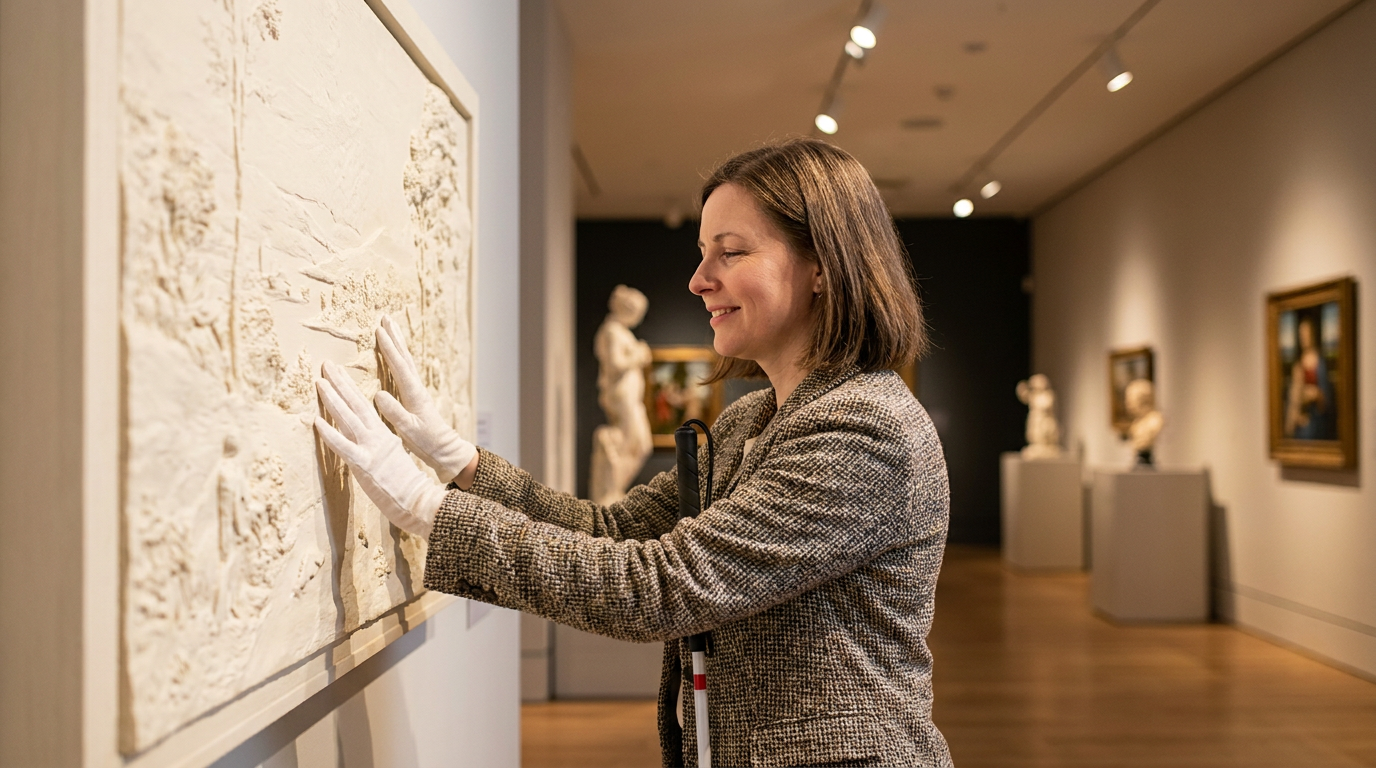
In museums across the globe, one universal rule has governed the visitor experience for centuries: look, but do not touch. Velvet ropes, glass cases, and proximity alarms are designed to protect priceless cultural heritage from the oils and friction of human hands. But this strictly visual paradigm creates an invisible wall for millions of blind and low-vision individuals, effectively locking them out of humanity’s shared artistic history. For a demographic that navigates the world tactilely, a museum has traditionally been a place of exclusion.[7]
For decades, the standard institutional response to this accessibility gap was the audio guide or the braille placard. While these tools provide valuable historical context, they fundamentally rely on a sighted person describing the art to the visually impaired visitor. The patron is told that a painting features a sweeping landscape or a melancholic expression, but they are denied the agency to experience the artwork's composition, scale, and emotional resonance for themselves.[7]
Now, a quiet revolution is dismantling the "do not touch" era of art history. Driven by advances in additive manufacturing and a broader cultural push for inclusive design, a growing number of institutions are deploying 3D printing, infrared scanning, and tactile graphics to turn visual masterpieces into multisensory experiences. The goal is no longer just to describe the art, but to place it directly into the hands of the visitor.[7]
The mechanism of translating a two-dimensional painting or a fragile antiquity into a touchable object begins with high-resolution digital capture. Technicians use infrared scanners to map the exact topography of an artwork. By rotating a handheld infrared device around a sculpture or scanning the surface of a canvas, they generate a precise three-dimensional digital file in a matter of minutes, capturing everything from the curve of a marble cheek to the thickness of an oil brushstroke.[3][6]
Once the digital model is secured, engineers use additive manufacturing—commonly known as 3D printing—to create a physical relief. At Lancaster University in the United Kingdom, engineering students recently partnered with local museums for the "Feeling as Seeing" project. Using industrial 3D printers, the team manufactured relief versions of 18th-century paintings, allowing visually impaired patrons to trace the outlines of historic landscapes and portraits just as they would read braille.[6]

The Prado Museum in Madrid was an early pioneer of this approach, launching its "Touching the Prado" exhibit using a specialized printing technique called "Didú." Rather than simply printing a bumpy surface, the Didú process uses chemical inks to selectively add volume and texture to key elements of a two-dimensional masterpiece. Visitors could run their fingers over a replica of a Velázquez or an El Greco, feeling the distinct textures of painted silk, armor, and skin.[1]
This selective translation is the most delicate part of the process. A direct, one-to-one topographical print of an impressionist painting is often just a confusing, chaotic mess of ridges to the fingertips. Curators and engineers must collaborate to decide which structural elements matter most to the narrative of the piece, artificially emphasizing the borders between a subject and the background so the tactile reader can successfully parse the scene.[1][7]
In the United States, the Cincinnati Art Museum has integrated this technology directly into its exhibition workflows. Working with the Clovernook Center for the Blind and Visually Impaired, the museum scanned ancient Roman statues, Egyptian artifacts, and contemporary pieces. The resulting 3D-printed replicas were mounted alongside the originals, allowing blind visitors to independently explore the forms without needing to request special access from a docent.[3]
Other institutions are focusing on raised-line tactile graphics to convey complex visual information. At the Portland Art Museum, artist Michael Cantino has pushed the boundaries of traditional embossed paper by using 3D printers to create tactile graphics with varying heights and depths. By layering these subtle textures, Cantino guides the user's fingers through a new dimension of raised-line art, translating the museum's permanent collection into a language of touch.[2]
Other institutions are focusing on raised-line tactile graphics to convey complex visual information.
But touch is only one component of the multisensory revolution. To create a truly immersive experience, museums are increasingly combining tactile elements with spatial audio, olfactory cues, and interactive technology, recognizing that the human brain synthesizes multiple sensory inputs to form a complete memory of an object.[7]

The Hong Kong Museum of Art recently launched "Beyond Seeing," a project that features a Tactile-Audio Interaction System. In this exhibit, visitors interact with a large tactile installation of the Victoria Harbour skyline. As they run their hands over the raised buildings and waterways, synchronized audio descriptions and ambient soundscapes trigger based on their exact hand placement, creating a dynamic, self-guided exploration of the city's geography.[4]
Similarly, the Singapore Art Museum's 2025 "Access Showcase" treats accessibility not as an afterthought, but as the core medium of the exhibit. Partnering with Beyond Vision International, the museum hosts multisensory art creation workshops that invite both sighted and visually impaired participants to interpret contemporary photography through tactile materials, fostering a shared language of touch.[5]
Curators are quickly discovering that the impact of these tactile exhibits extends far beyond the visually impaired community. When sighted visitors are allowed to touch a replica of a Renaissance painting or a Roman bust, it fundamentally shifts their engagement. The tactile replicas have proven especially effective for young children, older adults, and neurodivergent individuals who process information kinesthetically.[1][2]
By breaking the purely visual barrier, the art becomes a body-based, emotional experience. A sighted person might glance at a painting for ten seconds before moving on, but when invited to close their eyes and feel the contours of a 3D-printed replica, they spend minutes exploring the composition, noticing spatial relationships and details they would have otherwise ignored.[7]
Despite the widespread enthusiasm, scaling these multisensory programs remains a significant logistical and financial challenge. High-fidelity infrared scanning and industrial 3D printing are resource-intensive processes. The equipment is expensive, and the digital modeling requires specialized engineering expertise that most fine arts institutions do not have on staff.[6][7]
Because a single tactile replica can take weeks to properly model, test with visually impaired consultants, and print, most museums can only afford to offer a handful of touchable pieces. The goal of full collection accessibility remains distant, with tactile exhibits currently serving as curated highlights rather than comprehensive catalogs.[3][7]

There is also an ongoing philosophical debate within the art world regarding authenticity and material. Does a lightweight plastic or resin replica truly convey the essence of a heavy marble sculpture or a delicate oil painting? Some critics argue that the medium is the message, and a plastic translation loses the soul of the original work.[7]
To address this, cutting-edge accessibility labs are experimenting with advanced printing filaments that mimic the thermal properties of stone, ensuring a replica feels cold to the touch, or using textured resins that perfectly replicate the weave of a 16th-century canvas.[7]
Ultimately, the curators driving this movement argue that the goal is not to perfectly clone the original artifact, but to provide a functional translation. Just as a translated novel allows a foreign reader to experience a story, a tactile replica acts as a bridge, allowing those without sight to participate in the cultural dialogue.[1][7]
As scanning technology becomes cheaper, 3D printing becomes faster, and artificial intelligence assists in generating spatial audio descriptions, the barriers to entry for museums will continue to fall. The "do not touch" era is slowly giving way to a more inclusive philosophy—one that invites every visitor to reach out and grasp the history of human creativity.[7]
How we got here
2015
The Prado Museum in Madrid launches 'Touching the Prado,' pioneering the use of the 'Didú' technique to create textured replicas of masterpieces.
2022
Lancaster University partners with local museums to launch the 'Feeling as Seeing' project, using engineering students to 3D print relief versions of 18th-century art.
2024
The Cincinnati Art Museum integrates 3D-printed replicas of ancient statues into its Accessible Expressions exhibition.
2025
The Singapore Art Museum and Hong Kong Museum of Art launch dedicated multisensory initiatives, combining tactile graphics with spatial audio.
Viewpoints in depth
Accessibility Advocates & Curators
Argue that relying solely on visual observation excludes millions, and advocate for independent, unguided access to cultural heritage.
For accessibility advocates, the traditional museum model is fundamentally flawed because it treats sight as the only valid way to consume culture. They argue that audio descriptions, while helpful, still leave the visually impaired visitor dependent on a sighted person's interpretation. By providing high-fidelity tactile replicas, curators are returning agency to the blind community, allowing them to form their own emotional and intellectual connections with the artwork's physical form.
Technologists & Engineers
Focus on the complex technical challenge of filtering visual noise and amplifying structural geometry to translate 2D data into meaningful 3D tactile reliefs.
From an engineering perspective, a painting is a dataset that must be carefully filtered before it can be printed. Technologists point out that a direct 3D print of a painting's surface captures every brushstroke, creating a chaotic texture that is meaningless to the fingertips. Their goal is to digitally edit the scan—removing visual noise like color gradients and artificially raising the borders of key subjects—so the resulting relief acts as a clear, readable map for the hands.
Multisensory Education Advocates
View tactile and audio-integrated art not just as an accommodation, but as a superior pedagogical tool for sighted children and neurodivergent visitors.
Educators emphasize that the benefits of tactile art extend far beyond the visually impaired community. They note that many people, particularly young children and neurodivergent individuals, are kinesthetic learners who process information better through physical interaction than through passive observation. By allowing sighted visitors to touch replicas, museums break down the intimidating, sterile atmosphere of traditional galleries, fostering a more engaging and memorable learning environment.
What we don't know
- How quickly the cost of industrial 3D printing will fall to allow smaller, regional museums to build tactile collections.
- Whether future material sciences can perfectly replicate the thermal properties and exact textures of original stone and canvas.
- How copyright and reproduction laws will adapt to the widespread digital scanning and 3D printing of contemporary artworks.
Key terms
- Tactile Graphic
- An image designed to be interpreted by touch, often using raised lines or embossed textures on paper or plastic.
- Relief Printing
- In this context, a 3D-printed model where the subjects of a 2D painting project outward from a flat background, similar to a sculpted coin.
- Infrared (IR) Scanning
- A technology that uses infrared light to capture the exact three-dimensional shape and surface topography of an object.
- Tactile-Audio Interaction System (TAIS)
- A setup where touching specific parts of a physical model triggers synchronized audio descriptions or sound effects.
- Additive Manufacturing
- The industrial term for 3D printing, where objects are built layer by layer from digital models.
Frequently asked
Can visitors touch the original artworks?
No. The original artworks remain protected behind glass or ropes. Visitors touch high-fidelity 3D-printed replicas or specially designed tactile graphics.
How is a 2D painting turned into a 3D object?
Engineers use infrared scanners to capture the painting's topography, then digitally enhance key features—like faces or clothing folds—before 3D printing a relief version.
Are these exhibits only for blind visitors?
No. While designed for the visually impaired, museums encourage sighted visitors, children, and neurodivergent individuals to engage with the tactile replicas to deepen their understanding of the art.
Sources
Source coverage
7 outlets
3 viewpoints surfaced







[1]Smithsonian MagazineTechnologists & Engineers
The New 'Touching the Prado' Exhibit in Madrid Showcases 3-D Replicas of Paintings
Read on Smithsonian Magazine →[2]Portland Art MuseumAccessibility Advocates & Curators
Making art experiences more accessible
Read on Portland Art Museum →[3]Cincinnati Art MuseumAccessibility Advocates & Curators
Accessible Expressions Ohio: 3D printing and tactiles
Read on Cincinnati Art Museum →[4]Hong Kong Museum of ArtAccessibility Advocates & Curators
Beyond Seeing: A Multisensory Art Project
Read on Hong Kong Museum of Art →[5]Singapore Art MuseumAccessibility Advocates & Curators
Access Showcase 2025 – 'common languages'
Read on Singapore Art Museum →[6]Lancaster UniversityTechnologists & Engineers
Feeling as Seeing: 3D printing brings museum art to life for people with sight loss
Read on Lancaster University →[7]Factlen Editorial TeamMultisensory Education Advocates
Synthesis by Factlen editorial team
Read on Factlen Editorial Team →

Every angle. Every day.
Get culture stories with full source coverage and perspective breakdowns delivered to your inbox.