
How Multi-Agent AI Systems Collaborate to Solve Complex Problems
Single AI models are giving way to multi-agent systems—virtual teams of specialized AI agents that collaborate, debate, and iterate to tackle complex workflows.
By Factlen Editorial Team
- Enterprise Adopters
- Focus on scaling operations, reducing human-in-the-loop bottlenecks, and deploying agentic workflows to replace static software.
- AI Researchers
- Focus on collective intelligence, reinforcement learning, and how agents develop emergent reasoning through multi-turn debate.
- Open-Source Developers
- Focus on community-driven frameworks and the importance of transparent, customizable orchestration tools.
What's not represented
- · Human workers whose roles are being automated by multi-agent systems
- · Cybersecurity experts concerned about autonomous agent permissions
Why this matters
As AI moves from answering questions to executing complex, multi-step workflows, multi-agent systems are becoming the new standard for enterprise automation. Understanding how these virtual teams collaborate is essential for anyone looking to leverage the next generation of artificial intelligence.
Key points
- The AI industry is shifting from single-agent models to multi-agent systems (MAS) for complex workflows.
- MAS architectures distribute tasks across specialized AI agents that share context and memory.
- Frameworks like ChatDev simulate virtual companies, assigning agents roles like CEO, CTO, and Programmer.
- Microsoft's Agent Framework (MAF) enables enterprise-grade, cross-language agent orchestration.
- Developers are using Reinforcement Learning (RL) environments to teach agents how to coordinate and recover from errors.
- Analysts project agentic AI will be embedded in 33% of enterprise applications by 2028.
The artificial intelligence industry is undergoing a structural shift. For the past few years, the standard approach to AI has been the single-agent model: a user prompts a single, highly capable Large Language Model (LLM) to perform a task. While effective for isolated queries, this approach struggles with complex, long-horizon workflows. A single model acting as a researcher, coder, and reviewer simultaneously often loses context or hallucinates. To solve this, developers are moving from the "brilliant freelancer" model to an "agency" model: Multi-Agent Systems (MAS).[3][7]
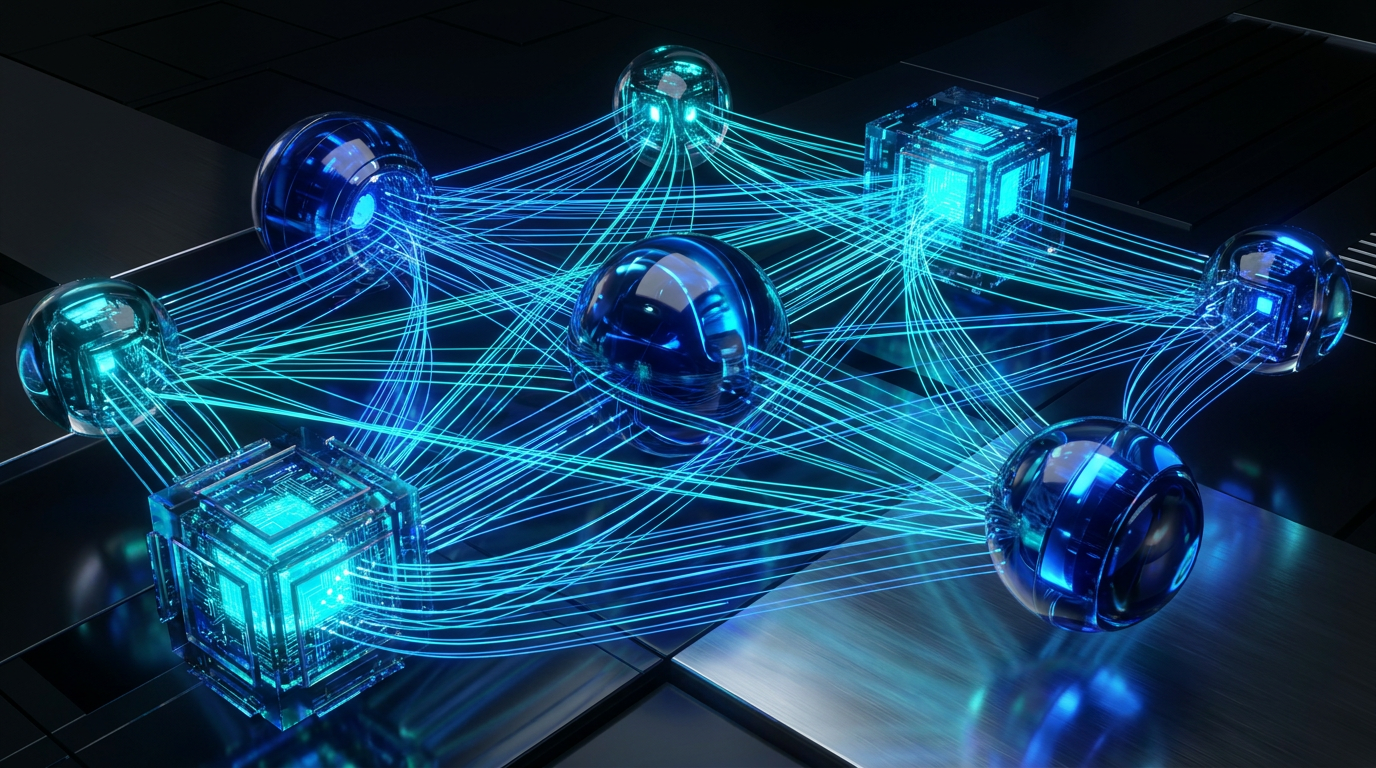
A Multi-Agent System is an architecture where multiple specialized AI agents collaborate to accomplish tasks that a single agent cannot handle effectively. Instead of one monolithic brain attempting to juggle every requirement, the system distributes intelligence across a network of distinct models. Each agent is assigned a specific role, domain expertise, and set of tools, but they share a common memory and context window.[7][8]
This delegation mirrors human organizational structures. In a multi-agent pipeline, one agent might be responsible solely for retrieving data, another for analyzing it, a third for drafting a report, and a fourth for fact-checking the output. Because each agent focuses on a narrow domain, the risk of manual errors drops, and the system's overall reliability increases dramatically.[3][7]

One of the most vivid examples of this architecture is ChatDev, an open-source framework that simulates a virtual software company. Rather than asking a single LLM to write an entire application from scratch, ChatDev breaks the software development lifecycle into a traditional waterfall model: designing, coding, testing, and documenting.[1]
Within the ChatDev environment, AI agents assume specific corporate personas, such as Chief Executive Officer, Chief Technology Officer, Programmer, and Tester. These agents participate in "functional seminars"—structured communication loops where the CTO might outline the architecture, the Programmer writes the code, and the Tester reviews it, sending it back to the Programmer if bugs are found.[1][8]
The evolution of these frameworks is accelerating rapidly. Recent iterations, such as ChatDev 2.0 (now known as DevAll), have introduced zero-code visual orchestration. This allows developers and non-technical teams to design complex agent collaboration networks using drag-and-drop interfaces, expanding the use cases beyond software development into research pipelines and 3D generation workflows.[6]

Recent iterations, such as ChatDev 2.0 (now known as DevAll), have introduced zero-code visual orchestration.
At the enterprise level, Microsoft has pioneered scalable multi-agent orchestration with its AutoGen framework, which recently evolved into the enterprise-grade Microsoft Agent Framework (MAF). While early multi-agent setups relied on sequential handoffs, MAF utilizes an actor model that supports distributed, asynchronous communication across different programming languages and organizational boundaries.[2]
Crucially, advanced multi-agent frameworks do not just sequence tasks; they enable agents to argue. In a robust setup, an evaluator agent might critique a generator agent's output, forcing a revision before the task is marked complete. This dynamic negotiation is what makes multi-agent systems powerful, allowing them to converge on high-quality solutions through genuine multi-turn dialogue.[3][8]
However, scaling these systems introduces new complexities. As the number of agents increases, the communication overhead scales non-linearly. Two agents share one communication channel, but five agents share ten. Managing this shared context, preventing infinite loops, and ensuring secure data handoffs are the primary engineering challenges of the MAS era.[3]
To solve these coordination challenges, the industry is increasingly turning to Reinforcement Learning (RL). You cannot safely debug a self-modifying, tool-using agent in a live production environment. Instead, forward-deployed engineers are building sandboxed RL environments—digital twins of business operations where agents can act, fail, and improve.[4]
In these simulated environments, developers inject chaos: rate-limited APIs, simulated customers changing their minds, and third-party tools going offline. By exposing multi-agent teams to these adversarial conditions, the agents learn self-healing behaviors and role clarity through trial and error, guided by reward functions rather than static prompts.[4][8]
This training paradigm has been supercharged by breakthroughs in Reinforcement Learning with Verifiable Rewards (RLVR). Instead of relying on human labelers to grade agent performance, the environment itself provides a binary signal. If a coding agent writes a script and the compiler runs it successfully, the agent receives a reward. This allows multi-agent systems to develop complex reasoning and self-verification strategies entirely on their own.[5]

The commercial implications of this shift are profound. Industry analysts project that agentic AI will be embedded in a third of all enterprise applications by 2028, up from less than one percent in 2024. Companies are already deploying agent pipelines that automate workflows previously handled by entire operations teams.[3]
Ultimately, multi-agent systems represent a fundamental step toward collective intelligence in AI. By combining specialized expertise, structured communication protocols, and rigorous reinforcement learning environments, these systems prove that in artificial intelligence, a well-coordinated team is vastly superior to a solitary genius.[1][8]
How we got here
2023
Microsoft Research introduces AutoGen, pioneering open-source multi-agent orchestration.
2024
The single-agent paradigm dominates, but complex workflows reveal the limitations of isolated LLMs.
Jan 2025
DeepSeek-R1 introduces Reinforcement Learning with Verifiable Rewards (RLVR), boosting agent reasoning.
Late 2025
Microsoft releases Microsoft Agent Framework (MAF), bringing enterprise-grade scalability to multi-agent systems.
Early 2026
Zero-code platforms like DevAll democratize multi-agent orchestration for non-technical teams.
Viewpoints in depth
Enterprise Adopters
Focus on scaling operations, reducing human-in-the-loop bottlenecks, and deploying agentic workflows to replace static software.
For enterprise leaders, the appeal of multi-agent systems lies in their ability to automate entire operational pipelines rather than just individual tasks. By deploying specialized agents that can hand off context seamlessly, companies are replacing traditional software with dynamic, self-correcting workflows. The primary focus for this group is ensuring these systems are scalable, secure, and observable, which is driving the adoption of enterprise-grade frameworks over experimental research tools.
AI Researchers
Focus on collective intelligence, reinforcement learning, and how agents develop emergent reasoning through multi-turn debate.
Researchers view multi-agent systems as a sandbox for studying collective intelligence. They are particularly interested in how agents can improve their own reasoning by arguing with one another—a process where a generator agent proposes a solution and an evaluator agent critiques it. With the rise of Reinforcement Learning with Verifiable Rewards (RLVR), researchers are exploring how these virtual teams can learn to coordinate and solve complex math or coding problems entirely without human intervention.
Open-Source Developers
Focus on community-driven frameworks and the importance of transparent, customizable orchestration tools.
The open-source community is driving the rapid democratization of multi-agent technology. Developers advocate for modular, extensible frameworks like LangGraph, CrewAI, and AG2 that allow anyone to build and customize agent networks. This camp emphasizes the importance of zero-code visual orchestration and interoperability, ensuring that multi-agent systems remain accessible to independent builders rather than being locked behind proprietary enterprise walls.
What we don't know
- How effectively multi-agent systems will handle highly ambiguous, creative tasks that lack clear verifiable rewards.
- The long-term security implications of allowing autonomous agents to negotiate and execute code without human oversight.
- Whether the computational cost of running multiple LLMs simultaneously will limit adoption for smaller enterprises.
Key terms
- Multi-Agent System (MAS)
- An AI architecture where multiple specialized models collaborate to solve complex tasks.
- Agentic Workflow
- A process where AI systems autonomously plan, execute, and iterate on tasks with minimal human intervention.
- Actor Model
- A computer science framework used in MAS where agents act as independent entities that communicate via asynchronous messages.
- Reinforcement Learning with Verifiable Rewards (RLVR)
- A training method where AI agents learn by receiving automated binary feedback (pass/fail) from their environment, rather than relying on human labelers.
Frequently asked
What is the difference between a single AI agent and a multi-agent system?
A single agent attempts to handle every part of a task itself, which often leads to lost context or errors. A multi-agent system delegates the workflow to specialized agents (e.g., a researcher, a writer, and a reviewer) that collaborate to produce a final result.
How do AI agents communicate with each other?
Agents communicate through shared memory, asynchronous messaging, and structured frameworks like Microsoft's Agent Framework, allowing them to pass data, critique each other's work, and request revisions.
What is an RL environment in the context of AI agents?
It is a sandboxed simulation—a digital twin of a business operation—where agents can safely practice tasks, make mistakes, and learn to recover from errors before being deployed into live production.
Do multi-agent systems require coding to set up?
Historically, yes. However, newer zero-code platforms like DevAll allow users to design complex agent collaboration networks using visual drag-and-drop interfaces.
Sources
Source coverage
8 outlets
3 viewpoints surfaced








[1]IBMAI Researchers
What is ChatDev?
Read on IBM →[2]MicrosoftOpen-Source Developers
AutoGen: Enabling Next-Gen LLM Applications
Read on Microsoft →[3]ProtectoEnterprise Adopters
What are multi-agent AI systems?
Read on Protecto →[4]Invisible TechEnterprise Adopters
Trend prediction: RL environments for agentic systems
Read on Invisible Tech →[5]Turing PostAI Researchers
Reinforcement Learning in 2025: Year in Review
Read on Turing Post →[6]YuvOpen-Source Developers
ChatDev 2.0 (DevAll) Explained
Read on Yuv →[7]PixelMojoEnterprise Adopters
Multi-Agent AI Systems Explained: When One AI Is Not Enough
Read on PixelMojo →[8]Factlen Editorial TeamAI Researchers
Synthesis by Factlen editorial team
Read on Factlen Editorial Team →

More in ai
See all 139 stories →Open-Source AI
IBM and Red Hat Pledge $5 Billion to Secure Open-Source AI as Autonomous Agents Enter the Enterprise
7 sources
On-Device AI
The AI Revolution Moves Offline: How Small Language Models Are Putting Privacy First
7 sources

Frontier Model Security
New U.S. Executive Order Shifts AI Oversight to National Security and Cyber Defense
8 sources
Global AI Governance
U.S. and EU Finalize Diverging AI Regulations as State-Level Patchwork Takes Effect
10 sources
Every angle. Every day.
Get ai stories with full source coverage and perspective breakdowns delivered to your inbox.