
How Digital Weight is Rewriting the Science of Strength Training at Home
Electromagnetic motors and AI spotters are replacing cast iron plates, offering safer, more efficient muscle growth through adaptive resistance.
By Factlen Editorial Team
- Digital Strength Advocates
- Focus on the unparalleled safety, space efficiency, and hypertrophy benefits of computer-controlled resistance.
- Sports Science Researchers
- Emphasize the biomechanical advantages of eccentric overload and its role in the longevity economy.
- Home Gym Minimalists
- Prioritize the aesthetic and spatial benefits of replacing bulky iron racks with sleek, all-in-one technology.
- Traditional Iron Purists
- Argue that free weights better engage stabilizer muscles and avoid the fragility of software subscriptions.
What's not represented
- · Commercial gym operators facing competition from high-end home setups
- · Physical therapists using digital resistance for clinical rehabilitation
Why this matters
Strength training is increasingly recognized as a critical medical intervention for healthy aging and metabolic stability. By replacing bulky, intimidating iron weights with adaptive, space-saving digital resistance, this technology is dismantling the traditional barriers to building muscle at home.
Key points
- Digital weight machines use electromagnetic motors instead of cast iron to generate resistance.
- The technology allows for "eccentric overload," adding weight during the lowering phase to maximize muscle growth.
- AI spotters automatically reduce resistance if a user struggles, making solo training significantly safer.
- Digital resistance now commands a 60 percent market share in the premium home gym segment.
- High upfront costs and mandatory software subscriptions remain the primary barriers to entry.
For over a century, the fundamental technology of strength training has remained stubbornly unchanged: individuals fighting gravity by lifting heavy pieces of cast iron. Whether in a commercial facility or a garage, building muscle has historically required bulky racks, stacks of plates, and a significant amount of dedicated floor space. But as of 2026, the home fitness landscape is undergoing a quiet, high-tech revolution. "Digital weight" has arrived in force, replacing static iron with sophisticated electromagnetic motors that generate resistance on demand.[6]
Machines like Tonal, Speediance, and Vitruvian are no longer viewed as niche luxury items for early adopters; they have rapidly become the new standard for domestic strength training. According to industry tracking, digital resistance systems now command a staggering 60 percent market share within the premium home gym segment. This shift is driven by a broader cultural movement toward the "longevity economy," where resistance training is increasingly recognized not just as a pursuit of bodybuilding aesthetics, but as a critical medical intervention for healthy aging and metabolic stability.[3]
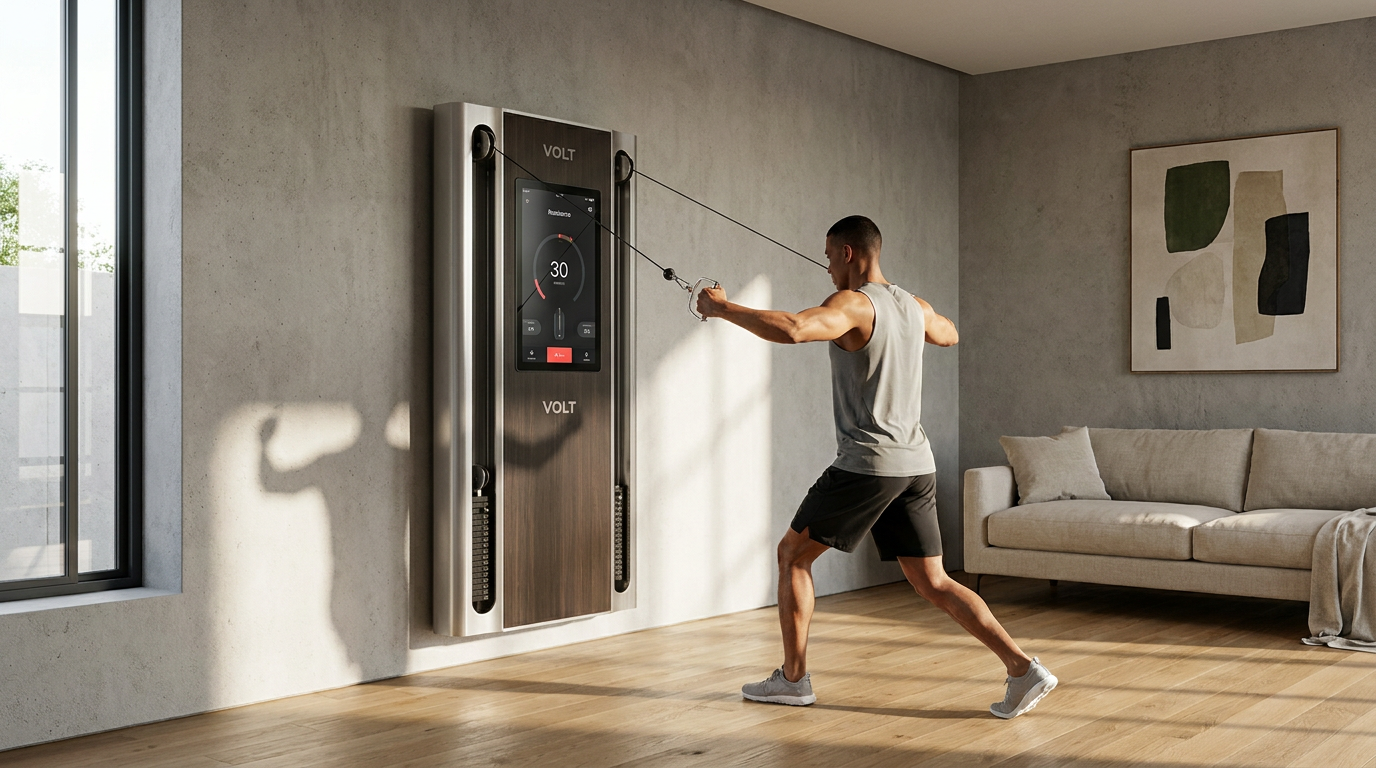
The immediate appeal of these smart machines is undeniably their compact footprint. By eliminating the need for physical weight plates, a complete functional trainer can now be mounted flat against a bedroom wall or folded away into the corner of a living room. However, the true breakthrough of digital weight lies far beyond interior design and space-saving aesthetics. The underlying technology fundamentally manipulates the physics of lifting to accelerate muscle growth in ways that traditional free weights simply cannot replicate safely.[1][6]
To understand why digital resistance is so effective, one must look at the basic biomechanics of human movement. Every standard repetition in strength training consists of two distinct phases: the concentric phase, where the muscle shortens as it lifts the weight, and the eccentric phase, where the muscle lengthens as it lowers the weight back to the starting position. For decades, sports science has understood that human muscles are naturally capable of generating 20 to 50 percent more force during the eccentric, lowering phase than they can during the concentric, lifting phase.[5]

When training with traditional free weights, a lifter is inherently limited by their concentric strength. If you can only curl a 40-pound dumbbell upward, you are forced to use that same 40-pound weight on the way down. Consequently, the eccentric phase of the movement is chronically under-loaded. The muscle is never forced to work to its full capacity during the lengthening portion of the exercise, leaving significant strength and hypertrophy gains on the table.[4][5]
Digital weight machines solve this physiological bottleneck through a software feature known as "eccentric overload." Because the resistance is generated by a computer-controlled electromagnetic motor rather than gravity, the machine can dynamically alter the weight in the middle of a single repetition. When a user reaches the top of a bicep curl or the peak of a squat, the system instantly increases the resistance by up to 50 percent for the downward descent.[4]
This means a lifter can push 100 pounds upward, and the machine will seamlessly load 150 pounds of resistance onto the handles for the lowering phase. Sports science researchers note that this targeted eccentric loading places immense mechanical tension on the muscle fibers, specifically engaging structural proteins like titin. This deep stretching tension acts as a powerful biological signal to build more muscle tissue, triggering faster hypertrophy and strength adaptations than traditional lifting.[4][5]
This means a lifter can push 100 pounds upward, and the machine will seamlessly load 150 pounds of resistance onto the handles for the lowering phase.
Crucially, eccentric overload achieves these results with a surprisingly low metabolic cost. Because the lowering movements require significantly less oxygen than explosive lifting, the heart rate does not spike as aggressively. This allows users to place massive amounts of productive force through their muscles without experiencing the severe cardiovascular exhaustion typically associated with heavy barbell training, making it an ideal modality for older adults or those focused on joint longevity.[3][5]
Beyond optimizing the physics of the lift, digital weight systems act as an invisible, hyper-attentive spotter. Using high-frequency motion tracking that monitors the cable speed thousands of times per second, the onboard algorithms can detect the exact moment a user begins to struggle mid-repetition. If the bar speed slows down dramatically or the user's form begins to break under fatigue, the machine instantly dials back the resistance by a few pounds, allowing the lifter to finish the set safely.[2][3]

This adaptive resistance completely removes the fear of being pinned under a heavy barbell during a bench press or squat. By mitigating the risk of catastrophic failure, smart machines empower beginners and solo home-gym users to push closer to their true muscular limits. The psychological safety net provided by the AI spotter often leads to more intense, effective workouts than a user would dare attempt alone with free weights.[2][6]
As the technology has matured, the hardware landscape has diversified rapidly to meet varying consumer needs and spatial constraints. Tonal remains the most recognized pioneer in the category, offering a sleek, wall-mounted interface that provides up to 250 pounds of digital resistance. Its highly refined artificial intelligence acts as a virtual personal trainer, automatically setting the optimal weight for every exercise, tracking progress over time, and offering real-time form correction through its integrated sensors.[1][2]
For renters or those who cannot drill heavy lag bolts into their walls, freestanding options have surged in popularity. The Speediance Gym Monster, for example, offers a foldable, cable-centric design that requires no installation. While it maxes out at 220 pounds of resistance, it appeals heavily to value-conscious consumers because, unlike many of its competitors, it does not require a mandatory monthly software subscription to access its core lifting features.[2][4]
Meanwhile, companies like Vitruvian have engineered solutions specifically for advanced lifters who quickly outgrow the resistance limits of wall-mounted units. The Vitruvian Trainer+ strips away the large touchscreen entirely, focusing its engineering on a slim, carbon-fiber floor platform. Despite its minimalist profile, the dual motors inside the platform can generate a staggering 440 pounds of resistance, proving that digital weight can challenge even elite powerlifters and professional athletes.[2]

Despite these technological leaps, the digital resistance revolution is not without its detractors. Traditional iron purists frequently argue that cables and electromagnetic motors fail to engage the body's smaller stabilizer muscles in the exact same way as a free-moving barbell. Because the machine's cables dictate a slightly more fixed path of motion, some strength coaches caution that digital lifting might not perfectly translate to real-world, off-balance physical tasks.[1][6]
There is also the unavoidable issue of cost and digital dependency. While the upfront price of these machines ranges from two thousand to over four thousand dollars, the true financial burden often lies in the recurring software subscriptions required to unlock the AI coaching and data tracking. Furthermore, these machines are entirely reliant on electricity and Wi-Fi; a power outage or a server disruption instantly transforms a state-of-the-art home gym into an unusable piece of modern art.[1][3][4][6]
Yet, for the vast majority of the population, the benefits far outweigh the drawbacks. The friction of commuting to a crowded commercial gym, waiting for equipment, and navigating the intimidating atmosphere of a free-weight room keeps millions of people from engaging in consistent strength training. By bringing guided, hyper-efficient, and mathematically optimized resistance into the living room, digital weights are dismantling the traditional barriers to entry.[4][6]

As the science of longevity continues to emphasize muscle mass as a vital organ for metabolic health, the demand for accessible strength training will only accelerate. Digital resistance machines have successfully bridged the gap between the safety of guided gym machines and the heavy-lifting potential of free weights. In doing so, they are not just changing what a home gym looks like—they are fundamentally rewriting the rules of how we build and maintain human strength.[3][6]
How we got here
Early 2000s
Flywheel training emerges in elite sports science, introducing the concept of variable eccentric resistance without traditional weights.
2018
Tonal launches its wall-mounted digital weight machine, bringing electromagnetic resistance and AI coaching to the consumer home gym market.
2022
Floor-based platforms like Vitruvian enter the market, pushing digital resistance limits past 400 pounds to cater to serious powerlifters.
2026
Digital resistance systems capture a 60 percent market share in the premium home gym segment, driven by the broader longevity and metabolic health movement.
Viewpoints in depth
Sports Science Perspective
Researchers emphasize the unique physiological benefits of computer-controlled resistance.
For exercise physiologists, the true value of digital weight lies in its ability to manipulate the strength curve. By safely overloading the eccentric phase of a lift, these machines stimulate structural proteins like titin more effectively than static iron. This allows users to achieve significant hypertrophy and strength adaptations with less cardiovascular strain, making it a highly efficient modality for both elite athletes and aging populations focused on metabolic health.
Traditional Iron Purists
Advocates for free weights argue that digital machines cannot fully replicate the demands of barbell training.
Despite the technological advancements, many strength coaches and barbell purists remain skeptical of replacing iron entirely. They argue that balancing a free-moving barbell requires intense engagement from smaller stabilizer muscles—a demand that is somewhat diminished when pulling cables on a fixed track. Furthermore, the reliance on electricity and expensive monthly software subscriptions makes digital gyms a fragile, recurring expense compared to the lifetime durability of cast iron plates.
Digital Strength Advocates
Proponents highlight the unparalleled safety and accessibility of AI-guided lifting.
For digital strength advocates, the elimination of the 'fear factor' is the technology's greatest triumph. The inclusion of AI spotters that automatically reduce weight when a user struggles allows solo lifters to train to failure safely. Combined with the space-saving form factors that fit into a living room, advocates argue that digital weights remove the most common friction points—intimidation, space, and safety—that keep people from consistent strength training.
What we don't know
- Whether the long-term durability of electromagnetic motors can match the multi-generational lifespan of cast iron weights.
- How the secondary market for used smart gyms will evolve given the reliance on proprietary software and subscriptions.
Key terms
- Concentric Phase
- The portion of an exercise where the muscle shortens while contracting, such as lifting the dumbbell upward during a bicep curl.
- Eccentric Phase
- The portion of an exercise where the muscle lengthens under tension, such as slowly lowering the dumbbell back down.
- Hypertrophy
- The biological process of increasing the size of skeletal muscle fibers, commonly referred to as muscle growth.
- Adaptive Resistance
- A software feature that automatically adjusts the weight in real-time based on the user's fatigue, speed, or form.
- Titin
- A giant structural protein within muscle tissue that acts like a molecular spring, heavily engaged during eccentric movements.
Frequently asked
What exactly is digital weight?
Digital weight uses computer-controlled electromagnetic motors to generate resistance, replacing the need for traditional cast iron plates or gravity.
What is eccentric overload?
Eccentric overload is a training method where the resistance is increased during the lowering phase of an exercise, taking advantage of the muscle's natural ability to handle more weight on the way down.
Do smart gyms require a monthly subscription?
Most premium smart gyms, like Tonal, require a monthly subscription to access AI coaching and data tracking, though some alternatives like Speediance offer core features without mandatory fees.
Can digital weights build as much muscle as free weights?
Yes. By utilizing constant tension and eccentric overload, digital weights can provide equal or greater mechanical tension to the muscles, which is the primary driver of hypertrophy.
Sources
Source coverage
6 outlets
4 viewpoints surfaced






[1]PCMagTraditional Iron Purists
The Best Smart Home Gym Equipment for 2026
Read on PCMag →[2]Garage Gym ReviewsDigital Strength Advocates
Best Smart Home Gym Equipment
Read on Garage Gym Reviews →[3]FitnessNav IntelligenceSports Science Researchers
The 2026 Smart Strength Revolution and the Longevity Economy
Read on FitnessNav Intelligence →[4]Innerbody ResearchDigital Strength Advocates
Tonal vs. Speediance: Which Digital Weight Gym is Best?
Read on Innerbody Research →[5]Exxentric Sports ScienceSports Science Researchers
Eccentric Overload & Variable Resistance Fundamentals
Read on Exxentric Sports Science →[6]Factlen Editorial TeamHome Gym Minimalists
Synthesis by Factlen editorial team
Read on Factlen Editorial Team →
More in fitness
See all 5 stories →Metabolic Health
The Science of Zone 2 Cardio: How Low-Intensity Exercise Rewires Metabolism
8 sources

Dietary Science
Intermittent Fasting vs. Caloric Restriction: What the Latest Science Says About Weight Loss
6 sources

Cardio Science
Zone 2 Cardio vs. HIIT: The Science of Fat Loss, Longevity, and Metabolic Health
6 sources

Every angle. Every day.
Get fitness stories with full source coverage and perspective breakdowns delivered to your inbox.