
How AI and Computer Vision Are Eradicating Soft-Tissue Injuries in Soccer
Elite soccer clubs are using skeletal tracking and machine learning to predict and prevent hamstring tears and ligament damage days before they happen.
By Factlen Editorial Team
- Sports Medicine Professionals
- Views AI as a critical tool for extending careers and moving from reactive treatment to proactive care.
- Club Management
- Values predictive analytics as a way to protect massive financial investments in player contracts.
- Athlete Privacy Advocates
- Raises concerns over the ownership of biometric data and the psychological pressure of constant surveillance.
What's not represented
- · Lower-league clubs unable to afford the technology
- · Fans who want star players to play every match regardless of risk
Why this matters
By predicting soft-tissue injuries before they happen, artificial intelligence is extending the careers of elite athletes and saving clubs millions of dollars in lost playing time, fundamentally changing how the sport manages human performance.
Key points
- Elite soccer players face up to 70 matches a season, making injury prevention a critical priority for clubs.
- AI systems use computer vision to track 29 skeletal data points on players up to 50 times per second.
- Machine learning algorithms analyze this biomechanical data alongside GPS metrics to forecast soft-tissue injuries.
- Platforms like Zone7 claim a 72 percent accuracy rate in predicting injuries one to seven days before they occur.
- Early adopters like LAFC have reported up to a 53 percent reduction in days lost to injury.
- The technology raises new ethical questions regarding athlete data privacy and the psychological toll of constant monitoring.
The modern elite soccer player is pushed to the absolute limit of human endurance. With expanded international tournaments and relentless domestic schedules, top-tier athletes can face up to 70 high-intensity matches in a single season, leaving them highly vulnerable to physical breakdown.[1]
For decades, the sport's approach to this inevitable physical toll was entirely reactive: treat the torn hamstring, reconstruct the ruptured anterior cruciate ligament (ACL), and endure the grueling months of rehabilitation while the player sat on the sidelines.[3]
But a quiet revolution is taking place in the training grounds of Europe's biggest clubs. By combining computer vision, skeletal tracking, and machine learning, teams are no longer waiting for players to break down. They are predicting soft-tissue injuries before they happen.[1][4]
The foundation of this predictive capability lies in the same technology that recently transformed refereeing: semi-automated offside tracking. The optical systems originally designed to judge the exact moment a pass is played are now being repurposed for medical science.[3][4]

Stadiums and training facilities equipped with advanced optical systems use up to 12 dedicated cameras mounted beneath the roof to track the exact biomechanical movements of every player on the pitch without the need for cumbersome physical markers.[4]
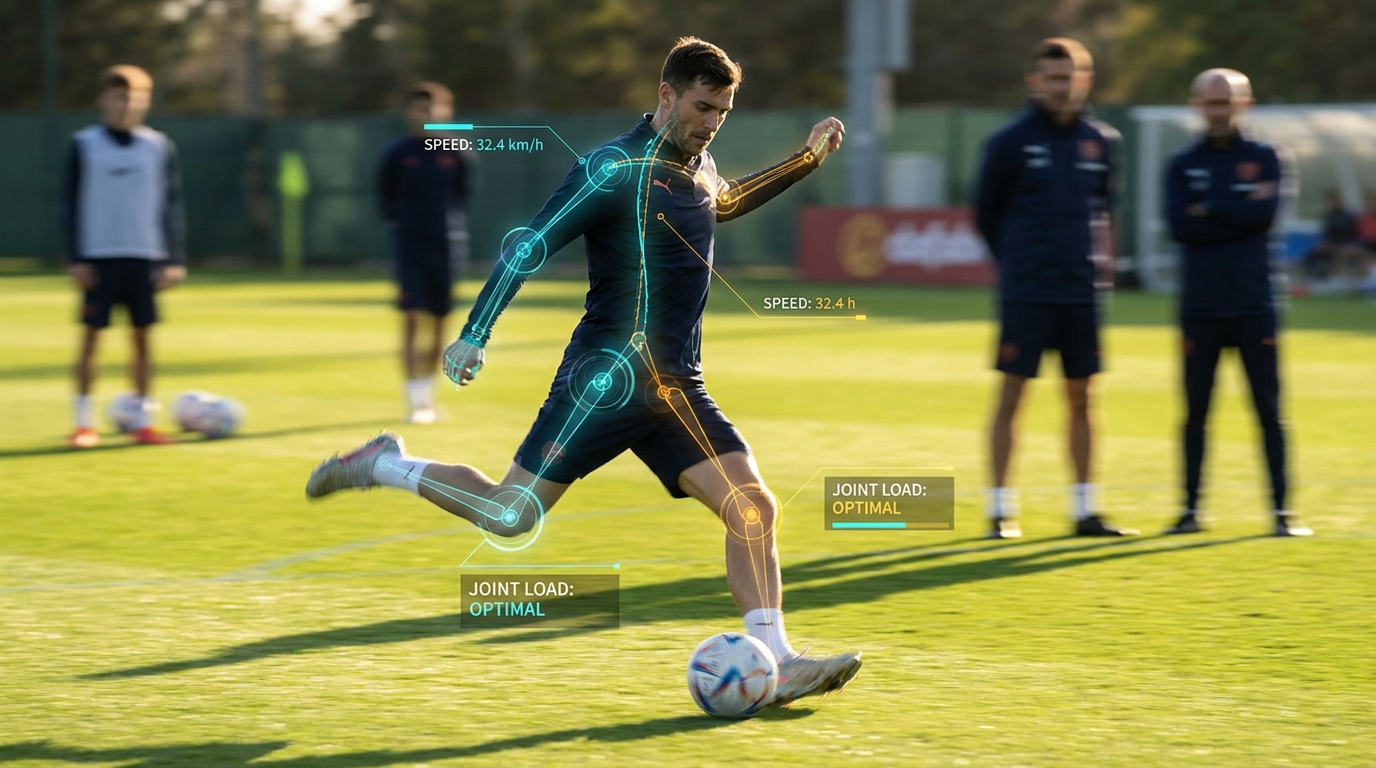
These computer vision models perform a process known as "pose estimation," capturing 29 distinct data points on an athlete's body—including knees, ankles, hips, and shoulders—up to 50 times per second.[4]
When combined with data from wearable GPS trackers and smart equipment—such as FIFA-approved smart shin guards that collect over one million data points per session—clubs amass a staggering volume of biomechanical information on how a player's body is handling stress.[1][5]
This raw data is then fed into artificial intelligence platforms designed specifically for human performance. These systems act as a digital nervous system for the entire squad, constantly monitoring the physical load each player is carrying.[2][5]

Systems developed by companies like Zone7, which was acquired by the sports analytics firm Svexa in 2024, ingest this biomechanical data alongside historical injury records, sleep metrics, and training workloads to build a comprehensive physiological profile of the athlete.[2][5]
The machine learning algorithms search for invisible patterns that precede a breakdown. A microscopic change in a player's gait, a five percent drop in lateral quickness, or an imbalance in how they distribute weight when landing can all signal an impending soft-tissue failure.[4][6]
The machine learning algorithms search for invisible patterns that precede a breakdown.
The results have been paradigm-shifting. In extensive testing across professional leagues, AI forecasting models have demonstrated the ability to predict an increased risk of injury one to seven days before the event occurs, with accuracy rates hovering around 72 percent.[2][5]
For clubs that have fully integrated these systems, the return on investment is measured in both points on the league table and millions of dollars saved in wages paid to sidelined players.[5]

Case studies from early adopters highlight the dramatic impact of predictive analytics. Liverpool and Los Angeles FC (LAFC) have utilized these platforms to manage player workloads, with LAFC reportedly seeing a 53 percent reduction in days lost to injury, and up to a 69 percent drop in non-contact injuries.[5]
Crucially, the AI does not simply flash a red light and demand a player be benched. Instead, it provides actionable "load management" prescriptions that allow coaches to intervene subtly.[2][5]
If a star striker is flagged as high-risk for a hamstring strain, the medical staff might adjust their training intensity for the week, limit their high-speed sprints in practice, or recommend a specific recovery protocol, allowing them to safely start the weekend's match.[5][6]
However, the integration of predictive AI is not without friction. The sheer volume of biometric surveillance raises complex questions about athlete data privacy and psychological welfare in a high-pressure environment.[3][6]

Players unions and privacy advocates are increasingly scrutinizing who owns this deeply personal physiological data, how long it is retained, and whether an algorithm's "high risk" flag could unfairly impact a player's contract negotiations or transfer value.[6]
Furthermore, there is a psychological toll to consider. Telling a perfectly healthy-feeling athlete that a computer model believes they are on the verge of a tear requires immense trust between the player, the coaching staff, and the medical team.[3][5]
How we got here
2017
Sports analytics company Zone7 is founded to apply machine learning to athlete injury forecasting.
2022
FIFA introduces semi-automated offside tracking at the World Cup, normalizing the use of skeletal tracking cameras in stadiums.
2024
Svexa acquires Zone7, expanding the reach of AI-driven injury prediction across global soccer leagues.
2026
Computer vision and predictive load management become standard infrastructure for elite clubs seeking to protect their players.
Viewpoints in depth
Sports Scientists & Medical Staff
Focuses on extending careers and moving from reactive to proactive medicine.
For medical professionals, AI is a tool of empowerment rather than replacement. By quantifying fatigue and biomechanical stress, sports scientists can justify resting a star player or modifying their training load with hard data, rather than relying solely on subjective feedback. This proactive approach aims to extend athletic careers and protect long-term physical health.
Club Executives & Managers
Focuses on protecting financial investments and maintaining a competitive edge.
At the executive level, player availability is directly tied to financial success and on-pitch performance. With top players costing tens of millions of dollars in transfer fees and wages, minimizing days lost to injury is a critical business objective. Managers view predictive analytics as a vital competitive advantage in an increasingly congested sporting calendar.
Player Privacy Advocates
Focuses on data ownership, algorithmic bias, and the psychological pressure of surveillance.
Privacy advocates raise concerns about the sheer volume of biometric data being collected on athletes. They question who ultimately owns this physiological information and warn that an algorithm's 'high risk' flag could be used against players during contract negotiations. Furthermore, the constant surveillance can create psychological stress for athletes who feel their every movement is being judged by a machine.
What we don't know
- Whether the widespread adoption of AI injury prediction will lead to changes in standard player contracts regarding data ownership.
- How smaller, less wealthy clubs will compete as predictive technology becomes a costly baseline for elite performance.
Key terms
- Computer Vision
- A field of artificial intelligence that enables computers to derive meaningful information from digital images and videos.
- Pose Estimation
- A computer vision technique that detects human figures in images and tracks the exact positions of key joints and limbs.
- Load Management
- The practice of monitoring and adjusting an athlete's physical exertion during training and matches to optimize performance and prevent injury.
- Soft-Tissue Injury
- Damage to muscles, ligaments, or tendons, such as sprains and strains, which are common in high-intensity sports.
Frequently asked
Does the AI force coaches to bench players?
No. The system provides risk forecasts and load management suggestions, allowing medical staff to adjust a player's training intensity rather than benching them entirely.
How does the system track player movements?
It uses computer vision cameras mounted in the stadium to track 29 skeletal data points on each player 50 times per second, alongside data from wearable GPS trackers.
Can AI predict contact injuries like tackles?
No. The technology is designed to forecast soft-tissue injuries, such as hamstring strains and ligament tears, which are caused by fatigue and biomechanical stress.
Sources
Source coverage
6 outlets
3 viewpoints surfaced






[1]Factlen Editorial TeamClub Management
Synthesis by Factlen editorial team
Read on Factlen Editorial Team →[2]Zone7Sports Medicine Professionals
The Future of AI for Injury Prevention
Read on Zone7 →[3]Human KineticsAthlete Privacy Advocates
Artificial Intelligence Is Changing Soccer
Read on Human Kinetics →[4]UltralyticsClub Management
How Vision AI is Changing Soccer
Read on Ultralytics →[5]FootbAISports Medicine Professionals
Zone7 tackles the problem of football injuries
Read on FootbAI →[6]RespeecherAthlete Privacy Advocates
How Is AI Being Used in Sports Analytics Today
Read on Respeecher →

More in sports
See all 7 stories →Sports Biomechanics
How Markerless Motion Capture and AI Are Extending Athlete Careers
7 sources

Snowboard Tech
The 1620 Era: How Women's Snowboarding Shattered the Spin Barrier
5 sources

US Cricket
How Major League Cricket's 2026 Season is Reshaping the American Sports Landscape
6 sources
UWCL Format
How the New 18-Team Format is Transforming the UEFA Women's Champions League
6 sources

Every angle. Every day.
Get sports stories with full source coverage and perspective breakdowns delivered to your inbox.