
Google Researchers Propose 'Faithful Uncertainty' to Solve AI Hallucinations Without Sacrificing Utility
A new metacognitive approach allows large language models to express doubt instead of defaulting to a strict answer-or-abstain binary, paving the way for more reliable enterprise AI agents.
By Factlen Editorial Team
- AI Research Community
- Focuses on the fundamental mathematical limits of model capacity and the need for metacognition to bridge the discrimination gap.
- Enterprise Implementers
- Emphasizes the practical cost of the utility tax and the need for AI systems that can offer hypotheses without breaking trust.
- Agentic System Developers
- Views faithful uncertainty primarily as a control layer for routing API calls and managing autonomous tool use.
What's not represented
- · End-users who may misinterpret hedged language
- · Hardware providers optimizing for inference speed over metacognitive checks
Why this matters
For enterprise applications, an AI that confidently hallucinates is dangerous, but an AI that refuses to answer most questions is useless. This breakthrough allows models to safely offer hypotheses and know exactly when to trigger external search tools, unlocking more autonomous and trustworthy AI agents.
Key points
- Current AI models struggle to distinguish between what they know and what they are guessing.
- Forcing models to refuse answers to avoid hallucinations results in a massive loss of useful information.
- Google researchers propose 'faithful uncertainty' to align an AI's spoken confidence with its internal statistical doubt.
- Under this framework, factual errors are treated as 'honest mistakes' if the AI appropriately hedges its response.
- This metacognitive awareness acts as a crucial control layer for autonomous AI agents deciding when to use external search tools.
Despite billions of dollars in research and rapid advancements in artificial intelligence, the hallucination problem remains a primary roadblock for enterprise adoption. State-of-the-art large language models—systems capable of writing complex code and passing professional exams—still confidently invent facts when pushed beyond their knowledge boundaries. For enterprise applications, an AI that confidently hallucinates is dangerous, as it can mislead users or trigger catastrophic downstream errors in automated workflows. Historically, developers have attempted to solve this by expanding the model's knowledge base, packing more facts into its parameters during training. However, model capacity is finite, and the long tail of human knowledge is effectively infinite, meaning models will always eventually encounter questions they cannot answer accurately.[1][3]
When models inevitably hit the edge of their knowledge, the traditional engineering response has been to enforce a strict "answer-or-abstain" binary. Under this paradigm, if a model cannot guarantee the factual accuracy of its response, it is programmed to refuse the prompt entirely, often replying with a generic statement about its inability to assist. While this heavy-handed approach reduces the raw number of hallucinations, it fundamentally cripples the model's usefulness in nuanced or complex scenarios. Developers are forced to navigate a strict tradeoff where eliminating factual errors simultaneously suppresses a massive volume of valid, helpful answers.[1]
This strict tradeoff creates what researchers call the "utility tax." A new position paper published by Google researchers Gal Yona, Mor Geva, and Yossi Matias mathematically details the severe cost of this approach. The researchers demonstrate that attempting to completely eliminate hallucinations through abstention destroys the practical value of the AI system. Because models cannot perfectly distinguish between what they know and what they are guessing, safety guardrails end up catching and discarding a vast amount of correct information alongside the errors.[1][2]
The numbers behind the utility tax are striking. In simulated environments mirroring frontier models, the researchers found that a model with a baseline error rate of 25 percent requires drastic measures to achieve a strict 5 percent error target. To reach that safety threshold through abstention alone, the system must discard approximately 52 percent of its valid, correct answers. This visualizes the core dilemma for enterprise developers: without a better mechanism, making an AI system safe means making it largely useless for open-ended problem solving.[2][4]

The root cause of this utility tax is a phenomenon known as the "discrimination gap." Current AI models lack the internal discriminative power to perfectly separate their own truths from their errors at an instance level. Even if a model is generally well-calibrated—meaning it is correct 60 percent of the time when it feels 60 percent confident—it does not know exactly which specific answers in that batch are the wrong ones. Without a flawless internal filter to separate fact from fiction, the model cannot selectively abstain only on the errors.[3][6]
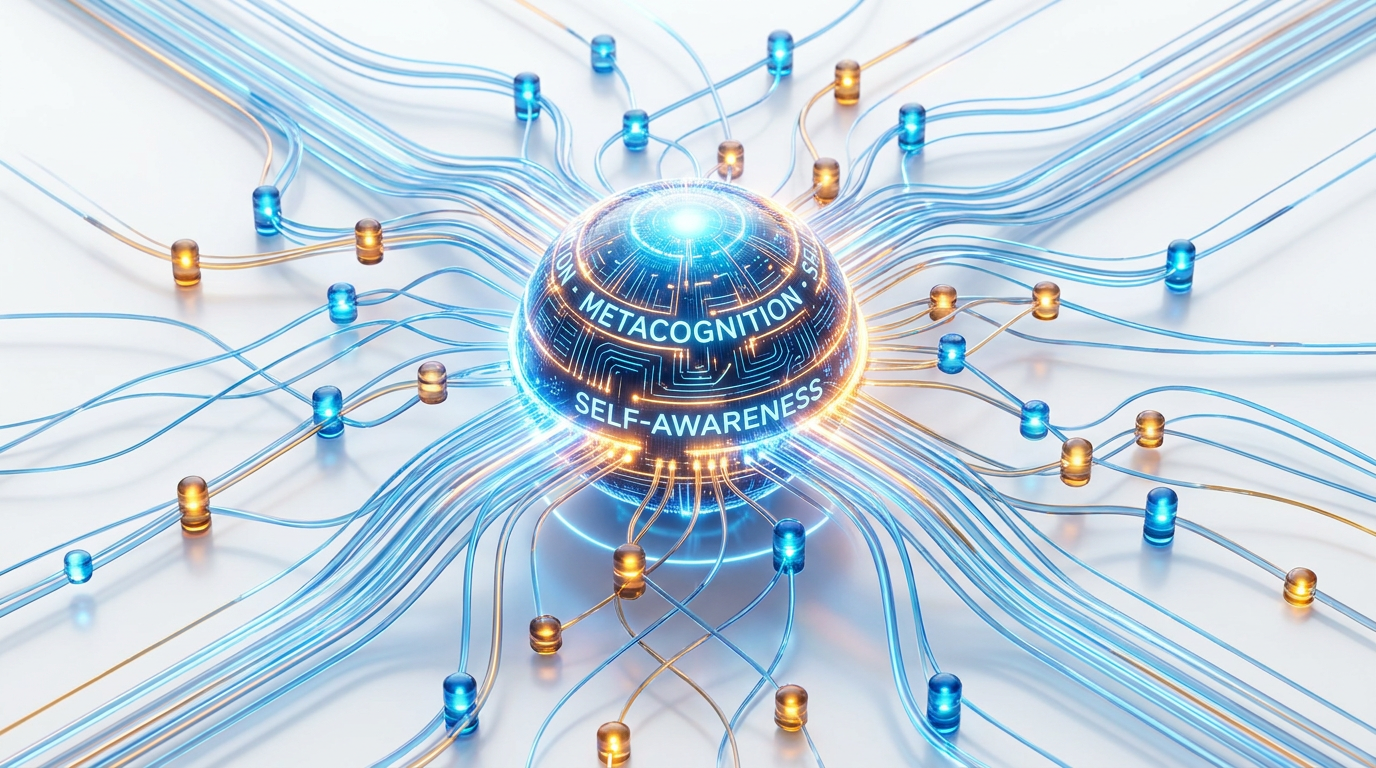
To break free from this paralyzing dilemma, the Google research team proposes a metacognitive framework called "faithful uncertainty." Rather than forcing the model to choose between absolute silence and absolute confidence, faithful uncertainty allows the AI to express its internal statistical doubt using natural language. This approach requires aligning the model's linguistic uncertainty—the actual words it uses to hedge a statement—with its intrinsic, mathematical confidence in that specific answer.[1][2]
Achieving faithful uncertainty is a complex engineering challenge. Research shows that state-of-the-art large language models typically express high linguistic confidence even when their internal uncertainty is substantial. On metrics designed to measure faithful uncertainty, where a score of 1.0 represents perfect alignment and 0.5 represents random correlation, current models often score in the 0.5 to 0.7 range. This means the assertive tone of an AI's response is often completely disconnected from its actual internal probability calculations, leading users to over-rely on shaky outputs.[2][7]
Achieving faithful uncertainty is a complex engineering challenge.
Under the faithful uncertainty framework, a model that is only 60 percent confident in an answer does not refuse the prompt, nor does it state the answer as an absolute fact. Instead, it provides the information wrapped in an appropriate linguistic hedge, such as "I am not completely sure, but my best guess is..." or "Based on available data, it is likely that..." This allows the model to deliver the 60 percent of correct information without deceiving the user about the 40 percent chance of error, preserving utility while maintaining trust.[1][3]

This subtle shift in output behavior fundamentally reframes how the AI industry defines a hallucination. The researchers propose that we should stop treating every factual error as a hallucination. Instead, hallucinations should be narrowly defined as "confident errors"—incorrect information that is delivered authoritatively without any appropriate qualification. By changing the definition, the strict answer-or-abstain dichotomy dissolves, opening up a third path for model behavior.[2][4]
In this new paradigm, if an AI model makes a factual mistake but appropriately hedges its response, it is no longer considered a hallucination. It is categorized as an "honest mistake" or a hypothesis offered to the user for consideration. This mirrors human professional interactions; a doctor or consultant is trusted not because they are omniscient, but because they clearly distinguish between their definitive diagnoses and their educated guesses.[1]
The implications of faithful uncertainty extend far beyond chatbot interactions, serving as a critical foundation for the deployment of autonomous AI agents. As enterprises move toward agentic systems that can independently execute tasks, write code, and access external databases, metacognitive awareness becomes an essential control layer. An agent with tool access that confidently acts on a wrong premise is significantly more dangerous than a conversational model giving a hedged answer.[1][5]
Without faithful uncertainty, an autonomous agent is essentially flying blind. It must rely on static, external heuristics or over-engineered scaffolding to decide when to use its tools. This often leads to highly inefficient behavior, where the model might waste computing resources and API costs searching the web for a well-known fact it already possesses. Conversely, it might confidently pull a hallucinated answer from its memory when it should have triggered a search tool to verify the information.[1][5]

By acting as an internal control layer, faithful uncertainty allows an AI agent to dynamically govern its own tool use. When the agent evaluates a task and detects low internal confidence, that metacognitive signal automatically triggers a retrieval-augmented generation (RAG) process or a web search API. If the agent is highly confident, it bypasses the external tools and executes the task directly, drastically reducing latency and operational costs while maintaining high reliability.[2][4]
Implementing this metacognitive layer requires moving beyond traditional prompt engineering. Earlier studies have demonstrated that simply instructing models to "be cautious" or "only answer if you are sure" provides marginal gains in accuracy but fails to achieve true faithful calibration. To solve this, researchers are developing fine-tuning methods that teach instruction-tuned models to express faithful uncertainty hedges without altering their underlying distribution of knowledge, ensuring the hedges genuinely reflect the model's internal state.[7]
The Google researchers emphasize that developing faithful uncertainty does not replace the need to train smarter models. Instead, knowledge expansion and faithful uncertainty are completely complementary efforts. Expanding a model's knowledge base through larger parameter counts and better training data pushes the absolute boundary of what the AI knows, minimizing the total number of honest mistakes it will make.[1][2]
While knowledge expansion pushes the boundary outward, faithful uncertainty ensures the AI honestly communicates exactly where that boundary currently lies. As artificial intelligence continues to integrate into critical enterprise workflows, the ability of a model to know what it doesn't know—and to say so clearly—may prove to be the most realistic path to building AI systems that businesses can actually trust.[2][3]
How we got here
Late 2024
Initial research highlights the gap between an LLM's internal confidence and its linguistic output.
2025
Studies demonstrate that simple prompt engineering fails to reliably fix the faithful calibration gap.
May 2026
Google researchers publish a comprehensive framework for metacognition and faithful uncertainty to solve the utility tax.
Viewpoints in depth
AI Research Community
Focuses on the fundamental mathematical limits of model capacity and the discrimination gap.
Researchers argue that the industry's obsession with expanding model knowledge has masked a deeper flaw: models do not know what they do not know. Because of the 'discrimination gap,' models cannot perfectly separate their own truths from their errors. Therefore, attempting to train a model that never hallucinates is mathematically impossible without destroying its utility. The research community views metacognition—teaching the model to accurately assess its own internal state—as the only sustainable path forward for frontier models.
Enterprise Implementers
Emphasizes the practical cost of the utility tax and the need for AI systems that can offer hypotheses.
For businesses deploying AI, the traditional 'answer-or-abstain' safety guardrails have proven too restrictive. When an AI refuses to answer 50 percent of prompts just to guarantee factuality on the other half, the system loses its return on investment. Enterprise developers welcome the faithful uncertainty framework because it allows the AI to act like a human consultant—offering educated guesses and hypotheses clearly labeled as such, which keeps the tool useful without breaking user trust.
Agentic System Developers
Views faithful uncertainty primarily as a control layer for routing API calls and managing autonomous tool use.
Developers building autonomous AI agents see faithful uncertainty as a critical infrastructure component. When an agent is tasked with a complex workflow, it needs to know exactly when to pull data from its own memory and when to spend time and money querying an external search API. By using the model's internal confidence score as a routing mechanism, developers can build agents that are both highly accurate and computationally efficient, avoiding the pitfalls of static, hard-coded search rules.
What we don't know
- How effectively faithful uncertainty scaling applies to extremely long-form reasoning traces.
- Whether fine-tuning models specifically for metacognition degrades their performance on other creative tasks.
- How end-users will adapt to AI systems that frequently use hedged, uncertain language instead of authoritative answers.
Key terms
- Metacognition
- An AI's ability to be aware of its own uncertainty and act on that awareness appropriately.
- Faithful Uncertainty
- Aligning the words a model uses to express doubt with its actual internal statistical confidence.
- Utility Tax
- The massive loss of correct answers that occurs when forcing a model to abstain from answering in order to avoid hallucinations.
- Discrimination Gap
- A model's inability to perfectly distinguish between what it knows and what it doesn't know at an instance level.
- Confident Error
- Incorrect information that is delivered authoritatively without any appropriate qualification or hedging.
Frequently asked
What is the difference between a hallucination and an honest mistake?
A hallucination is a confident error, where the AI presents false information as absolute truth. An honest mistake is when the AI provides incorrect information but appropriately expresses doubt, such as saying "My best guess is..."
Why can't we just train AI to never make mistakes?
Model capacity is finite, and the long tail of human knowledge is infinite. AI models will always encounter edge cases they don't know, making it essential for them to recognize their own limits rather than just memorizing more facts.
How does faithful uncertainty help AI agents?
It acts as a control layer. If an autonomous agent knows it is uncertain about a fact, it can automatically trigger a web search or use an external tool to verify the information before acting on it.
Sources
Source coverage
7 outlets
3 viewpoints surfaced







[1]VentureBeatEnterprise Implementers
Google researchers introduce 'faithful uncertainty', allowing LLMs to offer best guesses instead of hallucinations
Read on VentureBeat →[2]arXivAI Research Community
Hallucinations Undermine Trust; Metacognition is a Way Forward
Read on arXiv →[3]GitConnectedEnterprise Implementers
Faithful Uncertainty is the way forward
Read on GitConnected →[4]AI Research RoundupAgentic System Developers
Hallucinations Undermine Trust; Metacognition is a Way Forward
Read on AI Research Roundup →[5]RedditAgentic System Developers
Faithful uncertainty in LLM agents: calibration vs utility tradeoff in practice
Read on Reddit →[6]TechWalkerEnterprise Implementers
AI幻觉中提到的'判别力缺口'是什么意思
Read on TechWalker →[7]ACL AnthologyAI Research Community
Can large language models faithfully express their intrinsic uncertainty in words?
Read on ACL Anthology →
More in technology
See all 79 stories →Passwordless Tech
The Evidence on Passkeys: Are They Actually Ending the Password Era?
8 sources

Commercial Space
How SpaceX Executed the Largest IPO in History and Rewrote the Space Economy
8 sources

AI Metacognition
Google Researchers Propose 'Faithful Uncertainty' to Solve AI Hallucinations
6 sources

Social Portability
How Social Graph Portability Works: The Tech Letting Users Own Their Networks
7 sources
Every angle. Every day.
Get technology stories with full source coverage and perspective breakdowns delivered to your inbox.