
Why AI Agents Stall in Production—and How Hypernetworks Could Fix Them
As enterprise AI agents hit severe memory and accuracy limits, a novel architecture called hypernetworks is emerging to generate custom model weights on demand.
By Factlen Editorial Team
- Dynamic Generation Advocates
- Argue that injecting knowledge directly into model weights at inference time is the only scalable path to autonomous agents.
- Retrieval Optimizers
- Believe RAG remains the most practical, verifiable, and secure method for grounding AI in enterprise data.
- Base Model Scalers
- Focus on expanding raw context windows and hardware capacity to brute-force the memory wall.
What's not represented
- · Hardware Manufacturers
- · Enterprise IT Compliance Officers
Why this matters
As companies rush to deploy autonomous AI agents, most are hitting a wall where models either forget their training or become too expensive to run. Hypernetworks offer a breakthrough architecture that could finally make long-running, reliable AI agents financially viable for everyday business tasks.
Key points
- Enterprise AI agents frequently stall in production due to memory limits and context loss.
- Fine-tuning models on corporate data often causes them to forget their foundational reasoning skills.
- RAG pipelines hit a memory wall, consuming up to 40GB of memory for large context windows.
- Hypernetworks solve this by generating custom model weights on demand at inference time.
- This approach keeps context windows small and base models frozen, drastically reducing costs.
Enterprise artificial intelligence teams are hitting a structural wall. While AI agents demo beautifully in controlled environments, they frequently stall when deployed into production, requiring constant human supervision to top up their context or correct their outputs. The bottleneck is not orchestration or model size, but the fundamental architecture of how models access and retain specialized corporate knowledge.[1][7]
Historically, developers have relied on two primary methods to teach a frontier model new information: fine-tuning the model's internal weights, or using Retrieval-Augmented Generation (RAG) to stuff external documents into the model's prompt. Both approaches are now showing severe limitations at enterprise scale, prompting researchers to seek a third path.[1][6]
When engineers attempt to permanently bake enterprise knowledge into a Large Language Model (LLM) through fine-tuning, the model often overwrites its foundational reasoning capabilities. This phenomenon, known as catastrophic forgetting, has plagued neural networks for decades and remains a critical vulnerability for modern LLMs.[3][7]
A 2024 peer-reviewed study published by the Association for Computational Linguistics mapped this degradation directly to the mathematical flatness of the model's loss landscape. As the model learns highly specific new tasks, the representations of earlier, broader concepts degrade, leaving the agent unable to perform general reasoning alongside its new specialized skills.[3]

To avoid altering the model's weights, the industry standardized on RAG, which retrieves relevant data from a vector database and injects it into the user's prompt at runtime. However, as developers push RAG to handle complex, multi-step agent workflows, the required context windows have ballooned, creating new points of failure.[4][6]
This expansion introduces the "Lost in the Middle" syndrome. Research indicates that when crucial information is buried in the center of a massive prompt—rather than at the beginning or end—model accuracy drops by 10 to 20 percentage points. The model simply loses track of the data it was just handed.[4][5]
Furthermore, massive prompts consume exorbitant computing resources. Processing a 100,000-token context window can consume up to 40 gigabytes of High-Bandwidth Memory (HBM) just to store the Key-Value (KV) cache. For enterprises attempting to run hundreds of autonomous agents simultaneously, this memory wall makes the infrastructure financially unviable.[1][7]

Furthermore, massive prompts consume exorbitant computing resources.
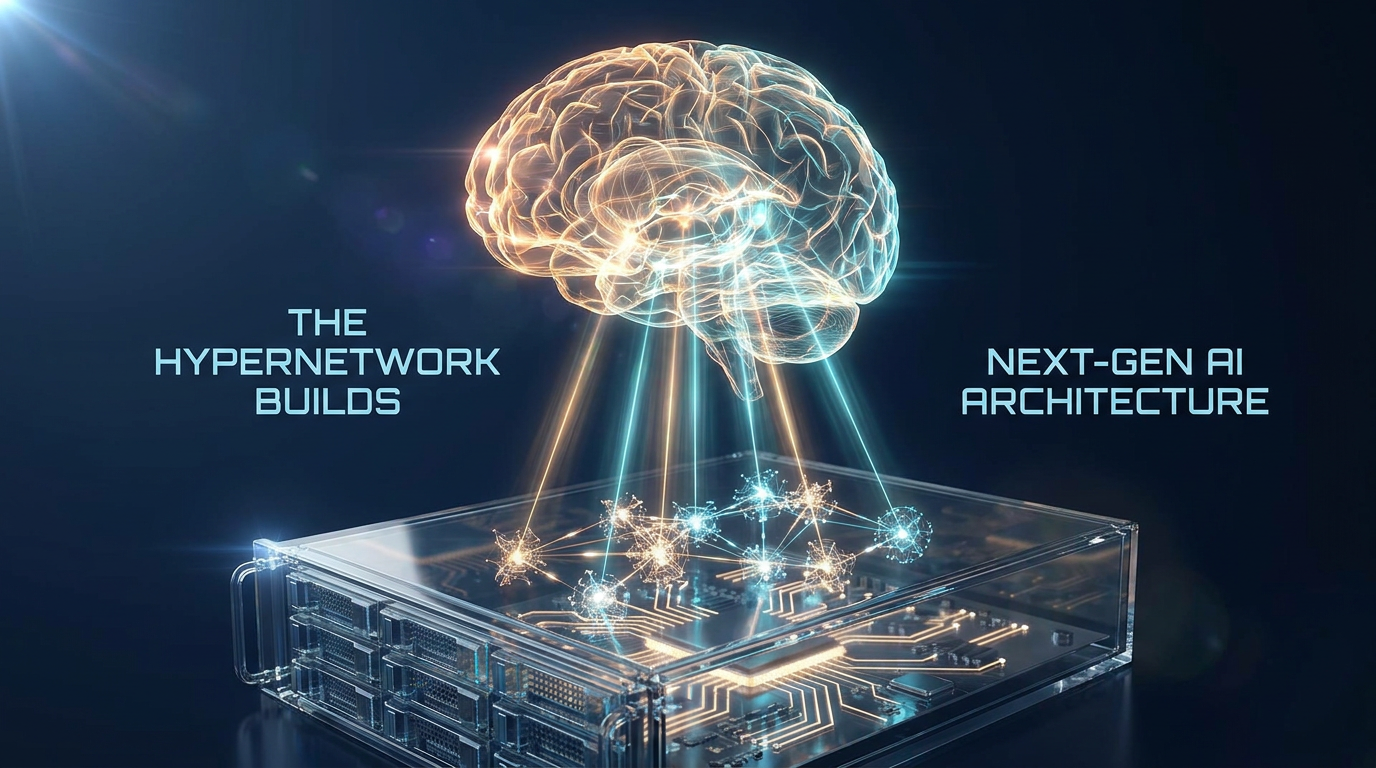
To bypass the pitfalls of both fine-tuning and RAG, researchers are moving a novel architecture from the lab into early production: hypernetworks. First conceptualized in 2016, a hypernetwork is a specialized neural network whose sole output is the parameters, or weights, of another target network.[1][7]
Instead of permanently retraining a base model or stuffing its prompt with text, a hypernetwork acts as a dynamic weight factory. At inference time, the hypernetwork takes a task description or a specific document as its input and instantly generates a small, specialized model adapter tailored exactly to that task.[1][2]
Evidence for this approach's viability is accelerating. AI research lab Sakana AI recently introduced "Doc-to-LoRA" and "Text-to-LoRA," systems that compress document information into Low-Rank Adaptation (LoRA) weights in a single forward pass. This allows the base model to internalize new factual content instantly without any traditional retraining loop.[2]
In this architecture, the base model remains entirely frozen. The hypernetwork learns the complex update rule during an expensive meta-training phase. Once trained, deploying it to generate task-specific updates is computationally cheap, allowing an agent to swap its specialized knowledge in milliseconds as it moves between tasks.[2][7]

Commercial applications of this dynamic generation are already securing capital. Nace.AI, a Palo Alto-based startup, recently raised a $21.5 million seed round to commercialize a MetaModel generator. The system produces parameter adaptations on the fly from a company's internal policies, specifically targeting highly regulated workflows like audit and compliance risk assessment.[1]
By generating weights dynamically, hypernetworks elegantly sidestep the catastrophic forgetting of fine-tuning. Because the base model is never permanently altered, it retains all of its foundational reasoning capabilities, simply applying the temporary, generated adapter to complete the specialized task at hand.[1][2]
Simultaneously, this approach bypasses the RAG memory wall. Because the specialized knowledge is injected directly into the model's parameters rather than its context window, the prompt remains short. The KV cache stays small, drastically reducing the GPU memory required and allowing agents to run long, autonomous jobs overnight without bankrupting the infrastructure.[1][7]

Despite the promise, transparent uncertainty remains regarding calibration and scale. While generating weights for small LoRA adapters is proven in constrained environments, scaling hypernetworks to reliably generate parameters for massive, trillion-parameter frontier models remains computationally daunting. The most critical components of this scaling are currently undergoing peer review.[1][7]
For enterprise AI teams, the shift from static models to dynamically generated weights represents a fundamental architectural pivot. If hypernetworks fulfill their early promise, the sprawling library of fine-tuned models will stop being a governance headache and become a generated output, finally enabling the autonomous, long-running agents the industry has been promising.[1][7]
How we got here
1989
The concept of catastrophic forgetting in neural networks is first formally identified.
2016
The term 'hypernetwork' is coined for networks that generate weights for other networks.
2020
Retrieval-Augmented Generation (RAG) emerges as the standard for grounding LLMs in external data.
2024
Peer-reviewed studies confirm catastrophic forgetting remains a severe limitation for fine-tuning modern LLMs.
2025
Sakana AI introduces Text-to-LoRA, using hypernetworks to generate task-specific adapters in a single pass.
June 2026
Hypernetworks gain commercial traction as a scalable alternative to RAG for autonomous enterprise agents.
Viewpoints in depth
Dynamic Generation Advocates
Argue that injecting knowledge directly into model weights at inference time is the only scalable path to autonomous agents.
Researchers in this camp, including teams at Sakana AI, view prompt-stuffing as a temporary hack. They argue that true agentic workflows require models to adapt their actual neural pathways to the task at hand. By using hypernetworks to generate temporary weights, they believe the industry can achieve the deep specialization of fine-tuning without the permanent brain-damage of catastrophic forgetting, ultimately reducing inference costs by keeping context windows small.
Retrieval Optimizers
Believe RAG remains the most practical, verifiable, and secure method for grounding AI in enterprise data.
Proponents of Retrieval-Augmented Generation argue that dynamic weight generation introduces unacceptable opacity into enterprise systems. When a model relies on retrieved text, developers can easily audit exactly which document led to a specific decision—a critical requirement for compliance. They argue that advancements in agentic chunking, hierarchical retrieval, and semantic caching will solve RAG's current memory and context limitations much faster than hypernetworks can scale to production.
Base Model Scalers
Focus on expanding raw context windows and hardware capacity to brute-force the memory wall.
This camp believes that architectural workarounds like hypernetworks and vector databases will eventually be rendered obsolete by sheer compute. As hardware providers develop more efficient memory architectures and foundational models natively support multi-million-token context windows with near-perfect recall, they argue that developers will simply load entire corporate databases into the prompt, bypassing the need for complex retrieval or dynamic weight generation entirely.
What we don't know
- Whether hypernetworks can reliably scale to generate parameters for massive, trillion-parameter frontier models.
- How the latency of generating weights on the fly will compare to optimized semantic caching in production environments.
Key terms
- Hypernetwork
- A specialized neural network designed to output the parameters (weights) for a separate target network.
- Catastrophic Forgetting
- A phenomenon where a neural network abruptly loses previously learned information upon learning new data.
- Retrieval-Augmented Generation (RAG)
- A technique that retrieves relevant documents from an external database and adds them to an AI's prompt to ground its answers.
- Key-Value (KV) Cache
- The memory mechanism used by language models to store previously processed tokens, which grows linearly with the size of the prompt.
- Low-Rank Adaptation (LoRA)
- A highly efficient method for fine-tuning models by updating only a small, targeted subset of parameters.
Frequently asked
What is a hypernetwork?
A hypernetwork is a specialized neural network designed to output the parameters (weights) for another target network, rather than processing data directly.
Why does fine-tuning fail for AI agents?
It often suffers from catastrophic forgetting, where learning new, highly specific enterprise data overwrites the model's foundational reasoning capabilities.
What is the memory wall in RAG?
As context windows grow to accommodate more retrieved documents, the Key-Value cache consumes massive amounts of GPU memory, making it too expensive to scale for autonomous agents.
Sources
Source coverage
7 outlets
3 viewpoints surfaced






[1]VentureBeatDynamic Generation Advocates
Fine-tuning forgets. RAG leaks context. Hypernetworks build the model your agent needs on demand
Read on VentureBeat →[2]Sakana AIDynamic Generation Advocates
Doc-to-LoRA and Text-to-LoRA: Generating Weights for Rapid Few-Shot Adaptation
Read on Sakana AI →[3]Association for Computational LinguisticsBase Model Scalers
Revisiting Catastrophic Forgetting in Large Language Model Tuning
Read on Association for Computational Linguistics →[4]RedisRetrieval Optimizers
RAG vs Long Context Windows: The Real Trade-offs
Read on Redis →[5]F5Retrieval Optimizers
Context windows and implications for Large Language Models
Read on F5 →[6]IBMRetrieval Optimizers
It's time to face the truth about retrieval augmented generation
Read on IBM →[7]Factlen Editorial TeamDynamic Generation Advocates
Synthesis by Factlen editorial team
Read on Factlen Editorial Team →
Every angle. Every day.
Get technology stories with full source coverage and perspective breakdowns delivered to your inbox.