
The Science of Temperature Therapy: When to Use Ice vs. Heat for Muscle Recovery
Cold plunges and saunas are more popular than ever, but sports science reveals that timing is everything. While cold water immersion reduces acute soreness, it can actively sabotage muscle growth if used immediately after strength training.
By Factlen Editorial Team
- Sports Physiologists
- Argue that recovery protocols must be periodized, warning that cold therapy blunts the necessary inflammation required for muscle growth.
- Team Sport & Endurance Athletes
- Prioritize immediate pain relief, lactate clearance, and perceived recovery to survive grueling multi-game schedules.
- Wellness & Longevity Advocates
- Emphasize the systemic nervous system benefits, mental resilience, and mood boosts of temperature exposure, regardless of muscle size.
What's not represented
- · Physical therapists treating non-athletic populations
- · Manufacturers of commercial cold plunge and sauna equipment
Why this matters
Understanding the physiological differences between heat and cold therapy allows you to align your recovery protocol with your specific fitness goals. Using the wrong temperature at the wrong time can nullify the hard work you put into your training, particularly if your goal is building muscle mass.
Key points
- Cold water immersion effectively reduces acute inflammation and numbs pain, making it ideal for immediate short-term recovery.
- Using an ice bath immediately after resistance training actively blunts the cellular signals required for muscle growth.
- Heat therapy promotes vasodilation, increasing blood flow to deliver nutrients and clear metabolic waste from damaged tissues.
- Contrast water therapy alternates hot and cold to create a vascular pumping effect, significantly reducing perceived fatigue.
- Athletes should periodize recovery: use cold for immediate pain relief and heat or passive rest for long-term adaptation.
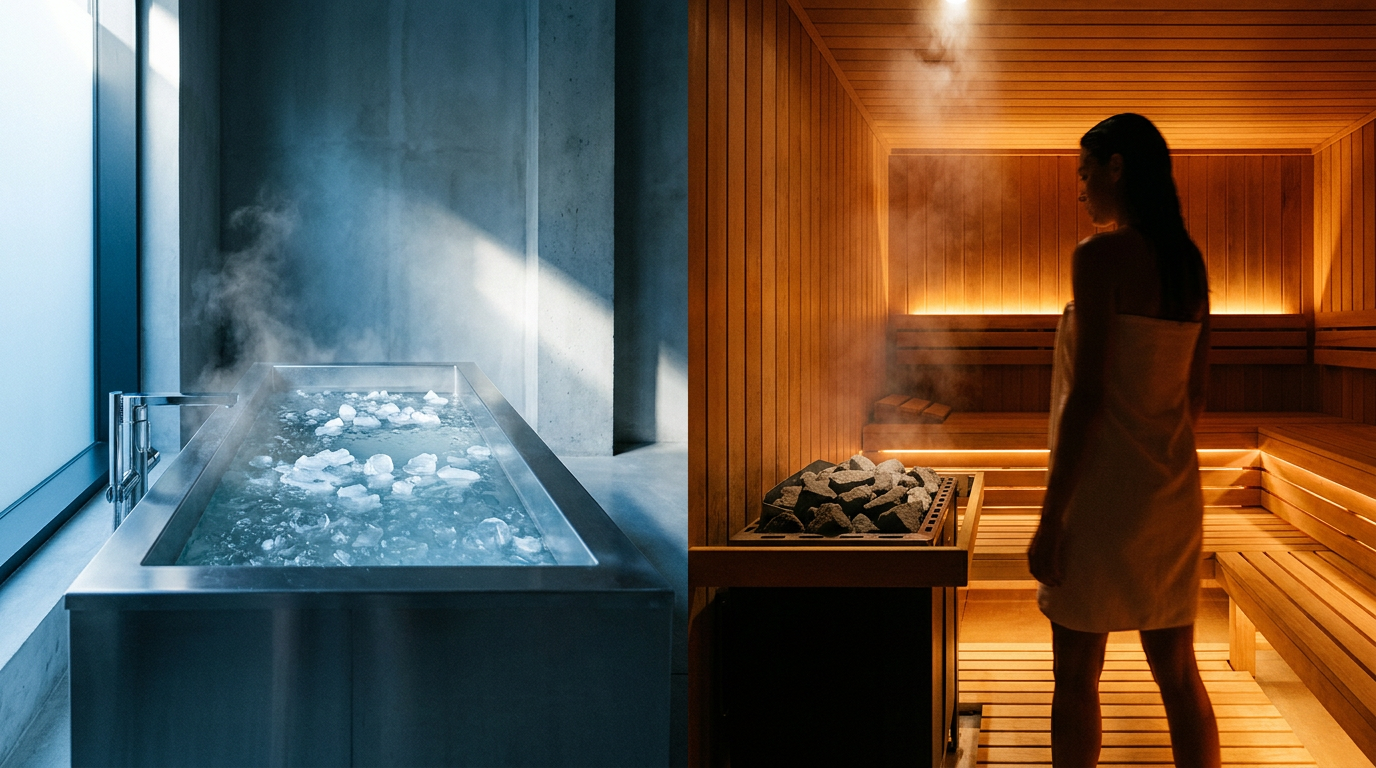
From professional locker rooms to suburban garages, extreme temperature therapy has taken the fitness world by storm. Cold plunges and infrared saunas are no longer niche tools reserved for elite competitors; they have become mainstream wellness staples. Social media is flooded with influencers and weekend warriors alike plunging into ice water or sweating it out in cedar boxes, all in the pursuit of optimized recovery and mental resilience.[1]
The underlying assumption driving this trend is simple: if a workout breaks the body down, extreme temperatures must help build it back up faster. However, sports science reveals a much more complex and nuanced reality. The body’s response to heat and cold is profoundly different, and applying the wrong temperature at the wrong time can actually sabotage the very fitness goals an athlete is trying to achieve.[1]
To understand how temperature alters recovery, it is essential to understand the core rule of physiological adaptation. Exercise itself does not make a person stronger or faster; it is merely a stressor that causes micro-tears in muscle tissue and depletes energy stores. The actual improvement occurs during the recovery phase, when the body repairs the damage to handle future stress better. Interfering with that natural stress response changes the ultimate outcome.[1]
Cold water immersion, typically involving water chilled to between 10 and 15 degrees Celsius, triggers an immediate survival response in the body. The primary mechanism is vasoconstriction—the rapid narrowing of blood vessels in the extremities. This shunts blood away from the limbs and toward the core to preserve heat, effectively reducing local blood flow to the muscles that were just exercised.[7]

This restriction of blood flow is highly effective at managing acute trauma. By limiting circulation to micro-torn muscles, cold therapy slows down the inflammatory cascade and reduces tissue swelling. It also acts as a powerful natural analgesic, slowing the transmission of pain signals to the brain. For athletes suffering from Delayed Onset Muscle Soreness (DOMS), a cold plunge within the first 24 to 48 hours provides unmatched immediate relief.[7]
However, this immediate relief comes with a significant physiological cost, creating what sports scientists call the "hypertrophy trap." For decades, gym-goers assumed that an ice bath after a heavy weightlifting session would speed up their recovery and help them build muscle faster. Recent landmark studies have proven the exact opposite: cold water immersion actively sabotages muscle growth.[2]
A pivotal study published in the Journal of Applied Physiology tracked men performing resistance training followed by either 15 minutes of cold water immersion or passive recovery. While both groups gained strength, the athletes who took ice baths saw their muscle fiber growth completely blunted. The active recovery group experienced a 17 percent increase in type II muscle fiber size, whereas the cold plunge group saw virtually no increase in muscle mass.[2]
While both groups gained strength, the athletes who took ice baths saw their muscle fiber growth completely blunted.
The molecular explanation for this phenomenon is striking. Research in Frontiers in Physiology demonstrated that cold water immersion suppresses the activity of satellite cells, which are crucial for muscle repair and growth. Furthermore, the cold temperatures blunt key anabolic signaling pathways, such as p70S6 kinase, which the body uses to synthesize new proteins. By artificially putting out the "fire" of inflammation, the ice bath removes the biological signal that tells the muscle to grow larger.[3]

The takeaway for strength athletes and bodybuilders is definitive: if the primary goal of a workout is hypertrophy, the post-exercise inflammation is a necessary feature, not a bug. Applying cold therapy immediately after lifting weights effectively cancels out the cellular signals required for tissue expansion. For these athletes, passive rest or light active recovery is vastly superior to an ice bath.[2][3]
Heat therapy, on the other hand, operates through the exact opposite mechanism. Whether through a hot tub, a sauna, or localized heat packs, warming the tissue induces vasodilation. The blood vessels expand, significantly increasing local circulation. This rush of blood brings oxygen, nutrients, and immune cells directly to the damaged muscle tissue, actively supporting the biological repair process rather than pausing it.[7]
Because it promotes blood flow, heat therapy is generally considered superior for chronic stiffness, joint pain, and injuries that are older than 48 hours. It helps relax muscle spasms and clears out lingering metabolic waste products. Furthermore, some studies suggest that the upregulation of angiogenesis—the creation of new blood vessels—induced by heat can actually support the recovery of muscle strength and endurance over the long term.[7]
For athletes who want the benefits of both extremes, Contrast Water Therapy (CWT) has emerged as a highly effective middle ground. This protocol involves alternating between hot water immersion and cold water immersion, typically spending a few minutes in the heat followed by a brief plunge into the cold. This cycle is repeated several times, ending on cold to ensure the core temperature remains stable.[5]

The physiological magic of contrast therapy lies in the "shunting" effect. The rapid transition from vasodilation in the hot water to vasoconstriction in the cold water acts like a vascular pump. This pumping action is theorized to accelerate the removal of metabolic byproducts, such as blood lactate, and reduce localized edema without completely freezing the inflammatory repair process.[5]
The efficacy of contrast therapy is particularly pronounced in team sports and high-intensity interval training. Systematic reviews in Sports Medicine and The Journal of Strength & Conditioning Research have shown that while CWT may not immediately improve objective power metrics like sprint speed or jump height, it significantly reduces perceived muscle soreness and fatigue. For an athlete facing a grueling multi-game schedule, feeling recovered is often just as important as being physiologically recovered.[4][6]
Beyond the muscular system, the systemic benefits of temperature therapy cannot be ignored. Both cold plunges and saunas force the autonomic nervous system to adapt to extreme environmental stress. This exposure triggers the release of cold-shock and heat-shock proteins, spikes endorphins, and improves overall cardiovascular tone. For many wellness advocates, the mental resilience built by sitting in freezing water or a sweltering sauna is the primary draw, regardless of its impact on muscle size.[1]

Ultimately, the science of temperature therapy dictates that recovery must be periodized just like training. Cold water immersion is an unparalleled tool for immediate pain relief and surviving intense competitive schedules where performance tomorrow matters more than adaptation next month. Conversely, heat therapy and passive rest are the optimal choices when the goal is long-term muscle growth and physiological adaptation. By aligning the temperature with the goal, athletes can finally stop guessing and start recovering with precision.[1][7]
How we got here
1990s-2000s
Ice baths become a staple in professional locker rooms for post-game recovery across major sports leagues.
2013
Systematic reviews confirm contrast water therapy reduces perceived muscle soreness better than passive rest.
2015-2019
Landmark physiological studies reveal that cold water immersion actively blunts muscle hypertrophy and anabolic signaling.
2020s
The rise of 'periodized recovery,' where athletes cycle heat and cold based on their specific training goals rather than using ice universally.
Viewpoints in depth
The Adaptation Camp
Sports scientists focused on long-term muscle growth and physiological adaptation.
This perspective emphasizes that exercise is merely a stimulus; the actual improvement happens during recovery. Because inflammation is a necessary biological signal for muscle repair and growth, this camp argues against using cold water immersion after resistance training. They point to molecular data showing that ice baths suppress satellite cell activity and blunt the pathways responsible for hypertrophy, effectively sabotaging the workout's primary goal.
The Acute Performance Camp
Athletes and trainers prioritizing immediate recovery for grueling schedules.
For athletes in the middle of a playoff series, a multi-day tournament, or intense endurance blocks, long-term muscle growth is irrelevant compared to immediate functional recovery. This camp relies heavily on cold water immersion and contrast therapy to numb pain, flush out blood lactate, and reduce acute swelling. The psychological benefit of feeling 'fresh' often outweighs the physiological blunting of hypertrophy, allowing them to compete at a high level the very next day.
What we don't know
- Whether the hypertrophy-blunting effects of cold water immersion apply equally to highly trained elite bodybuilders as they do to recreational lifters.
- The exact optimal ratio of hot-to-cold time in contrast water therapy, as protocols currently vary widely across different sports.
- How long a lifter must wait after resistance training before a cold plunge no longer interferes with the anabolic signaling window.
Key terms
- Hypertrophy
- The enlargement of skeletal muscle tissue, typically achieved through resistance training and subsequent protein synthesis.
- Vasoconstriction
- The narrowing of blood vessels, which reduces blood flow to an area and helps limit acute swelling.
- Vasodilation
- The widening of blood vessels, which increases blood flow and delivers oxygen and nutrients to tissues.
- Delayed Onset Muscle Soreness (DOMS)
- Muscle pain and stiffness that typically peaks 24 to 72 hours after unfamiliar or intense exercise.
- Contrast Water Therapy (CWT)
- A recovery protocol that alternates between hot and cold water immersion to create a vascular pumping effect.
Frequently asked
Should I take an ice bath immediately after lifting weights?
No, if your primary goal is muscle growth. Research shows that cold water immersion blunts the anabolic signals and inflammation necessary for muscle hypertrophy.
When is the best time to use a cold plunge?
Cold therapy is optimal after endurance events, during intense tournament schedules, or when immediate pain relief and inflammation reduction are the top priorities.
Does contrast therapy actually improve performance?
While it may not immediately increase objective power or speed, contrast therapy significantly reduces perceived fatigue and clears blood lactate, helping athletes feel recovered faster.
Is heat or cold better for chronic muscle stiffness?
Heat therapy is generally superior for chronic stiffness and injuries older than 48 hours, as it promotes blood flow and relaxes muscle spasms.
Sources
Source coverage
7 outlets
3 viewpoints surfaced







[1]Factlen Editorial TeamWellness & Longevity Advocates
Synthesis by Factlen editorial team
Read on Factlen Editorial Team →[2]Journal of Applied PhysiologySports Physiologists
Cold water immersion attenuates anabolic signaling and skeletal muscle fiber hypertrophy, but not strength gain, following whole-body resistance training
Read on Journal of Applied Physiology →[3]Frontiers in PhysiologySports Physiologists
The Effects of Cold Water Immersion and Active Recovery on Molecular Factors That Regulate Growth and Remodeling of Skeletal Muscle After Resistance Exercise
Read on Frontiers in Physiology →[4]The Journal of Strength & Conditioning ResearchTeam Sport & Endurance Athletes
Cold Water Immersion and Contrast Water Therapy for Recovery in Team Sport: A Systematic Review and Meta-analysis
Read on The Journal of Strength & Conditioning Research →[5]Physical Therapy in SportTeam Sport & Endurance Athletes
Alternating hot and cold water immersion for athlete recovery: a review
Read on Physical Therapy in Sport →[6]Sports MedicineTeam Sport & Endurance Athletes
Contrast Water Therapy and Exercise-Induced Muscle Damage: A Systematic Review and Meta-analysis
Read on Sports Medicine →[7]Brigham and Women's HospitalSports Physiologists
Evaluating Hot vs. Cold Therapy for Athletic Recovery
Read on Brigham and Women's Hospital →
Every angle. Every day.
Get fitness stories with full source coverage and perspective breakdowns delivered to your inbox.