
Prescribed Burns Cut Long-Term Wildfire Smoke Pollution, Satellite Data Shows
A comprehensive analysis of two decades of California satellite data reveals that intentionally burning forests reduces long-term exposure to toxic wildfire smoke, despite an initial increase in pollution.
By Factlen Editorial Team
- Forest Ecology Researchers
- Argue that prescribed fire is an essential, evidence-backed tool for long-term ecosystem health and net-reduction in smoke.
- Fire Management Agencies
- Tasked with implementation, balancing the proven benefits of fuel treatments against operational risks and limited budgets.
- Public Health Advocates
- Concerned with immediate particulate matter exposure but increasingly recognizing the long-term trade-off of controlled burns.
What's not represented
- · Indigenous fire practitioners
- · Homeowners in the wildland-urban interface
Why this matters
Wildfire smoke has become a dominant public health threat across the American West, forcing millions indoors and exacerbating respiratory diseases. Understanding that short-term, controlled smoke is the only proven mechanism to prevent catastrophic, sky-darkening mega-fires is essential for communities voting on forest management policies and health regulations.
Key points
- Intentionally burning 500,000 acres of California forest annually reduces long-term smoke exposure by 10 percent over a decade.
- Low-severity prescribed fires immediately cut the risk of severe mega-fires in the same location by 92 percent.
- The protective benefits of a controlled burn extend up to three miles into neighboring, untreated forest areas.
- Forest fuel treatments across the West have averted an estimated $2.8 billion in damages and prevented 60 premature deaths.
For decades, the dominant strategy for managing Western wildfires was simple: put them out as quickly as possible. But as climate change accelerates and forests grow dense with unburned fuel, that century-old policy of strict suppression has inadvertently engineered an era of catastrophic mega-fires. Now, a growing body of empirical evidence suggests that fighting fire with fire is not just an ecological necessity, but a critical public health intervention. According to a comprehensive synthesis of recent data, intentionally setting low-severity fires—known as prescribed burns—can significantly reduce long-term human exposure to toxic wildfire smoke.[4][9]
The core claim rests on a paradox that has long frustrated forest managers and air quality advocates alike: to have less smoke in the future, communities must tolerate more smoke today. A landmark study published in the journal Science in June 2026 provides the most robust quantitative backing for this trade-off to date. Researchers from Stanford University’s Doerr School of Sustainability analyzed two decades of satellite measurements tracking fire severity and particulate matter across California. Their findings confirm that while prescribed burns initially increase local air pollution, they ultimately deliver a substantial net reduction in dangerous smoke exposure over a ten-year horizon.[1][3][6]
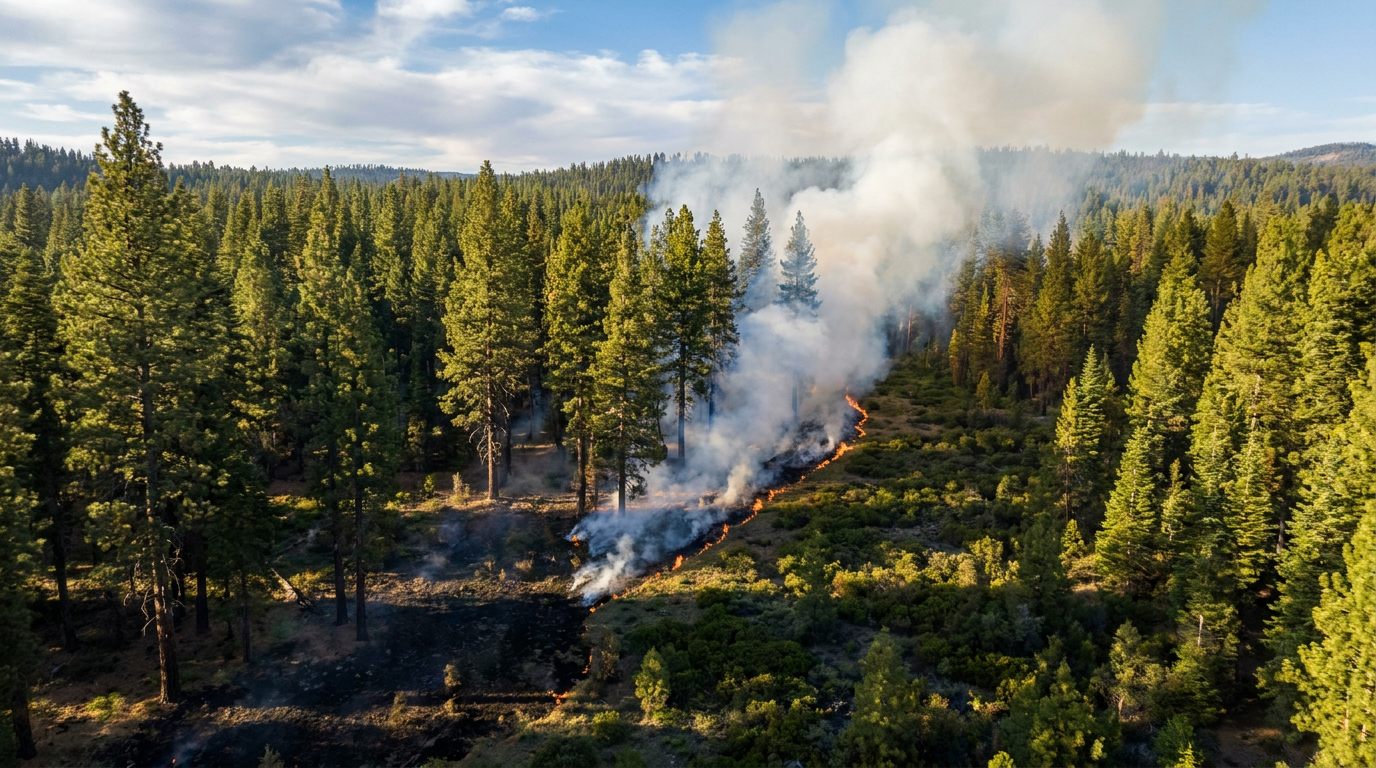
The mechanism behind this benefit is rooted in fuel reduction. When a low-severity prescribed fire sweeps through a conifer forest, it consumes the dry underbrush, dead leaves, and fallen branches that act as kindling. By clearing out this accumulated fuel, the intentional burn starves future, uncontrolled wildfires of the energy they need to explode into the forest canopy. The Stanford analysis revealed that when a low-severity fire burns an area, it immediately cuts the risk of a very severe wildfire occurring in that exact location by 92 percent.[1][3][5]
Crucially, the protective benefits of these controlled burns are not confined to the incinerated acreage. The data demonstrates a powerful spillover effect, where the reduction in severe fire risk extends up to three miles beyond the boundaries of the prescribed burn. Because a treated area acts as a buffer, it slows the momentum of advancing mega-fires, making them easier for firefighters to contain and protecting adjacent, untreated forests from catastrophic ignition.[3][5][9]

However, the transition from theory to practice involves a steep public health trade-off. Wildfire smoke is laden with fine particulate matter (PM2.5), which can penetrate deep into the lungs and enter the bloodstream, exacerbating asthma, causing cardiovascular issues, and increasing premature mortality. When forest managers ignite prescribed burns, they are deliberately releasing PM2.5 into the atmosphere. The Stanford modeling acknowledges this upfront cost, noting that if California were to hit its target of burning 500,000 acres of conifer forest annually, smoke pollution would initially rise.[1][4][6]
The inflection point—the moment when the long-term benefits overtake the short-term costs—arrives around year four of a sustained prescribed burning campaign. According to the researchers, after this initial period of elevated smoke, the reduction in catastrophic mega-fires begins to yield cleaner air. Over a full decade, burning 500,000 acres annually would reduce overall wildfire smoke pollution by roughly 10 percent. During historically severe fire seasons, such as the catastrophic years of 2020 and 2021, the reduction in dangerous fine particle pollution could reach as high as 20 to 25 percent.[1][3][6]
The economic and human health arguments for this strategy are further bolstered by a separate study published in Science in May 2026 by researchers at the University of California, Davis. This team analyzed data from nearly 300 wildfires across 11 Western states between 2017 and 2023, specifically looking at incidents where advancing wildfires encountered areas that had previously undergone fuel reduction treatments, including prescribed burns and mechanical thinning.[2][7]
The UC Davis evidence pack is striking in its quantification of avoided disaster. The researchers calculated that these fuel treatments prevented an estimated $2.8 billion in damages, which includes losses to buildings, economic disruptions, and health impacts. Furthermore, the treatments warded off the release of 2.7 million tons of carbon dioxide and prevented more than 25,000 tons of fine particle pollution from entering the atmosphere. Most profoundly, the modeling suggests that these interventions averted nearly 60 premature deaths across the region.[7][8]

The UC Davis evidence pack is striking in its quantification of avoided disaster.
The financial return on investment for proactive forest management is exceptionally high. The UC Davis analysis concluded that for every dollar invested in fuel treatments, the public receives $3.73 in expected benefits. Similarly, the Stanford researchers estimated that the air quality benefits of prescribed burns outweigh the initial cost of the generated smoke by a factor of about five to one over a decade. Despite this strong economic rationale, fuel treatments remain chronically underutilized across the American West.[3][7][8]
The primary barrier to scaling up prescribed burns is risk aversion among both the public and land management agencies. While the vast majority of controlled burns go exactly as planned, the rare instances where fires escape containment dominate public perception. For example, the Putah Fire in Yolo County, California, which burned in early June 2026, began as a prescribed burn that breached its boundaries. Such incidents often trigger intense political backlash and temporary moratoriums on intentional burning.[7][8]
Yet, the statistical evidence suggests that escaped burns are exceedingly rare anomalies rather than the norm. A comprehensive review of prescribed burns conducted across 16 California air districts between 2013 and 2020 found that only 1.76 percent of controlled fires escaped containment. Forest ecology researchers argue that the minimal risk of an escaped prescribed burn pales in comparison to the absolute certainty of catastrophic, uncontrolled mega-fires if the forests are left untreated.[5][7][9]
There is, however, transparent uncertainty regarding the benefits of prescribed burning during years with historically low wildfire activity. Michael Kleeman, a professor at the UC Davis Air Quality Research Center who is leading a separate project for the California Air Resources Board, has emphasized a critical caveat. While aggressive prescribed burning undeniably improves public health during active, high-fire years, the intentional smoke could theoretically result in a net detriment to air quality during a year where natural wildfires would have been scarce anyway.[6]

This uncertainty highlights the complex calculus facing state and federal environmental regulators. Agencies must balance the immediate, localized air quality mandates of the Clean Air Act against the long-term, regional threat of climate-driven mega-fires. Currently, California treats only about a quarter of the 500,000 acres recommended by the Stanford study, constrained by limited budgets, narrow weather windows suitable for safe burning, and a shortage of trained personnel.[3][6][9]
The U.S. Forest Service and state agencies like Cal Fire are attempting to navigate this bottleneck by restructuring their approaches to prioritize prevention over pure suppression. The new scientific consensus provides these agencies with the empirical ammunition needed to justify the upfront costs and temporary smoke to skeptical communities and lawmakers. By proving that the treatments pay off economically and medically, researchers hope to incentivize a massive increase in the pace and scale of prescribed burning.[5][7]
Ultimately, the evidence pack presented by the 2026 studies frames the wildfire crisis not as an unsolvable natural disaster, but as a manageable public policy challenge. The data clearly indicates that society cannot choose a future with zero smoke; it can only choose between the controlled, low-intensity smoke of a prescribed burn in the spring, or the toxic, sky-darkening plumes of a mega-fire in the late summer.[4][6][9]
As Marshall Burke, the senior author of the Stanford study, noted, the transition requires a societal shift in perspective. He acknowledged the difficulty of accepting immediate pollution for future safety, pointing out that humans often struggle with delayed gratification. However, the data is unequivocal: enduring the temporary discomfort of a prescribed burn is the most effective way to secure the long-term health of both Western forests and the people who live near them.[6][9]
How we got here
Pre-1900s
Indigenous communities routinely use low-severity fire to manage forest health and reduce fuel loads.
1910
The 'Big Blowup' wildfires prompt the U.S. Forest Service to adopt a policy of strict fire suppression.
2020-2021
Record-breaking mega-fires in California produce the worst smoke pollution years in the state's history.
May 2026
UC Davis researchers publish data showing fuel treatments saved $2.8 billion in damages across the West.
June 2026
Stanford study in Science proves prescribed burns reduce long-term smoke exposure by 10 percent.
Viewpoints in depth
Forest Ecology Researchers
Advocating for a massive scale-up of fuel treatments to restore natural fire regimes.
Ecologists and environmental scientists point to decades of satellite data and historical records to argue that Western forests are dangerously overgrown. They view prescribed burns not as a novel intervention, but as a necessary restoration of the low-severity fire cycles that existed before 20th-century suppression policies. Their modeling demonstrates that the short-term carbon emissions and smoke from controlled burns are dwarfed by the massive, uncontrolled releases of mega-fires, making proactive burning a critical climate mitigation strategy.
Fire Management Agencies
Navigating the operational and political realities of intentionally setting fires.
Agencies like Cal Fire and the U.S. Forest Service face the practical burden of executing prescribed burns safely. They must contend with narrow 'burn windows'—days where wind, humidity, and temperature are perfectly aligned to prevent a fire from escaping. When a controlled burn does breach its containment lines, as happened with the Putah Fire, these agencies face intense public backlash and political scrutiny, which often leads to risk aversion and a default return to fire suppression tactics.
Public Health Advocates
Weighing the immediate harm of PM2.5 exposure against the promise of future clear air.
Air quality experts and public health officials are caught in a difficult bind. The Clean Air Act mandates strict limits on daily particulate matter, and prescribed burns intentionally introduce these pollutants into local communities, posing immediate risks to vulnerable populations with respiratory issues. However, as the evidence mounts that controlled burns prevent the apocalyptic smoke waves of severe mega-fires, many in the public health sector are cautiously endorsing the strategy as a necessary, albeit painful, long-term harm reduction measure.
What we don't know
- How the net air quality benefits hold up during historically low-fire years where natural wildfires would have been scarce.
- Whether federal and state governments will allocate the sustained, long-term funding required to hit the 500,000-acre annual target.
- The exact long-term health impacts of repeated, low-dose smoke exposure from annual prescribed burns compared to acute exposure from mega-fires.
Key terms
- Prescribed Burn
- An intentional, controlled fire set by professionals to clear out dead brush and reduce the fuel available for future wildfires.
- PM2.5
- Fine particulate matter found in smoke that is small enough to penetrate deep into the lungs and enter the bloodstream.
- Fuel Treatment
- Forest management strategies, including controlled burns and mechanical thinning, designed to remove excess flammable vegetation.
- Spillover Effect
- The phenomenon where treating one area of a forest with a prescribed burn reduces the risk of severe fire in neighboring, untreated areas.
- Crown Fire
- An extreme, highly destructive wildfire that spreads rapidly through the top canopy of a forest.
Frequently asked
Do prescribed burns always reduce smoke?
No, they initially increase local smoke pollution. However, satellite data shows that after about four years, the reduction in severe wildfires leads to a net decrease in overall smoke.
What happens if a controlled burn escapes?
Escaped burns are rare—occurring in less than 2% of cases—but when they happen, they can trigger uncontrolled wildfires that require immediate suppression efforts.
Why doesn't California burn more acres?
Agencies are constrained by limited budgets, a shortage of trained personnel, and narrow weather windows where it is safe to ignite a fire without it spreading out of control.
Sources
Source coverage
9 outlets
3 viewpoints surfaced








[1]ScienceForest Ecology Researchers
Prescribed fire reduces long-term smoke exposure
Read on Science →Economic value of US Forest Service fuel reduction treatments
Read on Science →[3]Stanford UniversityForest Ecology Researchers
Stanford study finds prescribed burns reduce long-term smoke exposure
Read on Stanford University →[4]NaturePublic Health Advocates
Fiery data hint that controlled forest fires benefit human health
Read on Nature →[5]The Washington PostFire Management Agencies
Setting intentional forest fires can reduce toxic smoke over time
Read on The Washington Post →[6]SFGATEPublic Health Advocates
Stanford study finds surprising upside of prescribed burns
Read on SFGATE →[7]The Sacramento BeeFire Management Agencies
UC Davis study: Prescribed burns, forest thinning save billions but underused
Read on The Sacramento Bee →[8]Inside Climate NewsPublic Health Advocates
Work to reduce excess flammable vegetation in forests warded off $2.8 billion in damages
Read on Inside Climate News →[9]Factlen Editorial TeamFire Management Agencies
Synthesis by Factlen editorial team
Read on Factlen Editorial Team →

Every angle. Every day.
Get science stories with full source coverage and perspective breakdowns delivered to your inbox.