
Beyond Sustainability: How Regenerative Tourism is Rewriting the Rules of Travel
The travel industry is shifting from a 'do no harm' sustainability model to regenerative tourism, where visitors actively fund and participate in the ecological and social restoration of their destinations.
By Factlen Editorial Team
- Regenerative Pioneers
- Argue that travel must actively heal ecosystems and empower communities, moving beyond the 'do no harm' baseline.
- Academic & Scientific Observers
- Emphasize systems-thinking, rigorous environmental measurement, and the integration of Indigenous knowledge.
- Industry Pragmatists
- Focus on the commercial viability of the trend, consumer demand, and the urgent need to prevent greenwashing.
What's not represented
- · Local residents in over-touristed areas who prefer degrowth over any form of tourism
- · Aviation industry executives defending the economic necessity of long-haul flights
Why this matters
As global travel volumes surge, the traditional tourism model is straining local ecosystems and communities. The shift toward regenerative travel empowers tourists to actively fund environmental restoration and cultural preservation, fundamentally changing how our vacation dollars impact the world.
Key points
- Regenerative tourism aims to leave destinations measurably better than they were found, moving beyond traditional sustainability.
- The sector is projected to grow from $8.2 billion in 2024 to nearly $29 billion by 2033.
- Initiatives include coral reef restoration, wetland revival, and community-led biological corridors.
- Experts warn of 'regen-washing' and stress the need for rigorous, destination-scale environmental measurement.
- The carbon footprint of long-haul aviation remains a systemic challenge for the global travel industry.
For decades, the highest aspiration of the conscientious traveler was to leave no trace. The global hospitality industry rallied around the concept of "sustainability," a paradigm largely defined by minimizing harm. This meant reusing hotel towels, reducing single-use plastics, and purchasing carbon offsets to assuage the guilt of long-haul flights. But as global travel volumes surge past pre-pandemic peaks in 2026, the math of simply doing less damage is no longer adding up. The sheer scale of modern tourism means that merely slowing the rate of environmental degradation is insufficient to protect the world's most vulnerable ecosystems.[1]
In response, a profound shift is sweeping the global travel industry. The new baseline is no longer sustainability, but "regenerative tourism"—a model that demands visitors leave a destination measurably better than they found it. Rather than merely pausing the degradation of a local ecosystem, regenerative travel actively funds and facilitates its restoration. This represents a fundamental rewiring of the tourist-host relationship, moving from an extractive transaction to a reciprocal partnership aimed at long-term ecological and social healing.[1][5]
Industry analysts and major publications have dubbed 2026 the tipping point for this movement, marking its transition from a niche academic concept to a visible, action-oriented market force. The shift is driven by a stark realization: the traditional tourism model is inherently extractive, consuming local resources, straining infrastructure, and commodifying culture while exporting the profits to multinational corporations. Destinations are increasingly refusing to bear the hidden costs of mass tourism, demanding that visitors contribute directly to the vitality of the places they visit.[1]

The stakes for this transition are quantified in the industry's massive environmental footprint. A landmark peer-reviewed assessment published in the journal Nature estimated that global tourism accounts for roughly 8.8 percent of the world's greenhouse gas emissions, or about 5.2 gigatons of carbon dioxide equivalent. This staggering figure encompasses everything from aviation and cruise ships to hotel energy consumption and the complex agricultural supply chains required to feed and entertain millions of travelers across the globe. Without a radical intervention, these numbers threaten to overwhelm international climate targets.[3]
Furthermore, the United Nations tourism body warns that transport-related emissions from international travel are projected to grow by 45 percent between 2016 and 2030. Against this backdrop, "sustainable" practices that merely shave a few percentage points off an expanding carbon footprint are increasingly viewed as inadequate. The industry is recognizing that it cannot simply efficiency its way out of a systemic crisis; it must actively sequester carbon, restore biodiversity, and build climate resilience at the destination level.[2]
Academics define regenerative tourism as a transformational approach that treats destinations not as static products, but as complex, living systems. According to researchers publishing in MDPI, the model seeks to enhance the natural, cultural, and social capital of a place, creating a net-positive benefit for both people and the planet. Crucially, this framework weaves together Western ecological science with Indigenous knowledge and stewardship practices, acknowledging that local communities have often managed these landscapes sustainably for millennia.[4]
This philosophy is rapidly materializing in concrete projects worldwide. In Uganda, Volcanoes Safaris' Kyambura Wetland Restoration Project offers a striking example of regeneration in action. Tourism revenue and direct visitor participation are being used to transform a former illegal brickworks site into a thriving wetland ecosystem. Today, the once-degraded landscape has been successfully revived and now supports more than 200 distinct bird species, demonstrating how travel capital can be weaponized for ecological good. By linking the financial success of the lodge directly to the health of the surrounding environment, the project creates a self-sustaining cycle of conservation.[1]
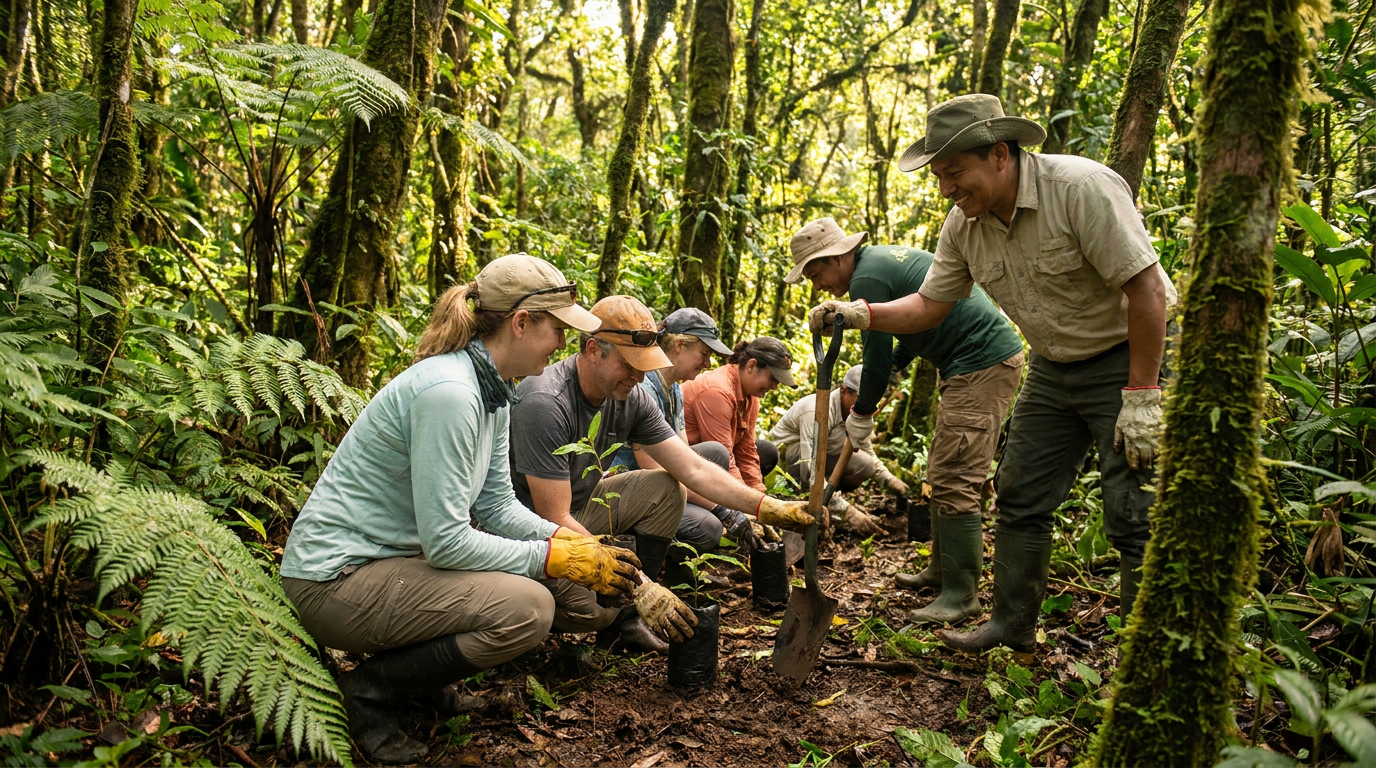
Costa Rica, long recognized as a global pioneer in ecotourism, has fully embraced the regenerative model as its new national standard. On the Nicoya Peninsula, local labor, conservationists, and tourism operators are collaborating on an ambitious "biological corridor" project designed to restore the region's depleted dry forests. Visitors are invited to participate in reforestation efforts, turning their vacation into a hands-on conservation mission that directly benefits the local watershed and wildlife populations. This approach not only rehabilitates the land but also provides sustainable employment for residents who might otherwise rely on extractive industries.[1]
Costa Rica, long recognized as a global pioneer in ecotourism, has fully embraced the regenerative model as its new national standard.
Off the coast at Playa Blanca, the "Reef Project" utilizes artificial structures to regenerate the seabed, turning marine restoration into an immersive, educational experience for visiting divers. This dual approach ensures that both terrestrial and marine environments benefit directly from visitor dollars. By actively rebuilding the coral infrastructure, the initiative provides a crucial habitat for marine life while simultaneously protecting the coastline from erosion and storm surges exacerbated by climate change. Tourists leave with a deeper understanding of marine biology, and the ocean is left measurably healthier than before they arrived.[1]

Similar marine initiatives are taking root across the globe, driven by the urgent need to protect the world's oceans. In Australia, the Maldives, and Saudi Arabia, coral gardening programs allow visitors to directly participate in planting resilient coral fragments. These programs actively contribute to the recovery of fragile reef ecosystems that have been devastated by warming oceans and acidification. The physical act of planting coral transforms tourists from passive observers into active custodians of the marine environment.[5]
The regenerative approach also extends deeply into cultural preservation and community empowerment. In New Zealand, the national tourism board asks all visitors to take the "Tiaki Promise"—a formal, culturally grounded pledge to care for the land, sea, and people. This initiative is rooted in the Māori concept of kaitiakitanga, or guardianship and protection, seamlessly blending Indigenous values with modern destination management to ensure that tourism respects the host culture. It sets a clear behavioral expectation for visitors before they even arrive, signaling that the destination is a shared home, not merely a playground.[5]
This shifts the dynamic from a transactional service economy to one of mutual respect and shared responsibility. By framing the tourist as a temporary steward rather than a mere consumer, destinations can protect their cultural heritage from being diluted or commodified. When local communities retain control over how their stories are told and how their land is accessed, tourism becomes a tool for cultural continuity rather than a force of homogenization. This empowerment ensures that the economic benefits of travel circulate within the local economy, funding schools, healthcare, and infrastructure.[5]
The financial momentum behind this shift is substantial, proving that purpose and profitability are not mutually exclusive. Market research forecasts that the regenerative tourism sector will grow exponentially, expanding from $8.2 billion in 2024 to nearly $29 billion by 2033. This rapid growth trajectory indicates that regeneration is not a passing fad, but a fundamental restructuring of the global travel market, attracting significant investment from both boutique operators and major hospitality conglomerates. Investors are increasingly recognizing that climate-resilient, community-backed destinations offer far better long-term returns than those vulnerable to environmental collapse.[5]

This growth is fueled by rapidly shifting consumer preferences. Recent industry data indicates that over half of global travelers now actively prioritize destinations that offer a regenerative approach, and a significant majority are willing to pay a premium for experiences that deliver verifiable positive impacts. Modern travelers, acutely aware of the climate crisis, are actively seeking ways to align their leisure time with their ethical values, driving a massive reallocation of capital toward responsible operators. The demand for transparency is forcing the entire supply chain to adapt or risk obsolescence.[5]
However, the rapid commercialization of the concept brings significant risks. Industry watchdogs warn of "regen-washing," a phenomenon where hotels and tour operators adopt the vocabulary of regeneration without fundamentally changing their extractive business models. Slapping a "regenerative" label on a standard luxury resort simply because it has a small organic garden or a towel-reuse program threatens to dilute the meaning of the movement and erode consumer trust before the paradigm can fully take hold. Without strict accountability, the industry risks repeating the same superficial marketing tactics that plagued the early days of the eco-tourism boom.[6]
To combat this, experts argue that the industry must move beyond marketing rhetoric and establish rigorous, destination-scale measurement. A truly regenerative project cannot be evaluated solely on financial key performance indicators or hotel-level carbon compliance; it must be judged on measurable biodiversity outcomes, community prosperity, and cultural continuity designed from the ground up. Certifications and independent audits will be crucial in separating the genuine pioneers from the opportunistic fast-followers. The ultimate metric of success is not how many tourists visit, but how much the destination thrives as a direct result of their presence.[6]

There is also an inherent, unavoidable tension at the heart of regenerative travel: the carbon cost of getting there. A traveler flying long-haul from London to Costa Rica generates a massive carbon footprint that cannot be entirely offset by planting trees or restoring a reef upon arrival. This paradox remains the most significant hurdle for the movement, as the aviation sector currently lacks the technology to decarbonize at the speed required to meet global climate goals. Until sustainable aviation fuel or alternative propulsion systems become widely available, long-distance travel will continue to carry a heavy environmental tax.[2][3]
Acknowledging this paradox, proponents of regenerative tourism argue that while aviation emissions remain a systemic challenge requiring technological solutions, the impact on the ground can still be transformed. If people are going to travel—and global trends suggest they will in record numbers—the capital they bring must be aggressively redirected from extractive multinational corporations to local, restorative initiatives. The goal is to maximize the localized positive impact to counterbalance the unavoidable emissions of the journey, ensuring that the net effect on the specific destination is overwhelmingly beneficial.[7]
As 2026 unfolds, the travel industry is being forced to recognize that its core product—the beauty of the natural world and the richness of human culture—is finite and fragile. Regenerative tourism offers a blueprint for a future where travel is not a destructive force to be mitigated, but a powerful engine for ecological and social healing. By demanding that we leave places measurably better than we found them, this movement is redefining what it means to explore the world, transforming the act of vacationing into a profound act of global stewardship.[7]
How we got here
2019
Global tourism emissions peak at 5.2 gigatons of CO2 equivalent, accounting for nearly 9% of global greenhouse gases.
2020
The COVID-19 pandemic halts global travel, exposing the vulnerabilities of extractive tourism models and sparking industry-wide reflection.
2022
The launch of certifications like Regenera Luxury signals a shift from theoretical discussions to actionable standards.
2024
The regenerative tourism market reaches $8.2 billion as consumer demand for positive-impact travel surges.
2026
Industry analysts declare a 'tipping point' as regenerative practices move from niche offerings to mainstream expectations.
Viewpoints in depth
Regenerative Pioneers
Advocates argue that travel must actively heal ecosystems and empower communities, moving beyond the 'do no harm' baseline.
For these pioneers, sustainability is no longer enough. They argue that the travel industry has historically extracted value from destinations, leaving behind degraded environments and commodified cultures. By shifting to a regenerative model, tourism can become a mechanism for funding biodiversity restoration, such as coral gardening and wetland revival, while ensuring that the economic benefits remain within the local community.
Academic & Scientific Observers
Researchers emphasize systems-thinking, rigorous environmental measurement, and the integration of Indigenous knowledge.
Academics view regenerative tourism through the lens of living systems theory, arguing that destinations are complex networks of nature and people. They stress that true regeneration cannot be achieved through isolated hotel initiatives; it requires destination-wide coordination. Furthermore, scientists point to the massive carbon footprint of global aviation, cautioning that local restoration efforts must be weighed against the emissions generated to reach the destination.
Industry Pragmatists
Industry leaders focus on the commercial viability of the trend, consumer demand, and the urgent need to prevent greenwashing.
Pragmatists recognize that consumer demand is driving the shift toward regenerative travel, with billions of dollars at stake. However, they are highly concerned about 'regen-washing'—the risk that companies will adopt the terminology without changing their underlying practices. They advocate for strict, measurable standards and certifications to ensure that regenerative claims are backed by verifiable environmental and social outcomes.
What we don't know
- Whether global certification standards can be established quickly enough to prevent widespread 'regen-washing' by major hospitality brands.
- How the industry will reconcile the localized benefits of regenerative tourism with the escalating carbon emissions of long-haul aviation.
- If the premium pricing often associated with regenerative travel will limit its accessibility to wealthy tourists, excluding broader demographics.
Key terms
- Regenerative Tourism
- A travel model that aims to create a net-positive impact by actively restoring ecosystems, empowering local communities, and preserving cultural heritage.
- Greenwashing (or Regen-washing)
- The deceptive practice of marketing a company or product as environmentally friendly or regenerative without making meaningful, verifiable sustainability efforts.
- Net-Positive Impact
- An outcome where an activity puts more back into the environment or society than it takes out.
- Living Systems Theory
- An ecological framework that views destinations not as static products, but as complex, interconnected networks of nature, people, and culture.
Frequently asked
What is the difference between sustainable and regenerative tourism?
Sustainable tourism aims to minimize harm and maintain the status quo, essentially leaving no trace. Regenerative tourism goes a step further, aiming to leave the destination measurably better than it was found through active ecological and social restoration.
What is an example of a regenerative travel experience?
Examples include participating in coral reef restoration in the Maldives, helping reforest a biological corridor in Costa Rica, or staying at a lodge that uses its profits to revive local wetlands.
Does regenerative tourism solve the carbon footprint of flying?
No. Aviation emissions remain a major systemic challenge for the travel industry. Regenerative tourism focuses primarily on maximizing the positive ecological and social impact at the destination itself to counterbalance the journey.
Sources
Source coverage
7 outlets
3 viewpoints surfaced







[1]ForbesRegenerative Pioneers
2026 Will Be The Year Regenerative Travel Moves To The Forefront
Read on Forbes →[2]UN TourismAcademic & Scientific Observers
Transport-related emissions from international tourism
Read on UN Tourism →[3]NatureAcademic & Scientific Observers
The carbon footprint of global tourism
Read on Nature →[4]MDPIAcademic & Scientific Observers
Defining and Implementing Regenerative Tourism
Read on MDPI →[5]The Tourism SpaceRegenerative Pioneers
Regenerative Tourism Market Research Report 2033
Read on The Tourism Space →[6]Regenera LuxuryIndustry Pragmatists
Regenerative Tourism in 2026: From a trend to global measurable leadership
Read on Regenera Luxury →[7]Factlen Editorial TeamIndustry Pragmatists
Synthesis by Factlen editorial team
Read on Factlen Editorial Team →
Every angle. Every day.
Get travel stories with full source coverage and perspective breakdowns delivered to your inbox.