
How Magnetic Joysticks Finally Solved the Stick Drift Epidemic
Hall Effect sensors are replacing traditional mechanical joysticks in gaming controllers, using magnetic fields to eliminate friction and permanently cure stick drift.
By Factlen Editorial Team
- Consumer Advocates & Gamers
- Argue that magnetic sensors are a necessary consumer right to end the cycle of disposable hardware.
- Hardware Manufacturers
- Balance the higher component and calibration costs of magnetic sensors against traditional reliability.
- Competitive FPS Players
- Prioritize absolute precision and physical center-damping, sometimes preferring newer TMR tech.
What's not represented
- · Environmental NGOs focused on e-waste reduction
- · First-party console hardware engineers
Why this matters
Stick drift has cost gamers hundreds of millions of dollars in replacement hardware over the last decade. The industry-wide shift to magnetic Hall Effect sensors permanently solves this mechanical failure, ending the era of disposable controllers and saving consumers money.
Key points
- Traditional joysticks fail because physical friction wears down internal carbon tracks, causing stick drift.
- Hall Effect sensors use magnets to track movement, eliminating physical contact and mechanical wear.
- Magnetic joysticks boast a lifespan of over 50 million cycles, compared to just 2 million for standard sticks.
- Third-party manufacturers have driven the price of Hall Effect controllers down to under $50.
- A newer magnetic technology, TMR, is emerging to offer even higher precision for competitive esports players.
The universal frustration of stick drift is a rite of passage for modern gamers. You are lining up a perfect sniper shot, or carefully navigating a narrow platform, and suddenly your character creeps to the left. You aren't touching the thumbstick. This is stick drift, the most infuriating and ubiquitous hardware failure in the gaming industry.[6]
For years, players have treated this as an inevitable "controller tax." After six to twelve months of heavy use, standard gamepads begin registering phantom inputs, rendering them useless for precision gameplay. Millions of controllers have been relegated to landfills, sparking class-action lawsuits and endless frustration among consumers who feel forced to constantly replace expensive hardware.[2]
But in 2026, the era of disposable controllers is rapidly coming to an end. A technology known as the Hall Effect has moved from niche enthusiast hardware into the mainstream, promising a permanent cure to the stick drift epidemic and fundamentally changing how gamepads are manufactured.[1]
To understand the cure, one must first understand the disease. For decades, the industry standard for thumbsticks has been the ALPS potentiometer. It is a mechanical marvel of 1990s engineering, but it is fundamentally flawed for the high-stakes, high-repetition environment of modern competitive gaming.[4]
A potentiometer measures the position of the joystick using physical contact. As you tilt the stick, a tiny metal wiper drags across a curved, resistive carbon track inside the sensor housing. The console measures the change in electrical resistance to determine exactly how far, and in what direction, you are pushing.[5]

The fatal flaw of this design is friction. Every single time you move the joystick, that metal wiper is essentially sanding down the carbon track. Over hundreds of hours of gameplay, this physical scraping inevitably wears away the conductive material.[6]
As the track degrades, microscopic carbon dust accumulates inside the sensor housing. This conductive sludge creates electrical "noise" that the controller's processor misinterprets as intentional movement. The result is stick drift—a physical hardware death sentence that cannot be fixed with software updates or recalibration.[5]
The Hall Effect offers an elegant, physics-based solution. Discovered in 1879 by American physicist Edwin Hall, the principle dictates that when a magnetic field is applied perpendicular to an electric current flowing through a conductor, a measurable voltage is generated.[6]
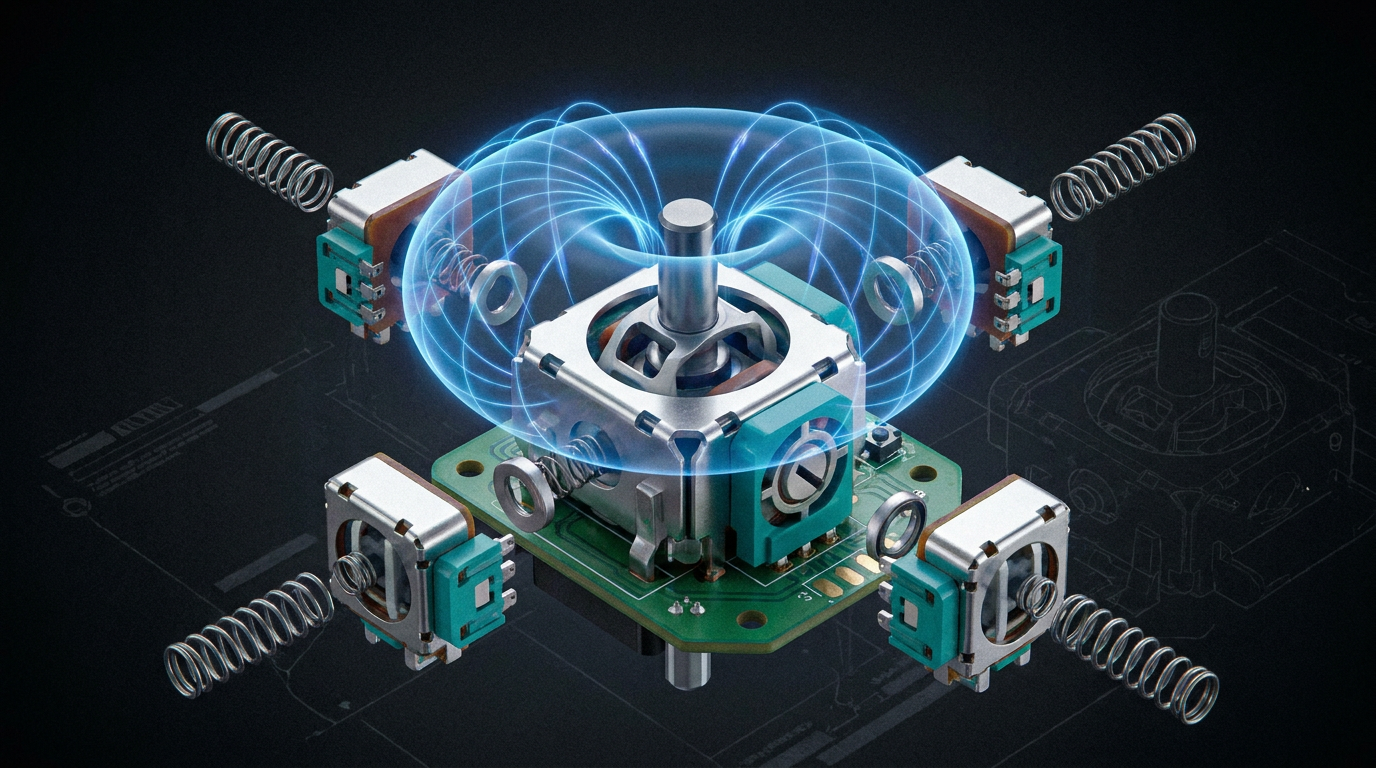
In a Hall Effect joystick, the physical wiper and carbon track are entirely removed. Instead, a small permanent magnet is attached directly to the base of the thumbstick mechanism.[4]
In a Hall Effect joystick, the physical wiper and carbon track are entirely removed.
As the player moves the stick, the magnet shifts its position. A stationary semiconductor sensor sits nearby, measuring the microscopic changes in the magnetic field—known as the Lorentz force—and translating those changes into precise voltage readings that the console understands as movement.[6]

The crucial advantage of this system is the complete lack of physical contact. Because the sensor and the magnet never touch, there is zero friction inside the mechanism. No friction means no carbon dust, no mechanical wear, and ultimately, no stick drift.[2]
The difference in longevity is staggering. Traditional potentiometers are rated for roughly two million cycles before failure is expected. Hall Effect sensors, by contrast, boast a Mean Time Between Failure (MTBF) of over 50 million cycles—often outlasting the plastic chassis of the controller itself.[5]
If the technology is so superior, why did it take so long to become the standard? The answer lies in manufacturing complexity. Potentiometers are incredibly cheap and offer a "plug-and-play" reliability on the assembly line. Hall Effect sensors are highly sensitive to magnetic variances and require expensive, precise factory calibration to ensure the center point is perfectly aligned.[6]
However, third-party hardware manufacturers forced the industry's hand. Brands like GameSir, 8BitDo, and Flydigi began engineering affordable Hall Effect controllers, proving that drift-proof technology could be delivered to consumers for under $50. This sparked a consumer awakening, making magnetic sticks a baseline demand rather than a premium luxury.[1]

By 2026, the landscape has entirely shifted. Premium esports controllers, such as the Razer Wolverine V3 Pro, now feature magnetic thumbsticks as a core selling point, while budget-friendly options ensure that even casual players can access drift-free hardware without breaking the bank.[2]
Yet, the transition is not without its trade-offs. Because Hall Effect sticks lack the physical friction of a carbon track, they can feel "loose" or "slippery" to players accustomed to the slight mechanical resistance of a traditional potentiometer.[3]
This lack of physical damping can also lead to centering jitter. Without mechanical friction to hold the stick perfectly still, the magnetic sensor might read a resting position of 0.0002 instead of a true 0.0000. Manufacturers solve this by implementing microscopic software deadzones, though purists sometimes notice the difference in raw input.[3]
For the most demanding competitive players, a newer evolution is already emerging: Tunnel Magnetoresistance (TMR). While Hall sensors measure the distance of a magnet, TMR sensors measure changes within the magnetic field itself, acting more like radar.[4]

TMR technology offers even higher precision, faster polling rates, and significantly lower power consumption, making it the new gold standard for professional esports controllers. It bridges the gap, offering the infinite lifespan of magnetic sensing with the tight, responsive feel of traditional sticks.[3]
Whether powered by standard Hall Effect sensors or advanced TMR modules, the shift toward contactless joysticks is a watershed moment for gaming hardware. It represents a rare victory for consumer longevity, ensuring that the only thing players have to fight is the enemy on the screen—not the controller in their hands.[6]
How we got here
1879
Edwin Hall discovers the Hall Effect principle of electromagnetism.
1990s
ALPS potentiometers become the mechanical standard for 3D gaming controllers.
1999
Sega Dreamcast briefly utilizes early Hall Effect sensors in its controller.
2023-2024
Third-party brands like GuliKit and GameSir popularize affordable Hall Effect controllers.
2026
Magnetic sensors, including advanced TMR tech, become the expected standard across budget and premium PC gamepads.
Viewpoints in depth
Consumer Advocates & Gamers
Argue that magnetic sensors are a necessary consumer right to end the cycle of disposable hardware.
For years, consumers have been forced to pay a "controller tax," replacing expensive gamepads annually due to inevitable mechanical failure. Advocacy groups and repair communities like iFixit have championed Hall Effect technology as a definitive solution to this planned obsolescence. They view the industry-wide shift toward magnetic sensors not just as a performance upgrade, but as a massive victory for consumer wallets and a necessary step to reduce global electronic waste.
Hardware Manufacturers
Balance the higher component and calibration costs of magnetic sensors against traditional reliability.
While third-party manufacturers have aggressively adopted Hall Effect sticks to win market share, traditional first-party console makers have been slower to pivot. Potentiometers are incredibly cheap to mass-produce and offer "plug-and-play" reliability on the assembly line without the need for complex magnetic calibration. Manufacturers must weigh the upfront costs of retooling their factories and implementing software deadzones against the long-term brand damage caused by stick drift complaints.
Competitive FPS Players
Prioritize absolute precision and physical center-damping, sometimes preferring newer TMR tech.
While casual players celebrate the end of stick drift, the competitive esports community has a more nuanced view. Because Hall Effect sticks lack the physical friction of a carbon track, they can feel "loose" or "slippery," making micro-adjustments difficult in fast-paced shooters. Many professional players are now migrating toward Tunnel Magnetoresistance (TMR) controllers, which offer the durability of magnetic sensing but with higher polling rates and a tighter, more traditional physical resistance profile.
What we don't know
- Whether first-party console manufacturers will fully abandon potentiometers in their next-generation base controllers.
- How long the internal springs in Hall Effect modules will last before losing tension, even if the sensors themselves never fail.
Key terms
- Potentiometer
- A mechanical sensor that measures position by dragging a metal wiper across a resistive carbon track.
- Hall Effect
- A principle of physics where a voltage is generated when a magnetic field is applied perpendicular to an electric current.
- Stick Drift
- A hardware failure where a controller registers movement even when the joystick is not being touched.
- Deadzone
- A software setting that ignores small joystick movements to prevent minor sensor noise from affecting gameplay.
- TMR (Tunnel Magnetoresistance)
- An advanced magnetic sensing technology that measures changes within the magnetic field itself, offering higher precision than standard Hall sensors.
Frequently asked
What causes stick drift?
Friction wears down the carbon track inside traditional potentiometer joysticks, creating conductive dust that registers as false inputs.
Do Hall Effect controllers ever drift?
They are immune to mechanical wear-based drift, though extreme magnetic interference or spring fatigue over many years could theoretically affect centering.
Can I install Hall Effect sticks in my current controller?
Yes, but it requires advanced micro-soldering to remove the old modules and calibrate the new magnetic ones to the motherboard.
What is TMR technology?
Tunnel Magnetoresistance is a newer, more precise magnetic sensor technology that uses less power than Hall Effect, favored by esports pros.
Sources
Source coverage
6 outlets
3 viewpoints surfaced






[1]PC GamerConsumer Advocates & Gamers
The best PC controllers in 2026
Read on PC Gamer →[2]ComicBookConsumer Advocates & Gamers
The Best Hall Effect Controllers in 2026
Read on ComicBook →[3]GamepadTesterCompetitive FPS Players
Best Hall Effect Controllers (Drift Proof) in 2026: The Final List
Read on GamepadTester →[4]HLPlanetCompetitive FPS Players
Hall effect vs potentiometer joysticks in game controllers
Read on HLPlanet →[5]Turtle BeachHardware Manufacturers
Hall Effect Controllers Explained: The Stick Drift Solution
Read on Turtle Beach →[6]Factlen Editorial TeamConsumer Advocates & Gamers
Synthesis by Factlen editorial team
Read on Factlen Editorial Team →
Every angle. Every day.
Get gaming esports stories with full source coverage and perspective breakdowns delivered to your inbox.