
Prescribed Burns Actually Reduce Long-Term Smoke Pollution, Major Study Finds
A comprehensive analysis of two decades of California wildfire data reveals that controlled burns cut net smoke exposure by 10% over a decade, offering a counterintuitive solution to the West's air quality crisis.
By Factlen Editorial Team
- Environmental Economists & Researchers
- Argue that the long-term health benefits of reduced PM2.5 exposure far outweigh the short-term smoke generated by prescribed burns.
- Public Health Advocates
- Concerned about the immediate impacts of any smoke on vulnerable populations, highlighting the challenge of accepting short-term pollution.
- Land Managers & Fire Agencies
- Emphasize the logistical, financial, and safety challenges of scaling up prescribed burns to the recommended levels.
What's not represented
- · Indigenous cultural burn practitioners
- · Asthma and respiratory illness patients
Why this matters
Wildfire smoke is a leading driver of poor air quality and respiratory illness across North America. This data proves that tolerating mild, planned smoke today is the most effective way to prevent toxic, catastrophic smoke tomorrow, fundamentally shifting how communities should view controlled burns.
Key points
- Stanford researchers analyzed 20 years of satellite data on fire severity and smoke pollution in California.
- Low-severity fires reduce the immediate risk of subsequent severe wildfires in the same area by 92%.
- Treating 500,000 acres annually would initially increase smoke but result in a 10% net reduction over a decade.
- The protective benefits of a prescribed burn extend up to 5 kilometers into surrounding unburned forests.
The American West is caught in a toxic paradox. For decades, the primary strategy for managing wildfires was aggressive suppression, a policy that inadvertently allowed massive amounts of dry vegetation to accumulate on forest floors.[5]
When fires inevitably ignite in these overgrown landscapes, they explode into severe megafires that blanket entire regions in hazardous smoke. This fine particulate matter, known as PM2.5, can travel thousands of miles, penetrating deep into human lungs and triggering a cascade of respiratory and cardiovascular crises.[2]
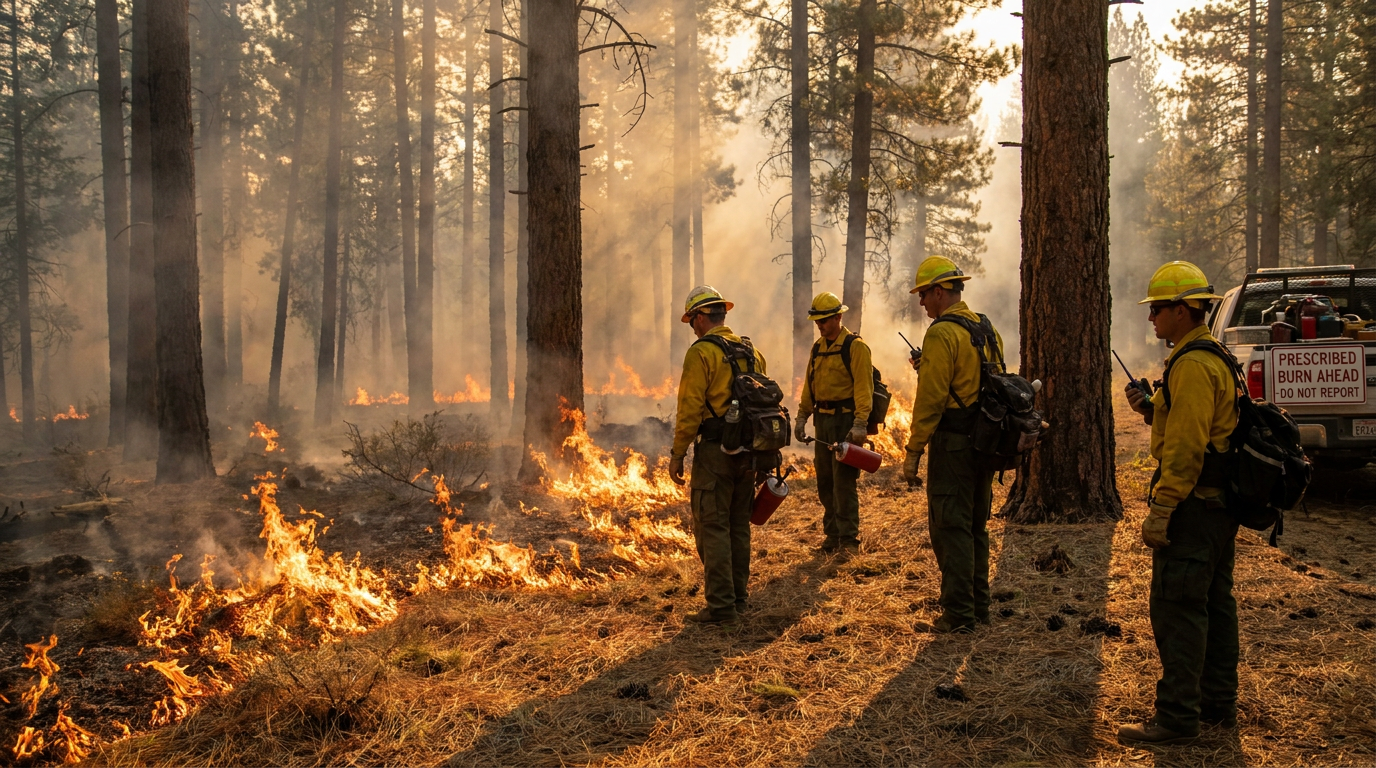
Land managers have long argued that the solution is "prescribed burning"—intentionally setting low-severity fires during favorable weather to clear out accumulated fuel before a catastrophic blaze can take hold.[3]
However, this strategy faces intense public resistance because prescribed burns generate their own smoke, forcing communities to endure immediate air pollution in exchange for theoretical future protection.[4]

Now, a landmark study published in the journal Science provides the first large-scale empirical evidence that this trade-off is overwhelmingly worth it.[1][6]
Researchers from Stanford University analyzed two decades of satellite data tracking fire severity and smoke particulate matter across California, creating a comprehensive model of how fire behavior influences air quality.[2]
They found that low-severity fires—acting as a proxy for prescribed burns—immediately reduce the risk of a subsequent severe wildfire in the exact same location by a staggering 92%.[2]
Crucially, this protective effect is not confined to the burn scar. The researchers documented a "spillover effect," where the risk of severe fire is significantly reduced in unburned areas up to 5 kilometers (about 3 miles) away.[2]

Crucially, this protective effect is not confined to the burn scar.
To understand the public health implications, the team modeled what would happen if California scaled up its prescribed burning to 500,000 acres of conifer forests annually.[1]
The simulation confirmed the public's immediate fear: treating that much land would initially increase smoke pollution by about 50% in the early years of the program.[2]
But the long-term math tells a radically different story. By year four, the reduction in catastrophic wildfires begins to outpace the smoke generated by the controlled burns.[4]
Over a ten-year period, this sustained campaign of prescribed burning would result in a 10% net reduction in cumulative smoke pollution across the state.[3]
During the most extreme wildfire years, when the air quality crisis is at its most lethal and widespread, the reduction in smoke severity would reach 20% to 25%.[2][3]

"We know that smoke is killing a lot of people. Any reduction in that is meaningful," noted Marshall Burke, a Stanford professor and co-author of the study.[3]
The researchers calculated that for every acre treated, the long-term air quality benefits outweigh the initial cost of the prescribed burn's smoke by a factor of 5 to 1 within a decade.[2]
The findings highlight a profound psychological and political challenge: the need for delayed gratification. Policymakers and the public must accept a visible, immediate nuisance to prevent a future catastrophe.[4]
The study's most dramatic results were observed in conifer forests, which make up roughly 60% of California's forestlands and have been the site of many recent, highly destructive megafires.[5]

The evidence is less clear for other ecosystems, such as chaparral and coastal shrublands, where fire dynamics differ significantly and the benefits of prescribed burning remain a subject of active ecological debate.[5]
Ultimately, the data suggests that while we cannot eliminate wildfire smoke entirely, we can choose how we experience it: as a controlled, predictable nuisance, or as a sudden, deadly crisis.[1]
How we got here
Pre-1900s
Indigenous communities regularly use cultural burning to manage forest health and reduce fuel loads.
20th Century
Federal and state policies mandate aggressive fire suppression, leading to a massive buildup of forest fuels.
2020
California experiences its worst wildfire season on record, blanketing the West Coast in toxic smoke.
June 11, 2026
Stanford researchers publish a landmark study in Science quantifying the long-term health benefits of prescribed burns.
Viewpoints in depth
Environmental Economists & Researchers
Argue that the long-term health benefits of reduced PM2.5 exposure far outweigh the short-term smoke generated by prescribed burns.
This camp relies on longitudinal data to demonstrate that aggressive fire suppression only delays inevitable emissions. By quantifying the "delayed gratification" of prescribed burns, they argue that accepting a 50% increase in short-term smoke is a necessary public health intervention to secure a 10% net reduction over a decade. They emphasize that controlled burns allow communities to prepare for smoke exposure, unlike the sudden, catastrophic plumes of megafires.
Public Health Advocates
Concerned about the immediate impacts of any smoke on vulnerable populations, highlighting the challenge of accepting short-term pollution.
While acknowledging the long-term mathematical benefits, public health officials point out that "short-term" smoke still triggers asthma attacks, cardiovascular events, and hospitalizations today. They argue that if land managers scale up prescribed burning to 500,000 acres annually, it must be paired with robust community support—such as subsidized HEPA filters, clean air shelters, and early warning systems—to protect those who cannot afford the immediate health costs of this ecological transition.
Land Managers & Fire Agencies
Emphasize the logistical, financial, and safety challenges of scaling up prescribed burns to the recommended levels.
Forestry officials agree with the science but face immense practical hurdles. Conducting prescribed burns requires a narrow "Goldilocks" window of weather conditions—not too windy, not too dry, but dry enough to burn. Furthermore, the liability risks of a controlled burn escaping its boundaries, combined with chronic underfunding and a shortage of trained personnel, make treating 500,000 acres annually a monumental logistical challenge that requires significant policy reform.
What we don't know
- How changing wind patterns driven by climate change might alter the trajectory and concentration of smoke from prescribed burns.
- The exact health trade-offs for vulnerable populations exposed to the initial four-year increase in smoke before the net benefits materialize.
- Whether the dramatic 92% reduction in severe fire risk observed in conifer forests applies equally to chaparral and coastal shrubland ecosystems.
Key terms
- Prescribed Burn
- A carefully planned and controlled fire set by land managers to reduce accumulated vegetation and prevent larger, uncontrolled wildfires.
- PM2.5
- Fine particulate matter in smoke that is 2.5 micrometers or smaller, which can penetrate deep into the lungs and enter the bloodstream, posing severe health risks.
- Low-Severity Fire
- A fire that burns close to the ground, consuming surface fuels like needles and small branches without killing the mature trees.
- Spillover Effect
- The phenomenon where treating one area with a prescribed burn reduces the risk of severe fire in adjacent, unburned areas up to 5 kilometers away.
Frequently asked
Don't prescribed burns just create more smoke?
They do create smoke initially, but the study shows they prevent much larger, more toxic smoke plumes from severe wildfires later, resulting in a net 10% reduction in pollution over a decade.
How long does it take to see the benefits?
The air quality benefits begin to outweigh the initial smoke costs in as little as four years, according to the Stanford modeling.
Does this work in all types of forests?
The most dramatic benefits were observed in conifer forests. The evidence is more mixed for other vegetation types like chaparral and shrublands.
Sources
Source coverage
6 outlets
3 viewpoints surfaced






[1]ScienceEnvironmental Economists & Researchers
The air pollution benefits of low-severity fire
Read on Science →[2]Stanford UniversityEnvironmental Economists & Researchers
A double fire paradox: Where low-severity fire reduces severe wildfire risk
Read on Stanford University →[3]KQEDPublic Health Advocates
New study shows how helpful prescribed burns can be in reducing smoke pollution
Read on KQED →[4]SFGATEPublic Health Advocates
Stanford study finds surprising upside of prescribed burns
Read on SFGATE →[5]The Washington PostLand Managers & Fire Agencies
Setting intentional forest fires can significantly lower the chances of extreme blazes
Read on The Washington Post →[6]NatureEnvironmental Economists & Researchers
Fiery data hint that controlled forest fires benefit human health
Read on Nature →

Every angle. Every day.
Get science stories with full source coverage and perspective breakdowns delivered to your inbox.