
The Best E-Bikes of 2026: Commuter, Cargo, and Folding Models Compared
As electric bikes transition from recreational novelties to genuine car replacements, choosing the right model requires matching motor architecture and frame geometry to your daily life.
By Factlen Editorial Team
- Commuter Advocates
- Prioritize mid-drive efficiency and long range for daily car replacement.
- Utility Haulers
- Focus on payload capacity, torque, and passenger safety over speed.
- Portability Seekers
- Value lightweight folding frames and easy storage for multi-modal transit.
What's not represented
- · Traditional Acoustic Cyclists
- · Pedestrian Safety Advocates
Why this matters
Choosing the wrong electric bike can lead to a costly mistake that gathers dust in the garage. By understanding the specific trade-offs of commuter, cargo, and folding models, riders can invest in a vehicle that genuinely replaces car trips, saves money, and improves daily health.
Key points
- The 2026 e-bike market is highly segmented into commuter, cargo, and folding models, each with distinct engineering trade-offs.
- Mid-drive motors offer superior hill-climbing efficiency but accelerate drivetrain wear, while hub motors provide budget-friendly utility.
- Cargo e-bikes can haul up to 450 pounds, serving as genuine car replacements for families and professionals.
- Folding e-bikes solve the last-mile transit problem but compromise on ride comfort and battery range due to their compact size.
- Buyers should build a 30 to 40 percent buffer into advertised battery ranges to account for real-world conditions and long-term degradation.
The electric bicycle market in 2026 has officially transitioned from a recreational novelty to a primary mode of transportation. As cities expand their cycling infrastructure and battery technology matures, buyers are no longer simply asking whether to buy an e-bike, but rather which specific architecture aligns with their daily lives. The landscape is now heavily segmented into specialized categories, forcing consumers to navigate a maze of torque ratings, battery capacities, and frame geometries. Making the right choice requires looking past peak wattage claims and conducting a rigorous trade-off analysis of how a bike will actually be used.[1][5][7]
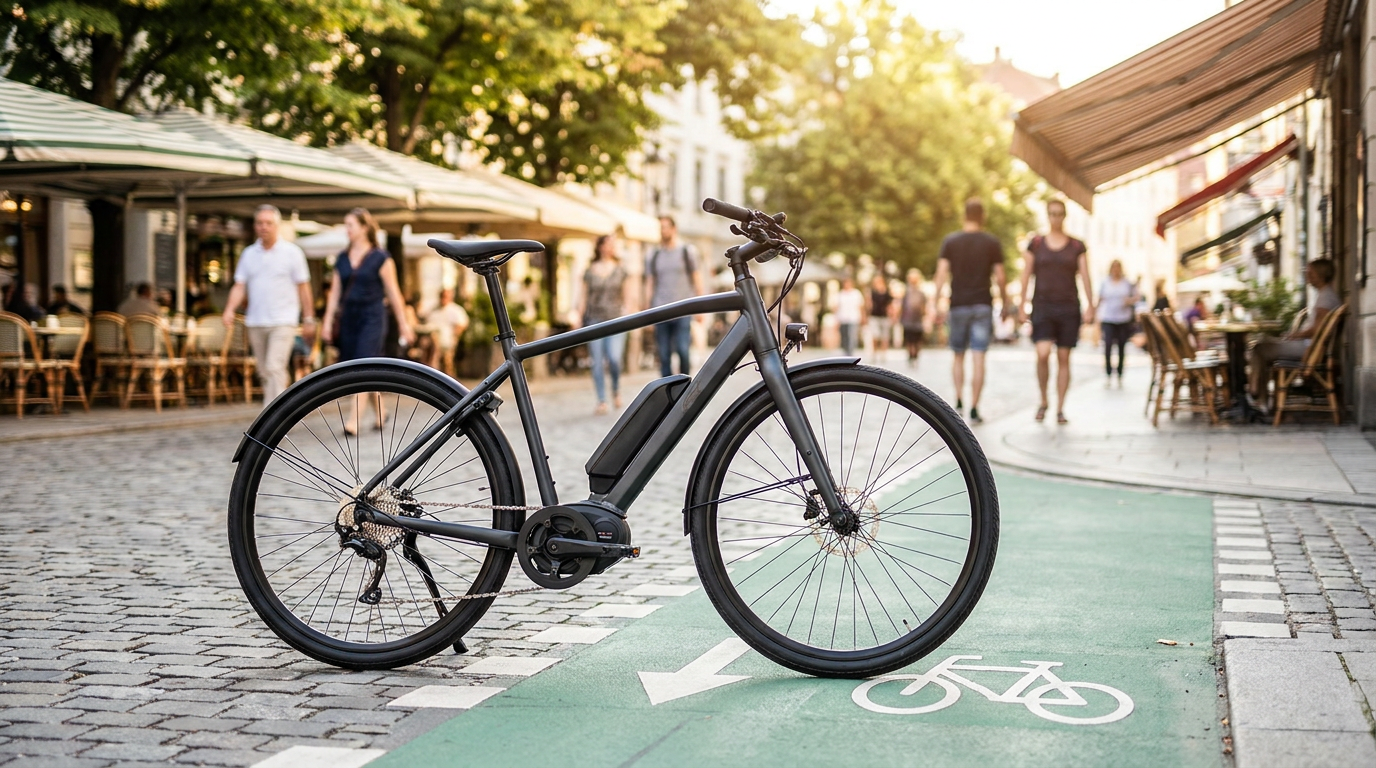
Before evaluating specific categories, buyers must understand the core mechanical divide: motor placement. Mid-drive motors, positioned at the pedals, leverage the bicycle's mechanical gears to climb hills efficiently and provide a natural, intuitive pedal stroke. Conversely, hub motors sit inside the wheel hub, offering a simpler, often throttle-enabled push that feels more like a scooter. While mid-drives dominate the premium market, hub motors remain the champion of budget-friendly utility. This foundational engineering choice dictates the price, maintenance schedule, and ride feel of every model on the market.[2][3][7][8]
When evaluating full-size commuter models like the Specialized Turbo Vado 5.0 or the Aventon Level 3, the argument for adoption centers on seamless integration into urban life. The case for these bikes highlights their balanced geometry, which blends the agility of a traditional bicycle with the sustained power needed to conquer a ten-mile commute without breaking a sweat. Equipped with high-capacity batteries often exceeding 700 watt-hours, these models prioritize range and ride comfort, featuring front suspension and integrated lighting systems.[1][3][4][5]

However, the argument against premium commuter e-bikes focuses on their steep entry price and the hidden costs of drivetrain maintenance. The evidence from long-term testing reveals that powerful mid-drive motors, which can output up to 85 Newton-meters of torque, place immense stress on standard bicycle chains and cassettes. Mechanics note that riders who frequently use maximum assist on steep hills may need to replace their drivetrain components every 1,000 miles, adding a recurring maintenance expense that hub-motor riders largely avoid.[3][7][8]
Ultimately, a dedicated commuter e-bike fits well when a rider faces a daily round-trip of ten to twenty miles, encounters rolling hills, and has access to secure, ground-level parking at both ends of their journey. It provides the most natural cycling experience and the highest efficiency for sustained speeds. Conversely, this category does not fit when the rider needs to haul heavy equipment, transport multiple children, or carry the bicycle up several flights of stairs to an apartment.[3][6][7][8]
For those who need to move serious weight, the cargo e-bike category has become the ultimate two-wheeled minivan. Models like the Tern GSD S10 and the Lectric XPedition 2.0 are engineered specifically for utility. The case for cargo bikes rests on their massive payload capacities, which can reach up to 450 pounds, allowing riders to carry two children on a reinforced rear rack alongside a week's worth of groceries. With specialized cargo-line motors delivering immense low-end torque, these bikes make starting from a dead stop with a heavy load feel effortless.[2][3]

For those who need to move serious weight, the cargo e-bike category has become the ultimate two-wheeled minivan.
The argument against cargo e-bikes centers on their sheer physical mass and unwieldy handling when riding empty. The evidence shows that a long-tail cargo bike, which can weigh upwards of 75 pounds and measure over six feet in length, is notoriously difficult to maneuver in tight urban spaces. Furthermore, their extended wheelbases and heavy-duty frames mean they cannot be transported on standard car racks or taken on public transit, effectively tethering the rider to their immediate geographic radius.[1][2][6][8]
A heavy-duty cargo e-bike fits well when a family is actively looking to replace a second car, needing a reliable vehicle for school drop-offs, hardware store runs, and neighborhood errands. The financial savings in gasoline and parking quickly offset the initial purchase price. However, a cargo model does not fit when the rider lives in a walk-up building, lacks a secure garage, or primarily rides for recreational fitness on narrow, winding trails where agility is paramount.[1][3][6][8]
Addressing the realities of urban storage and multi-modal transit, folding and compact e-bikes have carved out a vital segment of the 2026 market. The case for models like the Brompton Electric and the Ride1Up Portola highlights their unparalleled portability. By utilizing 16-inch or 20-inch wheels and collapsible frames, these bikes solve the 'last mile' transit problem. Riders can easily fold the bike in under thirty seconds, carry it onto a crowded commuter train, and store it discreetly under an office desk, completely eliminating the risk of outdoor theft.[4][5][6]

The argument against compact folding e-bikes focuses on their compromised ride quality and limited range. The evidence from road testing indicates that smaller wheels transmit significantly more vibration from potholes and rough pavement, leading to rider fatigue on longer journeys. Additionally, to keep the overall weight manageable—often targeting under 40 pounds—manufacturers must equip these bikes with smaller batteries, typically in the 250-watt-hour range, which severely limits their effective radius before requiring a recharge.[4][5][6]
A folding e-bike fits well when a commuter needs to combine cycling with public transportation, or when secure storage is strictly limited to a studio apartment closet or a workplace cubicle. It is the ultimate tool for short, flat urban hops. It does not fit when the daily route involves steep, sustained climbs, heavily potholed roads, or round trips exceeding fifteen miles, where the small wheels and limited battery capacity become significant liabilities.[4][5][6][7]
Regardless of the chosen category, buyers in 2026 must approach battery specifications with a critical eye. Industry experts warn against relying solely on advertised maximum ranges, which are typically calculated using a lightweight rider on perfectly flat ground with the lowest level of motor assist. The evidence suggests that real-world conditions—including headwinds, steep gradients, cargo weight, and the natural degradation of lithium-ion cells over a five-year lifespan—can reduce the actual range by up to forty percent.[7][8]

To mitigate range anxiety, riders are advised to build a substantial buffer into their daily mileage calculations. If a daily commute requires twenty miles of travel, purchasing a bike with a verified forty-mile range ensures that the battery will not be deeply discharged on every trip, which significantly extends the overall lifespan of the cells. Proper battery care, including avoiding extreme temperatures and charging to eighty percent when possible, remains the most effective way to protect the investment.[7][8]
Ultimately, the best electric bike of 2026 is not the model boasting the highest peak wattage or the most aggressive styling, but the one whose specific engineering trade-offs perfectly align with the rider's actual behavior. By honestly assessing their local terrain, storage limitations, and payload requirements, consumers can navigate the crowded market with confidence. When the motor type, frame geometry, and battery capacity match the reality of the daily route, an electric bike ceases to be a mere gadget and becomes an indispensable, joy-inducing part of daily life.[5][7][8]
How we got here
Early 2010s
Heavy, low-range hub motors dominate the early consumer e-bike market.
2018
Bosch and Shimano introduce refined mid-drive motors, dramatically improving the natural feel of pedal assist.
2021
The pandemic-driven outdoor boom accelerates e-bike adoption, pushing brands to diversify into cargo and folding categories.
2024
UL certification becomes a standard requirement in many regions to ensure lithium-ion battery safety.
2026
The market matures with highly specialized models, shifting consumer focus from peak speed to tailored geometry and torque.
Viewpoints in depth
Commuter Advocates
Prioritize mid-drive efficiency and range for daily car replacement.
This camp argues that the ideal e-bike should mimic the feel of a traditional bicycle while erasing the sweat factor of a ten-mile commute. They point to mid-drive motors that leverage the bike's gearing, providing a natural pedal stroke and superior hill-climbing efficiency. For these riders, investing in a premium commuter with a 700+ watt-hour battery is justified by the long-term savings in gas, parking fees, and vehicle maintenance.
Utility Haulers
Focus on payload capacity, torque, and passenger safety over speed.
Utility riders view the e-bike not as a bicycle, but as a two-wheeled minivan. They advocate for long-tail cargo frames and heavy-duty hub or cargo-line motors capable of moving 400 pounds of rider, children, and groceries. This perspective accepts the trade-off of a heavier, less agile bike in exchange for the sheer utility of leaving the car at home for school drop-offs and hardware store runs.
Portability Seekers
Value lightweight folding frames and easy storage for multi-modal transit.
For apartment dwellers and multi-modal commuters, a bike's footprint is its most critical specification. This camp champions folding models that can be carried onto a train or tucked under an office desk. They argue that a massive cargo bike is useless if it gets stolen from a city sidewalk, making the compromises in battery size and wheel diameter entirely worth the security of indoor storage.
What we don't know
- How upcoming changes to local e-bike speed classifications and trail access laws might impact the usability of high-powered commuter models.
- Whether solid-state battery technology will reach the consumer e-bike market soon enough to render current lithium-ion capacities obsolete.
- The long-term resale value of highly specialized cargo e-bikes as motor technology continues to evolve rapidly.
Key terms
- Mid-Drive Motor
- An electric motor positioned at the bike's bottom bracket (pedals) that powers the chain directly, offering efficient hill climbing.
- Hub Motor
- An electric motor housed in the center of the front or rear wheel, providing direct propulsion independent of the bike's gears.
- Torque
- Measured in Newton-meters (Nm), this is the rotational force that determines how quickly the bike accelerates and how easily it climbs steep hills.
- Watt-Hour (Wh)
- A measurement of battery capacity that indicates how much energy the battery stores, directly impacting the bike's maximum range.
- Pedal Assist
- A system where the electric motor only provides power while the rider is actively pedaling, as opposed to a throttle which works without pedaling.
Frequently asked
What is the difference between a hub motor and a mid-drive motor?
A hub motor sits inside the wheel and pushes the bike forward, often feeling like a scooter. A mid-drive motor sits at the pedals and works through the bike's gears, providing a more natural riding feel and better hill-climbing efficiency.
How long do e-bike batteries actually last?
Most lithium-ion e-bike batteries are rated for 500 to 1,000 charge cycles before their capacity drops noticeably. For the average rider, this translates to three to five years of reliable use before needing a replacement.
Can I ride an electric bike in the rain?
Yes, modern e-bikes are built with water-resistant components and sealed connections. However, they should not be fully submerged, and it is best to store them indoors to prevent long-term electronic wear.
Do I need a license to ride an electric bike?
In most regions, class 1 and class 2 e-bikes (which assist up to 20 mph) do not require a license or registration. Class 3 e-bikes (up to 28 mph) may have age or helmet restrictions depending on local laws.
Sources
Source coverage
8 outlets
3 viewpoints surfaced







[1]GearJunkieCommuter Advocates
The Best Electric Bikes of 2026
Read on GearJunkie →[2]Electric Bike ReportUtility Haulers
2025's Best Electric Bikes Revealed: See Our Top Picks!
Read on Electric Bike Report →[3]UpwayUtility Haulers
Best e-Bikes for hills to compare in 2026
Read on Upway →[4]OutdoorGearLabPortability Seekers
Best Electric Bikes of 2026
Read on OutdoorGearLab →[5]BicyclingCommuter Advocates
The Best E-Bikes for Every Rider
Read on Bicycling →[6]Cycling WeeklyPortability Seekers
Our experts top-rated & best electric bikes 2026
Read on Cycling Weekly →[7]EveloPortability Seekers
A complete 2026 electric bike buyer's guide
Read on Evelo →[8]Lyric CyclesPortability Seekers
Find your perfect eBike: Comprehensive Guide
Read on Lyric Cycles →



Every angle. Every day.
Get guides stories with full source coverage and perspective breakdowns delivered to your inbox.