
How Packrafting is Rewriting the Rules of Backcountry Exploration
By combining ultralight inflatable boats with traditional backpacking, a rapidly growing outdoor discipline is turning impassable rivers and lakes into new trails.
By Factlen Editorial Team
- Amphibious Adventurers
- Hikers, bikepackers, and explorers who view packrafts primarily as a utilitarian tool to link trails, cross obstacles, and access remote wilderness.
- Whitewater Enthusiasts
- Paddlers focused on running technical rapids and pushing the limits of what small, inflatable boats can handle in fast-moving water.
- Backcountry Conservationists
- Advocates who emphasize Leave No Trace principles and worry that the sudden accessibility of remote waterways could lead to overcrowding and ecological damage.
What's not represented
- · Traditional hardshell kayakers
- · Local search and rescue teams
Why this matters
Packrafting fundamentally changes how humans interact with wilderness maps. By removing the boundary between land and water travel, it empowers everyday hikers to access remote ecosystems, complete multi-day traverses, and experience nature without relying on heavy vehicles or crowded trailheads.
Key points
- Packrafts are ultralight, durable inflatable boats designed to be carried in a backpack.
- They allow hikers and cyclists to transition seamlessly between land and water travel.
- Modern innovations like the Cargo Fly allow gear to be stored inside the boat's air tubes.
- The sport has seen a 300% growth in sales since 2017, moving from a niche Alaskan tool to mainstream recreation.
- Despite their stability, packrafting requires proper safety gear, including PFDs and swiftwater training.
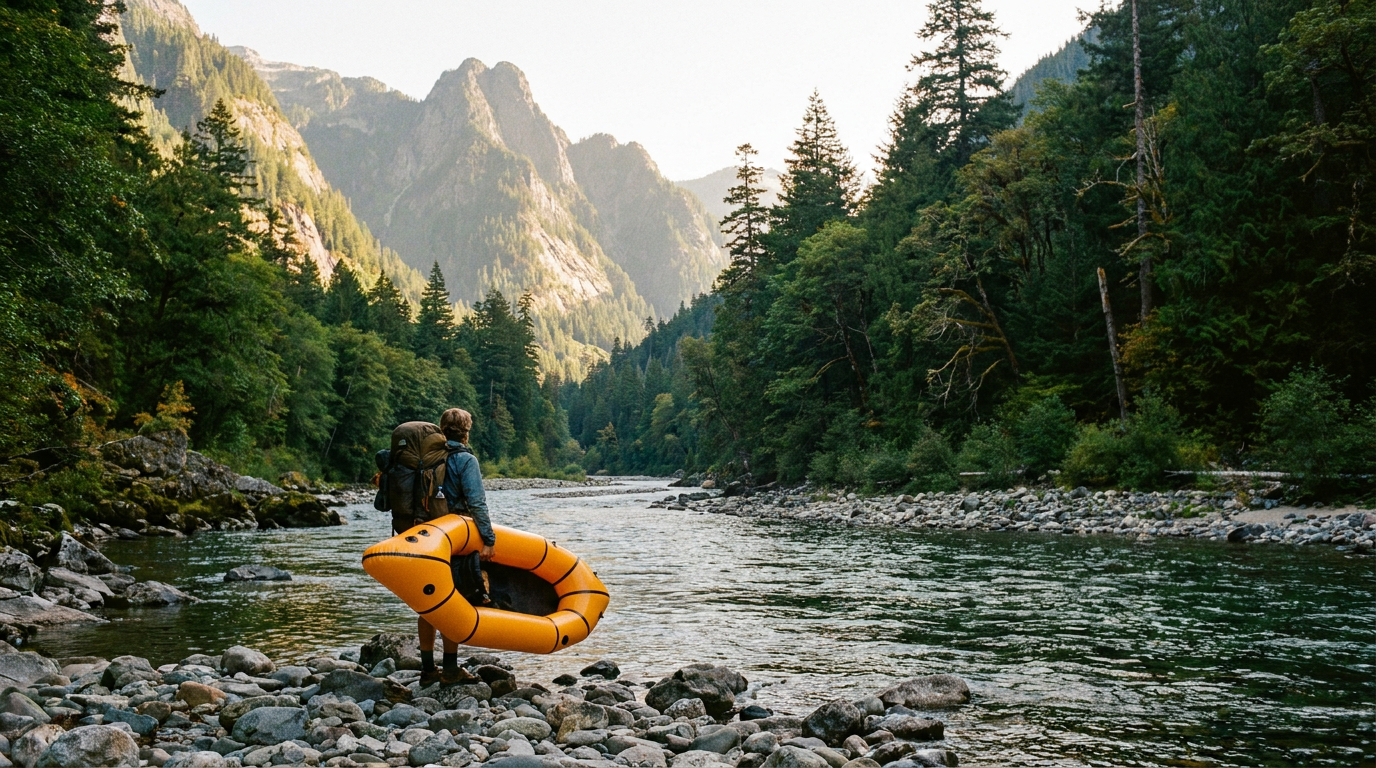
For generations of hikers, a river running across a topographic map represented a hard boundary. Unless there was a bridge or a shallow ford, a deep waterway meant the end of the trail. Today, a rapidly growing segment of the outdoor community looks at that same blue line and sees a highway. The catalyst for this shift is the packraft: an ultralight, highly durable inflatable boat that rolls up to the size of a sleeping bag.[1][7]
Packrafting is exactly what its portmanteau suggests—a hybrid of backpacking and rafting. Unlike traditional inflatable kayaks, which are often bulky and weigh upwards of 30 pounds, a modern packraft weighs between three and fifteen pounds. It is specifically engineered to be carried deep into the backcountry on foot or by bicycle, inflated at the water's edge, and paddled across lakes, down rivers, or along coastal waterways.[1][5]
The discipline has transitioned from a niche survival tactic to a mainstream adventure sport. Industry data shows a 300% increase in the sales of lightweight thermoplastic polyurethane (TPU) rafts since 2017. What was once the exclusive domain of Alaskan bushwhackers and hardcore expedition racers is now accessible to weekend backpackers looking to link trails or avoid long, grueling return hikes by simply floating back to their cars.[2][6]
The modern packrafting era traces its roots to the early 2000s in Alaska. Sheri Tingey, an outdoor gear designer, built a custom boat for her son Thor, who needed a craft light enough to carry across the tundra but buoyant and stable enough to survive glacial rivers. The resulting design launched Alpacka Raft, a company that set the gold standard for the industry. Today, dozens of manufacturers produce packrafts, driving rapid innovation in hull shapes, materials, and safety features.[2][4]

The mechanical genius of the packraft lies in how it solves the weight problem. Carrying a mechanical air pump into the wilderness defeats the purpose of an ultralight setup. Instead, packrafters use an "inflation bag"—a lightweight nylon sack with a nozzle at the bottom. The paddler scoops ambient air into the bag, seals the top, and rolls it down, forcing the trapped air into the raft's valve. This simple, pump-free mechanism can inflate a boat in under three minutes.[1][5]
Another transformative innovation is the internal cargo system, often referred to as a "Cargo Fly." Because a packraft is small, strapping a heavy 50-liter backpack to the bow can make the boat top-heavy and difficult to steer. The Cargo Fly solves this by installing an airtight, waterproof zipper directly into the raft's main inflatable tube. Paddlers slide their gear inside the hull before inflating the boat. This lowers the center of gravity, dramatically improves stability, and ensures equipment stays bone-dry even if the boat flips.[4][7]

As the sport has matured, the gear has specialized into two distinct categories: self-bailing and skirted. A self-bailing packraft features an inflatable floor with drainage holes around the edges. When crashing through whitewater, the boat sheds water as fast as it takes it in, making it ideal for splashy, high-volume rivers where the paddler expects to get wet. The tradeoff is that the paddler's lower body is constantly exposed to the water.[3][7]
As the sport has matured, the gear has specialized into two distinct categories: self-bailing and skirted.
Conversely, a skirted (or decked) packraft functions more like a traditional whitewater kayak. It features a sealed cover over the cockpit and a wearable spray skirt that locks the paddler in. This design keeps the interior entirely dry, making it the preferred choice for freezing glacial rivers, technical whitewater, and cold-weather expeditions. Advanced paddlers can even perform an "Eskimo roll" in a skirted packraft to recover from a capsize without swimming.[7]
The 2026 season has seen manufacturers push the boundaries of where these boats can go. While the last decade focused heavily on whitewater capability, companies are now expanding into specialized flatwater designs. Alpacka Raft's new Aleutian model, for instance, features an elongated, baffled hull and a removable skeg, allowing it to track straight and fast like a sea kayak for coastal ocean explorations. Meanwhile, brands like NRS have refined their whitewater models, such as the Neutron, with lighter denier tubes for maximum packability.[3][4]
One of the most visually striking sub-disciplines to emerge is "bikerafting." Adventurers strap the frame and wheels of a mountain bike horizontally across the bow of the packraft. This allows them to pedal up remote logging roads or singletrack trails, transition to the water to bypass impassable terrain, and then reassemble the bike on the opposite shore. It represents the ultimate form of multi-modal, human-powered travel.[1][3]

Despite the accessibility of the boats, the water itself remains unforgiving. Packrafts are inherently stable due to their wide, flat bottoms and oversized tubes, which can give beginners a false sense of security. However, moving water is powerful, and cold water is deadly. Experts universally stress that a packraft does not replace the need for swiftwater safety skills.[1][8]
A responsible packrafting kit extends far beyond the boat. A four-piece breakdown paddle, a Coast Guard-approved personal flotation device (PFD), and a specialized repair kit are mandatory. For anything beyond a placid summer lake, a whitewater helmet and a drysuit are critical to survive a swim in frigid backcountry rivers. The ease of carrying the boat must be matched by the discipline to carry the necessary safety gear.[1][5]
The cost of entry also remains a significant hurdle. While cheap pool toys masquerade as packrafts online, a genuine, expedition-grade TPU packraft capable of surviving rocky riverbeds costs between $800 and $2,500. When factoring in a carbon-fiber breakdown paddle, a drysuit, and safety equipment, a complete kit represents a major financial investment, often rivaling the cost of a high-end mountain bike.[2][8]

The explosion in popularity has also sparked conversations about backcountry conservation. Packrafts allow humans to easily access pristine, previously untouched riparian zones and narrow canyons. This increased traffic brings the risk of trampled shorelines, disturbed wildlife, and litter. The packrafting community has responded by heavily promoting Leave No Trace principles and emphasizing that the privilege of access comes with the responsibility of stewardship.[6][8]
Ultimately, packrafting is more than just a new way to paddle; it is a paradigm shift in how we view the map. It turns dead ends into thoroughfares and obstacles into highlights. For those willing to invest in the gear and the skills, a five-pound boat in the bottom of a backpack holds the keys to an entirely new world of wilderness exploration.[7][8]
How we got here
1980s–1990s
Early pioneers in Alaska begin using small, rudimentary rafts to cross remote rivers and access bush terrain.
Early 2000s
Sheri and Thor Tingey found Alpacka Raft, introducing the first highly durable, performance-oriented packrafts.
2012
The American Packrafting Association is formed to organize the growing community and advocate for river access.
2017–2026
The industry experiences a 300% surge in sales as the sport hits the mainstream outdoor recreation market.
2026
Manufacturers expand beyond whitewater, releasing specialized flatwater models designed for coastal and long-distance lake expeditions.
Viewpoints in depth
Amphibious Adventurers
Explorers who value packrafts as a tool to unlock new routes and link trails.
For the backpacking and bikepacking communities, the packraft is viewed primarily as a utilitarian key to the wilderness. These adventurers are less interested in the adrenaline of running Class IV rapids and more focused on the freedom of amphibious travel. By carrying a boat, they can turn a linear out-and-back hike into a dynamic loop, using the river as a fast, effortless trail back to civilization. Their focus is on minimizing weight and maximizing the efficiency of transitions between land and water.
Whitewater Enthusiasts
Paddlers focused on the technical performance of packrafts in fast, challenging rivers.
This camp views the packraft not just as a ferry, but as a highly capable whitewater vessel. Drawn by the boat's extreme buoyancy and forgiving stability, these paddlers run steep creeks and high-volume rivers that were previously the exclusive domain of hardshell kayaks. They advocate for skirted designs, thigh straps, and rigorous swiftwater rescue training, pushing the engineering limits of what a five-pound inflatable boat can survive.
Backcountry Conservationists
Advocates concerned with the ecological impact of increased human access to remote waterways.
While celebrating the empowerment of human-powered travel, conservationists warn that packrafts are opening up highly sensitive, previously unreachable riparian ecosystems to mass recreation. They point out that narrow canyons and pristine shorelines are now seeing unprecedented foot traffic, leading to erosion and wildlife disruption. This camp strongly advocates for strict adherence to Leave No Trace principles, proper human waste disposal, and the decontamination of boats to prevent the spread of invasive species like Quagga mussels.
What we don't know
- How public land managers will adapt permitting and access rules as packrafting traffic increases in remote wilderness areas.
- Whether the high cost of entry will eventually drop as more mainstream outdoor brands enter the manufacturing space.
Key terms
- TPU (Thermoplastic Polyurethane)
- A highly durable, flexible, and abrasion-resistant synthetic material used to construct modern packrafts.
- Self-Bailing
- A boat design featuring an inflatable floor with drainage holes, allowing water that splashes into the boat to immediately flow back out.
- Skirted (Decked)
- A boat design featuring a sealed top cover and a wearable spray skirt that locks the paddler in, keeping the interior completely dry.
- Bikerafting
- The practice of strapping a disassembled mountain bike to the bow of a packraft to combine cycling and paddling in a single trip.
- Thwart
- The main inflatable tubes that make up the outer structure and buoyancy of the raft.
Frequently asked
What is the difference between a packraft and an inflatable kayak?
Packrafts are significantly lighter (3-15 lbs) and pack down to the size of a sleeping bag, making them easy to carry in a backpack. Inflatable kayaks are generally heavier, bulkier, and designed primarily for transport in a vehicle.
How do you inflate a packraft without a pump?
Packrafters use a lightweight nylon 'inflation bag.' They scoop ambient air into the bag, seal the top, and roll it down to force the trapped air through a valve into the raft.
Can packrafts handle whitewater rapids?
Yes. While basic models are meant for flatwater, whitewater-specific packrafts feature reinforced materials, self-bailing floors or spray skirts, and thigh straps to give the paddler control in rough rapids.
What is a Cargo Fly?
A Cargo Fly is an airtight, waterproof zipper installed on the raft's main tube. It allows paddlers to store their heavy gear inside the hull of the boat, which keeps the equipment dry and lowers the boat's center of gravity.
Sources
Source coverage
8 outlets
3 viewpoints surfaced








[1]REI Co-opAmphibious Adventurers
What is Packrafting?
Read on REI Co-op →[2]Men's Journal
Packrafting 101: Everything You Need to Know
Read on Men's Journal →[3]NRSWhitewater Enthusiasts
Newly updated packrafts launching this season
Read on NRS →[4]Alpacka Raft
Alpacka Raft Introduces 2026 Collection
Read on Alpacka Raft →[5]Much Better AdventuresAmphibious Adventurers
What is Packrafting? A Beginner's Guide
Read on Much Better Adventures →[6]Wi-Fi TalentsBackcountry Conservationists
Rafting Industry Statistics and Trends
Read on Wi-Fi Talents →[7]Colorado Whitewater CollectiveWhitewater Enthusiasts
What is packrafting? The ultimate guide
Read on Colorado Whitewater Collective →[8]Factlen Editorial TeamBackcountry Conservationists
Synthesis by Factlen editorial team
Read on Factlen Editorial Team →
Every angle. Every day.
Get travel stories with full source coverage and perspective breakdowns delivered to your inbox.