
The Mechanics of the Mega-Merger: How Intesa Sanpaolo’s $35 Billion Bid for Monte dei Paschi Rewrites European Banking
Italy's largest lender has launched a historic takeover of the world's oldest bank, utilizing a complex branch spin-off to navigate antitrust laws while capturing billions in wealth management assets.
By Factlen Editorial Team
- Consolidation Advocates
- Argue that Europe needs massive banking champions to compete globally.
- Antitrust Regulators
- Focused on ensuring domestic competition isn't stifled by a single mega-bank.
- Retail & Institutional Investors
- Evaluating the financial mechanics and integration risks of the $35 billion premium.
What's not represented
- · MPS Employees
- · Small Business Borrowers
Why this matters
This $35 billion transaction creates a European banking superpower capable of funding massive technological and industrial projects. For investors, it highlights how legacy banks are pivoting aggressively toward high-margin wealth management to survive in the modern economy.
Key points
- Intesa Sanpaolo has launched a €30.66 billion ($35 billion) takeover bid for rival Italian lender Monte dei Paschi di Siena.
- The deal offers a 12.5% premium to shareholders and would create the eurozone's second-largest bank by market value.
- To satisfy antitrust regulators, Intesa has pre-arranged the sale of 635 overlapping branches to insurer Unipol.
- The acquisition is primarily driven by Intesa's desire to absorb MPS's highly lucrative wealth management and investment advisory assets.
The landscape of European finance shifted dramatically this week as Intesa Sanpaolo launched a €30.66 billion ($35 billion) takeover bid for Banca Monte dei Paschi di Siena (MPS). The unsolicited offer aims to unite Italy’s largest retail lender with the world’s oldest operating bank, creating a financial behemoth with roughly €1.7 trillion in combined assets. If approved by regulators and shareholders, the transaction will forge the eurozone’s second-largest banking group by market value, trailing only Spain’s Banco Santander. The sheer scale of the proposal has immediately redefined the ceiling for domestic consolidation within the European Union.[1][2][5]
The timing of the bid was a masterclass in aggressive corporate strategy. Just twenty-four hours before Intesa’s announcement, Italy’s Banco BPM had publicly proposed a merger of equals with MPS. Intesa’s swift intervention effectively sidelined BPM, utilizing its massive balance sheet to offer a premium that a smaller rival could not match. Under Italian takeover regulations, Intesa’s formal public offer legally prevents MPS management from continuing negotiations with BPM without explicit shareholder approval, effectively freezing the competing bid in its tracks.[1][2][5]
The financial mechanics of the offer are structured to reward MPS shareholders while preserving Intesa’s cash reserves. Intesa is offering 1.6 newly issued ordinary shares alongside €1 in cash for every MPS share tendered. Based on market prices prior to the announcement, this formula values the target at €10.09 per share, representing a 12.5% premium over MPS’s official closing price. Investors immediately welcomed the prospect of a bidding war, sending MPS shares surging 13% in Milan trading as markets digested the implications of the mega-deal.[1][2]

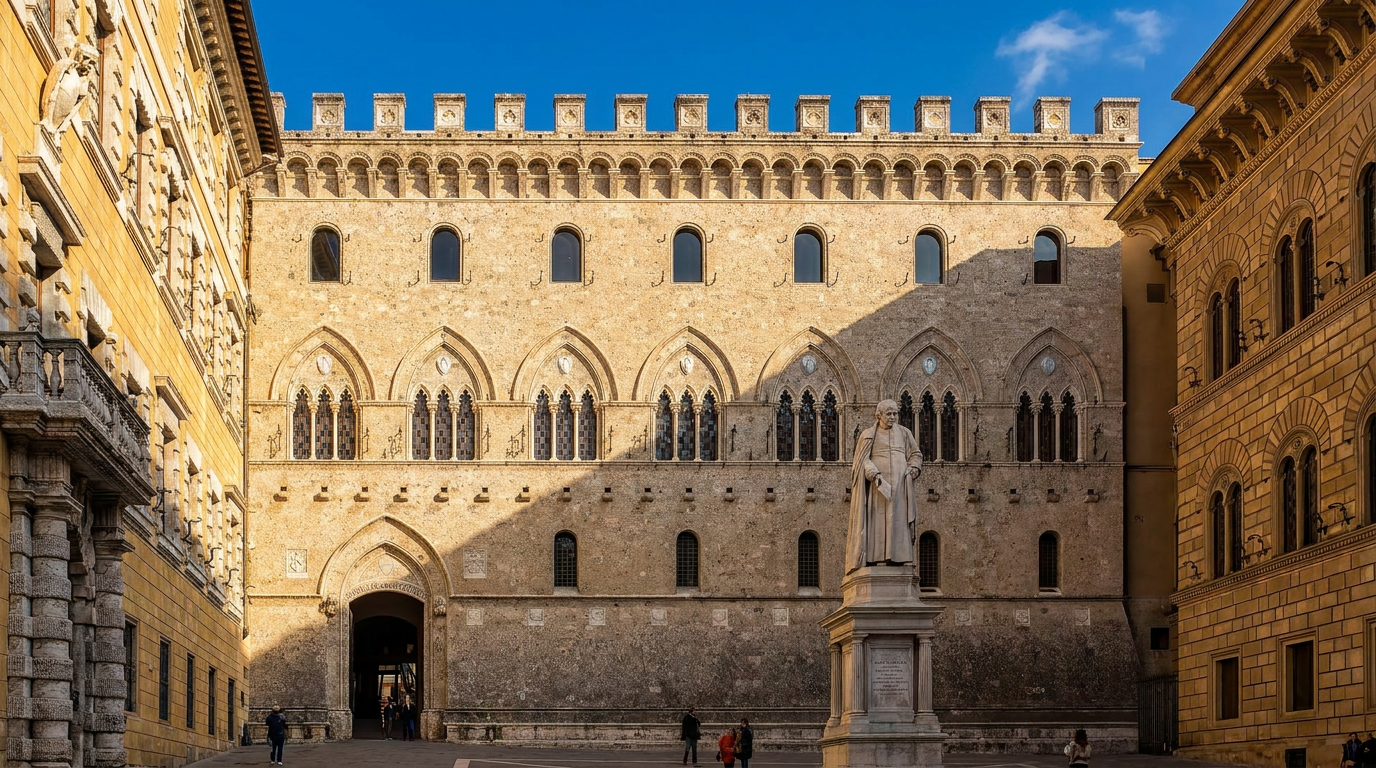
To understand the significance of this acquisition, one must look at the remarkable turnaround of Monte dei Paschi itself. Founded in 1472, the Siena-based institution spent the last decade as the poster child for Europe’s sovereign debt and non-performing loan crises. The Italian government was forced to bail out the bank in 2017 to prevent a systemic collapse. Following years of painful restructuring, aggressive cost-cutting, and a successful reprivatization in 2023, MPS transformed from a state-rescued liability into the most coveted asset in Italian finance.[2][5]
However, merging the first and third-largest banks in a single country presents an immediate and severe antitrust dilemma. To preempt regulatory roadblocks from the Banca d'Italia and European competition watchdogs, Intesa engineered a complex structural scaffolding before even announcing the bid. The bank struck a parallel agreement with Italian insurance giant Unipol to divest a massive chunk of the newly acquired retail footprint.[1][4][5]
Under this pre-arranged spin-off, Unipol will purchase approximately 635 MPS branches across Italy, along with associated central operations, for between €3 billion and €3.5 billion. This carve-out ensures that retail banking customers in heavily concentrated regions like Tuscany and Lombardy retain access to competing financial institutions. By proactively dismantling the overlapping retail networks, Intesa aims to neutralize monopoly concerns before regulators have the opportunity to object.[1][4][5]

While the retail footprint commands public attention, the true strategic prize lies in wealth management and corporate advisory. Last year, MPS executed its own ambitious expansion by acquiring Mediobanca, a powerhouse in Italian investment banking. Intesa’s leadership explicitly stated that they intend to retain the Mediobanca assets, its brand, and its highly lucrative asset management portfolio.[1][5]
While the retail footprint commands public attention, the true strategic prize lies in wealth management and corporate advisory.
This wealth management division is the engine of the entire transaction. The assets Intesa plans to keep generated roughly 80% of the combined net profit for MPS and Mediobanca last year. Furthermore, acquiring Mediobanca grants Intesa a highly strategic 13% stake in Generali, Italy’s premier insurance conglomerate. By absorbing these high-margin advisory and insurance assets, Intesa accelerates its pivot away from traditional, capital-intensive lending toward fee-based wealth management for high-net-worth clients.[1][2][5]
The broader macroeconomic environment heavily favors this type of aggressive consolidation. For years, the European Central Bank has urged the continent’s fragmented financial sector to scale up. European policymakers argue that the region requires massive, well-capitalized banking champions capable of competing with Wall Street giants and absorbing macroeconomic shocks. Intesa’s move aligns perfectly with this regulatory desire for scale, creating an institution with the balance sheet necessary to fund pan-European industrial and technological projects.[3][5]

Scale is particularly critical in the modern era of digital banking and artificial intelligence. The technological infrastructure required to run a global financial institution—from real-time fraud detection to algorithmic trading and personalized AI advisory—demands billions of euros in annual capital expenditure. Mid-sized banks increasingly struggle to fund these IT budgets, making consolidation the most viable path to technological parity. A €1.7 trillion balance sheet allows Intesa to amortize these massive software and infrastructure investments across 27 million clients.[2][3][5]
Despite the strategic elegance of the proposal, executing a merger of this magnitude carries profound operational risks. Intesa anticipates booking €2.1 billion in pretax integration charges to harmonize the two institutions. Merging legacy IT systems, aligning corporate cultures, and managing the overlap in central infrastructure will require years of meticulous execution. The bank has already signaled that the consolidation will involve approximately 6,800 voluntary employee exits to streamline operations.[1][4]
If the integration is successful, the financial payoff will be immense. Intesa projects that the combined entity will generate €1.4 billion in revenue synergies and €1.5 billion in annual cost savings by 2029. These efficiencies are expected to significantly boost the bank’s return on tangible equity, providing a massive dividend pipeline for shareholders and cementing Intesa’s position as a dominant force in European finance.[1][5]

The immediate question facing the market is whether a counter-bid will materialize. While Intesa’s sheer size makes it a formidable acquirer, the European banking sector is flush with capital. Analysts are closely watching UniCredit, Italy’s second-largest bank, which has recently been occupied with a hostile takeover attempt of Germany’s Commerzbank. If UniCredit decides that defending its domestic market share is more critical than its German expansion, a historic bidding war could erupt.[1][3][5]
For now, the transaction remains targeted for completion by December 2026, pending a gauntlet of shareholder votes and regulatory approvals. The Italian government, which still holds a minority stake in MPS from the 2017 bailout, has publicly supported sector consolidation but has yet to formally endorse Intesa’s specific offer. Their eventual blessing will be the final key to unlocking the deal.[2][5]
Ultimately, the $35 billion bid represents a watershed moment for the eurozone economy. It signals the end of the post-2008 era of banking retrenchment and the beginning of a new cycle of aggressive, strategic growth. By transforming a formerly distressed asset into the cornerstone of a global wealth management empire, Intesa Sanpaolo is rewriting the playbook for European financial dominance.[3][5]
How we got here
1472
Monte dei Paschi di Siena is founded, becoming the world's oldest operating bank.
2017
The Italian government bails out MPS to prevent a systemic financial collapse.
2023
MPS is successfully reprivatized after years of restructuring.
June 2026
Banco BPM proposes a merger of equals with MPS.
June 2026
Intesa Sanpaolo launches a preemptive $35 billion takeover bid.
Viewpoints in depth
Consolidation Advocates
Argue that Europe needs massive banking champions to compete globally.
Proponents of the merger, including voices within the European Central Bank, view massive scale as an economic necessity. They argue that fragmented national banks cannot generate the capital required to fund the continent's transition to artificial intelligence and green energy. By creating a €1.7 trillion behemoth, Europe gains a financial institution capable of competing head-to-head with Wall Street's dominant players, ensuring that European industrial projects are funded by domestic capital rather than foreign lenders.
Antitrust Regulators
Focused on ensuring domestic competition isn't stifled by a single mega-bank.
Regulatory bodies like the Banca d'Italia approach mega-mergers with inherent caution. Their primary mandate is to protect everyday consumers and small businesses from monopolistic pricing power. While they acknowledge the need for global scale, regulators insist that local retail banking markets—particularly in regions like Lombardy and Tuscany—must retain multiple competing lenders. This is why Intesa's pre-arranged spin-off of 635 branches to Unipol is considered the linchpin of the entire transaction, serving as a necessary compromise between global ambition and local protection.
Retail & Institutional Investors
Evaluating the financial mechanics and integration risks of the $35 billion premium.
For the markets, the success of this deal hinges entirely on execution. Investors are highly focused on the €2.1 billion in projected integration charges and the logistical nightmare of merging two massive, legacy IT architectures. While the 12.5% premium offers an immediate windfall for MPS shareholders, long-term institutional investors are scrutinizing Intesa's ability to actually deliver the promised €1.5 billion in annual cost savings by 2029 without alienating the high-net-worth clients they are paying a premium to acquire.
What we don't know
- Whether Banco BPM will attempt to secure financing for a counter-offer after their initial merger proposal was sidelined.
- How European antitrust regulators will view the Unipol branch spin-off, and if they will demand further divestments.
- If UniCredit will abandon its pursuit of Germany's Commerzbank to intervene in this domestic consolidation.
Key terms
- Antitrust Spin-off
- The strategic sale of overlapping business units (like bank branches) to a third party to prevent a merger from creating an illegal monopoly.
- Wealth Management
- High-level financial services combining investment advisory, estate planning, and asset management for high-net-worth individuals.
- Public Offer
- A proposal made directly to the shareholders of a target company to buy their stock at a specific price, often bypassing the board of directors.
- Integration Charges
- The upfront costs a company incurs when merging with another business, such as upgrading IT systems or paying severance packages.
Frequently asked
Why is Intesa buying Monte dei Paschi?
Intesa aims to acquire MPS's highly profitable wealth management and investment banking assets, specifically Mediobanca, to expand its fee-based revenue.
What happens to Monte dei Paschi's existing customers?
Most customers will be integrated into Intesa Sanpaolo's network, while customers at 635 specific branches will be transferred to Unipol to satisfy antitrust regulations.
How does this affect the European economy?
The merger creates a massive, well-capitalized banking champion capable of funding large-scale European technological and industrial projects, aligning with the European Central Bank's goals.
Sources
Source coverage
5 outlets
3 viewpoints surfaced





[1]Dow JonesRetail & Institutional Investors
Intesa Makes $35 Billion Bid for Monte dei Paschi to Rival BPM's Merger Plan
Read on Dow Jones →[2]Fintech FuturesRetail & Institutional Investors
Intesa Sanpaolo launches $35bn bid for Banca Monte dei Paschi di Siena
Read on Fintech Futures →[3]European Central BankConsolidation Advocates
Financial Integration and Structure in the Euro Area: The Case for Consolidation
Read on European Central Bank →[4]Banca d'ItaliaAntitrust Regulators
Financial Stability Report: Domestic M&A and Antitrust Frameworks
Read on Banca d'Italia →[5]Factlen Editorial TeamConsolidation Advocates
Synthesis by Factlen editorial team
Read on Factlen Editorial Team →


Every angle. Every day.
Get finance stories with full source coverage and perspective breakdowns delivered to your inbox.