
The Mechanics of Stratospheric Balloon Tourism: How Luxury Brands Are Redefining Space Travel
Aerospace startups are pivoting from high-G rockets to zero-pressure balloons, offering passengers a gentle, six-hour float to the edge of space complete with Michelin-star dining.
By Factlen Editorial Team
- Aerospace Innovators
- Argue that balloon flight democratizes near-space travel with a gentle, eco-friendly alternative to rockets.
- Luxury Travel Market
- Value the comfort, fine dining, and lack of physical training, viewing it as the ultimate experiential luxury.
- Industry Realists
- Point to high capital costs and the 2025 financial struggles of early pioneers as proof that scaling is difficult.
What's not represented
- · Environmental advocates assessing the true lifecycle impact of helium/hydrogen sourcing.
- · Traditional rocket-based space tourism operators.
Why this matters
By stripping away the physical punishment and environmental guilt of rocket travel, balloon tourism is transforming the edge of space from a hostile environment for test pilots into an accessible, serene destination. It represents a major shift in how the commercial space economy will scale to the broader public.
Key points
- Aerospace startups are using zero-pressure balloons to lift pressurized passenger capsules to 100,000 feet.
- The six-hour flights require no astronaut training and offer luxury amenities like Michelin-star dining and Wi-Fi.
- Unlike rocket launches, balloon flights are virtually carbon-neutral.
- Tickets range from $50,000 to $130,000, significantly undercutting rocket-based space tourism.
- Following industry consolidation in 2025, the first commercial passenger flights are targeted for late 2026 or early 2027.
The billionaire space race of the early 2020s was defined by roaring rockets, crushing G-forces, and utilitarian spacesuits. But a new era of space tourism is emerging, and it looks less like a centrifuge and more like a high-end lounge. A cohort of aerospace startups is pivoting away from explosive propulsion, opting instead to send passengers to the edge of space using massive, high-tech balloons.[6][7]
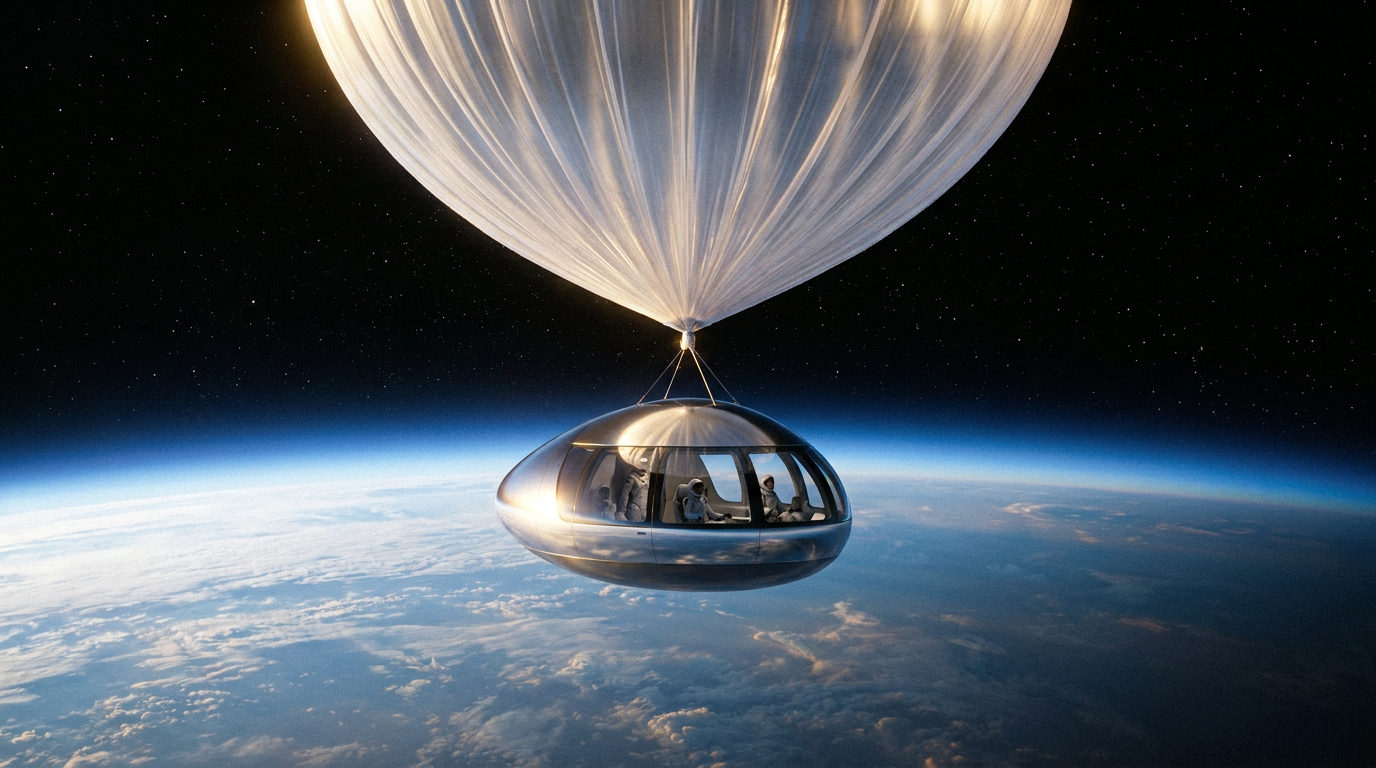
The concept, known as stratospheric ballooning, replaces the violent ascent of a rocket with a serene, hours-long float. Instead of blasting through the atmosphere, passengers sit inside a pressurized, climate-controlled capsule tethered to a zero-pressure balloon filled with hydrogen or helium. As the gas expands, the vessel gently rises to the stratosphere, offering a fundamentally different way to leave the Earth behind.[3][7]
The target altitude for these flights is roughly 100,000 feet—about 19 miles or 30 kilometers above sea level. While this falls short of the Kármán line (the internationally recognized boundary of space at 100 kilometers), it is more than high enough to deliver the ultimate prize: the "Overview Effect." At 100,000 feet, 98 percent of the Earth's atmosphere is below the capsule, allowing passengers to clearly see the curvature of the planet set against the pitch-black void of space.[1][5][6]

Because the ascent is slow and steady—averaging about 12 miles per hour—the physical toll on the human body is negligible. There are no intense G-forces to endure, and because the capsule does not enter a free-fall trajectory or reach orbital velocity, there is no zero-gravity environment. Operators emphasize that if a passenger is medically fit to fly on a standard commercial airliner, they are fit to fly to the stratosphere, eliminating the need for grueling astronaut training.[1][7]
This accessibility has allowed companies to focus entirely on the passenger experience, turning the capsules into venues for extreme luxury. Zephalto, a French startup working in collaboration with the French space agency (CNES), is outfitting its "Celeste" capsule to offer Michelin-star caliber dining and wine pairings during the flight.[1][6]
Other operators are similarly focused on high-end hospitality. World View, which plans to launch from global landmarks like the Great Barrier Reef and the Giza Pyramids, hired the London-based aviation design studio PriestmanGoode to craft its interiors. The resulting capsules feature plush, business-class-style seating, central cocktail bars, fully appointed lavatories, and onboard Wi-Fi so passengers can live-stream their view to the ground.[3][7]

Other operators are similarly focused on high-end hospitality.
A typical flight profile is designed for leisure rather than speed. The journey lasts approximately six hours: a gentle two-hour ascent, a two-hour float at apogee to take in the panoramic views, and a two-hour descent. Depending on the operator, the journey ends with either a guided splashdown in the ocean for boat recovery or a terrestrial landing.[1][3][7]
Beyond comfort, the balloon approach offers a compelling environmental argument. Traditional rocket launches emit significant amounts of carbon dioxide, soot, and other greenhouse gases directly into the fragile upper atmosphere. In contrast, stratospheric balloons are virtually carbon-neutral, relying on buoyancy rather than combustion to achieve lift.[3][6]
The economics of balloon tourism also represent a dramatic shift in the space travel market. Tickets currently range from $50,000 for a seat with World View to roughly $130,000 for flights with Zephalto or Eos X Space. While undeniably a luxury price tag, it is a fraction of the $450,000 charged by Virgin Galactic for a brief suborbital rocket flight, or the $55 million required for an orbital mission with SpaceX.[3][5][6]

However, building a commercial aerospace company is notoriously capital-intensive, and the nascent balloon tourism industry has already seen its share of turbulence. Space Perspective, a highly publicized Florida-based pioneer that had pre-sold over 1,800 tickets, faced severe financial headwinds in early 2025.[2][4]
After falling behind on facility leases and facing eviction from its Florida headquarters, Space Perspective was acquired by its Madrid-based rival, Eos X Space, in July 2025. The acquisition provided a crucial financial lifeline and merged two of the industry's leading technology platforms, with Eos X Space absorbing Space Perspective's successful uncrewed test flight data to accelerate their combined timeline.[2][4]
The consolidated company, alongside competitors like Zephalto and World View, must now navigate a complex regulatory landscape. The pressurized capsules must be certified by aviation authorities such as the FAA in the United States and EASA in Europe, meeting rigorous safety standards equivalent to those governing commercial airlines.[6]

With the industry stabilizing post-consolidation, the race to carry the first commercial passengers is entering its final stretch. Eos X Space and Zephalto are both targeting late 2026 or early 2027 for their inaugural crewed flights, transitioning years of engineering and uncrewed test launches into a fully operational luxury service.[2][6]
For the high-net-worth traveler, the stratosphere represents the ultimate experiential frontier. By stripping away the physical punishment and environmental guilt of rocket travel, balloon tourism is poised to transform the edge of space from a hostile environment for test pilots into a serene, contemplative destination.[1][6]
How we got here
2022-2023
Companies like Space Perspective and World View unveil luxury capsule designs and begin taking $125,000 reservations.
September 2024
Space Perspective successfully completes its first uncrewed test flight to 100,000 feet.
Early 2025
Space Perspective faces severe financial difficulties and eviction from its Florida facilities.
July 2025
Spanish aerospace firm Eos X Space acquires Space Perspective, merging their technologies.
2026-2027
Consolidated operators and European rival Zephalto target their first commercial passenger flights.
Viewpoints in depth
Aerospace Innovators
Startups and engineers who view ballooning as the democratization of near-space travel.
Companies like Eos X Space, Zephalto, and World View argue that the future of space tourism lies in accessibility, not extreme thrills. By eliminating G-forces and the need for astronaut training, they believe they can open the 'Overview Effect' to a much broader demographic. They also heavily emphasize the environmental benefits, contrasting their carbon-neutral zero-pressure balloons with the massive emissions generated by traditional rocket launches.
Luxury Travel Market
High-net-worth consumers and travel agencies who treat the stratosphere as the ultimate experiential destination.
For the luxury sector, the appeal of stratospheric ballooning is less about aerospace achievement and more about exclusive hospitality. Travel agencies and early ticket-holders value the ability to enjoy Michelin-star dining, cocktail bars, and Wi-Fi while looking down at the Earth. This camp views the $130,000 price tag not as a scientific expedition fee, but as the cost of the most exclusive six-hour reservation on the planet.
Industry Realists
Financial analysts and aerospace critics who caution about the difficult economics of scaling balloon tourism.
While the technology is proven, financial analysts point to the 2025 collapse and subsequent acquisition of Space Perspective as a cautionary tale. Developing human-rated, pressurized capsules and securing FAA or EASA certification requires massive upfront capital. Critics argue that until these companies can achieve a high cadence of commercial flights, the business model remains fragile, and the timeline for widespread profitability is highly uncertain.
What we don't know
- Whether the consolidated companies can secure final FAA and EASA certification in time for their late-2026 launch targets.
- If the market demand for $130,000 tickets is deep enough to sustain multiple competing operators long-term.
Key terms
- Stratosphere
- The second layer of Earth's atmosphere, extending from about 10 km to 50 km above the surface, where the air is extremely thin.
- Zero-pressure balloon
- A high-altitude balloon that is open at the bottom or has release valves, allowing the lifting gas to expand as outside pressure drops without bursting the envelope.
- Overview Effect
- A cognitive shift reported by astronauts when viewing the Earth from space, characterized by a profound sense of connection and a realization of the planet's fragility.
- Apogee
- The highest point in the flight path of the balloon, typically around 100,000 feet for these commercial flights.
Frequently asked
Do passengers experience zero gravity on these flights?
No. Because the capsule is lifted slowly by a balloon rather than falling freely or orbiting at high speeds, passengers experience normal Earth gravity throughout the flight.
How much does a ticket cost?
Prices currently range from $50,000 to roughly $130,000, depending on the operator and the level of luxury provided.
Is astronaut training required?
No physical training is needed. The gentle ascent and pressurized cabin mean the physical toll is similar to flying on a standard commercial airliner.
How do the balloons return to Earth?
The capsule slowly vents its lifting gas to descend. Depending on the company, it either splashes down in the ocean for boat recovery or lands on solid ground using a steerable parachute system.
Sources
Source coverage
7 outlets
3 viewpoints surfaced







[1]South China Morning PostLuxury Travel Market
How stratospheric balloon flights could be about to redefine space tourism
Read on South China Morning Post →[2]Space.comAerospace Innovators
Troubled balloon-tourism pioneer Space Perspective bought by Spanish company
Read on Space.com →[3]DezeenLuxury Travel Market
World View unveils balloon spacecraft to begin passenger flights
Read on Dezeen →[4]Travel WeeklyIndustry Realists
Space Perspective's balloon dreams deflate
Read on Travel Weekly →[5]Orbital RadarIndustry Realists
Space Tourism 2026 — Flights, Costs, Providers & Complete Flight Log
Read on Orbital Radar →[6]Channel News AsiaAerospace Innovators
Stratospheric balloons offer space travel without rockets
Read on Channel News Asia →[7]Business InsiderAerospace Innovators
Luxury space-tourism company shows off its capsule designed to float to the edge of space with a massive balloon
Read on Business Insider →
Every angle. Every day.
Get lifestyle stories with full source coverage and perspective breakdowns delivered to your inbox.