
The "Library of Things" Movement: How Communities Are Moving Beyond Books
Neighborhoods worldwide are establishing "Libraries of Things" to lend out tools, camping gear, and appliances, saving residents money while reducing environmental waste.
By Factlen Editorial Team
- Community Organizers
- Focus on the social cohesion, mutual aid, and skill-sharing benefits of community hubs.
- Environmental Advocates
- Emphasize the transition to a circular economy and the reduction of manufacturing waste.
- Economic Equity Proponents
- Highlight how shared resources save households money and democratize access to tools.
What's not represented
- · Traditional hardware retailers and tool manufacturers whose sales models rely on individual ownership.
- · Gig-economy rental platforms that monetize peer-to-peer sharing for profit.
Why this matters
By shifting from individual ownership to community access, residents can save thousands of dollars on rarely used items while drastically reducing household clutter and environmental waste.
Key points
- The average power drill is used for only 13 minutes over its lifetime, highlighting the inefficiency of individual ownership.
- Libraries of Things allow community members to borrow tools, camping gear, and appliances for free or a low cost.
- There are currently over 2,000 formal sharing libraries operating worldwide, ranging from mobile sheds to self-serve lockers.
- Beyond environmental benefits, these hubs foster social connection by hosting repair cafes and skill-sharing workshops.
- The biggest challenge for new libraries is securing affordable physical space and avoiding volunteer burnout.
The average power drill is used for only 13 minutes over its entire lifetime. Yet, millions of households purchase their own, storing them in garages and closets where they gather dust. This phenomenon extends to camping tents, pasta makers, carpet cleaners, and pressure washers—items that are essential for specific tasks but rarely needed on a daily basis.[1][2]
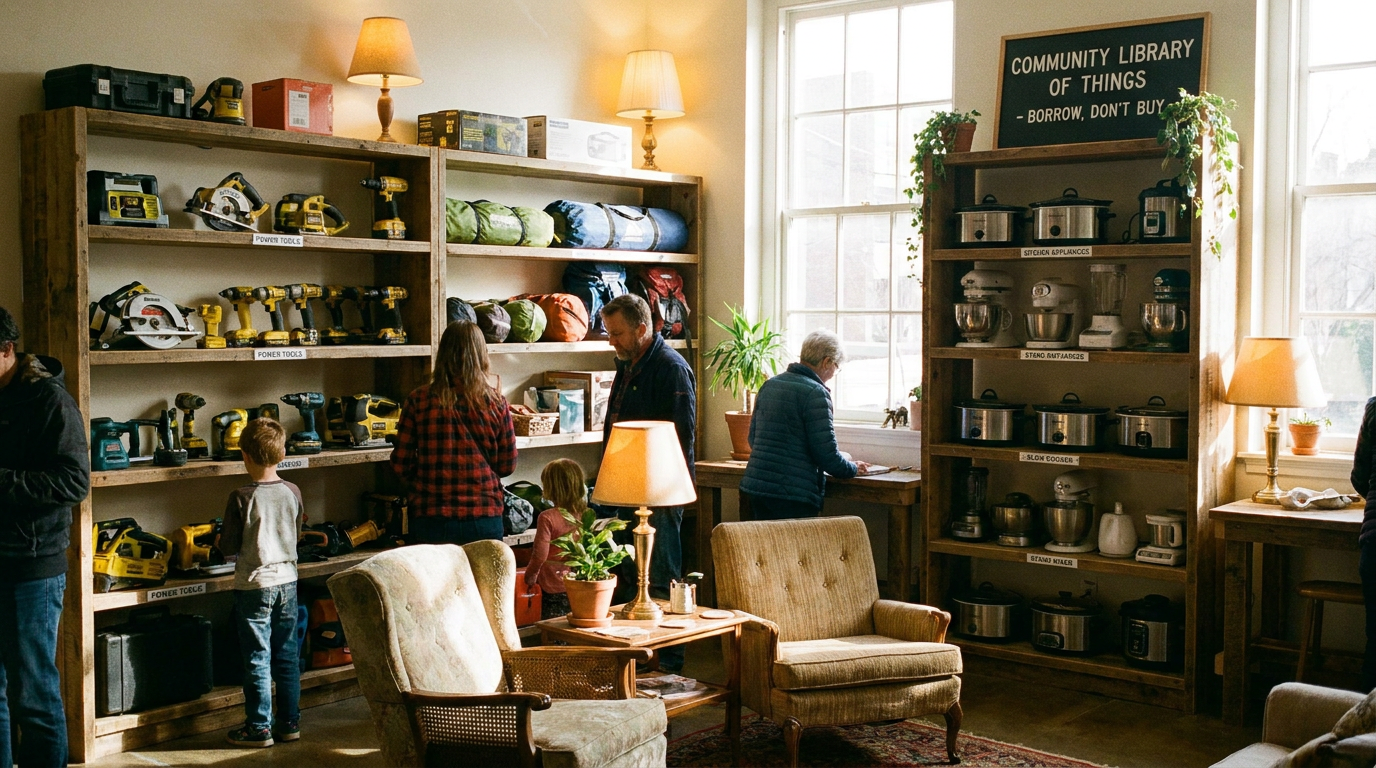
In response to this hyper-consumerism, a growing global movement is championing a simple alternative: the "Library of Things" (LoT). Operating much like traditional public libraries, these community hubs allow residents to borrow physical resources for a set period, completely bypassing the need for individual ownership.[1][5]
While the concept of sharing tools has roots in low-income communities dating back decades, the modern LoT movement has exploded in recent years. Today, there are an estimated 2,000 formal Libraries of Things worldwide, alongside countless informal neighborhood sharing networks.[1][6]

The mechanics of a LoT are straightforward but require careful organization. Members typically sign up for an annual subscription—often on a sliding scale to ensure equitable access—or pay a nominal fee per borrow. They can then browse an online or physical inventory, reserve items, and check them out for a week or two at a time.[2][4]
The physical footprint of these libraries varies wildly depending on the community's resources. Some operate out of converted shipping containers or pop-up shops, while others, like the Share Shed in the UK, function as mobile libraries that drive to different towns on a weekly schedule. Increasingly, traditional public libraries are also dedicating shelf space to non-traditional items.[3][4][5]

The economic benefits for households are immediate and profound. By providing affordable access to expensive equipment, tool libraries democratize resources and allow community members to cultivate self-sufficiency. A neighborhood full of aging homes can use a tool library to tackle renovations that would otherwise be cost-prohibitive, increasing local property values without driving residents into debt.[1][2]
The economic benefits for households are immediate and profound.
Beyond individual savings, the environmental impact is a primary driver for many organizers. The prevailing economic model relies on continuous manufacturing, packaging, shipping, and eventual disposal of consumer goods. By sharing a single carpet cleaner among fifty households, a community significantly reduces its carbon footprint, cuts down on plastic waste, and diverts usable materials from landfills.[3][6]
Yet, organizers frequently note that the most transformative impact of a LoT is social. These spaces act as "third places"—community anchors outside of home and work where neighbors interact. Many libraries host repair cafes, DIY workshops, and skill-sharing events, turning a simple transaction into an opportunity for connection and combating social isolation.[3][5]
Starting a Library of Things is fundamentally a grassroots endeavor. Successful projects usually begin with a core group of volunteers conducting a community needs assessment to determine what items locals actually want to borrow. From there, organizers must secure a physical space, which is often the highest hurdle in gentrifying or expensive urban areas.[1][3]

Gathering inventory is rarely a problem; once a community learns about a new LoT, donations of gently used tools and appliances typically flood in. However, libraries must implement strict intake policies to avoid becoming a dumping ground for broken junk. Electrical items require safety testing, and all tools need regular maintenance to ensure they remain safe and functional for the next borrower.[3][4]
The most significant challenge facing the movement is long-term sustainability. While sharing libraries seem like a simple concept, they are operationally complex. They require rent-free or low-cost space, specialized software to track inventory, and a dedicated team to manage the logistics of checking items in and out.[4]
Many libraries launch with a surge of volunteer enthusiasm and initial grant funding, but struggle with volunteer burnout over time. To survive, mature libraries often transition to a social enterprise model, aiming to generate enough revenue through memberships and late fees to employ paid part-time staff, ensuring consistent opening hours and reliable service.[3][6]

Despite these operational hurdles, the movement continues to gain momentum as part of a broader cultural shift toward the "sharing economy"—not the corporate, gig-economy version, but a genuine, community-led model of mutual aid. It challenges the assumption that individual consumption is the only path to a high quality of life.[2][6]
By prioritizing access over ownership, Libraries of Things are proving that communities can build resilience from the ground up. They offer a tangible, localized solution to global problems of waste and economic disparity, demonstrating that sometimes, the most valuable thing a neighborhood can build is a system for sharing what it already has.[1][7]
How we got here
1979
The Berkeley Public Library establishes one of the earliest formal tool lending libraries in the United States.
2011
The Tool Library is founded in Buffalo, New York, demonstrating the viability of a grassroots, neighborhood-focused sharing model.
2014
The UK's first high-street Library of Things emerges as a pilot in south London, popularizing the term.
2017
The Share Shed launches in the UK, eventually becoming the world's first mobile traveling library of things.
2024
The Tool Library Alliance is formed in the US to unite sharing libraries and foster community resilience on a national scale.
Viewpoints in depth
Community Organizers
Focus on the social cohesion, mutual aid, and skill-sharing benefits of community hubs.
For organizers on the ground, the primary value of a Library of Things isn't just the items themselves, but the social infrastructure they create. By providing a physical space where neighbors must interact to exchange goods, these libraries act as modern 'third places.' Organizers emphasize that the inclusion of repair cafes and DIY workshops turns a simple transaction into an opportunity for skill-sharing, combating urban isolation and building genuine community resilience.
Environmental Advocates
Emphasize the transition to a circular economy and the reduction of manufacturing waste.
From an ecological perspective, the movement is a direct intervention against the linear 'take-make-dispose' economy. Environmental advocates point out that manufacturing a single power tool requires significant raw material extraction, energy use, and shipping emissions. By maximizing the utility of a single item across dozens of households, communities can drastically reduce their collective carbon footprint and divert massive amounts of usable material from local landfills.
Economic Equity Proponents
Highlight how shared resources save households money and democratize access to tools.
Advocates for economic justice view tool libraries as a mechanism for democratizing wealth and access. When low-income households are forced to purchase expensive, rarely used equipment to maintain their homes or start small businesses, it traps them in cycles of debt. By offering sliding-scale memberships, these libraries ensure that a person's ability to repair their home or learn a new trade is not dictated by their disposable income.
What we don't know
- Whether traditional public library systems will universally adopt the lending of physical objects alongside media.
- How the model will adapt to high-density urban areas where commercial rent prices make securing physical space nearly impossible.
- If government grants and municipal funding will become a reliable revenue stream to replace the reliance on volunteer labor.
Key terms
- Library of Things (LoT)
- A community-based lending system that allows people to borrow physical items like tools and appliances instead of buying them.
- Circular Economy
- An economic system aimed at eliminating waste and the continual use of resources by sharing, repairing, and recycling existing materials.
- Sharing Economy
- A socio-economic system built around the sharing of resources; in this context, referring to genuine community mutual aid rather than corporate gig platforms.
- PAT Testing
- Portable Appliance Testing, a safety check process used by lending libraries to ensure donated electrical items are safe for public use.
Frequently asked
Are Libraries of Things free to use?
Many operate on a sliding scale or ask for a small annual membership fee to cover operational costs, though no one is typically turned away for lack of funds.
What are the most commonly borrowed items?
Power drills, carpet cleaners, pressure washers, camping tents, and specialized kitchen appliances like pasta makers or dehydrators are consistently the most popular.
What happens if an item breaks while I have it?
Most libraries expect normal wear and tear and have volunteers who repair items. Borrowers are usually only charged a nominal fee if an item is lost or intentionally damaged.
Can anyone start a Library of Things?
Yes. Most libraries are grassroots initiatives started by a small group of local volunteers who gather community support, find a space, and collect donated items.
Sources
Source coverage
7 outlets
3 viewpoints surfaced






[1]ShareableCommunity Organizers
Library of Things Toolkit (2.0)
Read on Shareable →[2]The Tool LibraryEconomic Equity Proponents
What is a tool library?
Read on The Tool Library →[3]Share ShedEnvironmental Advocates
How to set up a library of things
Read on Share Shed →[4]Library of Things UKCommunity Organizers
Choosing the right model for your community
Read on Library of Things UK →[5]Project CensoredCommunity Organizers
Libraries of Things Foster Community
Read on Project Censored →[6]Manna GumEconomic Equity Proponents
Tool libraries and the sharing economy
Read on Manna Gum →[7]Factlen Editorial TeamEnvironmental Advocates
Synthesis by Factlen editorial team
Read on Factlen Editorial Team →
Every angle. Every day.
Get community stories with full source coverage and perspective breakdowns delivered to your inbox.