
The Global Revival of Kintsugi: How the Ancient Art of Repair Became a Modern Movement
The 500-year-old Japanese tradition of mending broken pottery with gold is experiencing a massive global resurgence as a metaphor for sustainability and mental health.
By Factlen Editorial Team
- Traditional Artisans
- Preserving the slow, meticulous authenticity of the original craft.
- Mental Health Practitioners
- Utilizing the craft as a tangible metaphor for trauma recovery.
- Sustainability Advocates
- Championing repair as an antidote to throwaway consumerism.
- Modern Designers
- Adapting the aesthetic to contemporary fashion, architecture, and digital art.
What's not represented
- · Mass-Market Manufacturers
- · Synthetic Epoxy Producers
Why this matters
In an era dominated by disposable consumerism and the pursuit of flawless aesthetics, this 500-year-old Japanese philosophy offers a radical alternative. By reframing damage as a site of renewal, Kintsugi provides a practical framework for sustainable living and a profound psychological tool for navigating personal trauma.
Key points
- Kintsugi is a 15th-century Japanese art form that repairs broken pottery with lacquer mixed with precious metals.
- The technique highlights fractures rather than hiding them, treating damage as a meaningful part of an object's history.
- Rooted in the Zen philosophy of wabi-sabi, the practice celebrates imperfection, impermanence, and resilience.
- A massive 21st-century revival is being driven by global movements toward sustainability and anti-consumerism.
- Psychologists and therapists increasingly use Kintsugi as a tangible metaphor for trauma recovery and emotional healing.
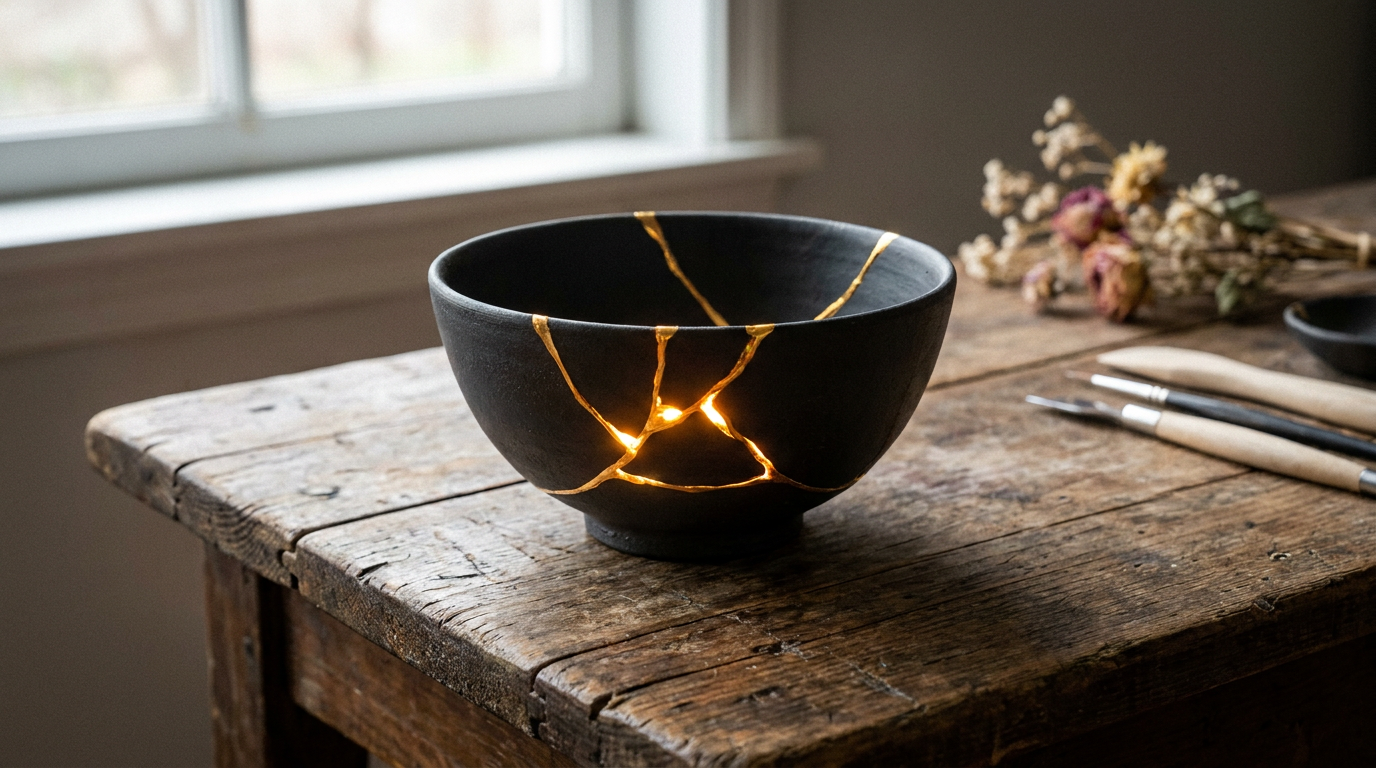
A shattered ceramic bowl rests on a wooden table, its jagged fragments seemingly beyond saving. Yet, instead of being swept into the trash, the pieces have been meticulously rejoined, the fault lines illuminated by brilliant, shimmering veins of gold. The bowl does not attempt to conceal its breakage; it wears its history with profound dignity. This is the visual manifesto of Kintsugi, an ancient Japanese art form that transforms catastrophic damage into breathtaking beauty.[8]
Translating literally to "golden joinery," Kintsugi is the centuries-old practice of repairing broken pottery using a specialized lacquer dusted or mixed with powdered gold, silver, or platinum. In stark contrast to Western restoration techniques—which typically strive to render repairs invisible and return an object to its pristine original state—Kintsugi deliberately highlights the fractures. The shimmering seams serve as a testament to the object's survival, elevating the repaired piece to a status often considered more precious than before it was broken.[1][3]
At its heart, the practice represents a radical reframing of value and loss. The core ethos of Kintsugi dictates that a break is not the end of an object's useful life, nor is it a fatal flaw to be disguised. Instead, the damage is viewed as a meaningful event in the life of the vessel. By accentuating the cracks, the artisan honors the object's unique history, suggesting that true beauty is forged through resilience and the passage of time.[4][5]
The exact origins of this transformative craft are shrouded in a blend of history and legend, but historians generally trace its emergence to Japan's Muromachi period in the late 15th century. During this era, the nation was experiencing a profound cultural flourishing, heavily influenced by Zen Buddhism and the rising prominence of the traditional tea ceremony. It was within this fertile aesthetic environment that the necessity for a new kind of repair was born.[1][3]
According to widely cited historical lore, the technique was catalyzed by Shogun Ashikaga Yoshimasa, the chief military commander of Japan. The shogun had broken a highly cherished Chinese celadon tea bowl and sent it back to China for restoration. When the bowl was eventually returned, Yoshimasa was dismayed to find it held together by heavy, unsightly metal staples—a standard Chinese repair technique known as "juci." While functional, the staples severely compromised the bowl's elegant aesthetic.[1][6]

Disappointed by the crude metal clamps, the shogun reportedly challenged his local Japanese craftsmen to devise a more aesthetically pleasing method of mending broken ceramics. Rising to the occasion, these artisans combined existing millennia-old techniques of using natural tree sap as an adhesive with the decorative traditions of applying powdered metals. The result was Kintsugi—a revolutionary approach that turned a functional repair into a deliberate work of art.[1][6]
The new technique quickly became inextricably linked with "chanoyu," the Japanese tea ceremony. Tea masters, who prized humility, simplicity, and spiritual depth, embraced the golden repairs. The ceramics used in these ceremonies—particularly the "chawan" (tea bowls)—were deeply cherished, and Kintsugi provided a way to preserve these vessels across generations. The craft became so revered that some collectors were rumored to have deliberately smashed valuable pottery simply to have it repaired with the striking gold seams.[1][6]
The enduring power of Kintsugi lies in its deep connection to "wabi-sabi," a foundational Japanese aesthetic philosophy. Rooted in Zen Buddhist principles, wabi-sabi is the practice of finding beauty in imperfection, impermanence, and incompleteness. It rejects the pursuit of artificial, flawless symmetry in favor of the natural patina of age and the inevitable cycle of growth and decay. Kintsugi is widely considered the ultimate physical manifestation of wabi-sabi in action.[3][4]

The traditional repair process itself is an exercise in "mushin," a Zen concept translating roughly to "no mind" or a state of accepting change without attachment. Repairing a bowl with natural urushi lacquer is not a quick fix; it is a meticulous, multi-stage endeavor that requires immense patience. The lacquer must cure in highly specific, humid conditions over weeks or even months. This slow, deliberate pacing forces the artisan into a meditative state, fostering a deep, tactile respect for the broken object.[8]
The traditional repair process itself is an exercise in "mushin," a Zen concept translating roughly to "no mind" or a state of accepting change without attachment.
While Kintsugi quietly sustained itself for centuries as a specialized heritage craft, the early 21st century has witnessed an explosive global revival. This modern resurgence extends far beyond the borders of Japan and the confines of antique restoration. Today, the philosophy is resonating across diverse cultures and disciplines, driven by a collective yearning for authenticity in an increasingly disposable, mass-produced world.[2][5]
A primary driver of this revival is the urgent modern focus on sustainability. In an era defined by overflowing landfills, fast fashion, and planned obsolescence, Kintsugi offers a powerful, elegant counter-narrative. The philosophy fundamentally challenges the linear economic model of "take, make, dispose," advocating instead for a culture of care, maintenance, and reverence for the materials we already possess.[2][5]
Environmentalists and eco-conscious designers have latched onto the craft as a manifesto against throwaway consumerism. By demonstrating that a repaired object can be more stylish, valuable, and meaningful than a brand-new replacement, Kintsugi models a sustainable ethos that was centuries ahead of its time. It encourages modern consumers to rethink their relationship with damaged goods, inspiring a broader movement of visible mending in clothing and electronics.[2]

Beyond its environmental implications, Kintsugi has found profound new life in the realms of psychology and emotional wellness. In recent years, therapists, counselors, and trauma specialists have increasingly adopted the art form as a tangible metaphor for human resilience. The imagery of golden seams provides a powerful visual language for individuals navigating grief, illness, or profound life transitions.[4][7]
In expressive arts therapy workshops, participants are sometimes guided to intentionally break a ceramic bowl and slowly piece it back together. This act of destruction and subsequent reparation serves as a safe, physical stand-in for the internal process of healing. Specialized programs, sometimes dubbed "Kintsugi Healing," explicitly blend the ancient aesthetic principles with modern trauma recovery techniques, helping patients process their experiences.[2][7]
The psychological wisdom of Kintsugi reminds individuals that healing is not about erasing the past or returning to an unbroken state. Whether dealing with the physical scars of cancer treatments or the invisible weight of emotional trauma, the philosophy encourages people to honor their history. It suggests that our struggles and fractures do not diminish our worth; rather, when integrated with care, they become the very sources of our unique strength and beauty.[7]
This widespread resonance has led to a democratization of the craft. Once the exclusive domain of highly trained master artisans, Kintsugi is now accessible to the general public through countless workshops in cities from Kyoto to London to Sydney. These hands-on experiences allow everyday people to engage with the meditative process, turning the repair of a simple household plate into a profound lesson in mindfulness and acceptance.[6]

The aesthetic has also transcended ceramics entirely, bleeding into broader contemporary design. Modern architects are incorporating Kintsugi principles into building renovations, choosing to highlight structural repairs with contrasting materials rather than hiding them behind drywall. Fashion designers are sending collections down the runway that feature visible, golden mending, while digital artists use the motif to explore themes of fragmentation in the virtual age.[2][5]
This rapid popularization has, inevitably, created tension between traditionalists and modern enthusiasts. Master craftspeople emphasize that authentic Kintsugi relies exclusively on natural urushi sap—which is toxic until fully cured—and pure precious metals, demanding months of patient labor. In contrast, many modern DIY kits utilize quick-drying synthetic epoxies and mica powders. While these accessible kits democratize the aesthetic, purists argue they bypass the meditative rigor that gives the practice its soul.[8]
Yet, the fact that the core concept can survive translation into new materials and new disciplines speaks to the robust, universal nature of the philosophy. Whether executed with 500-year-old tree sap or modern biodegradable plastics, the underlying message remains intact. The act of repairing what we have, and cherishing the marks of that repair, serves as a vital antidote to the wastefulness and perfectionism of contemporary life.[2]
In a society that relentlessly pursues youth, newness, and flawless presentation, Kintsugi stands as a quiet, shimmering rebellion. It teaches us to look at the shattered pieces of our objects—and our lives—not as trash to be discarded, but as the raw materials for a masterpiece. By filling our cracks with gold, we are reminded that we are all broken, and that is precisely what makes us beautiful.[8]
How we got here
Late 15th Century
Shogun Ashikaga Yoshimasa returns a broken tea bowl to China, sparking the search for a better repair method.
16th Century
Kintsugi becomes deeply integrated with the Japanese tea ceremony and the philosophy of wabi-sabi.
Early 2000s
A global resurgence begins as the philosophy aligns with modern sustainability and mindfulness movements.
2020s
The aesthetic expands beyond ceramics into global architecture, fashion, and trauma therapy programs.
Viewpoints in depth
Traditional Artisans
Preserving the slow, meticulous authenticity of the original craft.
For purists and master craftspeople, true Kintsugi cannot be rushed. They emphasize that the authentic practice relies exclusively on toxic-until-cured urushi sap and pure precious metals, a process demanding months of patient curing in specialized humidors. From this perspective, the modern proliferation of quick-drying synthetic epoxies and mica powders—while accessible—strips the practice of its meditative rigor and historical continuity.
Mental Health Practitioners
Utilizing the craft as a tangible metaphor for trauma recovery.
Psychologists and expressive arts therapists view Kintsugi primarily through the lens of emotional resilience. By guiding patients to physically rebuild a shattered object, therapists provide a safe, tactile stand-in for internal healing. This camp argues that the philosophy's greatest modern value lies in teaching individuals to integrate their psychological 'scars' into their identity, rather than attempting to hide them out of shame.
Sustainability Advocates
Championing repair as an antidote to throwaway consumerism.
Environmentalists and eco-conscious designers see Kintsugi as a manifesto against the modern linear economy of 'take, make, dispose.' By elevating a repaired object to a status higher than a pristine new one, the philosophy challenges the relentless demand for mass production. This viewpoint advocates for applying the Kintsugi ethos to everyday life—mending clothes, fixing electronics, and fundamentally shifting society's relationship with material goods.
What we don't know
- The precise identity of the original 15th-century artisan who first mixed gold powder with urushi lacquer remains lost to history.
- Whether the global surge in quick-drying DIY Kintsugi kits will dilute the cultural significance of the traditional, months-long urushi process.
Key terms
- Kintsugi
- The Japanese art of repairing broken pottery with lacquer dusted or mixed with powdered gold, silver, or platinum.
- Wabi-sabi
- A Japanese aesthetic philosophy that embraces imperfection, impermanence, and the natural cycle of growth and decay.
- Urushi
- A highly durable, natural lacquer made from the sap of the Chinese lacquer tree, used as the traditional adhesive in Kintsugi.
- Mushin
- A Zen concept translating to 'no mind,' representing an acceptance of change and a detachment from material perfection.
- Juci
- An ancient Chinese repair technique that uses metal staples to hold broken ceramic pieces together.
Frequently asked
Can you eat or drink from Kintsugi-repaired pottery?
Yes, if repaired using traditional, food-safe urushi lacquer and pure gold or silver. However, many modern DIY kits use synthetic epoxies that are not food-safe and should only be used for decorative items.
Does Kintsugi only use gold?
No. While gold is the most famous, the technique also utilizes silver (gintsugi), platinum, or sometimes just the plain lacquer itself (urushitsugi).
How long does the traditional Kintsugi process take?
Traditional Kintsugi is a slow, meticulous process that can take several months, as the natural urushi lacquer requires specific humidity and time to cure properly between layers.
Why is Kintsugi becoming so popular now?
Its resurgence is driven by a global interest in sustainable living—repairing rather than discarding—as well as its powerful psychological metaphor for healing and resilience.
Sources
Source coverage
8 outlets
4 viewpoints surfaced








[1]Japan House LondonTraditional Artisans
History of kintsugi
Read on Japan House London →[2]Deeper JapanSustainability Advocates
Sustainable Design and the Art of Repair
Read on Deeper Japan →[3]WikipediaTraditional Artisans
Kintsugi
Read on Wikipedia →[4]MediumMental Health Practitioners
Kintsugi: The Japanese Art of Embracing Imperfection
Read on Medium →[5]YourStorySustainability Advocates
The Golden Threads of Repair: Kintsugi in 2024
Read on YourStory →[6]In KanazawaTraditional Artisans
Kintsugi and the Japanese Tea Ceremony
Read on In Kanazawa →[7]Intimate PathwaysMental Health Practitioners
Life Lessons from Kintsugi: A Golden History
Read on Intimate Pathways →[8]Factlen Editorial TeamModern Designers
Synthesis by Factlen editorial team
Read on Factlen Editorial Team →

Every angle. Every day.
Get culture stories with full source coverage and perspective breakdowns delivered to your inbox.