
The Global Boom in Office-to-Residential Conversions
As remote work leaves downtown office towers vacant and cities face severe housing shortages, a record number of commercial buildings are being transformed into apartments. But the architectural and financial hurdles of adaptive reuse mean the transition is far from simple.
By Factlen Editorial Team
- Urban Planners & Municipalities
- View conversions as an essential tool to save downtown economies, protect municipal tax bases, and create 24-hour neighborhoods.
- Commercial Developers
- Argue that while conversions are theoretically cheaper than new builds, they require significant government subsidies and tax incentives to offset the massive risks of retrofitting older infrastructure.
- Architects & Engineers
- Focus on the physical limitations of modern buildings, noting that pre-WWII structures are ideal for housing, while 1980s glass boxes often require extreme structural interventions.
What's not represented
- · Existing Commercial Tenants
- · Suburban Commuters
Why this matters
Transforming empty office buildings into housing tackles two of the decade's biggest urban crises at once: dying downtowns and skyrocketing rent. For residents, it means more housing supply in walkable city centers, while for taxpayers, it prevents the collapse of municipal tax bases reliant on commercial real estate.
Key points
- The pipeline for office-to-residential conversions in the US is expected to hit a record 77,700 units in 2025.
- Architectural challenges, such as deep floor plates and centralized plumbing, make many modern office buildings difficult to convert.
- Calgary's aggressive $75 per square foot incentive program has successfully spurred the conversion of nearly 3 million square feet of vacant office space.
- Adaptive reuse saves massive amounts of embodied carbon by upcycling existing concrete and steel structures rather than demolishing them.
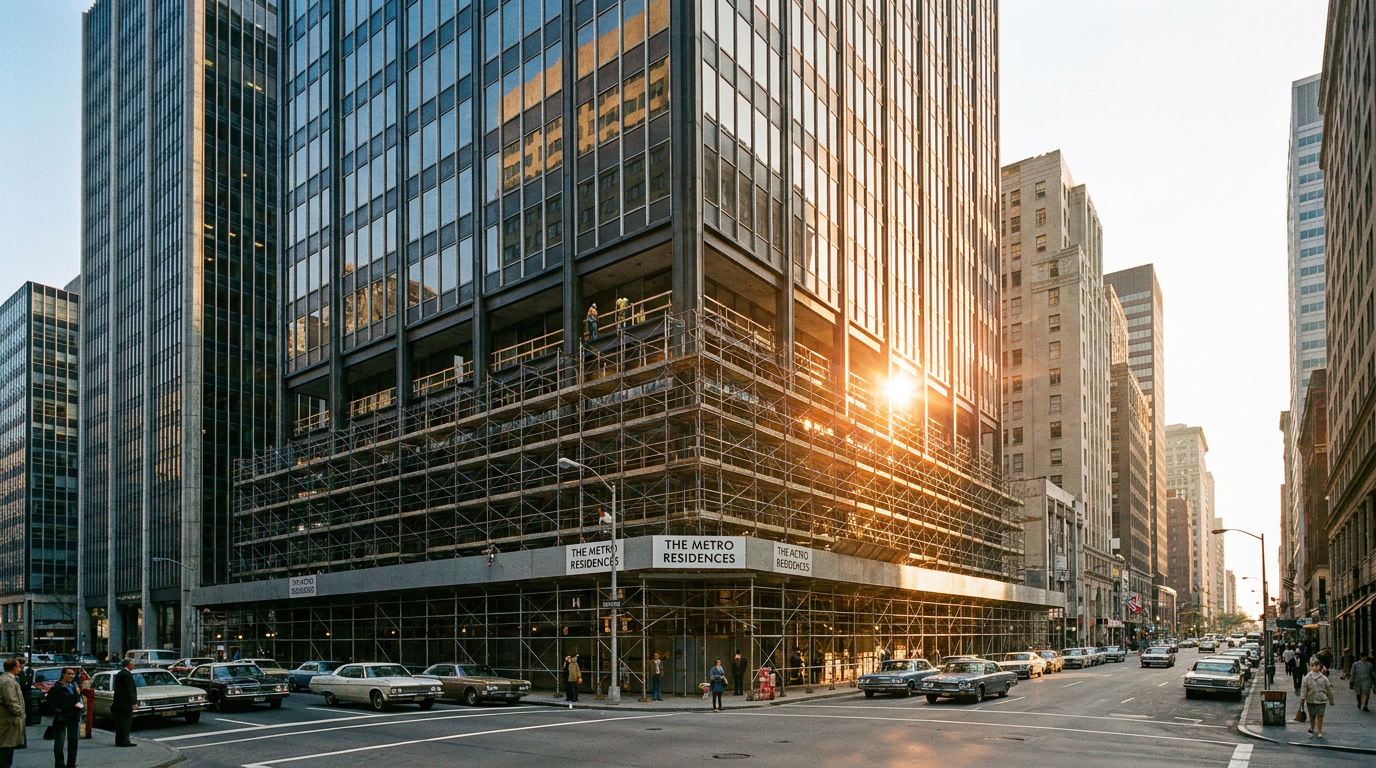
The shift away from the five-day office workweek has created an existential moment for cities across the globe. As remote and hybrid work solidify into permanent fixtures of the modern economy, downtown business districts are grappling with a massive surplus of commercial real estate. In the United States alone, the national office vacancy rate reached a three-decade high of over 20 percent in late 2024, leaving millions of square feet of prime real estate sitting idle. Yet, this commercial crisis has collided with a separate, equally urgent urban challenge: a severe shortage of affordable housing. In response, a growing coalition of developers, urban planners, and municipal governments are turning to a solution that tackles both problems simultaneously. By converting vacant office towers into residential apartments—a process known as adaptive reuse—cities are attempting to transform hollowed-out 9-to-5 business districts into vibrant, 24-hour neighborhoods.[2][7]
The scale of this architectural pivot is unprecedented. While converting old industrial warehouses into residential lofts was a hallmark of 1990s urban renewal, the current wave targets traditional corporate office stock. According to data tracked by real estate research firm RentCafe, the number of office spaces scheduled to become apartments in the United States grew from roughly 23,100 in 2022 to an estimated 77,700 units in the 2025 pipeline. This represents nearly 71 million square feet of commercial space currently undergoing or slated for conversion. Major metropolitan areas like New York City, Washington D.C., and Los Angeles are leading the charge, driven by acute housing shortages and a desperate need to revitalize their urban cores.[1][7]
However, transforming a structure designed for cubicles into a building fit for families is far more complex than simply erecting a few drywall partitions. Office buildings and multifamily housing differ fundamentally in their design, and successfully executing a conversion requires overcoming severe physical limitations. The most universally cited hurdle among architects and engineers is the "deep floor plate." A floor plate refers to the total rentable square footage on a single level of a building. In modern commercial real estate, developers maximized profitability by building massive, deep floor plates that stretch far from the exterior windows to the central elevator core.[3][7]

While a windowless interior is perfectly acceptable for a corporate conference room, a medical clinic, or a bank of cubicles, it is entirely unworkable for residential living. Building codes universally dictate that bedrooms must have direct access to natural light and ventilation. Consequently, developers attempting to convert post-1970s office buildings are often left with vast, dark interior spaces that cannot be legally or practically used for apartments. To solve this, architects are forced to undertake radical structural interventions, such as carving massive vertical light wells down the center of the building, effectively turning a solid square structure into a hollow "donut" or a "C" shape.[3][7]
Beyond the challenge of natural light, the hidden infrastructure of an office building presents another massive logistical hurdle. Commercial buildings are designed with centralized utilities; they typically feature one or two large communal bathrooms per floor and massive, centralized heating and cooling systems. Residential buildings, by contrast, require highly decentralized infrastructure. Every single apartment unit requires its own kitchen plumbing, its own private bathroom, and individualized climate control. Retrofitting an older concrete office building to accommodate dozens of new plumbing stacks and HVAC ducts requires drilling countless holes through reinforced concrete floors, adding immense complexity and cost to the project.[3][7]
Because of these structural realities, not all office buildings are created equal when it comes to adaptive reuse. Pre-World War II office buildings are widely considered the gold standard for residential conversion. Built before the advent of cheap, ubiquitous air conditioning and fluorescent lighting, these older structures were designed with narrow wings and operable windows to maximize natural ventilation and sunlight for office workers. Their U-shaped or H-shaped footprints naturally lend themselves to double-loaded corridors, where a central hallway feeds into well-lit apartments on either side. Conversely, the massive glass-and-steel boxes built in the 1980s and 1990s are often deemed financially unviable for conversion without heavy subsidies.[3][7]

Despite the architectural hurdles, the financial calculus of adaptive reuse is becoming increasingly attractive, particularly as the value of older commercial real estate plummets. While top-tier "Class A" trophy buildings with modern amenities continue to attract corporate tenants, older "Class B" and "Class C" buildings are rapidly becoming stranded assets. For developers, purchasing these depreciated assets and converting them to residential use generally costs between 75 and 80 percent of what it would cost to demolish the site and build a new residential tower from scratch. Furthermore, conversions typically face fewer zoning entitlements and can be brought to market months or even years faster than new construction.[5][6]
Furthermore, conversions typically face fewer zoning entitlements and can be brought to market months or even years faster than new construction.
The push for adaptive reuse is not merely a private sector endeavor; municipalities have a vested interest in ensuring these buildings do not sit empty. Empty office buildings lead to a collapse in foot traffic, which starves local retail and restaurants. More critically, commercial real estate is a foundational pillar of municipal tax revenue. If downtown office buildings lose their assessed value, cities face catastrophic budget shortfalls that threaten funding for public schools, transit systems, and emergency services. Recognizing this existential threat, local governments are stepping in to subsidize the high costs of conversion and streamline the notoriously sluggish permitting process.[2][7]
The most prominent success story in North America is unfolding in Calgary, Alberta. Long before the pandemic, Calgary’s downtown was battered by a prolonged downturn in the global energy sector, leaving the city with a staggering 30 percent office vacancy rate. Desperate to fill nearly 13.5 million square feet of unoccupied space and protect its dwindling tax base, the city launched a highly aggressive Downtown Development Incentive Program in 2021. The initiative offered developers a direct subsidy of $75 per square foot to convert empty offices into residential units, effectively bridging the financial gap that makes many conversion projects unviable.[5][7]
Calgary’s gamble has paid massive dividends. Within a few years, the program approved 21 distinct conversion projects, effectively removing nearly 3 million square feet of vacant office space from the market. These projects are slated to create approximately 3,000 new homes in the city center, alongside new hotels and student housing. The city’s investment of roughly $200 million has spurred over $800 million in private sector investment, transforming empty concrete monoliths into vibrant residential communities. Urban planners across the globe are now studying the "Calgary model" as a blueprint for how aggressive municipal intervention can untangle the financial knots of adaptive reuse.[5][7]

In the United States, federal lawmakers are attempting to replicate this success on a national scale. The bipartisan Revitalizing Downtowns and Main Streets Act, introduced in Congress, proposes a 20 percent tax credit to offset the eligible conversion costs of adaptive reuse projects. Proponents of the legislation argue that federal tax incentives are essential to help developers absorb the massive upfront costs of retrofitting plumbing and HVAC systems in older buildings. By lowering the financial barrier to entry, advocates believe the tax credit could unlock tens of thousands of new affordable housing units in cities struggling with both commercial blight and residential scarcity.[6][7]
The momentum for adaptive reuse is equally strong across the Atlantic. In Europe, the push to convert offices into homes is heavily intertwined with the continent's aggressive climate goals. The European Commission has highlighted office-to-housing conversions as a critical component of the forthcoming European Affordable Housing Plan. In France, the government recently introduced a national support plan featuring "reversible permits," which drastically simplify the bureaucratic process of changing a building's designated use. By removing the red tape that traditionally separates commercial and residential zoning, European policymakers are making it easier for developers to pivot based on real-time market demands.[4][7]
Beyond the immediate economic and social benefits, the environmental case for adaptive reuse is overwhelming. The construction and real estate sectors are responsible for a massive portion of global greenhouse gas emissions, largely due to the "embodied carbon" found in concrete and steel. Demolishing an existing high-rise and building a new one from scratch generates an enormous carbon footprint. By upcycling the existing structural frame of an office building, developers can save millions of tons of carbon emissions, reduce construction waste, and avoid the environmental degradation associated with suburban sprawl.[2][4]

While the momentum is undeniable, experts caution that adaptive reuse is not a silver bullet for the global housing crisis. The sheer volume of housing needed in major metropolitan areas far exceeds the number of viable office buildings available for conversion. Furthermore, ensuring that these new residential units remain affordable for middle- and lower-income families requires strict policy guardrails, as developers often target luxury renters to recoup their high conversion costs. Municipalities must carefully balance their financial incentives with mandates for affordable housing set-asides to ensure that revitalized downtowns remain accessible to all residents.[2][7]
Ultimately, the global boom in office-to-residential conversions represents a profound reimagining of the modern city. The rigid, mid-century zoning laws that strictly separated where people lived from where they worked are giving way to a more fluid, mixed-use urban philosophy. As the dust settles on the remote work revolution, the cities that thrive will be those that view their empty office towers not as stranded assets, but as the foundational building blocks for a more resilient, sustainable, and vibrant urban future.[2][7]
How we got here
2020–2021
The COVID-19 pandemic triggers a massive shift to remote work, emptying downtown office districts globally.
August 2021
Calgary launches its Downtown Development Incentive Program to combat a staggering 30% office vacancy rate.
Late 2024
US national office vacancies hit a three-decade high of over 20%, accelerating the push for adaptive reuse.
March 2025
France announces a national support plan to streamline change-of-use permits for vacant offices.
2026
North American conversion projects hit record highs, with nearly 78,000 units in the pipeline.
Viewpoints in depth
Urban Planners & Municipalities
View conversions as an essential tool to save downtown economies and protect municipal tax bases.
For city governments, the push for adaptive reuse is an existential necessity. Urban planners argue that the mid-century model of the 9-to-5 central business district is permanently broken. By subsidizing the conversion of empty offices into housing, municipalities hope to create vibrant, 24-hour neighborhoods that support local retail and restaurants. More importantly, city officials view these conversions as a critical defense mechanism to protect their commercial property tax revenues, which fund essential public services.
Commercial Developers
Argue that while conversions are theoretically cheaper than new builds, they require significant government subsidies to offset massive retrofitting risks.
Developers acknowledge that purchasing depreciated Class B and C office buildings offers a unique market opportunity, as conversions generally cost 75 to 80 percent of a new build. However, they emphasize that the financial risks are immense. Retrofitting older buildings with individualized plumbing, HVAC systems, and seismic upgrades often uncovers hidden costs that can derail a project. Consequently, the real estate industry argues that widespread adaptive reuse is only viable if governments provide robust tax credits, such as the proposed Revitalizing Downtowns and Main Streets Act, to bridge the financial gap.
Architects & Engineers
Focus on the severe physical limitations of modern buildings, noting that not all offices are suitable for housing.
The architectural community frequently tempers the enthusiasm surrounding adaptive reuse by pointing out the rigid physical constraints of commercial buildings. Engineers note that while pre-WWII buildings with narrow wings and operable windows are ideal for apartments, the massive glass-and-steel boxes built in the 1980s and 1990s are fundamentally incompatible with residential living. To make these modern structures habitable, architects must often carve massive vertical light wells through the center of the building to ensure every bedroom has access to natural light—a structural intervention that is both technically complex and prohibitively expensive.
What we don't know
- Whether federal tax incentives like the Revitalizing Downtowns and Main Streets Act will pass and provide enough capital to scale conversions nationally.
- How the influx of new residential units in traditionally commercial districts will impact local school zoning and municipal infrastructure.
- If the long-term maintenance costs of retrofitted office buildings will outpace those of purpose-built residential towers.
Key terms
- Adaptive reuse
- The process of repurposing an existing building for a new use, such as turning a commercial office tower into a residential apartment complex.
- Floor plate
- The total rentable square footage on a single floor of a building, which dictates how far the interior core is from the exterior windows.
- Class B and C offices
- Older or less desirable commercial buildings that lack modern amenities, making them prime candidates for residential conversion as they lose corporate tenants.
- Embodied carbon
- The total greenhouse gas emissions generated by the manufacturing, transportation, and assembly of building materials like concrete and steel.
Frequently asked
Can any office building be converted into apartments?
No. Buildings built after 1970 with massive, deep floor plates are notoriously difficult to convert because it is hard to get natural light into the center of the building. Pre-WWII buildings with narrower wings are much better suited for residential use.
Is it cheaper to convert an office or build from scratch?
Conversions typically cost 75% to 80% of a new build. However, unexpected structural or plumbing issues can quickly erase those savings, making thorough due diligence essential.
Why do cities care if office buildings sit empty?
Empty offices lead to closed downtown businesses and a massive drop in commercial property tax revenue, which funds critical city services like public schools, transit, and emergency responders.
Do these conversions include affordable housing?
It depends on local policy. Many cities require developers to set aside a percentage of units for lower-income residents in exchange for tax breaks, zoning variances, or direct conversion subsidies.
Sources
Source coverage
7 outlets
3 viewpoints surfaced







[1]RentCafeCommercial Developers
Adaptive Reuse Report: Office-to-Residential Conversions Hit Record Highs
Read on RentCafe →[2]Brookings InstitutionUrban Planners & Municipalities
State and local tools to facilitate office-to-residential conversion
Read on Brookings Institution →[3]Strong TownsArchitects & Engineers
5 Reasons Why Office-to-Residential Conversions Are a Serious Challenge
Read on Strong Towns →[4]European CommissionUrban Planners & Municipalities
Unlocking affordable homes through office-to-housing conversion
Read on European Commission →[5]City of CalgaryUrban Planners & Municipalities
Downtown Office Conversion Program
Read on City of Calgary →[6]NAIOPCommercial Developers
Adaptive Reuse and Housing Affordability
Read on NAIOP →[7]Factlen Editorial TeamArchitects & Engineers
Synthesis by Factlen editorial team
Read on Factlen Editorial Team →
Every angle. Every day.
Get real estate stories with full source coverage and perspective breakdowns delivered to your inbox.