
The Evidence on Eye-Tracking: How Webcams Are Diagnosing Dyslexia Years Earlier
AI-powered eye-tracking technology is moving from university labs to K-12 classrooms, allowing schools to screen for reading difficulties in minutes using standard webcams.
By Factlen Editorial Team
- Cognitive Researchers
- Focus on the physiological data, emphasizing that eye movements provide an objective, real-time window into the brain's language processing centers.
- EdTech Developers
- Prioritize scalability and accessibility, arguing that computer vision can democratize early intervention by running on standard school hardware.
- Special Educators
- Value the technology as a triage tool that saves months of manual testing, allowing them to focus their limited time on actual instruction.
- Privacy & Ethics Advocates
- Raise concerns about the collection of biometric data from minors and the potential for algorithmic misdiagnosis due to environmental factors.
What's not represented
- · Parents of neurodivergent children
- · School district IT administrators
Why this matters
Dyslexia affects up to 15% of the population, but traditional testing often misses it until a child has already fallen years behind. By turning standard school laptops into biometric screening tools, educators can intervene when neuroplasticity is highest, fundamentally altering a child's academic trajectory.
Key points
- Eye-tracking AI can identify reading difficulties and dyslexia risk in minutes.
- The technology analyzes micro-movements like saccades and fixations to detect cognitive struggle.
- Models achieve up to 97% accuracy, outperforming traditional behavioral observation.
- Advances in computer vision allow the software to run on standard school webcams.
- Challenges remain regarding biometric privacy and distinguishing dyslexia from ADHD.
For decades, diagnosing a reading disability has relied on a slow, subjective, and highly visible process. A special education teacher pulls a student out of class, administers a battery of behavioral tests, and listens to them read aloud. Because this process is so resource-intensive, schools typically reserve it for students who are already failing—meaning dyslexia often goes undiagnosed until the third or fourth grade, long after the critical window for early intervention has closed.[8]
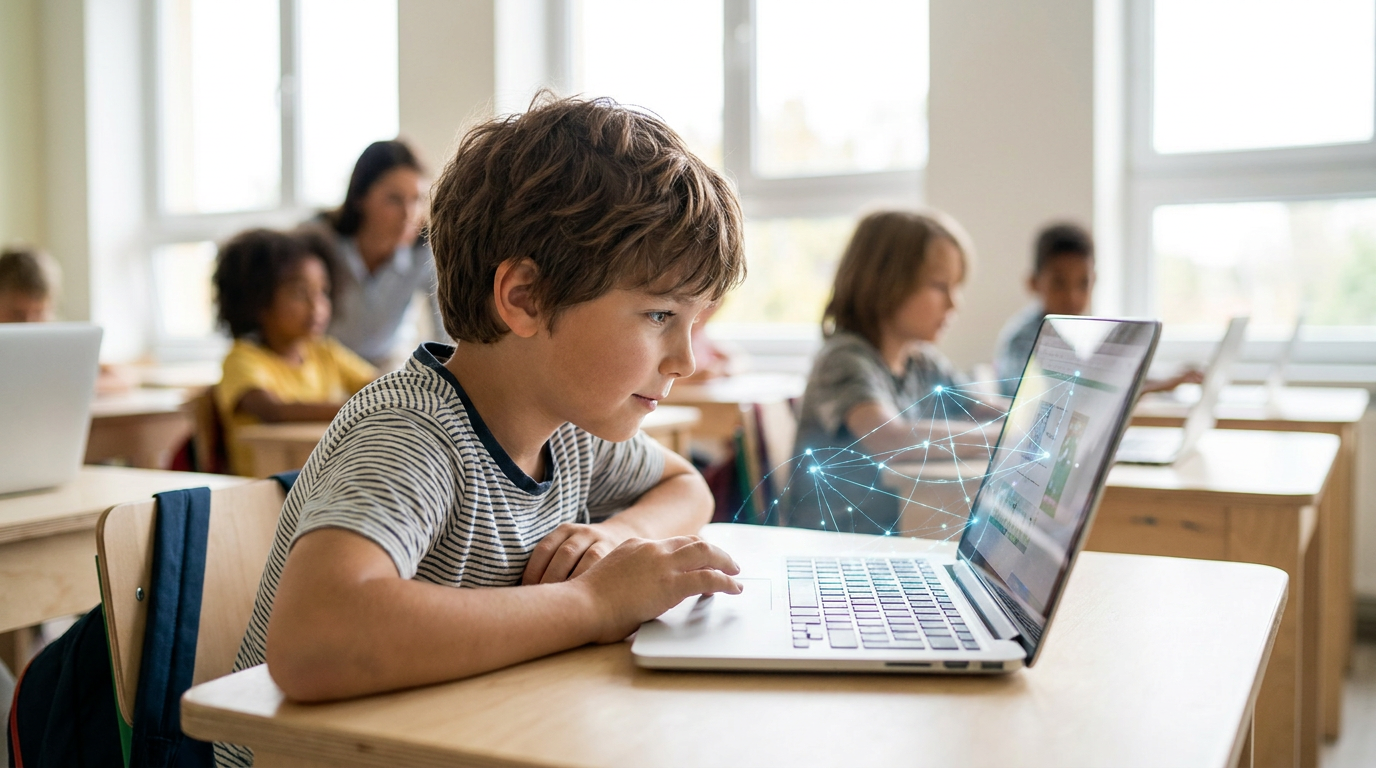
Now, a quiet revolution in computer vision is flipping that model. Eye-tracking technology, once confined to expensive university neuroscience laboratories, is being deployed directly into K-12 classrooms. By analyzing exactly how a child's eyes move across a screen of text, artificial intelligence models can identify the physiological markers of reading struggle in a matter of minutes, before the child even realizes they are falling behind.[2][8]
The core claim driving this shift is that reading is not a smooth, continuous process. When we read, our eyes make rapid, jerky jumps called saccades, pausing briefly on specific words to process visual information—a pause known as a fixation. Fluent readers exhibit a highly predictable pattern of long saccades and short fixations.[1][6]
A struggling reader's eyes tell a vastly different story. Their gaze lingers longer on individual words, their saccades are shorter, and they frequently make regressions—jumping backward in the text to re-read a confusing phrase. These micro-movements happen in milliseconds, entirely invisible to a teacher observing from across the room, but they are glaringly obvious to a high-speed camera.[1][3]

The evidence supporting this approach is rooted in decades of longitudinal research. At Sweden's Karolinska Institutet, researchers analyzed data from the Kronoberg Project, which tracked the reading development of children from the 1980s into adulthood. By feeding that historical eye-movement data into modern machine learning algorithms, they discovered that specific gaze patterns were highly predictive of future reading ability.[3][7]
Subsequent peer-reviewed studies published in Frontiers in Psychology have validated these models. When tested on thousands of students in natural school environments, the AI algorithms achieved up to 95% to 97% accuracy in distinguishing between students with low and high risks of dyslexia. The models proved equally adept at identifying children who had developed clever coping mechanisms to mask their struggles during traditional out-loud reading tests.[1][7]
This scientific breakthrough has rapidly transitioned into commercial EdTech. Companies like Lexplore have built platforms that allow schools to screen an entire classroom in a single afternoon. Instead of waiting months for a clinical evaluation, a teacher receives an immediate, color-coded dashboard highlighting which students need targeted phonics interventions and which are ready for more advanced material.[4][7]
This scientific breakthrough has rapidly transitioned into commercial EdTech.
The scale of adoption is accelerating thanks to partnerships with major educational networks. Juniper Education, which provides software to over 7,000 schools across 20 countries, recently integrated eye-tracking assessments into its core offering. The goal is to provide a holistic, objective baseline for every student as they enter the primary grades, eliminating the "wait to fail" model of special education.[4]

Crucially, the hardware barrier to entry has collapsed. Early iterations of this technology required schools to purchase specialized, infrared eye-tracking headsets that cost thousands of dollars. Today, advances in computer vision allow the software to run on the standard webcams already built into school-issued Chromebooks and iPads.[2][8]
A landmark study published in Behavior Research Methods demonstrated that webcam-based eye trackers, such as WebGazer, provide sufficiently accurate and precise gaze measurements to predict reading comprehension levels from a single, simple calibration. While infrared systems still offer higher precision, the webcam approach proved more than capable of flagging the broad cognitive disruptions associated with dyslexia.[2]

The technology's potential extends beyond the English-speaking world. Because the physiological mechanics of reading are largely universal, eye-tracking is proving effective across different languages and orthographies. The Indian Institute of Technology Madras (IIT-M) is currently leveraging eye-tracking to study language processing in dyslexic children, aiming to develop low-cost, localized screening tools for the Indian education system.[5][6]
Despite the overwhelming efficacy data, the widespread deployment of biometric tracking in schools introduces significant uncertainty. Privacy advocates have raised alarms about the collection and storage of children's eye-movement data. While EdTech providers stress that the data is anonymized and strictly governed by educational privacy laws, the normalization of webcam surveillance in the classroom remains a point of friction for many parents.[8]
There are also clinical edge cases that the AI struggles to parse. While the models are excellent at detecting that a child is struggling to read, they cannot always pinpoint why. A student with Attention Deficit Hyperactivity Disorder (ADHD), a student experiencing acute fatigue, or a student with a visual tracking impairment might all produce erratic gaze patterns that the algorithm flags as dyslexia risk.[1][8]
Furthermore, the physical environment of a typical public school presents logistical challenges. Webcam-based eye tracking relies heavily on adequate lighting and proper posture. A student slouching in a dimly lit classroom, or wearing thick glasses that reflect the screen's glare, can produce noisy data that compromises the assessment's accuracy.[2]

To mitigate these issues, researchers emphasize that eye-tracking should never be used as a standalone diagnostic tool. It is a screening mechanism—an early warning system that directs human expertise to where it is needed most. When the software flags a student, it triggers a comprehensive evaluation by a trained specialist, rather than an automatic diagnosis.[3][8]
Ultimately, the integration of eye-tracking into early education represents a profound shift from observational guesswork to physiological measurement. By catching the invisible signs of cognitive friction before they compound into years of academic frustration, schools are finally gaining the tools to make the promise of early intervention a reality.[7][8]
How we got here
1980s
The Kronoberg Project in Sweden begins tracking the eye movements of children to study reading development over time.
2013
Researchers develop the first machine-learning models capable of predicting reading ability from historical eye-tracking data.
2017
Lexplore is founded, bringing the first commercial AI eye-tracking reading assessments to schools using infrared headsets.
2022
Studies validate that standard webcams (like WebGazer) can accurately track eye movements for reading comprehension, lowering hardware barriers.
2026
Major educational software networks integrate eye-tracking tools, scaling the technology to thousands of classrooms globally.
Viewpoints in depth
Cognitive Researchers
Emphasize that eye movements provide an objective, real-time window into the brain's language processing centers.
For cognitive scientists, the value of eye-tracking lies in its objectivity. Traditional reading assessments rely on a teacher's subjective observation of a student reading aloud. However, many intelligent children develop coping mechanisms—such as memorizing the shape of words or guessing based on context—that mask their underlying decoding struggles. Eye-tracking bypasses these behavioral masks. By measuring the exact millisecond a child's gaze lingers on a complex phoneme, researchers can map the precise cognitive friction occurring in the brain, providing a physiological baseline that cannot be faked or hidden.
EdTech Developers
Prioritize scalability and accessibility, arguing that computer vision can democratize early intervention.
Technology developers view the shift from infrared headsets to standard webcams as the critical inflection point for this science. As long as eye-tracking required $2,000 hardware peripherals, it was destined to remain a niche clinical tool. By training artificial intelligence to extract accurate gaze data from the low-resolution webcams already built into school-issued Chromebooks, developers argue they have removed the financial barrier to entry. Their goal is to make biometric reading screening as routine and ubiquitous as an annual school vision or hearing test.
Special Educators
Value the technology as a triage tool that saves months of manual testing.
Special education teachers are chronically overworked, often spending weeks at the start of a school year conducting one-on-one baseline reading assessments. From their perspective, AI eye-tracking is a massive force multiplier. It acts as an automated triage system, instantly highlighting the 10% of the classroom that requires immediate, intensive phonics intervention. Educators stress that the AI does not replace their expertise; rather, it frees them from the administrative burden of testing so they can spend their time actually teaching the students who need it most.
Privacy & Ethics Advocates
Raise concerns about the collection of biometric data from minors and the potential for algorithmic misdiagnosis.
Privacy watchdogs caution against the rapid normalization of biometric surveillance in K-12 classrooms. Eye-movement data is highly personal, and advocates worry about how this data is stored, who owns it, and whether it could be used to permanently label a child's cognitive profile in a centralized database. Furthermore, ethicists point out that the algorithms are not infallible. Environmental factors like poor classroom lighting, or overlapping neurodivergent conditions like ADHD, can trigger false positives, potentially pushing a child into an unnecessary special education track based on a machine's misinterpretation of a distracted glance.
What we don't know
- How effectively the algorithms can distinguish between dyslexia and other conditions that cause erratic reading, such as ADHD or visual tracking disorders.
- The long-term data privacy implications of storing biometric eye-movement data for millions of K-12 students.
- Whether the technology will perform consistently across severely underfunded schools with poor lighting and older, low-resolution devices.
Key terms
- Saccade
- The rapid, jerky movement of the eye as it jumps from one word or focal point to the next during reading.
- Fixation
- The brief pause the eye makes on a specific word or letter to process visual information.
- Regression
- When the eye moves backward in a text to re-read a word or phrase, a pattern highly common in struggling readers.
- Orthography
- The conventional spelling system of a language, which dictates how spoken words are represented visually.
- Computer Vision
- A field of artificial intelligence that trains computers to interpret and understand the visual world, such as tracking pupil movements via a webcam.
Frequently asked
Can a standard webcam really track eye movements accurately?
Yes. Recent advances in computer vision allow standard webcams to capture gaze data with enough precision to predict reading comprehension and flag cognitive struggles, though they are slightly less precise than expensive infrared headsets.
Does this technology replace special education teachers?
No. It acts as an early warning screening tool. When the AI flags a student as high-risk, it triggers a comprehensive evaluation and targeted intervention by a trained human educator.
Can the AI tell the difference between dyslexia and ADHD?
This remains a challenge. Both conditions can cause erratic eye movements (such as losing focus or skipping lines). The eye-tracker identifies that a reading disruption is occurring, but a clinician is still needed to diagnose the exact cause.
Is it safe to record children's eye movements?
EdTech providers must comply with strict educational privacy laws (like FERPA in the US or GDPR in Europe). The data is typically anonymized, processed locally or on secure servers, and used solely for educational assessment.
Sources
Source coverage
8 outlets
4 viewpoints surfaced








[1]Frontiers in PsychologyCognitive Researchers
Eye Tracking and Machine Learning in Reading Assessment
Read on Frontiers in Psychology →[2]Behavior Research MethodsEdTech Developers
Webcam-based eye tracking for reading comprehension
Read on Behavior Research Methods →[3]Karolinska InstitutetCognitive Researchers
Follow the eyes as children read
Read on Karolinska Institutet →[4]The PIE NewsSpecial Educators
Juniper Education partners with Lexplore Analytics
Read on The PIE News →[5]The Hindu Business Line
IIT-M Lab Uses Eye-Tracking to Support Dyslexic Children
Read on The Hindu Business Line →[6]MDPICognitive Researchers
Eye Tracking Studies on Reading Comprehension
Read on MDPI →[7]LexploreEdTech Developers
Award-winning method for assessing reading ability using AI & eye tracking
Read on Lexplore →[8]Factlen Editorial TeamPrivacy & Ethics Advocates
Synthesis by Factlen editorial team
Read on Factlen Editorial Team →
Every angle. Every day.
Get education stories with full source coverage and perspective breakdowns delivered to your inbox.