
The $13 Billion Tournament: How the Economics of the 2026 World Cup Actually Work
As the 2026 World Cup expands to 48 teams across North America, economists and host cities are navigating a complex financial model where FIFA controls major revenue streams while local governments absorb operational costs.
By Factlen Editorial Team
- FIFA & Local Organizers
- Proponents argue the tournament brings unprecedented global visibility and billions in broader economic impact.
- Sports Economists
- Academic researchers argue that economic impact studies consistently overstate the financial benefits of mega-events.
- Municipal Governments
- Local officials are focused on the logistical and fiscal reality of funding massive operational costs.
What's not represented
- · Local small business owners facing disrupted foot traffic
- · Regular commuters affected by transit changes and price hikes
Why this matters
Understanding the financial mechanics of mega-events helps taxpayers and local businesses evaluate whether the promised influx of tourism and global visibility outweighs the public costs of security, infrastructure, and logistics.
Key points
- The 2026 World Cup is projected to generate a record $13 billion in revenue for FIFA.
- The tournament utilizes existing NFL and MLS stadiums, avoiding the multi-billion-dollar construction costs of past World Cups.
- Host cities face operational bills of $100 million to $200 million for security, transit, and fan festivals.
- FIFA retains direct revenue from tickets, broadcasting, and global sponsorships.
- Organizers project a $17.2 billion boost to U.S. GDP, driven heavily by international tourism.
- Sports economists warn that displacement and substitution effects often result in lower net economic gains than projected.
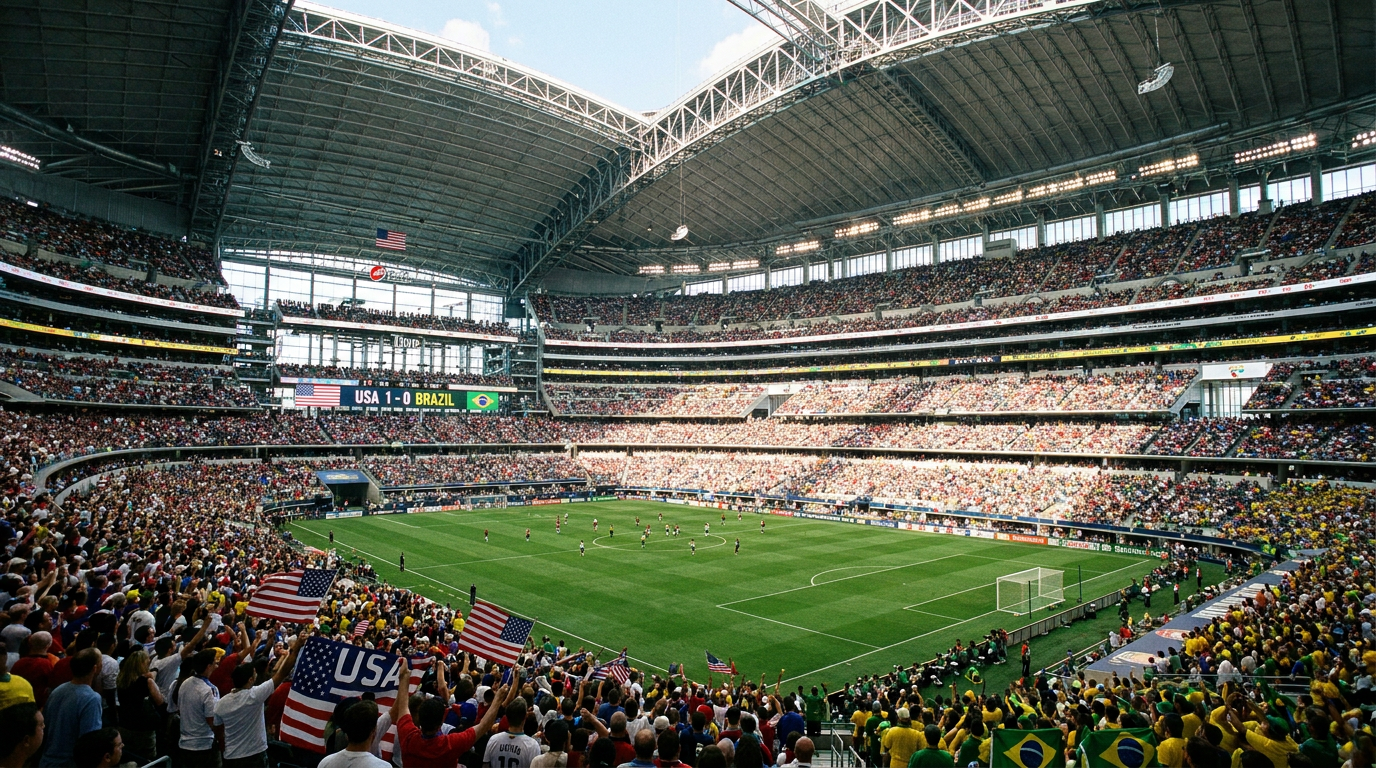
The 2026 FIFA World Cup is poised to be the largest and most logistically complex sporting event in history. Spanning the United States, Canada, and Mexico, the tournament has expanded to include 48 national teams competing in 104 matches over 39 days. This unprecedented scale requires a massive operational footprint across 16 North American host cities, stretching across four time zones and utilizing some of the continent's most iconic venues. As the opening match approaches, the sheer size of the event has brought the underlying financial mechanics of mega-events into sharp focus, highlighting a complex economic ecosystem where billions of dollars will change hands.[2][3]
For FIFA, the global governing body of association football, the expanded format represents a staggering financial windfall. The organization is projecting an estimated $13 billion in total revenue for the 2023–2026 commercial cycle. This figure marks a dramatic 73 percent increase from the $7.5 billion generated during the previous cycle that culminated in the 2022 tournament in Qatar. By bringing the world's most popular sport to the highly lucrative North American market, FIFA has successfully capitalized on the increased inventory of matches and the premium value of U.S. broadcast time slots.[2][4]
The revenue surge is driven by three primary pillars. Broadcasting rights remain the largest single source of income, projected to bring in $3.9 billion globally. Ticketing and premium hospitality packages are expected to generate another $3 billion, bolstered by the implementation of dynamic pricing models and the sheer capacity of North American stadiums. Finally, corporate sponsorships are forecast to reach $2.8 billion, a 55 percent increase from the previous tournament, as multinational brands vie for visibility during what FIFA President Gianni Infantino has likened to hosting "104 Super Bowls in a month."[4][5]

Unlike recent World Cups in Brazil and Qatar, which required the host nations to spend tens of billions of dollars constructing new stadiums and transit systems from scratch, the 2026 tournament relies entirely on existing infrastructure. The utilization of massive NFL and MLS venues—such as the $5.5 billion SoFi Stadium in Los Angeles and MetLife Stadium in New Jersey—eliminates the most significant and riskiest capital expenditures traditionally associated with hosting the event. This reliance on pre-built, state-of-the-art facilities was a central pillar of the "United 2026" bid, promising a more sustainable and financially responsible tournament.[5][8]
However, the absence of construction costs does not mean the event is cheap for the 16 host cities. Municipalities are discovering that the operational requirements of staging the tournament are immense. Local governments and organizing committees face estimated bills ranging from $100 million to over $200 million per city. These funds are required to cover the extensive logistical demands of the event, including heightened counter-terrorism security, traffic management, emergency response services, and the operation of month-long public fan festivals.[5][6]
The financial friction stems from a deeply asymmetric contractual arrangement between the governing body and the host cities. Under the terms of the hosting agreements, FIFA retains control over nearly all direct revenue streams. The organization collects the income from ticket sales, global sponsorships, and broadcasting rights. Meanwhile, host cities are generally restricted from directly taxing ticket sales or tapping into premium seating revenues, leaving local governments to absorb the operational costs without a direct mechanism to recoup their investments from the event's primary cash flows.[1][8]
The financial friction stems from a deeply asymmetric contractual arrangement between the governing body and the host cities.
Security and transportation represent the largest line items for local organizers. Providing comprehensive safety measures for millions of visiting fans requires massive police overtime, specialized equipment, and coordination with federal agencies. In some regions, transit authorities are being forced to implement significant fare hikes on specific routes—such as the train service to MetLife Stadium—to offset the millions of dollars required to run extended schedules and manage the unprecedented crowd volumes.[2][7]

To justify these substantial public outlays, local organizing committees and FIFA point to the massive broader economic impact the tournament is expected to generate. According to socioeconomic analyses cited by the organizers, the 2026 World Cup could produce up to $40.9 billion in gross economic output globally. Within the United States alone, the tournament is projected to add approximately $17.2 billion to the national GDP and support hundreds of thousands of jobs across the hospitality, retail, and service sectors.[3][5]
The mechanics of this promised economic boom rely heavily on an influx of international tourism. The projections assume that hundreds of thousands of foreign fans will fly into the host cities, book hotel rooms at premium rates for weeks at a time, and spend freely at local restaurants, bars, and attractions. For cities like Houston, Dallas, and Seattle, this sustained burst of external spending is viewed as the primary return on their operational investments, injecting new capital into the local economy that would not have otherwise existed.[5]
Despite these optimistic projections, independent sports economists remain highly skeptical of the promised windfalls. Academic researchers frequently criticize economic impact studies for utilizing multipliers that predictably overstate the benefits while understating the public costs. A primary critique is the failure to account for the "substitution effect." When local residents spend their disposable income on World Cup tickets or fan festival merchandise, they are simply redirecting money they would have otherwise spent on local movies, concerts, or dining, resulting in no net economic growth for the region.[5][6]
Economists also warn of the "crowding out" effect, which can severely dampen the net tourism gains. Mega-events inevitably bring extreme congestion, heightened security perimeters, and drastically inflated hotel prices. As a result, regular tourists, business travelers, and conventions often avoid the host city during the tournament window. While the hotels may be full of soccer fans, the displacement of normal economic activity means the actual net increase in visitors is often far lower than the gross attendance figures suggest.[6]

Faced with these economic realities, host cities are utilizing a patchwork of funding mechanisms to cover their obligations. In Texas, organizers in Houston and Dallas are relying heavily on the state's Major Events Reimbursement Program, which uses projected tax revenue increases to subsidize the costs of hosting. Other cities are leaning on aggressive private fundraising campaigns, corporate sponsorships for local host committees, and federal grants designed to assist with the extraordinary security requirements of international events.[1][7]
Beyond the strict financial calculus, civic leaders and proponents argue that the value of hosting the World Cup transcends immediate tax revenues. The tournament offers an unparalleled platform for global visibility, effectively serving as a multi-week, billion-dollar marketing campaign for the host cities. Supporters maintain that the civic pride, international prestige, and long-term tourism benefits generated by showcasing their cities to a television audience of billions justify the upfront public investment.[7]
As the summer of 2026 approaches, the World Cup is poised to serve as a real-time laboratory for the economics of modern mega-events. The tournament will test whether the sheer scale of the North American market can deliver a genuine win-win scenario, balancing FIFA's record-breaking commercial success with the fiscal realities of the cities tasked with bringing the world's biggest sporting spectacle to life.[1]
How we got here
2018
The 'United 2026' bid from the U.S., Canada, and Mexico wins the hosting rights, promising a highly profitable tournament using existing stadiums.
2022
FIFA generates $7.5 billion in revenue from the Qatar World Cup cycle, setting a new benchmark for the organization.
March 2026
FIFA updates its financial projections, anticipating a record $13 billion in revenue for the 2026 cycle.
June 2026
The expanded 48-team tournament kicks off across 16 North American cities.
Viewpoints in depth
FIFA & Local Organizers
Proponents argue the tournament brings unprecedented global visibility and billions in broader economic impact.
Organizing committees and FIFA emphasize that the World Cup is a unique catalyst for civic pride and international tourism. They point to macroeconomic studies projecting tens of billions in gross economic output, arguing that the global broadcast exposure serves as an invaluable, multi-week marketing campaign that will attract future business and tourism long after the final whistle.
Sports Economists
Academic researchers argue that economic impact studies consistently overstate the financial benefits of mega-events.
Economists caution that the promised financial windfalls rarely materialize for host cities. They argue that impact studies commissioned by event organizers often rely on flawed multipliers and fail to account for the substitution effect—where locals simply shift their entertainment spending—and the crowding out of regular tourists who avoid the city due to congestion and inflated prices.
Municipal Governments
Local officials are focused on the logistical and fiscal reality of funding massive operational costs.
For city councils and local taxpayers, the primary concern is the immediate burden of securing and managing the event. Bound by strict hosting contracts that grant FIFA control over direct revenues, municipalities must find creative ways to fund $100 million to $200 million in security, transit, and infrastructure costs, often turning to state reimbursement programs or federal grants to balance the books.
What we don't know
- The exact net economic impact on host cities, which will only be measurable years after the tournament concludes.
- How the implementation of dynamic ticketing will affect the final demographic makeup of stadium crowds.
- Whether the projected influx of international tourists will fully materialize or be dampened by high travel and lodging costs.
Key terms
- Dynamic Pricing
- A ticketing model where prices fluctuate in real-time based on market demand, often resulting in higher costs for highly sought-after matches.
- Substitution Effect
- An economic concept where consumers redirect their existing disposable income toward a mega-event rather than creating net new spending in the local economy.
- Crowding Out Effect
- When regular tourists and business travelers avoid a city during a major event due to high prices and congestion, offsetting the economic gains from event attendees.
- Operational Costs
- The day-to-day expenses required to run an event, such as security, traffic management, and emergency services, distinct from capital costs like building stadiums.
Frequently asked
How much revenue is FIFA expected to make from the 2026 World Cup?
FIFA is projected to generate approximately $13 billion in total revenue during the 2023-2026 commercial cycle, driven by broadcasting, ticketing, and sponsorships.
Are host cities building new stadiums for the tournament?
No. Unlike recent tournaments in Qatar and Brazil, the 2026 World Cup relies entirely on existing NFL and MLS stadiums across the United States, Canada, and Mexico.
Why do economists doubt the projected economic impact?
Economists argue that impact studies often ignore the 'substitution effect' (locals spending money on the event instead of other local entertainment) and the 'crowding out' effect (regular tourists avoiding the city due to congestion).
How much does it cost a city to host World Cup matches?
Operational costs for security, transportation, and fan festivals are estimated to range between $100 million and $200 million per U.S. host city.
Sources
Source coverage
8 outlets
3 viewpoints surfaced








[1]ForbesMunicipal Governments
World Cup economic impact explained: why host cities bear the costs while FIFA profits
Read on Forbes →[2]The GuardianMunicipal Governments
The $13bn World Cup: how the numbers stack up on Fifa's 2026 balance sheet
Read on The Guardian →[3]SportsProFIFA & Local Organizers
United 2026 commercial guide: The biggest World Cup of all time
Read on SportsPro →[4]MarketScaleFIFA & Local Organizers
Inside FIFA's $13B World Cup revenue surge
Read on MarketScale →[5]NC State UniversitySports Economists
The Economic Reality of Hosting the 2026 FIFA World Cup
Read on NC State University →[6]Smith CollegeSports Economists
The Economics of the World Cup: A Net Positive or Negative?
Read on Smith College →[7]News From The StatesMunicipal Governments
Texas taxpayers likely will be on the hook again when Houston and Dallas welcome the FIFA World Cup
Read on News From The States →[8]Huddle UpMunicipal Governments
The Financial Reality of the 2026 World Cup
Read on Huddle Up →


Every angle. Every day.
Get sports stories with full source coverage and perspective breakdowns delivered to your inbox.