
Zelenskyy Claims Belarus Has Disabled Equipment Used to Guide Russian Strikes Following Kyiv's Ultimatum
Ukrainian President Volodymyr Zelenskyy confirmed that Russian signal relays in Belarus, used to guide drone strikes into Ukraine, ceased operations days after Kyiv issued a one-week ultimatum.
By Factlen Editorial Team
- Ukrainian Defense Advocates
- Focuses on Ukraine's right to neutralize threats emanating from neighboring territories and the tactical success of the ultimatum.
- Regional Security Observers
- Analyzes the geopolitical tightrope Belarus is walking and the broader implications for NATO's eastern flank.
- Russian & Allied Media
- Frames the ultimatum as an aggressive escalation by Kyiv that violates Belarusian sovereignty and threatens regional stability.
What's not represented
- · Belarusian opposition figures in exile
- · Civilians living in the Belarus-Ukraine border regions
Why this matters
The shutdown of these guidance systems significantly degrades Russia's ability to launch precise, deep-penetrating drone strikes into northern Ukraine. It also marks a rare instance of Belarus yielding to Ukrainian diplomatic and military pressure, highlighting the fragile balancing act Minsk is playing to avoid being drawn directly into the war.
Key points
- Ukrainian President Volodymyr Zelenskyy announced that Russian signal repeaters in Belarus ceased operations on June 22.
- The equipment was used to extend the range and control of Russian Shahed drones striking northern Ukraine.
- The shutdown occurred three days after Zelenskyy issued a one-week ultimatum threatening Ukrainian military action if the relays were not removed.
- It remains unclear whether Belarusian authorities physically dismantled the equipment or simply turned it off.
- Ukrainian border guards have already reported a decrease in Russian drone incursions along the northern border.
Ukrainian President Volodymyr Zelenskyy has confirmed that Russian signal relay equipment stationed in Belarus, which was heavily utilized to coordinate and guide drone strikes against Ukrainian civilian infrastructure, has officially ceased operations. The sudden shutdown on June 22 comes just three days after Kyiv issued a stark one-week ultimatum to Belarusian leader Alexander Lukashenko. Zelenskyy had warned that if Minsk did not dismantle the guidance systems, the Ukrainian military would take independent action to destroy them across the border.[1][2][3][4]
"According to the available information, which was reported to me by the Commander-in-Chief, as well as intelligence, since June 22, the corresponding repeaters have ceased their operation on the territory of Belarus," Zelenskyy told reporters during a press briefing. The Ukrainian president acknowledged that the exact cause of the shutdown remains unverified, leaving open the question of whether Minsk yielded to the pressure or if other factors are at play. "Whether they dismantled them or not, frankly speaking, I do not know yet, but we are working on this, and I am monitoring this very closely," he said, adding that the critical fact is the equipment is currently offline.[1][3][4]
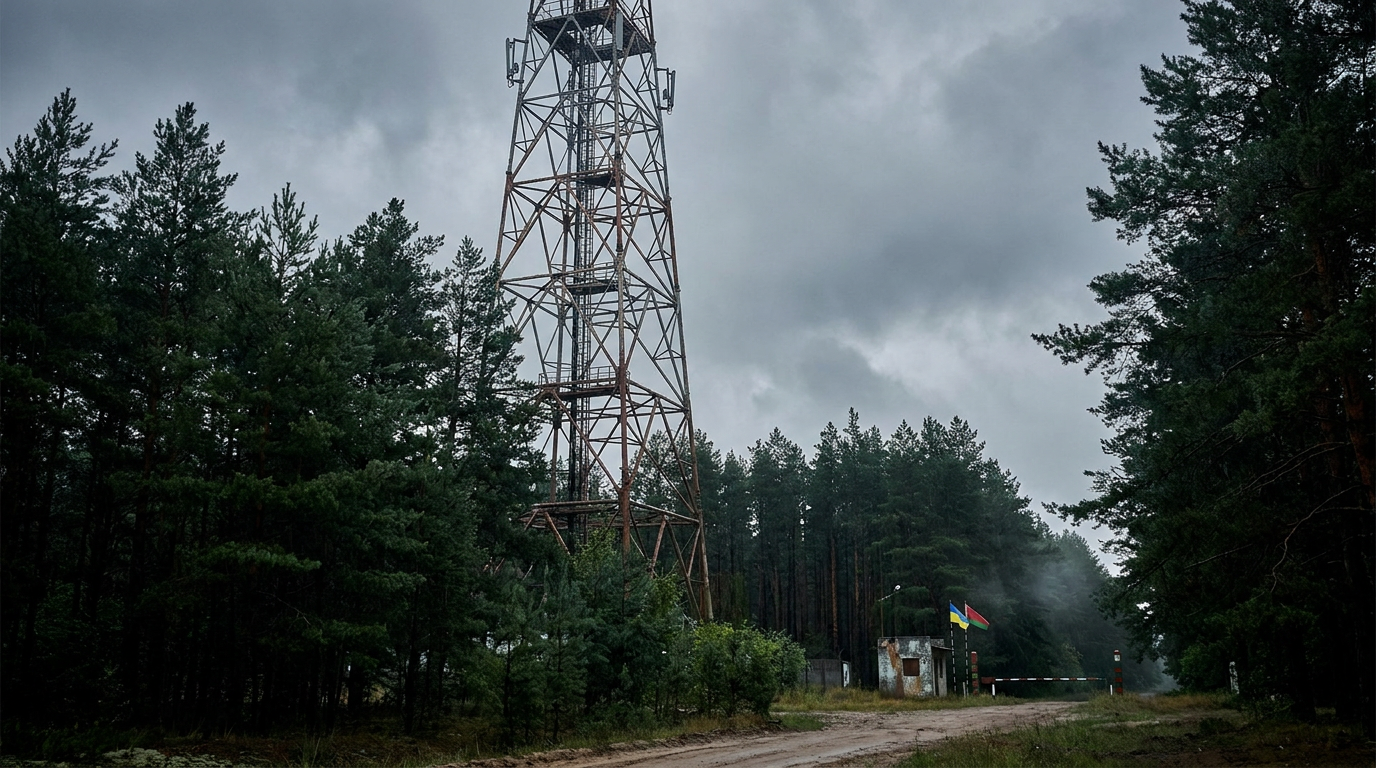
The targeted infrastructure consisted of specialized signal repeaters mounted on civilian communication towers and rooftops in Belarus's Gomel and Brest regions, both of which directly border northern Ukraine. Russian forces deployed these relays to artificially extend the operational range and maintain real-time control of their Shahed-type attack drones. By routing radio signals through Belarusian territory, Russian operators could navigate the loitering munitions deep into Ukraine's Kyiv, Rivne, and Volyn oblasts, reaching targets that would be difficult to strike from Russian soil alone due to signal degradation.[1][2][5][6]

The tactical impact of the equipment going dark appears to be immediate and measurable. The Ukrainian State Border Guard Service reported a noticeable drop in the number of Russian attack drones entering the northern Chernihiv Oblast over the past several days. Furthermore, large-scale Shahed raids along the Belarusian border have effectively ceased, providing a temporary reprieve for northern Ukrainian cities that have endured relentless aerial bombardment facilitated by the cross-border relays. Military analysts note that without these repeaters, Russia is forced to rely on longer, more predictable flight paths from its own territory, giving Ukrainian air defenses more time to intercept the incoming threats.[1][2]
The tactical impact of the equipment going dark appears to be immediate and measurable.
The diplomatic standoff that precipitated the shutdown began on June 19, when Zelenskyy publicly demanded the removal of the repeaters. He framed the issue entirely around the ongoing casualties of Ukrainian civilians and children caused by the guided strikes, rejecting any notion that Belarus could remain a passive observer while its infrastructure was weaponized. "What's the point of saying he doesn't want war? Just take down that equipment; just shut it down," Zelenskyy stated during the initial ultimatum, setting a firm seven-day deadline for compliance.[2][4]
The ultimatum followed a rare and unexpected public apology from Lukashenko earlier in June. During a media broadcast, the Belarusian leader expressed regret for previous insults directed at Zelenskyy and promised that Belarus posed no military threat to Ukraine, effectively crossing his heart that his country would not enter the war. While Zelenskyy accepted the personal apology—noting that if an insult is personal, "thank God for it"—he emphasized that diplomatic pleasantries were entirely insufficient while Russian military hardware continued to operate freely from Belarusian territory and facilitate the killing of Ukrainians.[2][6]

Pushing his advantage, Zelenskyy has also expanded his demands beyond the drone relays. He is now calling on Minsk to halt the supply of petroleum products from Belarusian refineries, which have become a crucial logistical lifeline for the Russian army's mechanized units. Additionally, the Ukrainian president demanded that Belarusian industrial enterprises stop providing essential components for Russia's Oreshnik medium-range missile systems. By broadening the scope of his demands, Zelenskyy is signaling that Kyiv is increasingly willing to target the broader military-industrial cooperation between Minsk and Moscow, treating Belarus's economic support for the invasion as a legitimate security threat.[4][5][6]
Moscow has reacted sharply to Kyiv's forceful diplomacy, viewing the ultimatum as a direct challenge to its influence over Belarus and the integration of their defense networks. Kremlin spokesperson Dmitry Peskov accused Ukraine of displaying blatant "aggression" and violating Belarusian sovereignty, ignoring the fact that the equipment in question was Russian military hardware. In response to the escalating tensions, Russian President Vladimir Putin and Lukashenko are reportedly scheduling an urgent meeting to discuss the ultimatum and coordinate their response to Ukraine's increasingly assertive posture along the northern border.[1][6]

For now, the cessation of the relay signals represents a significant tactical shift for Ukraine's northern air defense, reducing the immediate threat of cross-border drone incursions. However, it also tests the delicate limits of Belarus's involvement in the broader conflict. Lukashenko remains caught between his deep political and economic reliance on Putin and his desperate desire to avoid a direct military confrontation with a battle-hardened Ukrainian military that has just proven its willingness to issue—and potentially enforce—red lines. Whether the equipment remains offline permanently, or if Russia finds alternative methods to guide its munitions, the episode underscores Ukraine's growing confidence in dictating security terms to its northern neighbor.[1][3]
How we got here
Late 2025
Russia deploys signal repeaters on communication towers in Belarus to extend the range of its drone strikes.
Early June 2026
Belarusian leader Alexander Lukashenko publicly apologizes to Zelenskyy for past insults and claims Belarus poses no military threat.
June 19, 2026
Zelenskyy issues a one-week ultimatum for Belarus to remove the drone guidance equipment or face Ukrainian military action.
June 22, 2026
The Russian signal repeaters in Belarus cease operations, three days after the ultimatum.
June 24, 2026
Zelenskyy publicly confirms the equipment has gone dark, though its physical status remains unknown.
Viewpoints in depth
Ukrainian Leadership
Kyiv views the ultimatum as a necessary defensive measure to protect its civilians from guided drone strikes.
Ukrainian officials argue that Belarus cannot claim to be a non-combatant while allowing its civilian infrastructure to be weaponized by the Russian military. By hosting signal repeaters that guide Shahed drones into Ukrainian cities, Minsk is actively facilitating attacks on civilians. For Kyiv, the ultimatum was a pragmatic step to degrade Russia's strike capabilities in the north, signaling that Ukraine is willing to strike targets across the border if diplomatic warnings are ignored.
The Kremlin
Moscow frames the ultimatum as an aggressive provocation that violates the sovereignty of its closest ally.
Russian officials have condemned Kyiv's demands, characterizing the threat of cross-border strikes as an act of aggression against Belarus. The Kremlin views the military integration between Russia and Belarus as a sovereign right and a cornerstone of its regional security posture. By highlighting the ultimatum, Moscow seeks to portray Ukraine as a destabilizing force threatening to expand the conflict, while reinforcing its own defense commitments to Minsk.
Belarusian Government
Minsk is attempting to balance its deep alliance with Russia against the immediate threat of Ukrainian retaliation.
Alexander Lukashenko's administration finds itself in a precarious position. While Belarus relies heavily on Russian political and economic support, it has consistently sought to avoid direct involvement in the war. The recent apology to Zelenskyy and the subsequent shutdown of the drone relays suggest a desire to de-escalate tensions with Kyiv and prevent Ukrainian strikes on Belarusian soil, even as Minsk continues to support Moscow's broader war effort through industrial and logistical channels.
What we don't know
- Whether the Belarusian government ordered the equipment to be physically dismantled or if it was merely powered down temporarily.
- How the Kremlin will respond to the loss of this tactical infrastructure, and whether Russia will attempt to re-establish the relays elsewhere along the border.
Key terms
- Signal repeater
- An electronic device that receives a signal and retransmits it at a higher power, used in this context to extend the control range of military drones.
- Shahed drone
- A type of loitering munition (often called a "kamikaze drone") used extensively by Russian forces to strike infrastructure and civilian targets in Ukraine.
- Oreshnik missile system
- A Russian medium-range ballistic missile system, for which Ukraine alleges Belarusian enterprises are supplying key components.
Frequently asked
What equipment did Ukraine demand Belarus remove?
Ukraine demanded the removal of signal repeaters mounted on Belarusian communication towers, which Russia used to guide Shahed attack drones into northern Ukraine.
Did Belarus dismantle the equipment?
It is currently unclear. Ukrainian President Volodymyr Zelenskyy confirmed the equipment stopped transmitting on June 22, but intelligence has not yet verified if it was physically dismantled or simply turned off.
How has Russia responded to the ultimatum?
The Kremlin accused Ukraine of "aggression" and violating Belarusian sovereignty, with Russian President Vladimir Putin and Belarusian leader Alexander Lukashenko planning to meet to discuss the situation.
Sources
Source coverage
6 outlets
3 viewpoints surfaced





[1]The Kyiv IndependentUkrainian Defense Advocates
Communications equipment in Belarus used to support Russian drone strikes stopped operating, Zelensky says
Read on The Kyiv Independent →[2]Euromaidan PressUkrainian Defense Advocates
Russian drone relays in Belarus go dark after Ukraine's ultimatum
Read on Euromaidan Press →[3]United24 MediaUkrainian Defense Advocates
Belarus Shuts Down Drone Signal Repeaters Ahead of Zelenskyy's 7-Day Ultimatum Deadline
Read on United24 Media →[4]TVP WorldRegional Security Observers
Belarus-based Russian drone support systems 'not working' after Ukraine ultimatum
Read on TVP World →[5]Defence24Regional Security Observers
Russian Drone Control Systems in Belarus Disabled Following Ukrainian Ultimatum
Read on Defence24 →[6]Caliber.azRussian & Allied Media
Kyiv's ultimatum to Minsk: Who benefits from escalation?
Read on Caliber.az →



Every angle. Every day.
Get news politics stories with full source coverage and perspective breakdowns delivered to your inbox.