
Explainer: The Mechanics and Strategy Behind North Korea's New 5,000-Ton Destroyer
North Korea has commissioned its largest-ever warship, the Choe Hyon, as Kim Jong Un vows to integrate nuclear capabilities into the country's naval fleet. This deep dive examines the vessel's technical specifications, the geopolitical strategy behind Pyongyang's 'nuclear state' declarations, and the limits of its maritime expansion.
By Factlen Editorial Team
- Regional Defense Analysts
- Focuses on the technical leap and the likelihood of foreign assistance, while remaining skeptical of full operational readiness.
- North Korean State Leadership
- Argues that a nuclear-armed blue-water navy is essential for sovereign defense and deterring regional adversaries.
- Geopolitical Strategists
- Views the naval expansion as a diplomatic tool designed to solidify nuclear status and force international concessions.
What's not represented
- · South Korean Naval Command
- · Civilian populations in coastal regions of the Yellow Sea
Why this matters
Understanding the technical reality of North Korea's military hardware separates geopolitical fact from state propaganda. By breaking down the actual capabilities and limitations of this new naval expansion, observers can better assess the shifting balance of power in the Yellow Sea and the broader Pacific.
Key points
- North Korea commissioned its first 5,000-ton destroyer, the Choe Hyon, at Nampho Port.
- The vessel features vertical launch cells and modern radar, marking a shift toward a blue-water navy.
- Kim Jong Un stated the navy's nuclear armament is proceeding to solidify the country's 'nuclear state' status.
- Analysts suspect Russian technical assistance played a role in the rapid advancement of the ship's design.
- A second destroyer is in sea trials, with plans announced for future 10,000-ton strategic warships.
- Experts caution that true operational readiness and economic sustainability remain significant hurdles.
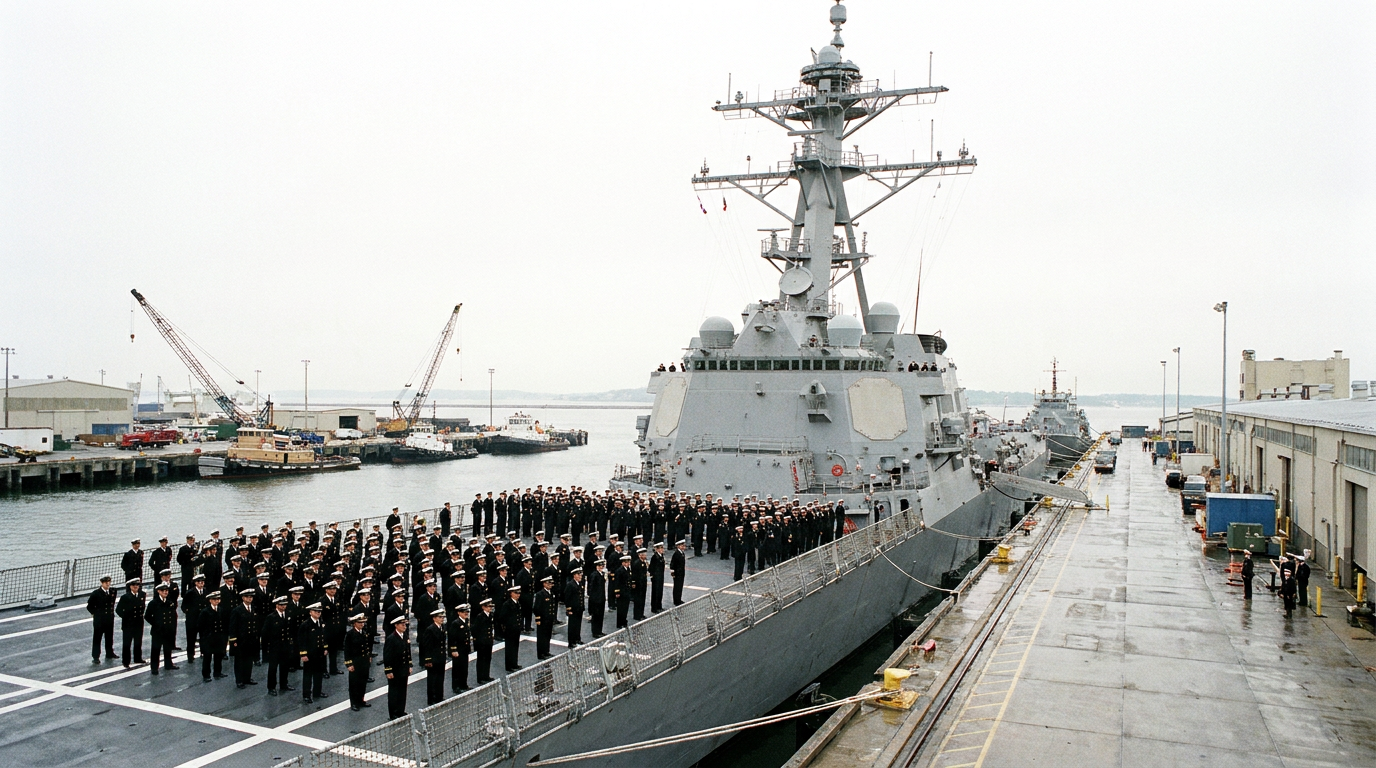
On June 23, 2026, North Korea officially commissioned the Choe Hyon, a 5,000-ton multi-mission destroyer, during a ceremony at the western port city of Nampho. The event, attended by leader Kim Jong Un, marked a significant milestone in Pyongyang's ongoing efforts to modernize its military infrastructure. For decades, the Korean People's Army Navy has operated primarily as a coastal defense force, relying on an aging fleet of small missile boats, corvettes, and diesel-electric submarines. The introduction of a large surface combatant signals a structural pivot toward a "blue-water" capable fleet designed to project power further into the Yellow Sea and beyond.[1][2][3]
The technical specifications of the Choe Hyon represent a substantial leap in North Korea's indigenous shipbuilding capabilities. Military analysts tracking the vessel's development note that it is equipped with approximately 74 vertical launch cells. These systems are capable of firing ship-launched cruise missiles and, potentially, nuclear-tipped ballistic missiles. Furthermore, imagery from the commissioning suggests the integration of modern phased-array radar systems, which allow the ship to track multiple targets simultaneously—a level of electronic sophistication far beyond anything previously fielded by Pyongyang.[3][7]
During his address at the Nampho shipyard, Kim Jong Un framed the commissioning as the end of "70 years of stagnation" for the country's naval forces. He declared that the navy's nuclear armament is proceeding exactly as planned, describing the integration of strategic weapons into the fleet as a necessary course to keep the country's forces ready for multifaceted operations. This rhetoric aligns with a broader constitutional enshrinement of North Korea's status as an "irreversible" nuclear state, a doctrine that Pyongyang uses to justify its continued military expansion despite heavy international sanctions.[1][5]

The concept of "nuclear state status" is central to understanding the strategic logic behind the Choe Hyon. In Pyongyang's geopolitical calculus, possessing a survivable, multi-domain nuclear deterrent is not solely about defense; it is a diplomatic lever. By demonstrating the ability to deploy strategic weapons at sea, North Korea aims to force the United States and its regional allies to engage with it on equal footing, effectively taking denuclearization off the negotiating table. The naval buildup is framed domestically as a direct response to the expansion of U.S. and South Korean military exercises in the region.[6][7]
However, the rapid advancement in North Korea's naval architecture has raised questions among international observers regarding the source of the technology. Defense analysts and intelligence agencies strongly suspect that the Choe Hyon was built with technical assistance from Russia. The swift progression in hull design, propulsion systems, and weapons integration points to potential technology transfers, reflecting the deepening military and economic ties between Moscow and Pyongyang over the past two years. While neither nation has publicly acknowledged such cooperation, the design similarities to Russian warships are heavily scrutinized.[4][6]
However, the rapid advancement in North Korea's naval architecture has raised questions among international observers regarding the source of the technology.
The Choe Hyon is not an isolated project, but rather the lead ship in a broader procurement pipeline. A second 5,000-ton destroyer, the Kang Kon, is currently undergoing sea trials, and Kim has announced ambitious plans to construct even larger 10,000-ton "strategic warships" in the coming years. To support this expanding fleet, the ruling Workers' Party has approved the construction of new naval bases capable of accommodating larger vessels and managing the complex logistics of a modernized, nuclear-capable maritime force.[2][3]

Despite the impressive optics of the commissioning ceremony, military experts caution against overestimating the fleet's immediate operational readiness. Transitioning from a coastal defense force to a blue-water navy involves a steep learning curve in naval engineering, crew training, and maintenance. Reports indicate that the naval buildup has not been entirely smooth; the sister ship, the Kang Kon, reportedly capsized during an initial launch attempt in May 2025. Such setbacks highlight the resource constraints and engineering challenges facing North Korean shipbuilders.[4][7]
The economic realities of sustaining a modern surface fleet present another significant hurdle. Building, equipping, and maintaining large destroyers is notoriously capital-intensive. For a heavily sanctioned economy, maintaining an annual production rate of multiple major warships will require severe domestic sacrifices and continued reliance on external material support. The long-term viability of Kim's naval ambitions will depend heavily on the resilience of North Korea's supply chains and its strategic partnerships.[5][7]
Regionally, the introduction of the Choe Hyon alters the maritime balance in the waters surrounding the Korean Peninsula. By providing Pyongyang with a platform to project power beyond its immediate coastal boundaries, the new destroyer complicates defense planning for South Korea and U.S. Pacific forces. It introduces a new vector for potential cruise missile strikes and forces allied navies to allocate additional resources to track and monitor North Korean surface movements in the Yellow Sea.[1][3]

Ultimately, the commissioning of the Choe Hyon serves as a concrete manifestation of North Korea's evolving military doctrine. By moving its strategic deterrent out to sea, Pyongyang is signaling that its military modernization is advancing across all domains. While questions remain about the true combat effectiveness and sustainability of this new fleet, the shift from a stagnant coastal force to an aspiring nuclear-armed blue-water navy marks a definitive and complex new chapter in the geopolitics of East Asia.[1][2][6]
How we got here
April 2025
The 5,000-ton destroyer Choe Hyon is first launched and begins a year of operational testing.
May 2025
A sister ship, the Kang Kon, reportedly capsizes during its initial launch attempt.
March 2026
Kim Jong Un oversees a cruise missile test from the Choe Hyon, signaling its offensive capabilities.
June 23, 2026
The Choe Hyon is officially commissioned into the Korean People's Army Navy.
Viewpoints in depth
Regional Defense Analysts
Focuses on the technical leap and the likelihood of foreign assistance, while remaining skeptical of full operational readiness.
Military experts view the Choe Hyon as a significant, albeit expected, evolution in North Korea's military modernization. They emphasize that the leap from small coastal boats to a 5,000-ton destroyer equipped with vertical launch cells and phased-array radar requires advanced naval architecture that Pyongyang likely did not develop in isolation. Many analysts point to deepening ties with Russia as the probable source of this technology transfer. However, these experts also caution against overestimating the fleet's immediate threat, noting that building a ship is only the first step; training a crew, integrating complex electronics, and maintaining a blue-water vessel require years of institutional experience that the North Korean navy currently lacks.
North Korean State Leadership
Argues that a nuclear-armed blue-water navy is essential for sovereign defense and deterring regional adversaries.
From Pyongyang's perspective, the naval buildup is a necessary and justified response to the expanding military capabilities of the United States and South Korea. State media and leadership frame the commissioning of the Choe Hyon as the end of a 70-year period of naval vulnerability. By integrating strategic and potentially nuclear weapons into the surface fleet, the leadership asserts it is securing the nation's sovereignty and ensuring that its status as a nuclear state remains irreversible. This narrative portrays the naval expansion not as an act of aggression, but as a vital deterrent against what it describes as imperialist schemes in the region.
Geopolitical Strategists
Views the naval expansion as a diplomatic tool designed to solidify nuclear status and force international concessions.
Strategists analyzing the broader geopolitical landscape see the new destroyer as a physical manifestation of North Korea's diplomatic strategy. By demonstrating the ability to deploy strategic weapons at sea, Pyongyang is attempting to change the facts on the ground, making denuclearization an increasingly unrealistic goal for Western diplomats. This camp argues that the ultimate goal of the naval buildup is to force the international community to accept North Korea as a de facto nuclear power, thereby gaining leverage to negotiate sanctions relief and drive a wedge between Washington and Seoul.
What we don't know
- The exact extent of Russian technical assistance in the design and construction of the Choe Hyon.
- Whether the vertical launch cells have been successfully integrated with nuclear-tipped ballistic missiles.
- How North Korea plans to economically sustain the production and maintenance of a large blue-water fleet.
Key terms
- Blue-water navy
- A maritime force capable of operating globally across the deep oceans, rather than being restricted to its own coastlines.
- Vertical Launch System (VLS)
- An advanced system for holding and firing missiles on naval platforms, allowing for rapid, multi-directional strikes without moving a physical turret.
- Phased-array radar
- An advanced radar system that electronically steers its beams, allowing a ship to track multiple targets simultaneously without moving physical antennas.
- Deterrence
- A military strategy aimed at dissuading an adversary from taking an action not yet started, often through the threat of overwhelming retaliation.
Frequently asked
What is the Choe Hyon?
It is North Korea's first 5,000-ton multi-mission destroyer, representing a major upgrade from its historical fleet of small coastal patrol boats.
Why is this ship significant?
The vessel is equipped with vertical launch cells capable of firing cruise and potentially ballistic missiles, extending North Korea's ability to project power into the Yellow Sea.
Did North Korea build the ship entirely on its own?
While built domestically, defense analysts and intelligence agencies strongly suspect that North Korea received technical assistance and naval architecture designs from Russia.
What does Kim Jong Un mean by 'nuclear state status'?
It refers to Pyongyang's doctrine of enshrining its nuclear arsenal as an irreversible fact, using it as leverage for military deterrence and diplomatic negotiations.
Sources
Source coverage
7 outlets
3 viewpoints surfaced







[1]Al JazeeraNorth Korean State Leadership
North Korea commissions warship as Kim eyes nuclear navy
Read on Al Jazeera →[2]Anadolu AgencyNorth Korean State Leadership
North Korea unveils new destroyer, signals expansion of nuclear-backed naval power
Read on Anadolu Agency →[3]Military Watch MagazineRegional Defense Analysts
North Korea's Navy Brings its First Ever Destroyer Into Active Service
Read on Military Watch Magazine →[4]CNNRegional Defense Analysts
North Korea on Tuesday commissioned its largest-ever warship
Read on CNN →[5]Daily NKGeopolitical Strategists
North Korea's dual strategy: engaging Washington, isolating Seoul
Read on Daily NK →[6]Defense HereRegional Defense Analysts
North Korea commissions 5,000-Ton destroyer as Kim outlines ambitious naval build-Up
Read on Defense Here →[7]RAND CorporationGeopolitical Strategists
North Korean Nuclear Weapons Threat
Read on RAND Corporation →
Every angle. Every day.
Get world stories with full source coverage and perspective breakdowns delivered to your inbox.