
The Engineering of Europe's Digital Border: How ETIAS and Biometric Scans Are Changing Entry for Travelers
The European Union has completed its transition to a fully digital border, replacing physical passport stamps with mandatory biometric scans and the ETIAS pre-authorization system. Here is how the massive technological overhaul works and what it means for non-EU travelers.
By Factlen Editorial Team
- Border Security Agencies
- View the digital border as an essential tool to track overstays and intercept criminals.
- Travel Operators
- Focus on minimizing passenger bottlenecks and integrating the tech seamlessly.
- Data Privacy Advocates
- Warn about the risks of centralizing millions of biometric profiles.
What's not represented
- · Elderly or non-digitally native travelers who may struggle with the online application and automated kiosks.
- · Non-EU cross-border commuters who cross land borders daily for work.
Why this matters
For decades, a passport stamp was the only proof of entering Europe. Now, any non-EU citizen traveling to the Schengen Area must navigate a sophisticated network of pre-screening algorithms and biometric checkpoints, fundamentally changing how you prepare for international trips.
Key points
- The EU has replaced physical passport stamps with a fully digital Entry/Exit System (EES) and ETIAS pre-authorization.
- Visa-exempt travelers must now pay €7 for an ETIAS, which is valid for three years and linked electronically to their passport.
- First-time arrivals require a biometric registration, including a facial scan and four fingerprints.
- Subsequent visits are processed rapidly through automated e-gates using facial recognition.
- The system automatically tracks the 90-day Schengen allowance, eliminating manual calculations by border guards.
The era of the ink-stained European passport page has officially closed. Across 29 European countries, the analog border has been replaced by a massive, interconnected digital infrastructure designed to process hundreds of millions of travelers annually.[3]
This transformation rests on two distinct but integrated pillars: the Entry/Exit System (EES) and the European Travel Information and Authorisation System (ETIAS). Together, they represent the largest overhaul of the Schengen Area's external borders since the abolition of internal checkpoints in 1995.[1][5]
For travelers from over 60 visa-exempt nations—including the United States, Canada, and the United Kingdom—the journey now begins long before arriving at the airport. ETIAS requires travelers to submit an online application before their departure, shifting the initial security screening from the arrival gate to the traveler's living room.[1]
The engineering behind ETIAS is built for immense scale and speed. When an application is submitted, the system cross-references the traveler's data against a suite of international databases, including Interpol, Europol, and the Schengen Information System.[2]

Despite the complex backend routing, the European Union designed the frontend to be frictionless. Officials project that roughly 97 percent of applications will be processed and approved within minutes, driven by automated algorithms that flag only genuine anomalies for manual review by border guards.[1][4]
Once approved, the €7 authorization is electronically linked to the traveler's passport for three years, or until the passport expires. This digital tethering means there is no physical document to print or lose; airlines and maritime carriers simply query the database during check-in to verify authorization.[3]
The second half of this digital equation, the Entry/Exit System (EES), takes over upon arrival in Europe. EES physically replaces the manual stamping of passports with a biometric registration process at the border checkpoint.[2]
The second half of this digital equation, the Entry/Exit System (EES), takes over upon arrival in Europe.
When a non-EU traveler arrives at a Schengen port of entry for the first time under the new system, they must provide facial images and four fingerprint scans. These biometric markers are captured by specialized kiosks and integrated directly into the central EES database.[4]
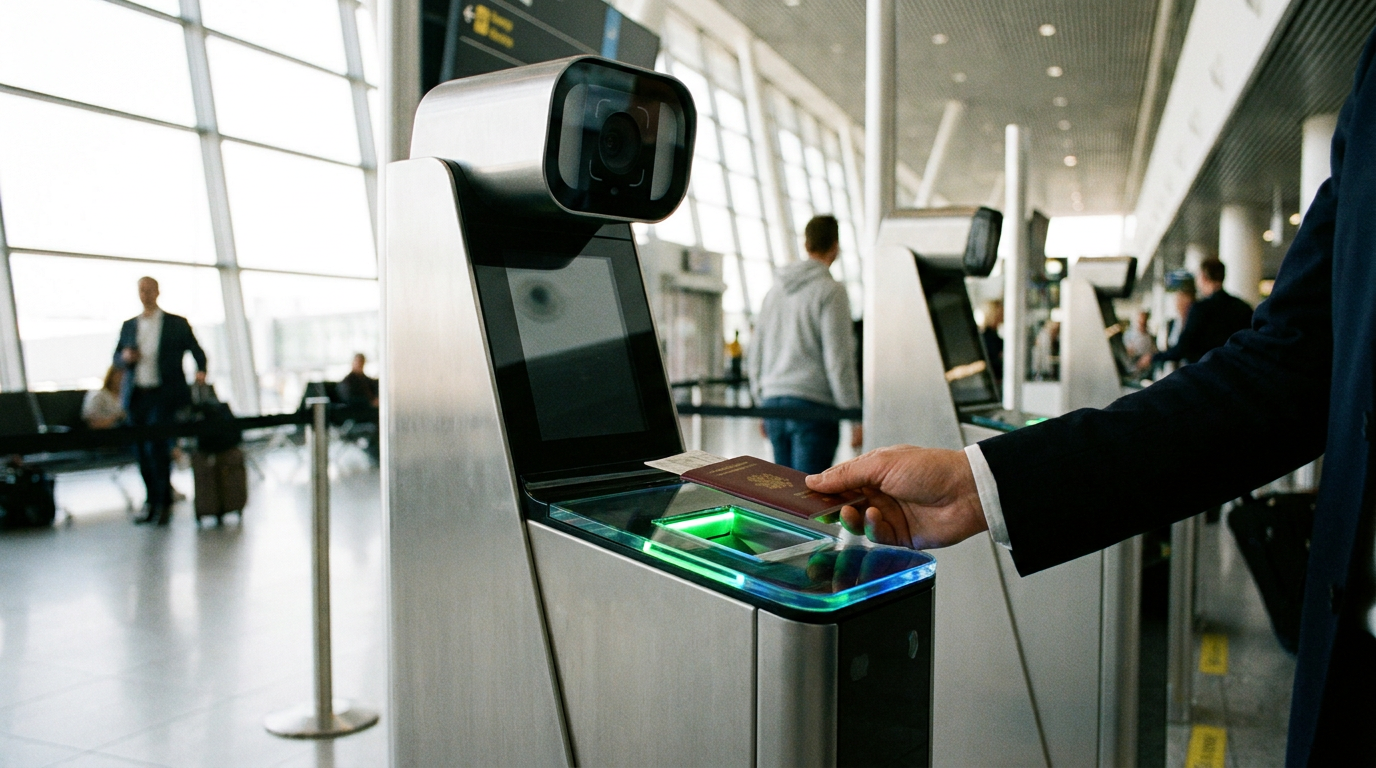
The hardware required to facilitate this has transformed European arrival halls. Airports and train stations have installed thousands of biometric pods equipped with advanced anti-spoofing technology, designed to capture high-resolution data even in the chaotic lighting of a busy terminal.[4][5]

This biometric anchoring solves a long-standing vulnerability in the Schengen system: the inability to accurately track overstays. Previously, border guards relied on manually calculating days based on faded ink stamps; now, the EES automatically calculates the 90-day allowance within any 180-day period and flags travelers who exceed their limit.[2][3]
Data privacy has been a central tension in the system's architecture. To comply with the EU's strict General Data Protection Regulation (GDPR), biometric data is heavily encrypted and stored for a maximum of three years for standard travelers, automatically purging once the retention period expires.[1][4]
Access to this central repository is strictly compartmentalized. While border guards and immigration officials have direct access for verification, law enforcement agencies can only query the database under specific, legally justified circumstances, such as terrorism investigations.[2]
The transition has not been without friction. The initial rollout required massive coordination between member states with vastly different legacy IT systems, leading to several delays before the infrastructure finally stabilized.[3][5]

Travel industry analysts note that while the first-time registration adds a few minutes to the arrival process, subsequent visits are significantly faster. Returning travelers simply scan their faces at automated e-gates, bypassing the traditional border guard booth entirely.[3]
This shift also fundamentally changes the liability for airlines and ferry operators. Carriers are now legally required to verify a passenger's ETIAS status through a dedicated carrier gateway before boarding; failing to do so results in steep fines and the responsibility of returning the denied passenger.[1][3]
Ultimately, the ETIAS and EES deployment signals the end of anonymous travel into Europe. By front-loading security checks and digitizing physical movements, the continent is betting that a transparent, data-driven border is both safer for residents and more efficient for the millions of tourists who visit each year.[5]
How we got here
1995
The Schengen Agreement takes effect, abolishing internal border checks between participating European countries.
2016
The European Commission first proposes the ETIAS system to strengthen external border security.
2017
The Entry/Exit System (EES) regulation is officially adopted by the European Parliament.
2024-2025
EES biometric infrastructure is gradually installed and tested at major European airports and land borders.
2026
The digital border ecosystem, including mandatory ETIAS pre-authorization, becomes fully operational for non-EU travelers.
Viewpoints in depth
European Security Agencies
Focus on closing intelligence gaps and preventing overstays.
For agencies like Frontex and Europol, the digital border is a long-overdue modernization. They argue that the analog stamping system was highly susceptible to forgery and made it nearly impossible to track individuals who overstayed their 90-day visa-free limit. By linking biometric data to a centralized database, security forces can instantly flag fraudulent passports and identify individuals with outstanding warrants across all 29 member states simultaneously.
Travel Industry Operators
Concerned with passenger flow and infrastructure bottlenecks.
Airlines, tour operators, and airport authorities generally support the long-term vision of frictionless travel but remain focused on the immediate logistical hurdles. Their primary concern is the physical space required for biometric registration kiosks in older, space-constrained terminals. Industry groups emphasize the need for robust API integrations so carriers can instantly verify ETIAS status without delaying boarding procedures or facing punitive fines for system outages.
Privacy and Data Advocates
Focused on the mass collection and retention of biometric markers.
Digital rights organizations acknowledge that the system complies with GDPR but remain wary of the sheer volume of sensitive biometric data being centralized. They argue that creating a massive honeypot of facial scans and fingerprints inherently increases the risk of catastrophic data breaches. These advocates continuously push for strict oversight on how often law enforcement agencies are granted access to the database, warning against 'function creep' where border data is routinely used for minor domestic policing.
What we don't know
- How the central databases will perform under the peak stress of the summer tourism season.
- Whether older, smaller border crossings (like remote land borders or small ferry ports) can maintain the necessary network uptime for real-time biometric verification.
- The exact rate of false-positive flags that will require manual intervention by border guards.
Key terms
- ETIAS
- The European Travel Information and Authorisation System, a mandatory pre-travel online screening for visa-exempt visitors.
- EES
- The Entry/Exit System, an automated IT system that registers travelers' biometric data and entry/exit dates, replacing passport stamps.
- Schengen Area
- A zone of 29 European countries that have abolished internal borders, allowing unrestricted movement between them.
- Biometric Data
- Unique physical characteristics, such as facial geometry and fingerprints, used to digitally verify a person's identity.
Frequently asked
Do I need an ETIAS if I already have a Schengen visa?
No. ETIAS is specifically designed for travelers from visa-exempt countries (like the US, UK, and Canada). If you require a traditional visa, you do not need an ETIAS.
What happens if my passport expires before my ETIAS?
Your ETIAS authorization is electronically linked to your specific passport document. If you get a new passport, you must apply and pay for a new ETIAS.
Will I still get a passport stamp as a souvenir?
No. The Entry/Exit System completely replaces physical stamping with digital records to ensure accuracy and prevent fraud.
How long does it take to get ETIAS approval?
Most applications are processed by automated algorithms and approved within minutes, though officials recommend applying at least 96 hours before departure in case manual review is required.
Sources
Source coverage
5 outlets
3 viewpoints surfaced




[1]European Union Official ETIAS Portal
What is ETIAS?
Read on European Union Official ETIAS Portal →[2]FrontexBorder Security Agencies
Entry/Exit System (EES) Implementation
Read on Frontex →[3]SkiftTravel Operators
How Europe's Digital Border is Reshaping Transatlantic Travel
Read on Skift →[4]Biometric UpdateData Privacy Advocates
Scaling the EU's Biometric Entry-Exit Infrastructure
Read on Biometric Update →[5]Factlen Editorial Team
Synthesis by Factlen editorial team
Read on Factlen Editorial Team →
Every angle. Every day.
Get travel stories with full source coverage and perspective breakdowns delivered to your inbox.