
The Hidden Cost of Safety: Why ADAS Recalibration Is Now Required on Over 65% of Collision Repairs
Advanced Driver Assistance Systems have made cars significantly safer, but the delicate sensors powering them mean that even minor fender-benders or windshield replacements now require precise, expensive recalibration.
By Factlen Editorial Team
- Collision Repair Shops
- Focuses on the massive equipment investments, training requirements, and cycle-time delays caused by the ADAS transition.
- Automotive Insurers
- Focuses on managing rising claim severities and requiring strict OEM documentation to justify reimbursement for calibration.
- Vehicle Safety Advocates
- Focuses on the absolute necessity of millimeter-perfect calibration to ensure life-saving systems function correctly.
What's not represented
- · Everyday Drivers
- · Automotive Manufacturers (OEMs)
Why this matters
Drivers are increasingly surprised by repair bills that are hundreds of dollars higher and take days longer than expected. Understanding the necessity of ADAS calibration explains these costs and highlights why skipping this step compromises the life-saving technology built into modern vehicles.
Key points
- ADAS recalibration is now required on roughly 65% of all collision repairs.
- Even a 1.5-degree shift in a sensor can cause automatic braking systems to fail.
- Windshield replacements trigger recalibration in 68% of ADAS-equipped vehicles.
- Only 44% of repair shops have the expensive equipment needed to perform calibrations in-house.
- Subletting calibration work adds an average of 3 to 5.5 days to repair cycle times.
- The average cost of a calibration procedure on a repair estimate is $688.
Remember when a minor fender-bender meant a quick trip to the body shop for a $500 bumper replacement? Those days are officially over. Today, the front bumper of a modern vehicle is no longer just a piece of painted plastic designed to absorb low-speed impacts; it is a highly sensitive, rolling sensor network. Behind the grille, inside the windshield glass, and tucked into the side mirrors are the cameras, radar units, and ultrasonic sensors that make up a vehicle’s Advanced Driver Assistance Systems (ADAS). These components are the eyes and ears of the car, powering life-saving features like automatic emergency braking, adaptive cruise control, and lane-keeping assist. But this technological leap has fundamentally rewritten the rules of automotive repair. When these sensors are disturbed by even the slightest impact, they lose their spatial orientation. Restoring the physical bodywork is now only half the job; the vehicle cannot safely return to the road until its digital vision has been painstakingly realigned.
The scale of this shift is staggering. According to recent industry data, between 61% and 65% of all collision repairs now require at least one ADAS recalibration procedure before the vehicle can be safely returned to the customer. This represents a massive operational pivot for an industry historically focused on metalwork, paint matching, and structural alignment. Five years ago, recalibration was a niche requirement reserved for luxury vehicles with cutting-edge tech packages. Today, it is a standard line item on the repair estimate for a standard Toyota Camry or Honda Civic. The sheer volume of vehicles requiring this service has caught many repair facilities off guard, transforming what used to be a straightforward mechanical fix into a complex software and geometry challenge that dictates the entire pace of the repair process.[1][3]
To understand why recalibration is so critical, one must look at the precise tolerances these systems require to function. ADAS sensors are calibrated at the factory to recognize the vehicle's exact centerline and thrust angle. A forward-facing camera mounted behind the rearview mirror or a radar sensor bolted behind the front emblem operates on millimeter-perfect geometry. If a minor collision, or even the process of removing and reinstalling a bumper cover, shifts a radar bracket by just a single millimeter or alters its pitch by 1.5 degrees, the system’s perception of the physical world is entirely warped. The vehicle's computer has no way of knowing the sensor has moved; it simply processes the incoming data as if the hardware were still perfectly aligned.[5]

The real-world consequences of this microscopic misalignment are severe. If a forward-facing radar unit is angled slightly to the left, the vehicle’s adaptive cruise control might lock onto a car in the adjacent lane rather than the one directly ahead. Worse, the automatic emergency braking system might misjudge the distance to a stationary object, either failing to engage when a crash is imminent or triggering a violent, unexpected stop on an empty highway because it perceived a roadside sign as a threat. Because these systems are designed to intervene and take control of the vehicle's brakes and steering to prevent accidents, a miscalibrated sensor is not just an inconvenience—it is an active safety hazard that can cause the very collisions it was engineered to prevent.
It is not just structural collisions that trigger these stringent recalibration requirements. Routine maintenance and minor aesthetic repairs now routinely disrupt the ADAS network. Windshield replacements are the most common trigger; industry data indicates that roughly 68% of ADAS-equipped vehicles require a forward-facing camera recalibration after new glass is installed. Because the camera looks through the glass, any variation in the windshield's curvature, thickness, or optical clarity requires the system to be retaught how to see. Similarly, wheel alignments, suspension repairs, and even changes in ride height alter the vehicle's pitch and yaw, changing the angle at which the sensors view the road. In the modern automotive ecosystem, almost any significant mechanical adjustment necessitates a corresponding digital realignment.[4]
It is not just structural collisions that trigger these stringent recalibration requirements.
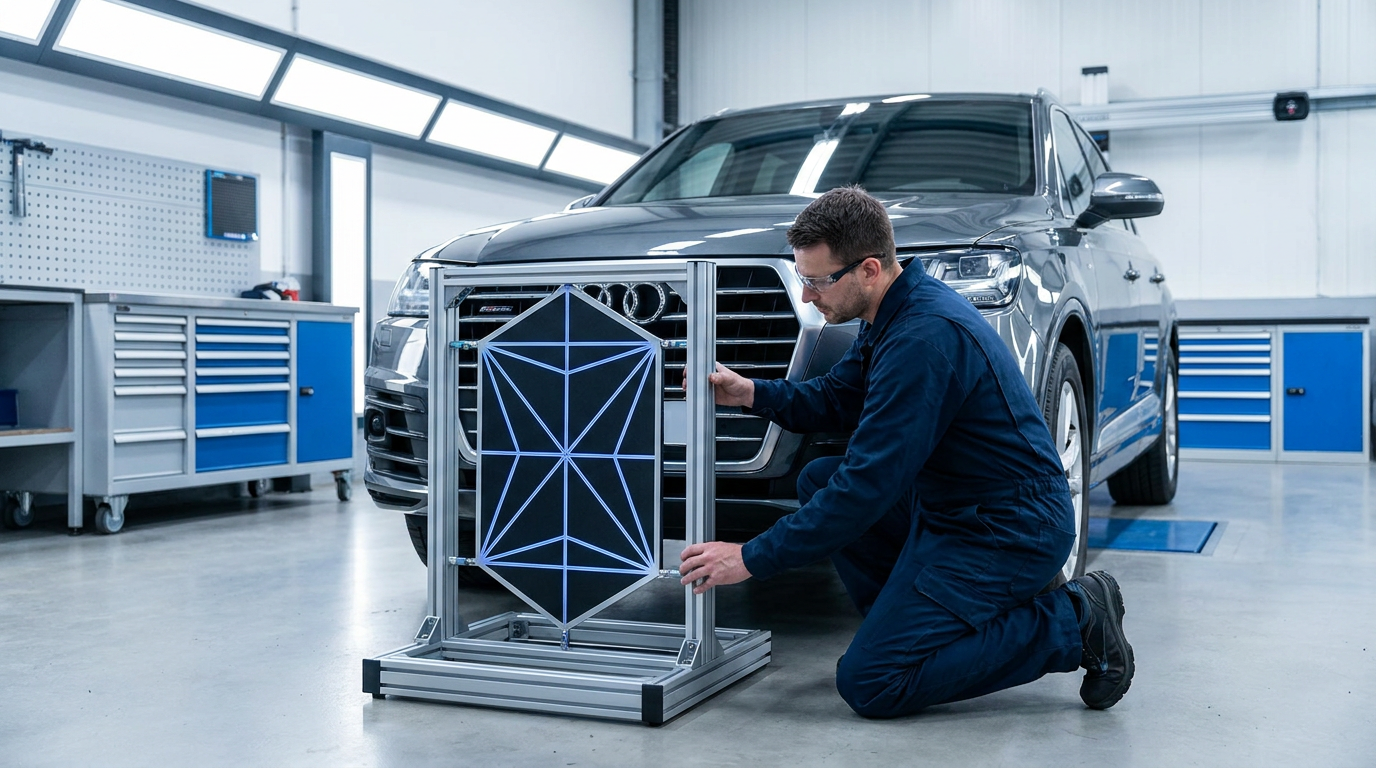
Restoring a vehicle's digital vision is achieved through two primary methods, the first being static calibration. This highly controlled procedure takes place inside the repair facility and requires a pristine environment. The vehicle is parked on a perfectly level floor—because even a slight slope can corrupt the sensor's vertical alignment—under specific, uniform lighting conditions to prevent glare from confusing optical cameras. Technicians place specialized geometric targets, patterned boards, or radar reflectors at exact distances and heights relative to the vehicle's thrust line. Using OEM-approved diagnostic software plugged into the car's OBD-II port, the technician commands the vehicle's computer to look at the targets and adjust its internal coordinates until its digital grid perfectly matches the physical world.[5][6]
The second method, dynamic calibration, requires the vehicle to relearn its environment out on the open road. Instead of looking at stationary targets in a controlled bay, the vehicle is driven at specific speeds—typically between 25 and 75 mph—on well-marked roads for a set distance. During this drive cycle, the ADAS module self-learns its alignment by continuously correlating the sensor data it receives against the expected geometry of the road lines and surrounding traffic. Dynamic calibration is highly dependent on external conditions; it cannot be successfully completed in heavy rain, snow, dense traffic, or on rural roads with faded lane markings, as the system requires clear, consistent reference points to validate its orientation.[6]
This added layer of technological complexity has driven up the cost of routine repairs. In 2025, the average cost of an ADAS calibration line item on a collision estimate reached $688, with basic single-sensor calibrations starting around $300 and complex, multi-sensor arrays on luxury SUVs easily exceeding $1,000. These costs reflect the specialized labor, the expensive diagnostic software, and the sheer time required to set up the precise physical environments needed for static targeting. As the penetration rate of ADAS calibrations has more than doubled since 2022—climbing from 12.1% of estimates to nearly 35%—insurers and consumers alike are feeling the financial impact of repairing vehicles that are fundamentally safer but vastly more fragile.[2]

For the collision repair industry, the ADAS revolution has created a massive logistical bottleneck. Currently, only about 44% of repair shops possess the in-house equipment and trained personnel required to perform these calibrations. The remaining majority must sublet the work to specialized calibration centers or local dealerships. This reliance on third-party vendors wreaks havoc on repair cycle times. Coordinating a sublet calibration typically adds between 3 and 5.5 days to the total repair time. A vehicle that is mechanically finished and fully painted will sit idle in a holding lot, waiting for an open slot at a calibration facility, driving up rental car costs and frustrating customers who do not understand why a finished-looking car cannot be driven home.[4]
Bringing this capability in-house requires a staggering capital investment that many independent shops struggle to justify. Setting up a proper static calibration bay requires purchasing base alignment frames, target sets, and diagnostic computers, which typically run between $75,000 and $150,000. But the hardware is only the beginning. Shops must also pay for continuous OEM software subscriptions to access the latest calibration protocols for new model years, an operational expense that can exceed $18,000 annually. Furthermore, the shop must dedicate a massive footprint of perfectly level, empty floor space—often 30 by 40 feet—just to set up the targets, sacrificing valuable square footage that could otherwise be used for active repair bays.[1][5]

As shops navigate these massive investments, they frequently encounter friction with insurance carriers over reimbursement. While insurers recognize the necessity of ADAS calibration for vehicle safety, the billing process is highly scrutinized. Repair facilities report significant pushback on line-item charges, with adjusters demanding extensive documentation, pre- and post-repair diagnostic scans, and proof of OEM procedures before approving payment. This administrative burden forces shops to become meticulous record-keepers, proving not only that the calibration was necessary based on the manufacturer's repair manual, but that it was executed flawlessly using the correct tools and targets.[1][2]
Looking ahead, the complexity of vehicle sensor networks is only going to increase. As automakers push toward Level 3 autonomous driving, vehicles are being equipped with even more sophisticated hardware, including LiDAR units and high-definition surround-view cameras. These advanced systems will require multi-plane geometric alignments that make today's target boards look primitive. The era of the purely mechanical auto body repair is definitively over. In its place is a highly technical discipline where software engineering and digital precision are just as critical as welding and painting, ensuring that the invisible safety nets protecting drivers remain intact long after the physical damage has been erased.
How we got here
Early 2010s
ADAS features like automatic emergency braking are introduced primarily as expensive options on luxury vehicles.
2018
Major automakers commit to making automatic emergency braking standard equipment on nearly all new passenger vehicles.
2022
ADAS recalibration appears on roughly 12% of collision repair estimates as the technology saturates the market.
2025
Recalibration penetration reaches nearly 35% of estimates, with average costs hitting $688 per procedure.
2026
High-volume, specialized ADAS calibration centers emerge to handle the overflow from independent shops unable to afford the $150,000 equipment costs.
Viewpoints in depth
Collision Repair Shops' view
The transition to ADAS represents a massive financial and operational burden for independent repairers.
For shop owners, the ADAS revolution is a double-edged sword. While it creates a new revenue stream for those who can afford the $150,000 initial equipment investment, it severely punishes those who cannot. Shops that sublet the work watch their cycle times balloon by up to 5.5 days, leading to angry customers and frustrated insurance partners. Even for shops that bring the work in-house, the requirement to dedicate 1,200 square feet of perfectly level floor space to static targeting—along with paying $18,000 annually in software subscriptions—strains profit margins in an already difficult industry.
Automotive Insurers' view
Rising claim severities must be balanced against the need for strict documentation to prevent fraud and ensure safety.
Insurers are bearing the brunt of the financial impact, watching the average cost of a minor fender-bender skyrocket due to $688 calibration line items. While carriers recognize that calibration is non-negotiable for vehicle safety, they are increasingly demanding rigorous proof that the work was actually performed to OEM standards. Adjusters frequently push back on blanket calibration charges, requiring shops to provide pre- and post-repair diagnostic scans, photographic evidence of target placement, and specific manufacturer guidelines to justify the reimbursement.
Vehicle Safety Advocates' view
Millimeter-perfect calibration is a non-negotiable requirement to keep life-saving technology functioning.
Safety experts view the rising costs and logistical headaches as a necessary growing pain in the pursuit of zero automotive fatalities. From their perspective, an uncalibrated ADAS system is worse than having no system at all, as it lulls the driver into a false sense of security. They argue that because these systems can actively take control of a vehicle's steering and braking, any compromise in sensor geometry—even a 1.5-degree radar shift—transforms a safety feature into an active hazard. To advocates, strict adherence to OEM calibration procedures is the only way to ensure the technology actually saves lives.
What we don't know
- How the collision repair industry will handle the even stricter calibration requirements of upcoming Level 3 autonomous vehicles.
- Whether insurance premiums will rise proportionally to cover the surging frequency of $600+ calibration line items.
- If automakers will eventually develop self-calibrating sensors that eliminate the need for massive in-shop target setups.
Key terms
- ADAS
- Advanced Driver Assistance Systems; the network of cameras and sensors that power safety features like automatic braking and lane-keeping.
- Static Calibration
- A highly controlled, in-shop alignment process using physical geometric targets and laser measurements.
- Dynamic Calibration
- An on-road alignment process where the vehicle is driven at specific speeds to self-learn its environment using lane markings.
- Thrust Angle
- The invisible centerline of the vehicle's rear wheels, used as the geometric baseline for aligning ADAS sensors.
- OEM
- Original Equipment Manufacturer; the company that built the vehicle and sets the strict repair and calibration guidelines.
Frequently asked
Do I need calibration after a windshield replacement?
Yes. Because the forward-facing camera looks through the glass, any variation in the new windshield requires the system to be recalibrated to ensure features like automatic braking work correctly.
Can any mechanic perform ADAS calibration?
No. Proper calibration requires specialized OEM diagnostic software, geometric target boards, and a perfectly level environment, which only about 44% of shops currently possess.
Does insurance cover ADAS calibration?
Generally, yes. If the calibration is required as part of a covered collision claim or windshield replacement, insurers will reimburse the cost, provided the shop supplies the proper documentation.
What happens if I skip the calibration?
Skipping calibration can result in safety systems failing to engage during an emergency or triggering falsely, such as slamming on the brakes for a non-existent obstacle.
Sources
Source coverage
6 outlets
3 viewpoints surfaced






[1]Collision Repair MagVehicle Safety Advocates
Nearly half of auto repair shops unequipped for ADAS repairs as demand surges
Read on Collision Repair Mag →[2]Auto Body NewsAutomotive Insurers
Enlyte's 2026 Annual Trends Report Documents Calibration Growth and Parts Inflation
Read on Auto Body News →[3]Aftermarket MattersCollision Repair Shops
In an environment where 65% of repairs now require ADAS recalibration, shops face liability risks
Read on Aftermarket Matters →[4]Find PigtailsCollision Repair Shops
ADAS Recalibration Now on 35% of Collision Repairs: How Rising Complexity is Reshaping Shop Operations
Read on Find Pigtails →[5]ProTech Automotive SolutionsCollision Repair Shops
The Real Cost of ADAS Equipment: The Bottom Line for Collision Centers
Read on ProTech Automotive Solutions →[6]National Auto Repair AuthorityVehicle Safety Advocates
ADAS Calibration and Repair: Advanced Driver Assistance System Service Requirements
Read on National Auto Repair Authority →
Every angle. Every day.
Get automotive stories with full source coverage and perspective breakdowns delivered to your inbox.