
The Evidence on DOE Outsourcing: How Interagency Agreements Are Restructuring the Department of Education
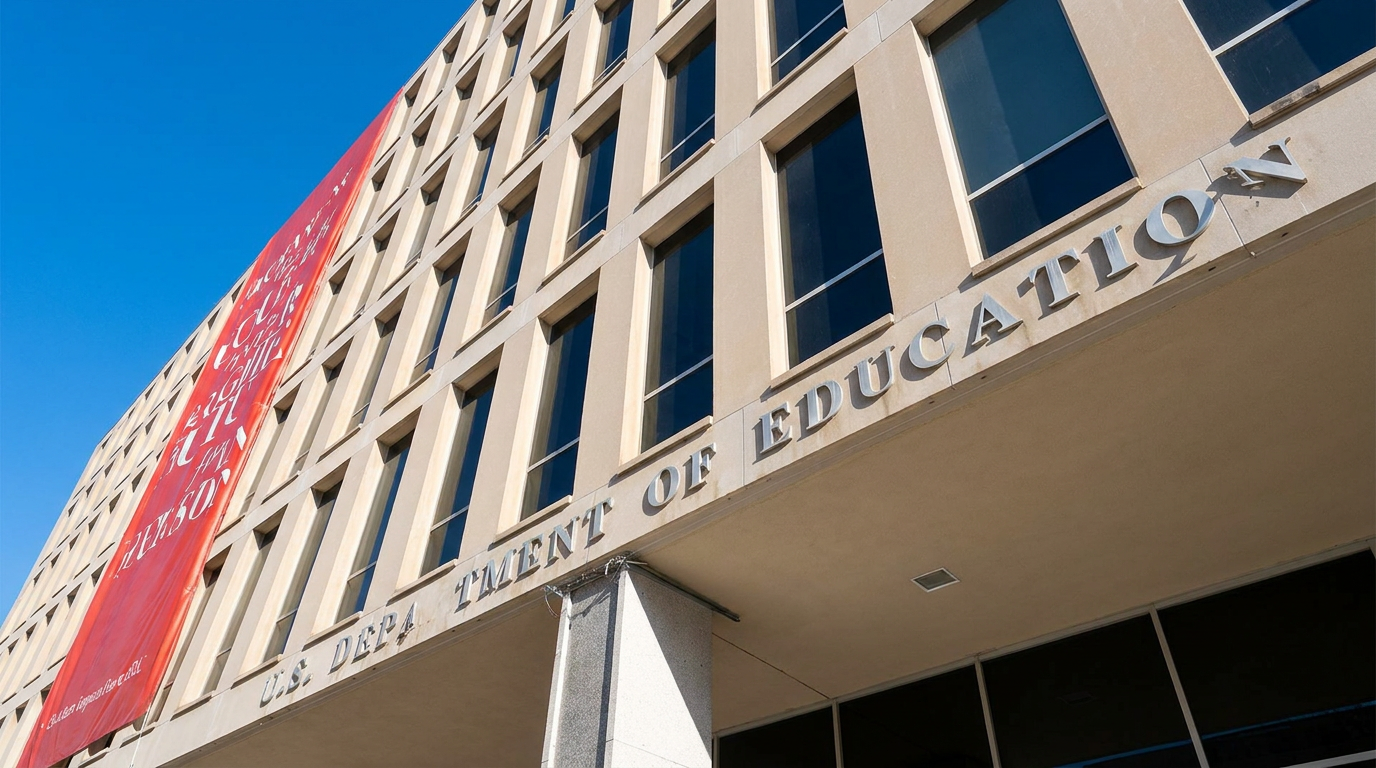
The U.S. Department of Education is systematically transferring its core functions to other federal agencies through 14 interagency agreements, fundamentally reshaping federal education policy.
By Factlen Editorial Team
- Administration & Proponents
- Argues that outsourcing cuts red tape, reduces federal bureaucracy, and returns education authority to states.
- Civil Rights & Disability Advocates
- Argues that splintering oversight threatens vulnerable students, weakens enforcement, and creates bureaucratic confusion.
- Institutional Administrators
- Concerned about the administrative burden, confusion over grant management, and loss of specialized expertise.
What's not represented
- · State-level education superintendents who will inherit the decentralized authority.
- · Classroom teachers navigating the changing federal compliance landscape.
Why this matters
This bureaucratic restructuring effectively dismantles the operational capacity of the Department of Education without congressional approval. The shift directly impacts how $1.7 trillion in student loans are managed, how civil rights are enforced in schools, and how local districts receive federal funding.
Key points
- The Department of Education has signed 14 interagency agreements since May 2025 to transfer its core functions to other federal agencies.
- The Treasury Department is absorbing the $1.7 trillion student loan portfolio, while the Labor Department takes over K-12 and postsecondary grants.
- Recent agreements shift special education oversight to Health and Human Services and civil rights enforcement to the Justice Department.
- Proponents argue the moves cut bureaucracy and empower states, while critics warn they illegally splinter oversight and threaten vulnerable students.
The U.S. Department of Education is undergoing a fundamental restructuring, not through a sweeping act of Congress, but through a bureaucratic mechanism known as "interagency agreements." Over the past year, the agency has systematically transferred the day-to-day management of its core functions to other federal departments. This strategy allows the administration to bypass the legislative branch, effectively dismantling the agency's operational footprint while retaining its statutory responsibilities on paper.[2][4]
The latest and most consequential phase of this reorganization was announced on June 16, 2026. Education Secretary Linda McMahon revealed four new agreements that shift the oversight of the nation's special education system to the Department of Health and Human Services (HHS). Simultaneously, the department's Office for Civil Rights and its student privacy enforcement division are being embedded within the Department of Justice (DOJ).[1][3]
These new partnerships bring the total number of interagency agreements executed since May 2025 to 14. Collectively, they redistribute the responsibilities of the 46-year-old department across six other federal agencies, including the Departments of Labor, Interior, State, and Treasury. The administration has framed the initiative as a practical step toward reducing federal bureaucracy and returning educational authority to state and local governments.[2][4][6]

The legal mechanism enabling this shift is the Economy Act, which authorizes federal agencies to enter into agreements to jointly carry out projects of common interest. Under these agreements, the Education Department officially retains its statutory authority and enforcement mandates. However, the actual administration of grants, technical assistance, and daily operations are outsourced to partner agencies.[2][8]
Earlier agreements set the template for this massive reorganization. The Department of the Treasury is currently absorbing the management of the $1.7 trillion federal student loan portfolio, and will eventually take over the administration of the Free Application for Federal Student Aid (FAFSA). Meanwhile, the Department of Labor has taken on a significantly expanded role in administering K-12 and postsecondary education grant programs, aligning them more closely with workforce development initiatives.[2][6]
Other specialized functions have also been dispersed. The Interior Department is now the primary point of contact for Indian Education programs, managing competitions and technical assistance for Native students. The State Department has assumed responsibility for monitoring foreign gifts and contracts reported by colleges and universities, framing the issue as a matter of national security.[2]
The Interior Department is now the primary point of contact for Indian Education programs, managing competitions and technical assistance for Native students.
Proponents of the restructuring argue that these moves eliminate redundant layers of Washington bureaucracy. Secretary McMahon has stated that partnering with agencies that possess specific administrative expertise will streamline federal activities and better serve taxpayers. Conservative policy groups have praised the strategy, noting that it shrinks the department's footprint and fulfills a long-standing presidential promise to decentralize education policy.[6][8]
However, the strategy has provoked intense backlash from civil rights organizations, disability advocates, and educational institutions. Critics argue that the interagency agreements are a legally dubious attempt to dismantle a cabinet-level agency without congressional approval. They warn that splintering federal oversight across multiple departments will create profound confusion for schools, districts, and families trying to navigate federal requirements.[2][7]

The transfer of the Office of Special Education and Rehabilitative Services (OSERS) to HHS has raised particular alarm. Disability advocates argue that separating special education from general education oversight marginalizes students with disabilities. While federal officials insist that funding for the Individuals with Disabilities Education Act (IDEA) will remain secure, advocacy groups warn that the shift undermines the core foundation of federal disability policy.[5]
Similarly, civil rights groups have condemned the move to embed the Office for Civil Rights within the DOJ. The Education Department's civil rights attorneys have historically focused on providing technical assistance to schools to ensure compliance with laws protecting students from discrimination. Critics fear that shifting this function to the DOJ will replace a collaborative, educational approach with a purely prosecutorial model, potentially weakening systemic oversight.[3][7]
Higher education administrators are also bracing for logistical chaos. Financial aid professionals have expressed deep concern over transferring FAFSA and student loan management to the Treasury Department. They argue that agencies without deep, specialized experience in higher education policy will struggle to resolve the complex, urgent problems that routinely arise in student aid administration, risking disruptions for millions of students.[9]
The broader philosophical shift—particularly moving K-12 and higher education grants to the Department of Labor—has also drawn scrutiny. Child advocacy groups argue that this signals a view of education solely as a vehicle for workforce preparation. They contend that moving programs to the Labor Department diverts attention from the holistic developmental, social, and civic roles that public schools play in children's lives.[10]

Despite the mounting opposition, the administration shows no signs of slowing the transition. Federal officials have directed the involved agencies to provide biweekly briefings to lawmakers on the implementation of the agreements, though Congress has not passed legislation to block the moves. Meanwhile, a coalition of advocacy groups is pursuing litigation in federal court, arguing that the transfers violate the statutory mandates established when Congress created the department in 1979.[2][7]
Ultimately, the success or failure of these interagency agreements will redefine the federal government's role in American classrooms. Whether the restructuring results in a more efficient, decentralized system or a fragmented bureaucratic maze, the operational dismantling of the Department of Education marks one of the most significant shifts in federal education policy in half a century.[4]
How we got here
May 2025
The Department of Education signs its first interagency agreements, transferring workforce and K-12 programs to the Department of Labor.
November 2025
Treasury Department begins absorbing the $1.7 trillion federal student loan portfolio.
February 2026
Agreements with the State and Interior Departments are finalized, moving foreign gift reporting and Indian Education programs.
June 2026
Four new agreements are announced, shifting special education to HHS and civil rights enforcement to the DOJ.
Viewpoints in depth
The Administration's View
Proponents argue that outsourcing functions cuts bureaucracy and empowers states.
The Trump administration and conservative policy groups view the interagency agreements as a necessary mechanism to dismantle an inefficient federal bureaucracy. By transferring operational control to agencies with specific expertise—such as the Treasury for loans or Labor for workforce alignment—they argue the government can reduce red tape and save taxpayer money. Ultimately, they see this as a fulfillment of the promise to return educational authority to state and local leaders.
Civil Rights and Disability Advocates
Advocates warn that splintering oversight threatens vulnerable students and weakens legal enforcement.
Organizations representing marginalized students argue that the Department of Education was explicitly created to ensure equitable access to learning. They fear that moving the Office for Civil Rights to the Justice Department will replace collaborative technical assistance with a rigid prosecutorial approach. Furthermore, disability advocates argue that separating special education from general K-12 oversight will isolate and marginalize students who rely on federal protections.
Institutional Administrators
School and university officials are concerned about the logistical chaos of navigating multiple federal agencies.
Financial aid officers and K-12 district administrators warn that the restructuring creates an administrative nightmare. They argue that agencies like the Treasury or Labor lack the specialized, nuanced understanding of education policy required to manage complex grant programs and student aid. These professionals fear that the loss of a centralized, expert point of contact will lead to delayed funding, compliance confusion, and ultimately, disruptions for students.
What we don't know
- How federal courts will rule on pending lawsuits challenging the legality of the interagency agreements.
- Whether the Department of Justice will alter the threshold for investigating civil rights complaints in schools.
- How the Treasury Department will handle the technical complexities of the upcoming FAFSA cycle.
Key terms
- Interagency Agreement (IAA)
- A written agreement between federal agencies allowing one to perform work or manage funds on behalf of another.
- Economy Act
- A federal law that permits agencies to purchase goods or services from other federal entities if it is more efficient than contracting externally.
- Office for Civil Rights (OCR)
- The division responsible for enforcing federal civil rights laws that prohibit discrimination in programs receiving Department of Education funding.
- Individuals with Disabilities Education Act (IDEA)
- The landmark federal law ensuring that students with disabilities receive a free appropriate public education.
- Statutory Responsibility
- The legal obligation assigned by Congress to a specific agency to oversee and enforce a law, even if day-to-day operations are outsourced.
Frequently asked
What is an interagency agreement?
A formal contract authorized by the Economy Act that allows one federal agency to manage programs or provide services on behalf of another.
Is the Department of Education officially closed?
No. Only Congress can formally abolish a cabinet-level agency. The department still exists and retains statutory responsibility for its programs on paper.
How will this affect student loans and FAFSA?
Operational management of the $1.7 trillion federal student loan portfolio and the FAFSA system is transitioning to the Department of the Treasury.
Will special education funding change?
The administration states that funding for the Individuals with Disabilities Education Act (IDEA) will continue to flow to states, though day-to-day management is shifting to the Department of Health and Human Services.
Sources
Source coverage
10 outlets
3 viewpoints surfaced










[1]Education Week
The Ed. Dept. Is Outsourcing Special Education and Civil Rights. Here's What That Means
Read on Education Week →[2]Higher Ed DiveInstitutional Administrators
Education Department now has 14 interagency agreements: Here are the details
Read on Higher Ed Dive →[3]NPR
Education Dept. shifts civil rights, special ed to other agencies
Read on NPR →[4]The Guardian
Trump administration takes new steps toward dismantling US education department
Read on The Guardian →[5]Disability ScoopCivil Rights & Disability Advocates
The Ed Department Is Outsourcing Special Education. Here's What That Means For Students With Disabilities
Read on Disability Scoop →[6]U.S. Department of EducationAdministration & Proponents
Education Department Announces New Interagency Agreements to Streamline Federal Programs
Read on U.S. Department of Education →[7]American Civil Liberties UnionCivil Rights & Disability Advocates
ACLU Condemns Trump Administration's Move to Dismantle Department of Education
Read on American Civil Liberties Union →[8]American Legislative Exchange CouncilAdministration & Proponents
Department of Education Continues to Shrink its Footprint
Read on American Legislative Exchange Council →[9]NASFAAInstitutional Administrators
NASFAA Statement on Department of Education Interagency Agreements
Read on NASFAA →[10]First Focus on ChildrenCivil Rights & Disability Advocates
Dismantling the Department of Education harms children
Read on First Focus on Children →
Every angle. Every day.
Get education stories with full source coverage and perspective breakdowns delivered to your inbox.