
Steam Deck OLED vs. ASUS ROG Ally X: Choosing the Right Premium Handheld in 2026
As the handheld PC market matures, the choice between Valve's seamless Steam Deck OLED and ASUS's high-performance ROG Ally X comes down to a strict trade-off between console-like efficiency and raw Windows power.
By Factlen Editorial Team
- SteamOS Advocates
- Value a curated, stable, and highly efficient console-like interface.
- Windows Power Users
- Prioritize raw performance, modding freedom, and access to all PC storefronts.
What's not represented
- · Budget-conscious gamers who rely on the secondary market or cheaper LCD models.
- · Cloud gaming advocates who prefer lightweight streaming devices over heavy local hardware.
Why this matters
Dropping $500 to $800 on a portable gaming PC is a significant investment. Understanding the hard trade-offs between battery efficiency, operating system friction, and raw graphical power ensures players buy the device that actually fits their daily routine.
Key points
- The Steam Deck OLED offers a frictionless, console-like experience powered by SteamOS.
- ASUS's ROG Ally X provides raw performance and full Windows 11 compatibility.
- Valve's handheld excels in battery efficiency, stretching up to 12 hours on lighter games.
- The ROG Ally X features a massive 80Wh battery to support its demanding Z1 Extreme processor.
- Buyers must choose between software simplicity and maximum graphical power.
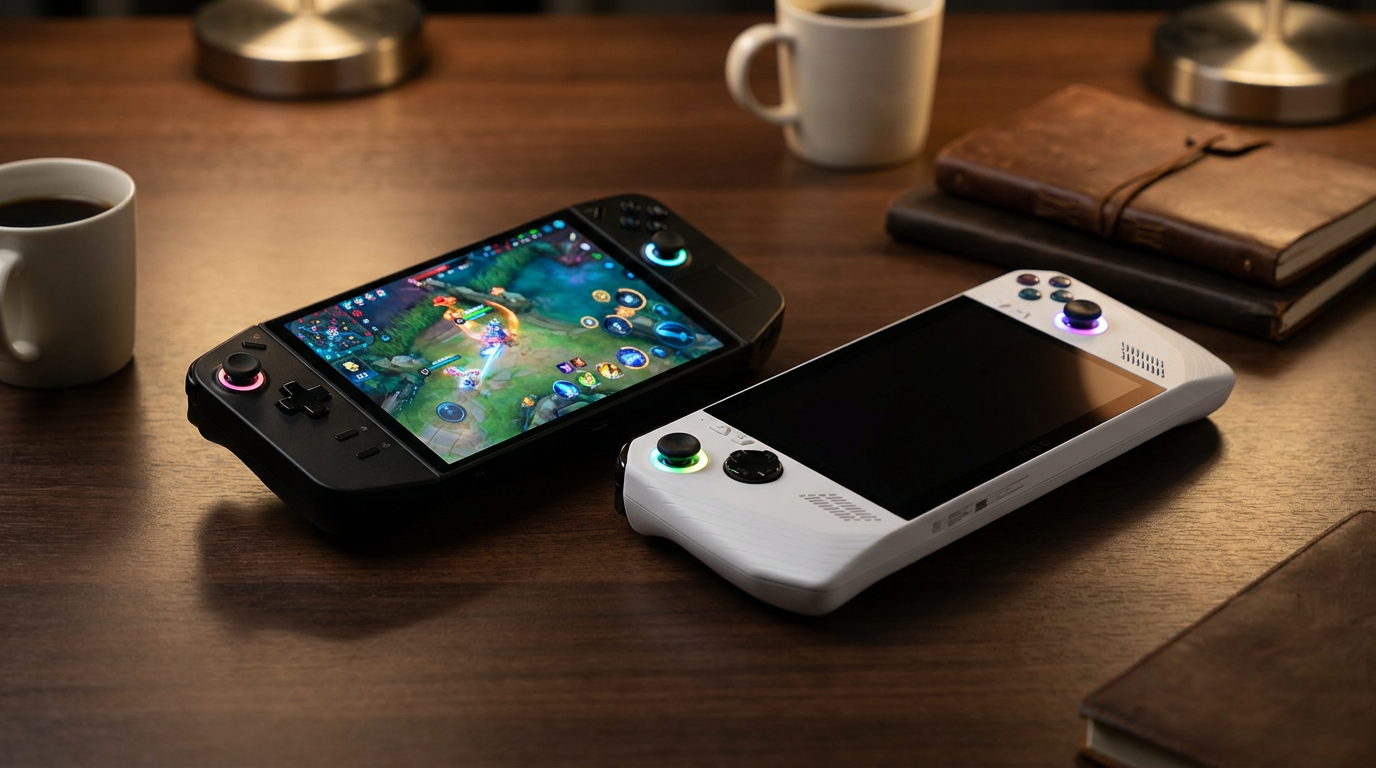
The gap between desktop performance and portable convenience has effectively vanished in 2026. While the market is flooded with new entrants boasting massive screens and modular controllers, the two titans of the premium handheld space remain Valve’s Steam Deck OLED and the ASUS ROG Ally X. Choosing between them is no longer a question of which device is objectively better, but rather a strict trade-off between software elegance and raw hardware muscle.[1][3]
The core philosophical divide centers entirely on the operating system. Valve has doubled down on SteamOS, a custom Linux-based environment designed exclusively for gaming and controller navigation. ASUS, conversely, relies on Windows 11, effectively shrinking a full desktop PC into a 7-inch form factor. This fundamental choice dictates every aspect of the user experience, from battery life to game compatibility.[4][5]
For the Steam Deck OLED, the primary argument is absolute frictionless play. The device operates like a traditional console: users press the power button, select a game, and immediately resume exactly where they left off. There are no background Windows updates to manage, no conflicting driver software, and no clunky desktop launchers to navigate with a joystick. It is designed to make the hardware disappear so the game can take over.[2][3]
Against the Steam Deck OLED, the main drawback is a hard ceiling on compatibility and top-end performance. Because it relies on Linux and a translation layer called Proton, certain major multiplayer titles with strict anti-cheat software simply refuse to run. Furthermore, its custom AMD APU, while highly efficient, struggles to maintain smooth frame rates in the most demanding AAA releases of 2026 without significant visual compromises.[1][4]

The evidence for Valve’s approach lies in its unmatched efficiency and display quality. The 7.4-inch OLED HDR panel delivers perfect black levels and vibrant contrast that LCDs cannot replicate. By operating at lower wattages, the device’s 50Wh battery can stretch up to an astonishing 12 hours when playing lightweight indie titles or retro emulators, drawing as little as 7 to 8 watts of power.[2][7]
The evidence for Valve’s approach lies in its unmatched efficiency and display quality.
For the ASUS ROG Ally X, the defining advantage is uncompromised power and absolute digital freedom. Because it runs Windows 11 natively, players have immediate access to Xbox Game Pass, the Epic Games Store, and any modding tools they would normally use on a desktop. It is a device that refuses to lock players into a single ecosystem, offering a true PC experience on the go.[5][6]
Against the ROG Ally X, the trade-off is the inherent friction of using a desktop operating system on a small touchscreen. Players must frequently interact with tiny Windows menus, manage software updates across multiple apps, and tolerate louder fan noise when the system is pushed to its limits. It requires a willingness to tinker that console purists often find frustrating.[3][4]
The evidence for the ROG Ally X’s dominance is written clearly on its spec sheet. It boasts an AMD Ryzen Z1 Extreme processor paired with a massive 24GB of LPDDR5X RAM, allowing it to brute-force its way through heavy titles. To support this power draw, ASUS equipped it with an 80Wh battery—the largest in its class—and a 7-inch IPS display featuring a 120Hz variable refresh rate that actively smooths out frame drops.[1][6]

Beyond the silicon, physical ergonomics play a massive role in daily use. The Steam Deck is wider and heavier but distributes its weight exceptionally well, featuring dual trackpads that make strategy and mouse-heavy games playable on the go. The Ally X is denser and utilizes a traditional Xbox-style asymmetrical stick layout, which feels immediately familiar to console veterans but lacks the precise input options of Valve’s machine.[3][7]
Ultimately, the Steam Deck OLED fits well when a player’s library is firmly rooted in Steam and they prioritize battery life, instant sleep-mode reliability, and a curated experience. It is the definitive choice for those who want a seamless, console-like interface, especially for indie titles and older classics.[1][2]

Conversely, the ROG Ally X fits well when a user demands access to non-Steam storefronts, requires the highest possible frame rates in modern AAA games, and is comfortable adjusting settings to optimize performance. It is the ultimate tool for power users who view their handheld as a portable extension of their primary desktop rig.[4][5]
However, neither device fits well when expectations are misaligned. The Steam Deck will deeply frustrate anyone relying on a massive Xbox Game Pass subscription, while the Ally X will inevitably annoy players looking for a zero-maintenance, plug-and-play toy. In 2026, the best handheld is simply the one that aligns with how much patience a player has for PC gaming quirks.[3][6]
How we got here
Early 2022
Valve launches the original Steam Deck, proving the viability of the handheld PC market.
Mid 2023
ASUS releases the first ROG Ally, introducing Windows 11 and a 120Hz screen to the category.
Late 2023
Valve releases the Steam Deck OLED, featuring a superior screen and improved battery efficiency.
Mid 2024
ASUS launches the ROG Ally X, doubling the battery capacity and increasing RAM to 24GB.
Viewpoints in depth
Console Purists
Gamers who want a seamless, plug-and-play experience without software friction.
This camp heavily favors the Steam Deck OLED. They argue that a handheld device should wake from sleep instantly and launch games without requiring driver updates or launcher logins. For these players, the deep integration of SteamOS and the efficiency of the custom APU matter far more than achieving the highest possible frame rates. They view Windows on a handheld as a fundamental design flaw that introduces unnecessary maintenance.
Performance Enthusiasts
Power users who demand desktop-level freedom and the highest graphical fidelity.
This group champions the ROG Ally X. They point out that locking a device to a Linux-based OS artificially limits a player's library, cutting off access to Xbox Game Pass, Epic Games, and titles with strict anti-cheat software. For these users, the ability to tweak TDP wattages, install mods, and push a 120Hz variable refresh rate screen to its limits justifies the occasional clunkiness of navigating Windows 11 on a 7-inch touchscreen.
What we don't know
- When Valve will officially announce and release the next-generation Steam Deck 2.
- How upcoming ARM-based processors might disrupt the x86 dominance in the handheld space.
Key terms
- APU
- Accelerated Processing Unit, a single chip that combines both the central processor and the graphics processor.
- SteamOS
- A Linux-based operating system developed by Valve, designed specifically to run PC games on a handheld interface.
- TDP
- Thermal Design Power, which indicates how much electrical power the processor is allowed to draw, directly affecting performance and battery life.
- VRR
- Variable Refresh Rate, a display technology that syncs the screen's refresh rate with the game's frame rate to prevent visual stuttering.
Frequently asked
Can the Steam Deck play Xbox Game Pass titles?
Not natively through a dedicated app. Players must either stream Game Pass titles via the cloud or go through a complex process to install Windows on the device.
Does the ROG Ally X have an OLED screen?
No, the ROG Ally X uses a 7-inch IPS LCD panel, though it does feature a faster 120Hz refresh rate and variable refresh rate support to smooth out gameplay.
Which device is better for emulation?
Both are excellent, but the Steam Deck OLED is often preferred for older titles due to its extreme battery efficiency and the ease of use provided by community tools like EmuDeck.
Sources
Source coverage
7 outlets
2 viewpoints surfaced







[1]PC GamerSteamOS Advocates
The best handheld gaming PC in 2026
Read on PC Gamer →[2]EngadgetSteamOS Advocates
Best handheld gaming devices for 2026
Read on Engadget →[3]Gadget ScoutSteamOS Advocates
The best handheld gaming PCs in 2026
Read on Gadget Scout →[4]Windows ForumWindows Power Users
Steam Deck OLED vs ROG Ally X: Which wins the 2026 handheld war?
Read on Windows Forum →[5]EnebaWindows Power Users
ROG Ally vs Steam Deck: Full Specs and Comparison
Read on Eneba →[6]DroiXWindows Power Users
Best Handheld Gaming PCs 2026
Read on DroiX →[7]RedditWindows Power Users
Steam Deck OLED versus ROG Ally X comparison
Read on Reddit →

More in shopping
See all 7 stories →Display Tech
OLED vs. Mini-LED: Which TV Technology Wins in 2026?
8 sources

Sensor Tech
Global Shutter vs. Rolling Shutter: How the New Sensor Tech is Changing Photography
9 sources

Sleep Tech
The Evidence Behind Smart Mattresses: Do Active Cooling Beds Actually Improve Sleep?
8 sources
Open-Ear Audio
The Open-Ear Audio Revolution: Air Conduction vs. Bone Conduction Explained
8 sources

Every angle. Every day.
Get shopping stories with full source coverage and perspective breakdowns delivered to your inbox.