
SK Hynix Files for Blockbuster $29 Billion Nasdaq Listing to Fund AI Expansion
The South Korean memory chipmaker plans to raise $29.4 billion in one of the largest share sales in history, capitalizing on its dominant position in the AI hardware supply chain.
By Factlen Editorial Team
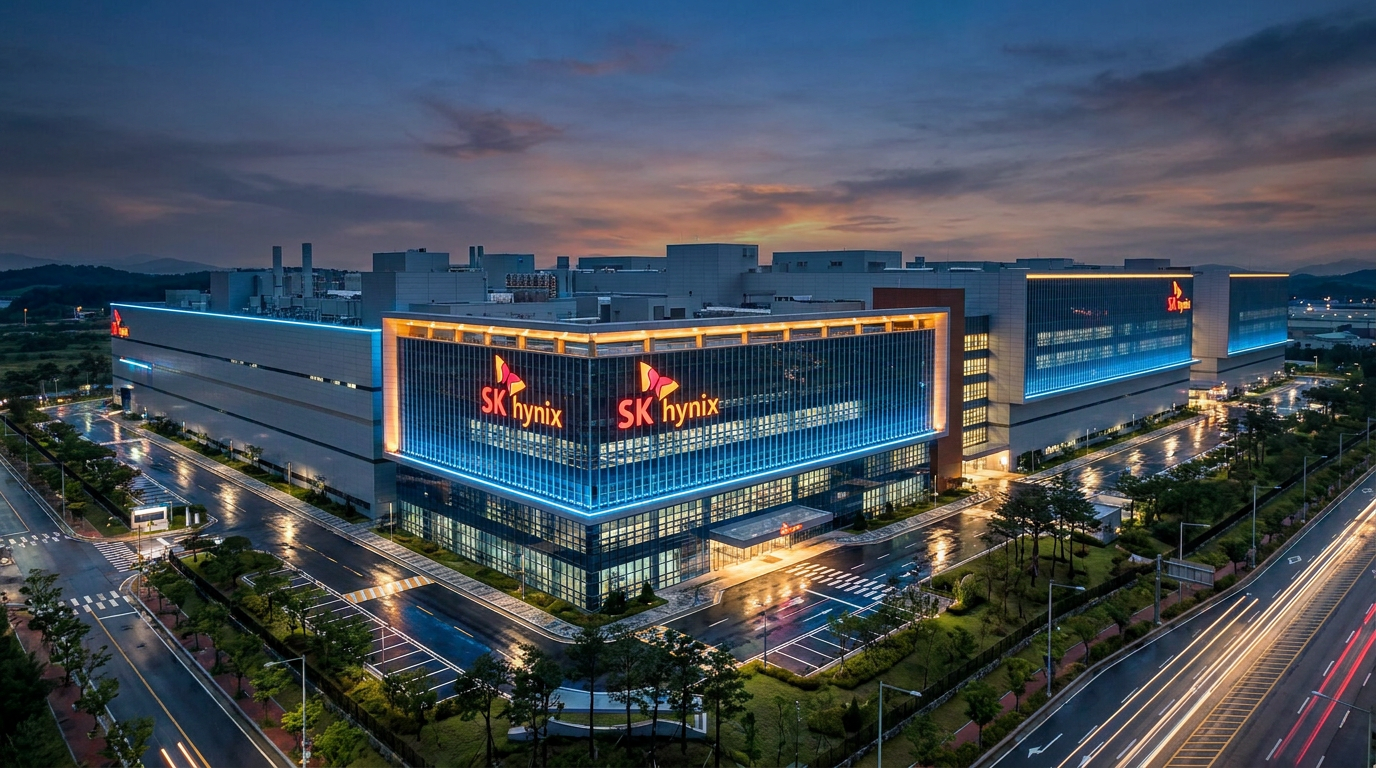
- Institutional Investors
- Eager for direct, frictionless exposure to the AI hardware supply chain via U.S. markets.
- Semiconductor Analysts
- Viewing the massive capital raise as a necessary step to alleviate global HBM supply constraints.
- Domestic Korean Markets
- Balancing national pride in the company's growth with concerns over near-term equity dilution.
What's not represented
- · Competitors like Micron and Samsung, who are racing to match SK Hynix's HBM capacity.
- · Retail investors in South Korea who may face volatility during the share issuance.
Why this matters
High-bandwidth memory is the critical bottleneck in the global artificial intelligence rollout. SK Hynix's massive capital injection signals that the AI boom is transitioning from software valuations to historic, physical infrastructure investments.
Key points
- SK Hynix filed to raise $29.4 billion via a Nasdaq ADR listing, expected to begin trading on July 10.
- The capital will fund the expansion of the company's high-bandwidth memory (HBM) manufacturing capacity in South Korea.
- SK Hynix shares surged 12% on the news, pushing its market capitalization to $1.2 trillion.
- The company has officially overtaken Samsung Electronics as South Korea's most valuable listed firm.
- The offering would eclipse Alibaba's 2014 debut to become the largest ADR listing in history.
South Korean memory chip giant SK Hynix has formally filed to raise approximately $29.4 billion through a listing of American Depositary Receipts (ADRs) on the Nasdaq, marking one of the largest capital market transactions in history. The company plans to issue 17.79 million new shares, aiming to capitalize on an insatiable global appetite for the specialized hardware that powers artificial intelligence. The move represents a massive strategic bet that the current boom in AI infrastructure will require sustained, multi-year investments in physical manufacturing capacity to meet the demands of the world's largest technology companies.[1][3][5]
If completed at the top of its indicated range, the 45.45 trillion won offering would eclipse Alibaba's $21.8 billion New York debut in 2014, making it the largest ADR offering on record. It would rank among the top global share sales of all time, trailing only massive domestic listings like Saudi Aramco's $25.6 billion initial public offering in 2019 and SpaceX's recent record-breaking $85.7 billion debut earlier this month. The sheer scale of the transaction underscores the unprecedented flow of capital currently being directed toward the foundational layers of the artificial intelligence economy.[3][4]
The market reaction to the filing was immediate and euphoric, reflecting deep investor confidence in the company's trajectory. SK Hynix shares surged as much as 12% in Seoul trading following the announcement, triggering a broader rally across the regional semiconductor supply chain. The surge pushed the company's market capitalization past the $1.2 trillion mark, allowing it to officially overtake its longtime rival Samsung Electronics as South Korea's most valuable listed company. Year-to-date, SK Hynix's stock has skyrocketed by more than 300%, transforming the firm into one of the most closely watched equities in the global tech sector.[1][2][4]

The timing of the Nasdaq listing is a direct reflection of SK Hynix's unique and highly lucrative position at the chokepoint of the global AI buildout. The company has established itself as the dominant supplier of high-bandwidth memory (HBM) chips—the specialized, vertically stacked DRAM components that sit alongside processors in advanced AI accelerators. Technology giants like Nvidia, Google, and Microsoft rely heavily on SK Hynix's HBM chips to process the enormous datasets required for training and operating large language models, creating a structural dependency that has given the chipmaker unprecedented pricing power.[3][5]
The timing of the Nasdaq listing is a direct reflection of SK Hynix's unique and highly lucrative position at the chokepoint of the global AI buildout.
Currently, the primary limiting factor for the artificial intelligence industry is no longer software demand or algorithmic capability, but the physical capacity to produce high-bandwidth memory at scale. While SK Hynix controls more than half of the global market for HBM chips, its existing fabrication plants are stretched to their absolute limits. The company stated explicitly in its regulatory filings that the entirety of the $29.4 billion raised through the Nasdaq listing will be directed toward expanding its manufacturing footprint to alleviate this critical supply chain bottleneck.[3][6]
Specifically, the newly raised capital will fund the construction of the first-phase fabrication plant at the massive Yongin Semiconductor Cluster in South Korea, a project designed to serve as the centerpiece of the country's next-generation chipmaking efforts. Additionally, the funds will support a $12.85 billion advanced packaging facility in Cheongju. A significant portion of the proceeds will also be used to acquire extreme ultraviolet (EUV) lithography scanners from Dutch equipment manufacturer ASML, which cost hundreds of millions of dollars each and are essential for printing the complex, microscopic circuits required for advanced memory.[5][6]

By choosing to list on the Nasdaq, SK Hynix is strategically removing structural barriers for large U.S. institutional investors who want direct exposure to the AI hardware boom. Many American pension funds, mutual funds, and exchange-traded funds face strict mandates that limit their ability to hold foreign-listed equities. The ADR program provides a frictionless on-ramp for the world's deepest capital market, potentially allowing SK Hynix to close the persistent valuation gap between itself and U.S.-listed semiconductor peers like Micron Technology, while broadening its global shareholder base.[2][4]
The massive transaction is being managed by a syndicate of Wall Street heavyweights, including BofA Securities, Citigroup Global Markets, Goldman Sachs, and J.P. Morgan Securities, highlighting the global financial sector's intense focus on the deal. Final pricing for the offering will be determined following a comprehensive bookbuilding process, with the initial range based on the company's recent closing prices in Seoul. Trading is tentatively scheduled to commence on July 10, pending final regulatory approvals from financial authorities in both South Korea and the United States.[4][6]
For the broader technology sector, the SK Hynix listing serves as a critical bellwether for the next phase of the technological revolution. It signals that the artificial intelligence boom is decisively transitioning from a narrative of rising software margins and speculative valuations into a phase of massive, capital-intensive infrastructure investment. As the world's largest semiconductor companies turn to the public markets to finance their multi-billion-dollar expansions, the physical architecture of the AI era is being cemented, promising to reshape the global hardware supply chain for decades to come.[2][3]
How we got here
March 2026
SK Hynix confidentially files an F-1 with the SEC, signaling its intent to pursue a U.S. listing.
April 2026
The company reports a record first-quarter operating profit, driven by surging demand for AI memory chips.
June 24, 2026
SK Hynix officially announces its plan to raise up to $29.4 billion through a Nasdaq ADR listing.
July 10, 2026
Expected date for the SK Hynix ADRs to begin trading on the Nasdaq.
Viewpoints in depth
Institutional Investors
U.S. funds are eager for direct exposure to the AI hardware supply chain.
For large American asset managers, pension funds, and retail traders, the Nasdaq listing provides a frictionless entry point into one of the most critical companies in the AI ecosystem. Because many U.S. institutional funds have strict mandates limiting their exposure to foreign-listed equities, they have historically been underweight on SK Hynix despite its market dominance. The ADR offering removes this structural barrier, allowing U.S. capital to directly fund the physical infrastructure of the AI boom.
Semiconductor Analysts
Industry watchers view the capital raise as a necessary step to alleviate severe supply bottlenecks.
Market analysts emphasize that the AI industry is currently constrained not by demand, but by the physical capacity to produce high-bandwidth memory. Analysts view SK Hynix's $29 billion raise as an aggressive but necessary maneuver to lock in its market leadership. By aggressively funding new fabrication plants and securing highly coveted EUV lithography machines from ASML, the company is positioning itself to meet the multi-year structural surge in data center expansion.
Domestic Korean Markets
Local investors balance national pride with concerns over near-term equity dilution.
In Seoul, the reaction is a mix of euphoria and caution. While SK Hynix overtaking Samsung Electronics as the nation's most valuable company is a point of immense pride, the sheer scale of the 17.79 million new shares being issued has sparked conversations about 'overhang risk.' Some domestic traders worry that a capital raise of this magnitude could temporarily dilute existing shares and absorb a massive amount of liquidity from the regional market, even as it secures the company's long-term global dominance.
What we don't know
- The final pricing of the ADRs will not be determined until the bookbuilding process concludes in early July.
- It remains to be seen exactly how the massive influx of new shares will impact the near-term trading dynamics of SK Hynix's Korea-listed stock.
Key terms
- American Depositary Receipt (ADR)
- A certificate issued by a U.S. bank representing a specified number of shares in a foreign stock, allowing it to be traded on U.S. exchanges.
- High-Bandwidth Memory (HBM)
- A specialized type of computer memory that stacks chips vertically to drastically increase the speed at which data can be processed, essential for AI accelerators.
- EUV Lithography
- Extreme Ultraviolet lithography is a cutting-edge manufacturing technology used to print the microscopically small circuits on the most advanced semiconductor chips.
- Bookbuilding
- The process by which an underwriter attempts to determine the price at which an initial public offering (IPO) or secondary offering will be offered, based on demand from institutional investors.
Frequently asked
Why is SK Hynix listing on the Nasdaq?
The company is seeking to raise $29.4 billion to fund the massive expansion of its semiconductor manufacturing facilities. Listing on the Nasdaq gives it direct access to the deep pool of capital held by U.S. institutional investors.
What will the $29.4 billion be used for?
The funds are earmarked entirely for physical infrastructure, including a new fabrication plant in Yongin, an advanced packaging facility in Cheongju, and the purchase of cutting-edge chipmaking equipment.
How does this affect Samsung?
Following the announcement, SK Hynix's stock surged, pushing its market capitalization to $1.2 trillion. This allowed it to officially overtake its rival Samsung Electronics as South Korea's most valuable company.
Sources
Source coverage
6 outlets
3 viewpoints surfaced






[1]CNBCDomestic Korean Markets
SK Hynix surges 11% after filing for blockbuster Nasdaq listing
Read on CNBC →[2]BloombergInstitutional Investors
SK Hynix Jumps 12% as US Listing Plan Boosts Valuation Hopes
Read on Bloomberg →[3]Financial TimesSemiconductor Analysts
Chipmaker SK Hynix to raise $29bn in US listing amid AI boom
Read on Financial Times →[4]The Wall Street JournalInstitutional Investors
SK Hynix Seeks to Raise About $29 Billion in U.S. Listing
Read on The Wall Street Journal →[5]ReutersSemiconductor Analysts
SK Hynix targets $29 bln U.S. ADR listing as AI demand surges
Read on Reuters →[6]Chosun IlboDomestic Korean Markets
SK Hynix to List on Nasdaq July 10, Raise 45 Trillion Won for Semiconductors
Read on Chosun Ilbo →

More in business
See all 6 stories →Cold Chain Tech
The Cold Chain Revolution: How AI and Smart Materials Are Eradicating Supply Chain Spoilage
8 sources
Solar Supply Chain
How China's Intervention to End the Global Solar Glut is Reshaping the Energy Market
8 sources
AI Data Supply Chain
How a New Wave of Startups is Teaching Physical AI to Navigate the Real World
6 sources
Corporate Childcare
Why Corporate America is Finally Waking Up to the Childcare Crisis
7 sources

Every angle. Every day.
Get business stories with full source coverage and perspective breakdowns delivered to your inbox.