
How a New Wave of Startups is Teaching Physical AI to Navigate the Real World
As humanoid robots and automated systems move from labs to factory floors, a booming ecosystem of data startups is emerging to provide the human-demonstrated video training they need.
By Factlen Editorial Team
- Spatial Data Entrepreneurs
- View this shift as an opportunity to move up the tech value chain and create higher-paying, specialized jobs.
- Embodied AI Researchers
- Emphasize that human demonstration remains the only reliable way to overcome the 'sim-to-real' gap in robotics.
- Industry Analysts
- Track the economic transition from cheap text labeling to premium physical data annotation as a major market trend.
What's not represented
- · Labor rights organizations monitoring the ergonomic safety of full-time teleoperation workers.
Why this matters
The transition from text-based AI to physical robots requires massive amounts of human movement data. The startups solving this bottleneck are creating a new, higher-paying tier of tech jobs while accelerating the timeline for commercially viable humanoid robots.
Key points
- The AI industry is shifting focus from text-based models to physical robots, creating a massive demand for human movement data.
- Startups, particularly in India, are pivoting to provide high-fidelity video and teleoperation data to robotics firms.
- This new form of data annotation requires specialized hardware and physical dexterity, commanding higher wages than traditional click-farm labeling.
- Human demonstration remains essential because computer simulations cannot yet perfectly replicate real-world physics and edge cases.
The artificial intelligence boom of the last three years was built on a simple premise: if you want to teach a machine to write, you feed it the entire internet. Large language models consumed trillions of words of human text, effectively scraping the collective output of humanity. But as the tech industry pivots from chatbots to physical robots, it has collided with a fundamental bottleneck. There is no "internet of physical actions" to scrape. To teach a humanoid robot how to fold a laundry shirt, sort defective parts on an assembly line, or navigate a cluttered kitchen, algorithms require highly specific, three-dimensional kinematic data.[5]
This data deficit has birthed an entirely new sector of the tech economy. Across the globe, a wave of specialized startups is emerging to serve as the "human teachers" for the next generation of embodied AI. Unlike the click-farm data labelers of the past decade—who spent hours drawing bounding boxes around stop signs in two-dimensional images—this new workforce is highly trained, physically active, and utilizing complex hardware to digitize human motion.[1][2]
The epicenter of this entrepreneurial boom is increasingly found in India, where founders are leveraging the country's deep history in IT services to capture a lucrative new market. Several companies have recently cropped up in hubs like Bengaluru and Pune, providing high-fidelity video and motion data that is directly exported to robotics labs in the United States and China. It represents a strategic pivot for the region, moving up the value chain from basic outsourcing to foundational AI infrastructure.[1][4]
To understand why this human-in-the-loop data is so critical, one must look at "Moravec's paradox." Formulated by AI researchers in the 1980s, the paradox observes that high-level reasoning requires very little computation, but low-level sensorimotor skills require enormous computational resources. A computer can easily beat a grandmaster at chess, but giving a robot the dexterity of a one-year-old child to grasp a soft, irregularly shaped object remains a monumental engineering challenge.[6]

The current gold standard for solving this is "imitation learning." Rather than trying to hard-code the physics of a folding shirt—which involves nearly infinite variables of fabric tension, friction, and gravity—engineers simply show the robot how a human does it. The robot's neural network then attempts to map the visual input of the shirt to the motor outputs required to replicate the human's exact movements.[3][5]
The robot's neural network then attempts to map the visual input of the shirt to the motor outputs required to replicate the human's exact movements.
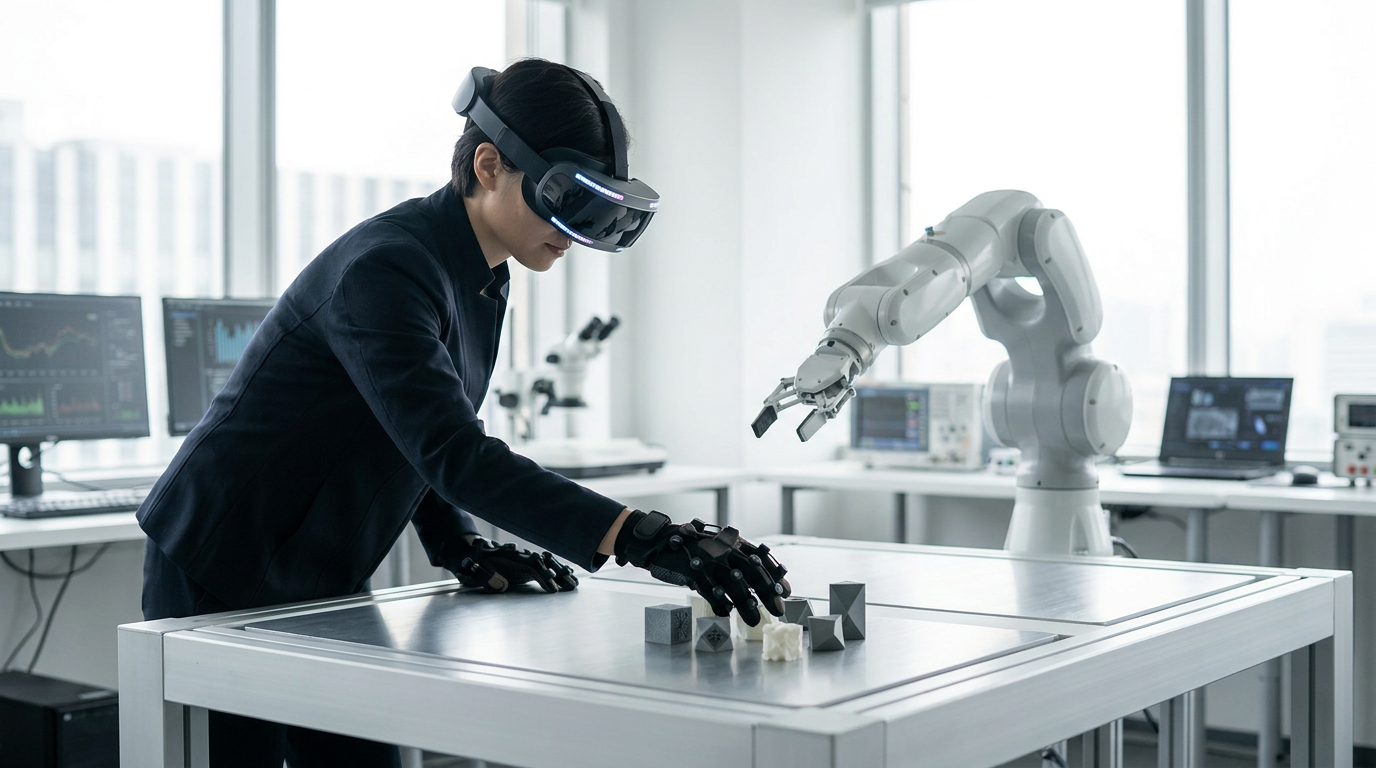
Gathering this demonstration data is a labor-intensive process. At the new wave of spatial data startups, human operators often wear specialized haptic gloves or virtual reality headsets to "teleoperate" a robotic arm located in the same room or across the facility. As the human performs a task—like picking up a fragile glass or sorting recyclable plastics—the system records the exact joint angles, applied force, and visual feed from the robot's perspective.[2][3]
In other instances, the data collection is entirely human-centric. Workers wear camera rigs mounted to their chests or heads, capturing first-person video as they perform routine household or industrial chores. This video is then processed through computer vision algorithms that extract the skeletal pose and hand trajectories, creating a mathematical blueprint of the action that a robot can ingest.[1][6]
The economics of this new industry are fundamentally different from traditional data annotation. Because the work requires physical dexterity, spatial awareness, and often the operation of complex teleoperation rigs, these "robot teachers" command a premium. Industry analysts note that spatial data annotators are earning significantly more than their text-labeling counterparts, reflecting the specialized nature of the work and the high barrier to entry for competing firms.[4]

For entrepreneurs, the margins are highly attractive. The global market for spatial and physical AI data annotation is projected to scale rapidly, with some estimates suggesting it could reach $3.2 billion by the end of 2026. This growth is driven by the sheer volume of data required; teaching a robot a single, reliable physical task can require anywhere from 40 to 60 hours of continuous human demonstration to account for various edge cases.[4][6]
Those edge cases are the primary reason human teachers remain indispensable. A robot might successfully learn to pick up a red cup on a white table after a few hours of data. But if the lighting changes, or if the cup is placed on a reflective glass surface, or if the cup is partially obscured by a napkin, the AI will likely fail. Human operators must deliberately demonstrate how to recover from these subtle environmental variations, building a robust dataset that prevents catastrophic failures in the real world.[3][5]
Some Silicon Valley researchers argue that the ultimate solution is "synthetic data"—using advanced computer simulations to generate millions of training scenarios virtually, without human intervention. However, the industry currently suffers from a severe "sim-to-real gap." Computer physics engines still struggle to perfectly simulate the unpredictable nature of the real world, particularly when it comes to soft materials, friction, and complex fluid dynamics.[3][5][6]

Until simulation technology perfectly mirrors reality, human demonstration remains the vital bridge. The startups providing this service are effectively building the foundational infrastructure for the physical AI revolution. By turning human intuition and dexterity into quantifiable, exportable data, these entrepreneurs are ensuring that when humanoid robots finally arrive in homes and factories, they will know exactly how to interact with the world around them.[1][2][5]
How we got here
2022-2023
The generative AI boom relies almost entirely on scraping existing text and images from the internet.
2024
Robotics companies hit a 'data wall,' realizing that physical tasks cannot be learned from internet text.
2025
The first wave of spatial data startups launch dedicated teleoperation centers to capture human movement.
Mid-2026
The IT sector formally recognizes 'physical AI training' as a distinct, high-growth export market.
Viewpoints in depth
Spatial Data Entrepreneurs
Founders view this shift as an opportunity to move up the tech value chain and create higher-paying, specialized jobs.
For entrepreneurs in emerging tech hubs, the pivot to physical AI data represents a maturation of the outsourcing model. Rather than competing in a race to the bottom for cheap text annotation, these startups are investing in specialized hardware—like haptic gloves and motion-capture rigs—to build a defensible moat. They argue that by professionalizing the 'robot teacher' role, they are creating a new class of technical jobs that are more resilient to automation than traditional data entry.
Embodied AI Researchers
Engineers emphasize that human demonstration remains the only reliable way to overcome the 'sim-to-real' gap in robotics.
While software engineers dream of a future where robots learn entirely inside computer simulations, roboticists dealing with physical hardware remain tethered to reality. They point out that physics engines still cannot accurately model how a soft t-shirt folds or how a greasy mechanical part slips. Until simulations achieve perfect fidelity, researchers argue that massive datasets of human demonstration are the only way to teach robots how to handle the infinite edge cases of the physical world safely.
What we don't know
- How quickly synthetic data and advanced simulations might eventually replace the need for human demonstration.
- Whether the high cost of human-in-the-loop data collection will bottleneck the commercial rollout of affordable home robots.
Key terms
- Embodied AI
- Artificial intelligence integrated into a physical body, such as a robot, that interacts with the real world.
- Imitation Learning
- A machine learning technique where an AI learns by observing and mimicking human demonstrations.
- Sim-to-Real Gap
- The discrepancy between how an AI performs in a computer simulation versus how it performs in the unpredictable physical world.
- Teleoperation
- The remote control of a robot or machine by a human operator, often used to generate precise training data.
Frequently asked
Why can't robots just learn from YouTube videos?
YouTube videos lack kinematic data. A standard video shows what happened, but it doesn't record the exact force, depth, and joint angles required to actually perform the physical task.
Is this the same as traditional data labeling?
No. Traditional labeling involves clicking boxes on static images or text. Spatial data annotation requires physically performing tasks or operating teleoperation rigs, which demands more skill and commands higher pay.
Will synthetic data eventually replace human teachers?
Eventually, but currently, computer simulations struggle to perfectly replicate real-world physics like friction and material deformation—a problem known as the 'sim-to-real gap.'
Sources
Source coverage
6 outlets
3 viewpoints surfaced






[1]CNBCSpatial Data Entrepreneurs
Meet the humans teaching robots to perform routine tasks, as India finds a way to enter the AI race
Read on CNBC →[2]Rest of WorldSpatial Data Entrepreneurs
The new data labeling: How global south startups are capturing human motion for Silicon Valley robots
Read on Rest of World →[3]arXivEmbodied AI Researchers
Scaling Imitation Learning for Embodied AI through Teleoperation and Human Video Data
Read on arXiv →[4]NASSCOMIndustry Analysts
The Future of India's AI Data Supply Chain: From Text to Spatial Computing
Read on NASSCOM →[5]IEEE SpectrumEmbodied AI Researchers
Why Physical AI Needs Human Teachers: The Bottleneck in Robotics
Read on IEEE Spectrum →[6]Factlen Editorial TeamIndustry Analysts
Synthesis by Factlen editorial team
Read on Factlen Editorial Team →

Every angle. Every day.
Get business stories with full source coverage and perspective breakdowns delivered to your inbox.