
OLED vs. Mini-LED TVs: The Complete 2026 Buying Guide
As Tandem OLEDs push brightness limits and Mini-LEDs master contrast, choosing the right premium television in 2026 comes down to your room's lighting and viewing habits. We break down the trade-offs to help you find the perfect display.
By Factlen Editorial Team
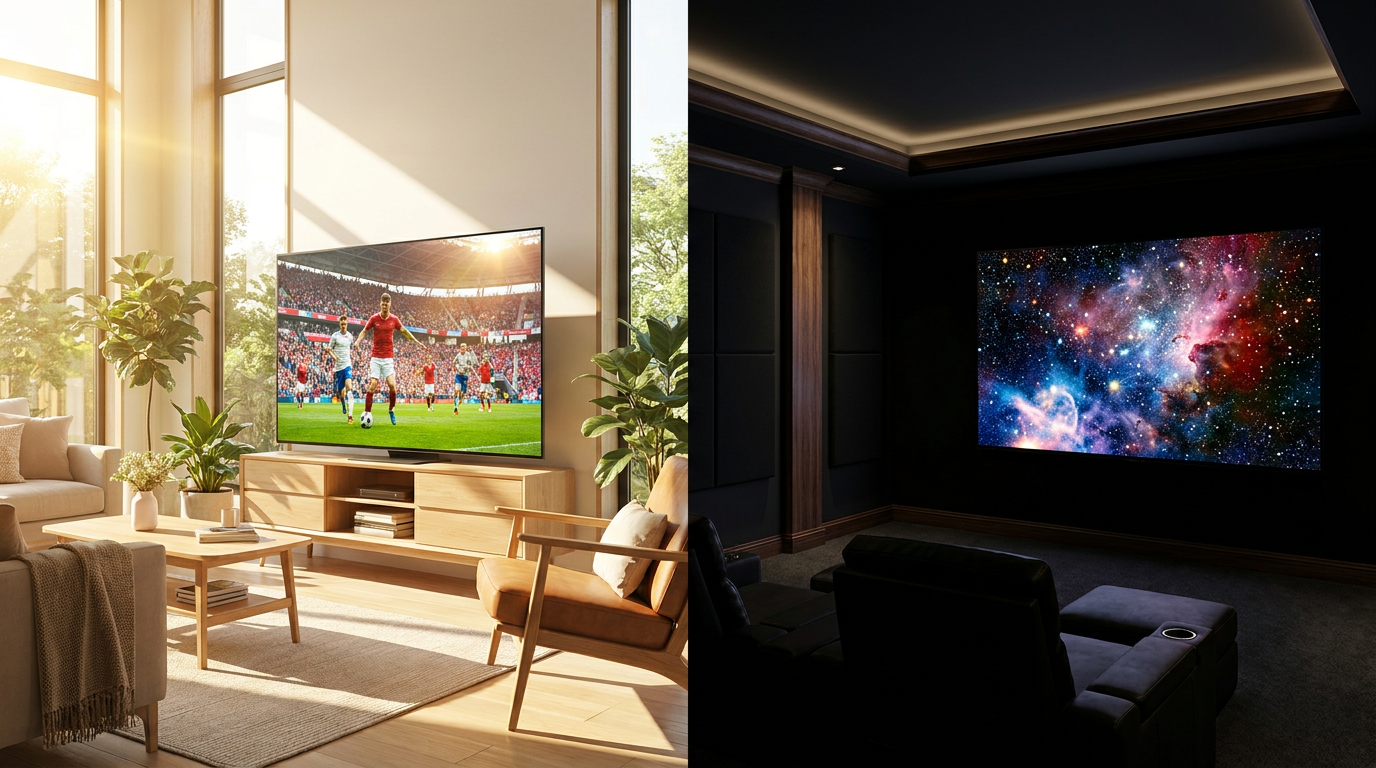
- Home Theater Purists
- Advocates for absolute picture perfection in controlled lighting environments.
- Bright-Room Viewers
- Prioritizes sustained brightness and glare reduction for everyday living spaces.
- PC & Productivity Users
- Values static-image reliability and text clarity for hybrid work setups.
- Value & Large-Screen Buyers
- Focuses on the price-to-performance ratio and maximizing screen real estate.
What's not represented
- · Environmental regulators monitoring the rising energy consumption of ultra-bright large-format displays.
- · Independent repair technicians dealing with the complexities of fixing highly integrated Tandem OLED and Mini-LED panels.
Why this matters
A premium television is a multi-year investment that dictates how you experience movies, sports, and games. Understanding the specific physical trade-offs between OLED and Mini-LED ensures you do not spend thousands on a display that fights against your room's natural lighting.
Key points
- OLED technology uses self-emissive pixels to deliver infinite contrast and perfect black levels, making it ideal for dark-room cinematic viewing.
- Mini-LED utilizes thousands of backlight dimming zones to achieve massive peak brightness, allowing it to easily overpower glare in sunlit living rooms.
- Tandem OLED architectures in 2026 have boosted peak brightness to 1,500 nits, though full-screen brightness remains limited by protective dimming algorithms.
- Mini-LED dominates the massive-screen market, offering 85-inch and larger displays at significantly more accessible price points than equivalent OLED panels.
The 2026 display market has reached a technological inflection point, transforming the once-simple decision of buying a premium television into a complex balancing act. For years, the conventional wisdom was straightforward: buy an OLED for the absolute best picture, or settle for an LED if you were on a strict budget. Today, that binary choice has been entirely obliterated. The rapid maturation of Mini-LED technology and the introduction of Tandem OLED architectures have created a heavyweight clash at the top of the market. Buyers are no longer choosing between a good and a bad display; they are choosing between two fundamentally different approaches to creating the perfect image, each with distinct physical trade-offs.[1][3]
Understanding the divide requires looking at how each screen generates light. OLED, or Organic Light-Emitting Diode, relies on self-emissive pixels. Every single microscopic dot on the screen generates its own light and color, meaning when a pixel needs to display black, it simply turns off completely. Mini-LED, conversely, uses a liquid crystal display paired with a sophisticated backlight made of thousands of microscopic LEDs. Instead of one uniform backlight, modern 2026 Mini-LED panels divide these lights into over 2,300 independent local dimming zones. The television analyzes the image and turns off the zones behind dark areas while blasting light through the bright areas.[2][4]
When it comes to sheer luminance and high dynamic range impact, Mini-LED holds a quantifiable and overwhelming advantage. Current-generation Mini-LED displays routinely sustain peak brightness levels of 2,500 to 3,000 nits in small highlights, while maintaining full-screen brightness well above 1,000 nits. For a television situated in a sun-drenched living room with wide windows, this raw power is not just a luxury—it is a necessity. The intense backlight easily overpowers ambient glare, ensuring that daytime sports broadcasts and bright video games remain vibrant and punchy without washing out.[3][7]

OLED manufacturers have not stood still in the brightness wars. The introduction of Tandem OLED—which stacks multiple light-emitting layers—has allowed premium 2026 models to hit 1,500 nits in small, localized windows. However, OLED technology remains constrained by Auto Brightness Limiters. To protect the organic materials from heat degradation, an OLED panel will aggressively dim the entire screen when displaying a large, bright image, such as a hockey rink or a white web browser. While OLED HDR looks incredibly nuanced and cinematic in a dark room, it simply cannot sustain the retina-searing full-screen brightness that Mini-LED delivers effortlessly.[2][6]
The counterweight to Mini-LED's brightness is OLED's undisputed mastery of contrast. Because OLED pixels turn off entirely, the technology boasts an infinite contrast ratio, routinely exceeding 1,000,000:1 in testing. This pixel-level precision means a bright star can sit directly next to the pitch-black vacuum of space without a single photon of light bleeding over. This creates a three-dimensional pop and a level of shadow detail that remains the holy grail for home theater purists and cinematic colorists.[2][4]
The counterweight to Mini-LED's brightness is OLED's undisputed mastery of contrast.
Mini-LED has closed the contrast gap significantly, but it cannot defy physics. Even with 2,304 dimming zones, a 4K television still contains over 8.2 million pixels. That means a single dimming zone must control thousands of pixels simultaneously. When a bright object, like a white cursor or a streetlamp, moves across a dark background, the zone behind it must light up. This creates a faint halo of light, known as blooming, around the object. While 2026 algorithms have suppressed blooming to near-imperceptible levels when viewed head-on, it remains slightly visible from off-angle seating, a compromise OLED entirely avoids.[3][4]

For gamers, the trade-offs become highly specific to the titles being played. Both technologies now universally support 144Hz refresh rates, Variable Refresh Rate, and Auto Low Latency Mode across multiple HDMI 2.1 ports. OLED holds the edge for competitive esports and fast-paced shooters due to its near-instantaneous pixel response time, which virtually eliminates motion blur. However, Mini-LED is increasingly favored for expansive, bright open-world games, where its sustained luminance makes virtual sunlight feel genuinely blinding, without the risk of the screen dimming during extended daytime sequences.[5][7]
The specter of permanent image retention, or burn-in, continues to influence buying decisions, particularly for hybrid users. While 2026 OLED panels feature robust mitigation software and improved heat sinks that make burn-in incredibly rare for standard video viewing, the physical risk remains for static content. Users who leave news tickers running all day, or who use their television as a massive PC monitor with static taskbars and spreadsheets, are still advised to exercise caution. Mini-LED, utilizing inorganic materials, carries zero risk of burn-in, making it the stress-free choice for productivity workflows and commercial installations.[3][5]

Sizing and total cost of ownership present the final, and often most decisive, battleground. Mini-LED has successfully commoditized the massive-screen market. Buyers can now secure high-performance 85-inch and even 115-inch Mini-LED displays at surprisingly accessible price points. Manufacturing massive OLED panels remains a complex, low-yield process, resulting in exponential price jumps for anything above 77 inches. For consumers looking to maximize their screen real estate without taking out a second mortgage, Mini-LED offers a vastly superior price-to-performance ratio.[6][7]
Ultimately, the evidence points away from a single, universal winner and toward application-specific victories. OLED fits perfectly when the display is housed in a light-controlled room or dedicated home theater. It is the definitive choice for viewers who prioritize absolute black levels, cinematic shadow detail, wide seating arrangements, and pixel-perfect contrast for evening movie watching. It does not fit well in brightly lit, open-concept living rooms, or for users who demand massive screen sizes on a strict budget.[1][2]

Conversely, Mini-LED fits exceptionally well when the television serves as the centerpiece of a bright, multi-use family room. It is the superior option for daytime sports viewing, PC productivity with static interfaces, and buyers seeking maximum HDR impact and screen size for their dollar. It does not fit well for dark-room purists who are highly sensitive to off-angle blooming or those who demand the absolute fastest pixel response times for competitive gaming. In 2026, the best television is simply the one that respects the reality of the room it lives in.[1][3]
How we got here
2013
The first large-screen OLED TVs enter the consumer market, establishing a new benchmark for contrast and black levels.
2019
Mini-LED technology debuts in premium consumer televisions, offering a brighter alternative to traditional full-array LED sets.
2022
QD-OLED technology is introduced, combining quantum dots with OLED to boost color brightness and challenge LED dominance.
2024
Mini-LED zone counts cross the 2,000 mark in consumer models, drastically reducing blooming artifacts.
2026
Tandem OLED architectures arrive in living room displays, pushing OLED peak brightness to 1,500 nits to compete with ultra-bright Mini-LEDs.
Viewpoints in depth
Home Theater Purists
Advocates for absolute picture perfection in controlled lighting environments.
For cinephiles and home theater enthusiasts, the conversation begins and ends with contrast. This camp argues that absolute black levels are the foundation of true picture quality, providing a three-dimensional depth that backlights simply cannot replicate. They point to the pixel-level precision of OLED as the only way to watch HDR movies as the director intended, dismissing Mini-LED's blooming artifacts as a dealbreaker for serious viewing.
Bright-Room Viewers
Prioritizes sustained brightness and glare reduction for everyday living spaces.
This perspective focuses on the reality of modern home architecture, which often features open floor plans and massive windows. They argue that OLED's perfect blacks are useless if the screen acts as a mirror during daytime viewing. For this camp, Mini-LED's ability to sustain 2,500+ nits of brightness is the ultimate trump card, ensuring that sports, news, and games remain vibrant and visible regardless of how much sunlight is pouring into the room.
PC & Productivity Users
Values static-image reliability and text clarity for hybrid work setups.
Users who double their displays as massive PC monitors prioritize longevity and stress-free operation. This camp heavily favors Mini-LED due to its inorganic construction, which entirely eliminates the risk of burn-in from static taskbars, spreadsheets, and web browsers. They also note that Mini-LED avoids the aggressive Auto Brightness Limiter dimming that can make working on white documents frustrating on an OLED screen.
Value & Large-Screen Buyers
Focuses on the price-to-performance ratio and maximizing screen real estate.
For budget-conscious buyers and those looking to fill a massive wall, the metric that matters most is cost-per-inch. This camp highlights that Mini-LED technology scales to 85-inch and 100-inch sizes at a fraction of the cost of equivalent OLED panels. They argue that the slight compromise in absolute black levels is a more than acceptable trade-off for the immersive experience of a truly massive, ultra-bright display.
What we don't know
- Whether manufacturing yields for massive (85-inch+) OLED panels will improve enough to match Mini-LED pricing in the near future.
- How long the new Tandem OLED structures will maintain their peak brightness before organic degradation occurs over a decade of use.
- If MicroLED technology will become affordable enough to render both OLED and Mini-LED obsolete before the end of the decade.
Key terms
- OLED (Organic Light-Emitting Diode)
- A display technology where each individual pixel generates its own light and color, allowing it to turn off completely for perfect black levels.
- Mini-LED
- An advanced backlight technology for LCD TVs that uses thousands of microscopic LEDs divided into dimming zones to improve contrast and brightness.
- Local Dimming Zones
- Specific areas of a TV's backlight that can dim or turn off independently to make dark parts of the image look darker without affecting bright areas.
- Blooming (Halo Effect)
- A visual artifact on backlit TVs where light bleeds from a bright object into the surrounding dark areas of the screen.
- Nits
- A unit of measurement for screen brightness. A higher number of nits means the display can output more light.
- Auto Brightness Limiter (ABL)
- A protective feature in OLED TVs that automatically dims the screen when a large portion of the image is bright white, preventing overheating and burn-in.
Frequently asked
Will an OLED TV get burn-in from normal viewing?
For standard movie and TV watching, burn-in is incredibly rare on 2026 OLED models due to advanced pixel-shifting and heat-sink technologies. However, leaving static images like news tickers or PC taskbars on screen for hours daily still poses a risk.
Is Mini-LED the same as MicroLED?
No. Mini-LED uses a traditional LCD panel with a backlight made of thousands of tiny LEDs. MicroLED is a completely different, vastly more expensive technology where each pixel is its own microscopic LED, combining the brightness of LED with the perfect blacks of OLED.
Which TV is better for a bright living room?
Mini-LED is significantly better for bright rooms. Its ability to sustain high full-screen brightness allows it to overpower sunlight and ambient glare much more effectively than an OLED panel.
Do both technologies support modern gaming consoles?
Yes. Both premium OLED and Mini-LED TVs in 2026 fully support HDMI 2.1 features, including 4K at 120Hz or 144Hz, Variable Refresh Rate (VRR), and Auto Low Latency Mode (ALLM).
Sources
Source coverage
7 outlets
4 viewpoints surfaced







[1]Factlen Editorial TeamHome Theater Purists
Synthesis by Factlen editorial team
Read on Factlen Editorial Team →[2]What Hi-Fi?Home Theater Purists
OLED vs Mini LED: which TV technology is better?
Read on What Hi-Fi? →[3]Display MasterBright-Room Viewers
The 2026 Display Dilemma: Which Tech Reigns Supreme?
Read on Display Master →[4]SunulBright-Room Viewers
Mini LED vs OLED: The 2026 Commercial Display Showdown
Read on Sunul →[5]KTC PlayPC & Productivity Users
The 2026 Prosumer Dilemma: Beyond Just Gaming
Read on KTC Play →[6]Data Wire SolutionsValue & Large-Screen Buyers
Best TVs for 2026: 10 OLED and Mini-LED Picks by Room
Read on Data Wire Solutions →[7]EcoPicksGoValue & Large-Screen Buyers
LG G5 OLED vs LG QNED9M Mini LED Comparison (2026 Buyer's Guide)
Read on EcoPicksGo →

Every angle. Every day.
Get shopping stories with full source coverage and perspective breakdowns delivered to your inbox.