
The 'Holy Grail' of EVs Arrives: How Solid-State Batteries Are Finally Moving From Lab to Road in 2026
After decades of research, solid-state batteries are entering pilot production and real-world testing, promising to double EV range, slash charging times, and eliminate fire risks.
By Factlen Editorial Team
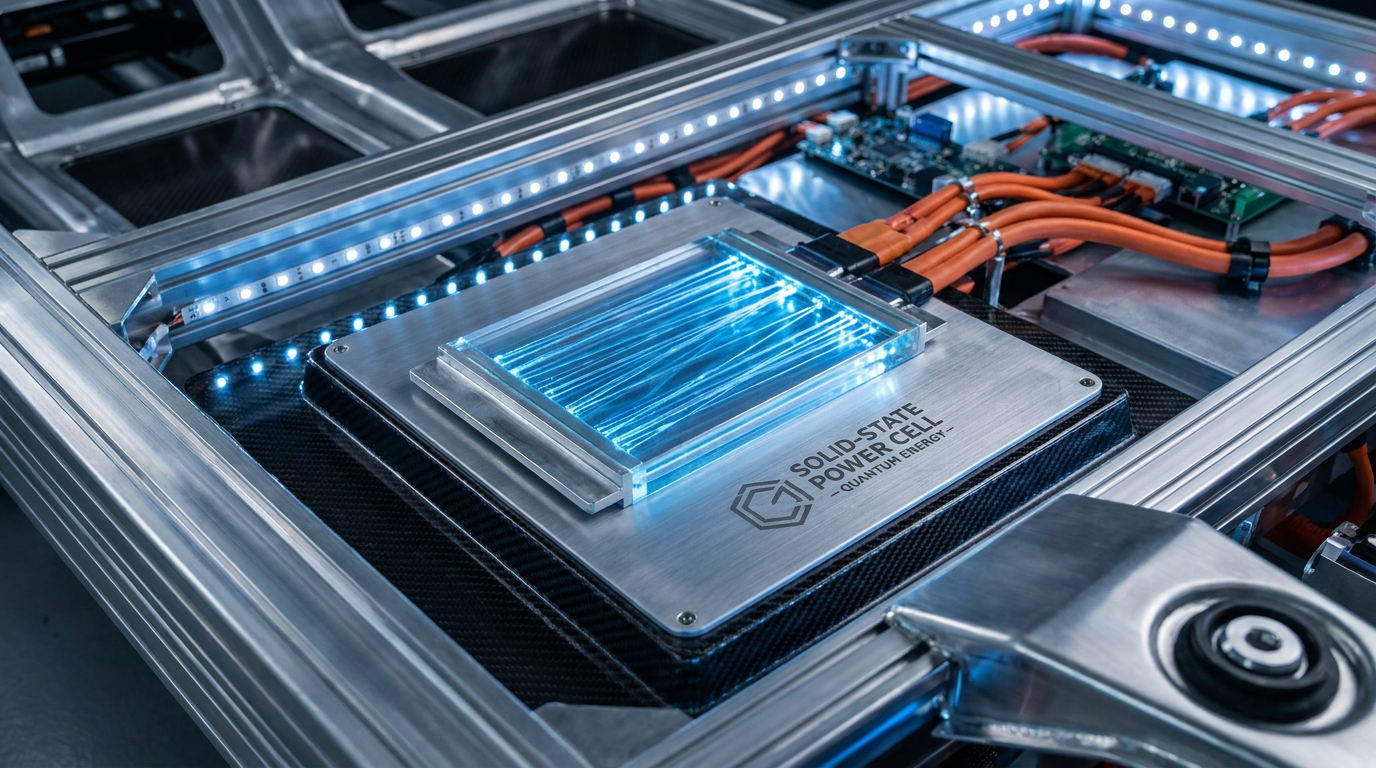
- Automakers & Battery Developers
- Focused on the engineering triumph of moving solid-state chemistry out of the lab and the race to scale gigawatt-hour production.
- Industry Analysts
- Cautiously optimistic, noting that while the technology works, high manufacturing costs will limit early adoption to premium markets.
- Aviation & Mobility Innovators
- Viewing solid-state batteries as the critical enabler for weight-sensitive transport like flying cars and electric motorcycles.
What's not represented
- · Raw Material Suppliers
- · Legacy Lithium-Ion Manufacturers
Why this matters
Solid-state batteries are the key to making electric vehicles lighter, safer, and capable of traveling over 600 miles on a 10-minute charge. Their commercialization removes the final major hurdles to mass EV adoption and unlocks new industries like electric aviation.
Key points
- Solid-state batteries replace flammable liquid electrolytes with solid materials, enabling lighter, safer, and more energy-dense cells.
- Recent 2026 milestones from QuantumScape, Honda, and Stellantis show the technology moving from lab prototypes to pilot manufacturing.
- The new batteries target energy densities of 400–500 Wh/kg, potentially doubling EV range to over 700 miles.
- Charging times are drastically reduced, with some solid-state cells capable of reaching 80% charge in just 12 minutes.
- While pilot production is underway, mass-market commercialization in consumer vehicles is expected between 2027 and 2030.
For the better part of a decade, the electric vehicle industry has chased a singular, elusive prize: the solid-state battery. Often described as the "holy grail" of energy storage, the technology promised to double driving ranges, slash charging times to mere minutes, and completely eliminate the fire risks associated with traditional lithium-ion cells. It represented the ultimate technological leap required to make electric vehicles unequivocally superior to their combustion-engine predecessors in every measurable category, from convenience to safety.
But for years, solid-state batteries remained stubbornly trapped in research laboratories. They were plagued by complex manufacturing hurdles and the sheer difficulty of scaling microscopic chemistry to industrial volumes. Skeptics wondered if the technology would ever become commercially viable. In mid-2026, that narrative has fundamentally shifted. The technology is finally crossing the threshold from prototype to production, with major automakers and battery startups moving from bench tests to pilot manufacturing lines and real-world road testing.
A flurry of recent milestones underscores this rapid transition. In June 2026, QuantumScape—a prominent leader in next-generation lithium-metal batteries—announced a major joint research agreement with Honda to advance its solid-state platform toward mass manufacturing. The same week, SEC filings revealed that Stellantis had deepened its integration with U.S. startup Factorial Energy, launching a rigorous road-testing program for its solid-state cells integrated into development vehicles.[1][2][4]
To understand why this shift is so monumental, one must look inside the battery cell itself. Traditional lithium-ion batteries, which power everything from smartphones to today's electric cars, rely on a liquid electrolyte. This chemical soup acts as a medium, shuttling lithium ions back and forth between the battery's anode and cathode during charging and discharging cycles.
While effective, liquid electrolytes have inherent physical flaws. They are highly flammable, which necessitates heavy, complex cooling systems and protective armor to prevent catastrophic thermal events. Furthermore, over repeated charging cycles, they are susceptible to the formation of "dendrites"—microscopic, needle-like metallic structures that can grow across the liquid, pierce the battery's internal separator, and cause dangerous short circuits.

Solid-state batteries solve this fundamental vulnerability by replacing the liquid soup with a solid material, typically a specialized ceramic, sulfide, or polymer. Because the solid electrolyte acts as an impenetrable physical barrier, it effectively suppresses dendrite growth. This seemingly simple substitution of a liquid for a solid unlocks a cascade of engineering breakthroughs that ripple through the entire vehicle architecture.
Most importantly, the solid barrier allows engineers to replace the traditional graphite anode with pure lithium metal. A lithium-metal anode is drastically lighter and can store vastly more energy in the exact same physical footprint. In a liquid battery, a lithium-metal anode would quickly degrade and form dendrites, but the solid electrolyte keeps it stable and safe over thousands of cycles.
The resulting leap in energy density is staggering. Today's best lithium-ion batteries max out around 250 to 300 watt-hours per kilogram (Wh/kg). The solid-state cells entering pilot production today are consistently hitting targets of 400 to 500 Wh/kg. In practical terms, this means an automaker can either double a vehicle's range to over 700 miles without increasing the battery's physical size, or cut the battery's weight in half while maintaining the same range, drastically improving the vehicle's efficiency and handling.[8]
Today's best lithium-ion batteries max out around 250 to 300 watt-hours per kilogram (Wh/kg).
Charging speeds see a similar revolution. Because solid electrolytes are significantly more stable at high voltages and temperatures, they can absorb energy much faster without degrading. QuantumScape's QSE-5 cells, for instance, have demonstrated the ability to fast-charge from 10% to 80% in just 12.2 minutes. This brings the EV charging experience remarkably close to the time it takes to fill a traditional gas tank.[1]

Safety and climate resilience also improve dramatically. Without a flammable liquid core, solid-state batteries are virtually immune to thermal runaway—the unstoppable chain reaction that causes EV fires. Furthermore, they perform exceptionally well in extreme cold, maintaining their capacity and charging speeds in temperatures as low as -30°C (-22°F), effectively solving a historical weak point for electric vehicles in northern climates.[5]
The race to commercialize this technology is now a global sprint. In China, automakers like Chery and GAC Group are already integrating early solid-state and semi-solid-state packs into high-end production vehicles. Greater Bay Technology (GBT) recently announced that its A-sample all-solid-state cells had successfully rolled off the production line, targeting gigawatt-hour scale manufacturing by the end of 2026.[5]
In Japan, Toyota has been laying the groundwork for years. While viral rumors occasionally claim Toyota has already launched a solid-state EV, the company's official roadmap targets commercialization in the 2027–2028 timeframe. To secure the necessary supply chain, Toyota has partnered with Idemitsu to build a large-scale pilot plant specifically dedicated to producing the complex solid electrolytes required for mass manufacturing.[6]

The impact of this breakthrough extends far beyond passenger cars. The extreme energy density of solid-state batteries is unlocking entirely new modes of transportation that were previously impossible due to the prohibitive weight of traditional lithium-ion battery packs.
In the aviation sector, solid-state cells are powering the first viable electric vertical takeoff and landing (eVTOL) aircraft. Recent tests in China utilized a 480 Wh/kg solid-state battery to power a cross-strait eVTOL flight, increasing the aircraft's travel distance by 60% to 90% compared to traditional cells. Electric motorcycles, which have notoriously tight space constraints, are also serving as early adopters for the technology.[7]

Despite the palpable momentum, the industry still faces a steep climb to achieve mass-market ubiquity. The primary hurdle is no longer the underlying chemistry, but the mechanics of manufacturing. Building solid-state batteries requires entirely new production lines, ultra-dry cleanrooms, and the precise application of novel materials at a microscopic level.
Scaling these processes to produce millions of cells without defects is an expensive and complex engineering challenge. As a result, early solid-state batteries will carry a premium price tag, debuting first in luxury vehicles, performance cars, and specialized aerospace applications before economies of scale eventually bring costs down for the everyday consumer.
Analysts at BloombergNEF project that while the transition has officially begun, it will take time for the technology to dominate the market. They estimate that solid-state batteries will account for roughly 10% of global EV and stationary storage demand by 2035, with the remaining market served by increasingly cheap lithium-iron-phosphate (LFP) batteries.[3]
Yet, the significance of the 2026 milestones cannot be overstated. By proving that solid-state batteries can be manufactured at scale and successfully integrated into real-world vehicles, the industry has crossed the Rubicon. The technology is no longer a theoretical concept, but a tangible product rolling off pilot assembly lines.
For consumers, it signals the approaching end of range anxiety and long charging stops. For the planet, it represents a massive acceleration in the viability of electrified transport, proving that the ultimate battery is no longer a futuristic dream, but an impending reality that will reshape how the world moves.
How we got here
2020
Toyota demonstrates an early prototype solid-state vehicle, but acknowledges significant manufacturing challenges.
2024
Major automakers and startups shift focus from lab chemistry to building pilot manufacturing lines.
Jan 2025
Honda begins operating an all-solid-state battery demonstration line in Japan to verify mass production.
Jun 2026
QuantumScape and Honda sign a joint research agreement; Stellantis expands road-testing of Factorial's solid-state cells.
2027-2028
Projected timeline for the first commercial solid-state EVs to reach consumers.
Viewpoints in depth
Automakers & Battery Developers
Focused on the engineering triumph of moving solid-state chemistry out of the lab and the race to scale gigawatt-hour production.
For the engineers and executives at companies like QuantumScape, Factorial, and Toyota, 2026 represents the culmination of billions of dollars in R&D. Their primary focus has shifted from proving the chemistry works to proving it can be manufactured at scale. They argue that the transition to solid-state is an existential imperative for the auto industry, as it is the only viable path to achieving the energy density required to make EVs lighter and more efficient than combustion vehicles. Their current obsession is perfecting the ultra-dry cleanroom environments and novel deposition techniques required to mass-produce solid electrolytes without microscopic defects.
Industry Analysts
Cautiously optimistic, noting that while the technology works, high manufacturing costs will limit early adoption to premium markets.
Financial and industry analysts, such as those at BloombergNEF, acknowledge the monumental technical achievements of 2026 but caution against expecting an overnight revolution in consumer driveways. They point out that the capital expenditure required to build entirely new solid-state gigafactories is staggering. Consequently, analysts project that early solid-state batteries will be prohibitively expensive, restricting their initial use to high-margin luxury vehicles, hypercars, and specialized aerospace applications. They estimate it will take until the mid-2030s for economies of scale to bring solid-state costs down to parity with today's lithium-ion cells.
Consumer Advocates
Focused on the real-world benefits: eliminating range anxiety, improving safety, and making EVs viable for cold-weather climates.
For consumer advocates and EV adoption proponents, solid-state batteries are the ultimate counter-argument to the remaining holdouts of the electric transition. They emphasize that a battery capable of charging in 10 minutes and driving 600 miles effectively eliminates 'range anxiety' and the inconvenience of road-trip charging. Furthermore, they highlight the safety benefits of removing flammable liquids from the vehicle chassis, and the operational benefits for drivers in northern climates, as solid-state cells do not suffer the severe range degradation in freezing temperatures that plagues current EVs.
What we don't know
- Exactly how quickly manufacturing costs will fall to make solid-state batteries competitive with traditional lithium-ion cells.
- Which specific solid electrolyte material (sulfides, oxides, or polymers) will ultimately dominate the global supply chain.
- How legacy battery manufacturers will adapt their existing gigafactories to accommodate the entirely new production processes required.
Key terms
- Solid Electrolyte
- A solid material (often ceramic or sulfide-based) that conducts ions between a battery's anode and cathode, replacing flammable liquids.
- Lithium-Metal Anode
- An advanced battery component made of pure lithium that stores vastly more energy than traditional graphite anodes, made possible by solid electrolytes.
- Dendrites
- Microscopic, needle-like metallic growths that can form inside liquid batteries, potentially causing short circuits and fires. Solid electrolytes physically block their growth.
- Energy Density (Wh/kg)
- A metric measuring how much energy a battery can store relative to its weight. Higher density means longer driving range without adding bulk.
- Thermal Runaway
- A dangerous chain reaction in traditional batteries where overheating causes the liquid electrolyte to catch fire or explode.
Frequently asked
What is a solid-state battery?
A battery that replaces the flammable liquid electrolyte found in traditional lithium-ion cells with a solid material, like a ceramic or polymer.
Why are solid-state batteries better?
They can store nearly twice as much energy in the same physical space, charge in 10 to 15 minutes, and are virtually immune to catching fire.
When can I buy a car with a solid-state battery?
While pilot production is happening now, the first commercial vehicles equipped with them are expected to hit the market in the 2027–2028 timeframe, likely starting with luxury models.
Will solid-state batteries work in the cold?
Yes, unlike liquid electrolytes that become sluggish in freezing temperatures, solid-state cells have been tested to maintain performance in temperatures as low as -30°C.
Sources
Source coverage
8 outlets
3 viewpoints surfaced








[1]ElectrekAutomakers & Battery Developers
Honda, QuantumScape enter solid-state battery tie-up
Read on Electrek →[2]ReutersIndustry Analysts
Stellantis holds 9.5% stake in solid state battery startup Factorial, filing shows
Read on Reuters →[3]BloombergNEFIndustry Analysts
Electric Vehicle Outlook 2025-2026
Read on BloombergNEF →[4]EV Infrastructure NewsAutomakers & Battery Developers
QuantumScape and Honda advance solid-state lithium-metal battery technology
Read on EV Infrastructure News →[5]ElectriveAutomakers & Battery Developers
Chery to deploy solid-state battery in EV this year
Read on Electrive →[6]EVWorldAutomakers & Battery Developers
Toyota's Solid-State Battery Roadmap: Reality vs. Rumor
Read on EVWorld →[7]CarNewsChinaAviation & Mobility Innovators
Solid-state batteries power cross-strait eVTOL flight
Read on CarNewsChina →[8]Intelligent LivingIndustry Analysts
Solid-State Battery Milestones 2025–2026: Strategic Facts, Specs, and Deployment Timelines
Read on Intelligent Living →
More in technology
See all 5 stories →Identity Security
The Evidence That Passkeys Have Finally Killed the Password
7 sources
AI Architecture
Why Hypernetworks Are Replacing RAG and Fine-Tuning for Enterprise AI Agents
7 sources
Memory Safety
The Evidence on Memory-Safe Languages: How Rust is Actually Performing in Core Infrastructure
7 sources

Every angle. Every day.
Get technology stories with full source coverage and perspective breakdowns delivered to your inbox.