
How the Brain Builds a Sentence, Neuron by Neuron
For the first time, scientists have tracked the electrical activity of individual brain cells during natural conversation, revealing a highly specialized cellular assembly line that plans grammar and meaning before a single word is spoken.
By Factlen Editorial Team
- Neuroscientists & Researchers
- Focuses on the fundamental biological discovery of how cellular networks physically encode abstract linguistic concepts.
- Clinical Neurologists & BCI Developers
- Views the findings as the missing key to building brain-computer interfaces that restore natural speech for paralyzed patients.
- Cognitive Linguists
- Analyzes how biological evidence of grammar and dictionary neurons supports theories of innate language structure.
What's not represented
- · Patients with speech-impairing conditions awaiting these technologies
- · Bioethicists concerned with the privacy implications of neural decoding
Why this matters
By decoding how individual brain cells build sentences in real-time, scientists are unlocking the biological secrets of human language. This breakthrough paves the way for next-generation brain-computer interfaces that could restore fluid, natural speech for millions of paralyzed patients.
Key points
- Researchers tracked the electrical activity of individual brain cells during natural human conversation for the first time.
- The brain uses a highly specialized assembly line, dividing labor between 'dictionary neurons' for meaning and 'grammar neurons' for sentence structure.
- Neural activity peaks roughly 400 milliseconds before a word is spoken, allowing AI models to predict speech before it happens.
- The findings bridge the gap between abstract linguistics and cellular biology, proving grammar rules have a physical footprint.
- This breakthrough paves the way for advanced brain-computer interfaces that could restore fluid, natural speech for paralyzed patients.
Human conversation is a biological miracle hiding in plain sight. At an average conversational pace of three words per second, the brain must seamlessly retrieve vocabulary, apply grammatical rules, and orchestrate the vocal cords—all in a fraction of a second. For decades, the exact cellular machinery behind this feat remained a black box.[5]
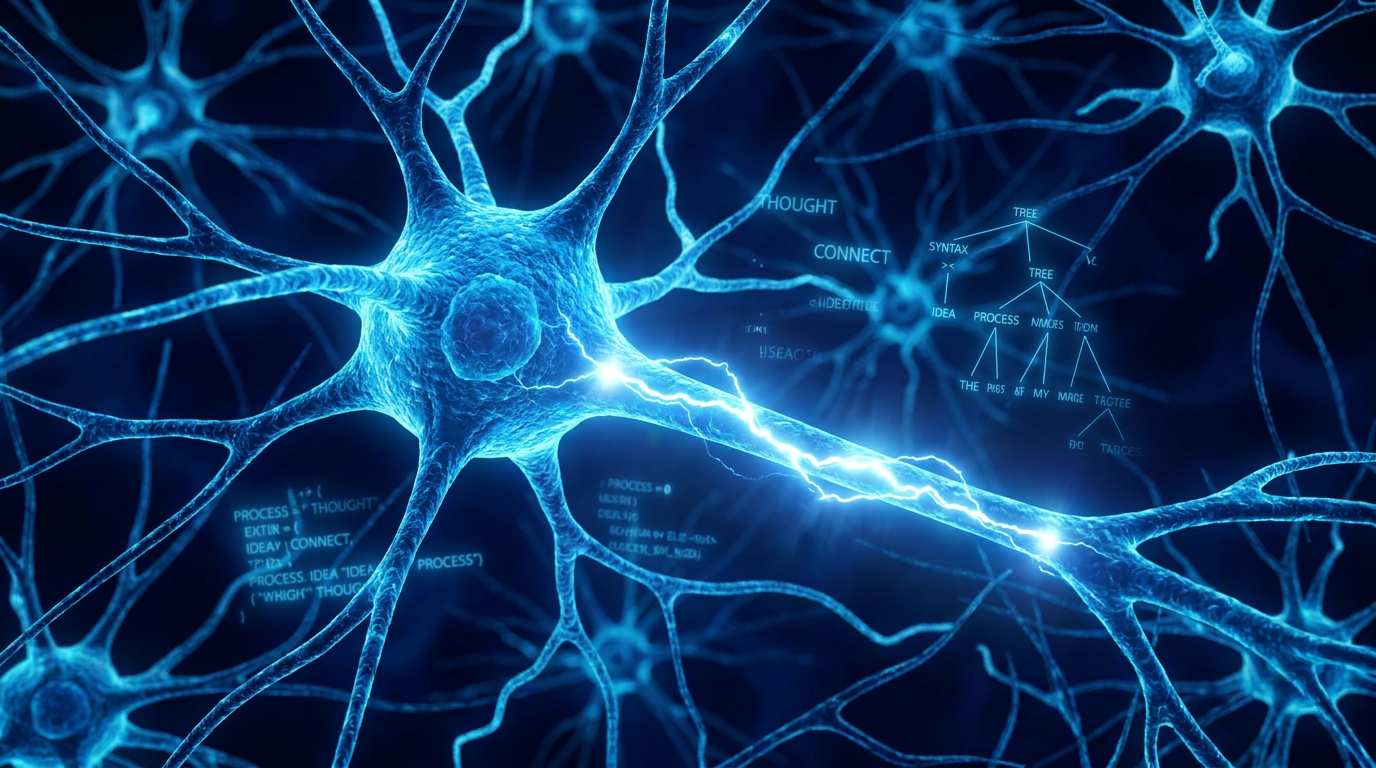
Now, a landmark 2026 study published in the journal Nature has offered an unprecedented look under the hood. By tracking the electrical activity of individual brain cells in real-time, researchers have captured exactly how the human brain builds a sentence, neuron by neuron, before a single word is ever spoken.[1][2]
The findings represent a massive leap in systems neuroscience. "We used to think language was this diffuse, whole-network phenomenon," the researchers noted. Instead, the data reveals a highly specialized, granular assembly line within the brain's prefrontal cortex, where specific cells are tasked with distinct linguistic jobs.[1]
Historically, scientists relied on functional magnetic resonance imaging (fMRI) to study language. While fMRI is excellent at showing which broad neighborhoods of the brain are active, it tracks blood flow, not electrical impulses. Relying on fMRI to understand conversation is like trying to map a city's traffic patterns by watching the glow of streetlights from space.[7]

To get down to the street level, the research team—led by scientists at Massachusetts General Hospital (MGH) and funded by the National Institutes of Health—utilized high-density microelectrode arrays known as Neuropixels. Thinner than a human hair, these probes were temporarily implanted in the brains of eight patients who were already undergoing surgery for epilepsy monitoring.[2][3]
With the electrodes in place, the researchers simply asked the patients to engage in naturally flowing, unscripted conversations. As the patients chatted about various topics, the Neuropixels recorded the rapid-fire electrical spikes of hundreds of individual neurons in the prefrontal cortex, a region long associated with speech production.[2]
When the team aligned the neuronal data with the audio transcripts of the conversations, a striking division of labor emerged. The brain does not process a sentence as a single, monolithic thought. Instead, it delegates the work to highly specialized cellular teams.[2]
One group of neurons acts as the brain's internal dictionary. These cells fire in response to the specific meanings and roles of individual words. Previous research from the MGH team in 2024 demonstrated that these "semantic neurons" cluster concepts together: words with similar meanings, like "mouse" and "rat," trigger nearly identical neural firing patterns, while unrelated words like "mouse" and "carrot" do not.[3][4][6]

But a pile of words is not a sentence. The 2026 study identified a second, entirely distinct class of cells: "grammar neurons." These cells do not care about the specific meaning of the words being spoken. Instead, their electrical activity spikes when the brain is tasked with grouping phrases into structured, syntactically correct sentences.[2]
The 2026 study identified a second, entirely distinct class of cells: "grammar neurons." These cells do not care about the specific meaning of the words being spoken.
This cellular assembly line operates with astonishing speed. The researchers found that neural activity peaked roughly 400 milliseconds before a word was actually vocalized. The brain is actively drafting the architecture of the sentence, selecting the concepts, and applying the grammar rules nearly half a second before the vocal cords begin to vibrate.[5]
The precision of this neural firing is so consistent that it can be mathematically decoded. By feeding the single-cell recordings into advanced machine-learning models, the NIH-funded team was able to predict the grammar, meaning, and context of the sentences the patients were about to speak.[2]
The AI models could even distinguish between homophones—words that sound identical but have different meanings, such as "sun" and "son," or "see" and "sea." Because the neurons encode the concept rather than just the sound, the neural signature for "sun" looks entirely different from "son," allowing the computer to know exactly which word the patient intended to use based on the context of the unuttered sentence.[6]
"This level of granularity is necessary for us to more completely understand how the brain generates speech," noted Dr. Debara Tucci, director of the NIH's National Institute on Deafness and Other Communication Disorders. It proves that language is not just a regional brain function, but a highly orchestrated cellular ballet.[2]
Beyond rewriting neuroscience textbooks, these findings carry profound clinical stakes. Millions of people worldwide suffer from conditions that leave their cognitive abilities intact but destroy their ability to speak, including amyotrophic lateral sclerosis (ALS), brainstem strokes, and severe traumatic brain injuries.[4][6]

For years, engineers have worked to build brain-computer interfaces (BCIs) that can restore communication for these patients. However, early BCIs often relied on spelling out words letter-by-letter, a slow and exhausting process that rarely exceeds a few words per minute.[7]
By tapping directly into the single-neuron signals that plan semantics and syntax, the next generation of BCIs could bypass the need for spelling entirely. If a computer can read the brain's pre-speech blueprint, it could translate a paralyzed patient's intended sentences into fluid, machine-generated audio in real-time, matching the natural speed of human conversation.[2][5]
Despite the breakthrough, researchers caution that we are still in the early days of neural decoding. The current studies rely on a small sample size of patients with epilepsy, and the Neuropixels probes only capture a fraction of the billions of neurons firing in the human brain.[5][7]

Furthermore, while scientists can now see that certain neurons handle grammar and others handle meaning, the exact mechanism of how these cells wire together and communicate across different brain regions remains an open frontier. The brain's full language network involves complex feedback loops between the prefrontal cortex, the motor cortex, and auditory processing centers.[7]
Nevertheless, the ability to eavesdrop on the brain as it builds a sentence marks a paradigm shift. It bridges the gap between abstract linguistics and hard biology, proving that the rules of grammar and the definitions of words are physically etched into the electrical firing of our cells.[7]
As recording technologies become less invasive and AI models grow more sophisticated, the ultimate goal of restoring natural voice to those who have lost it is moving rapidly from the realm of science fiction into clinical reality.[7]
How we got here
1990s-2010s
fMRI technology maps language processing to broad regions of the brain, but lacks the resolution to track individual cells.
2024
Researchers use Neuropixels to discover a 'brain thesaurus,' showing how single neurons group words by meaning and plan phonemes.
June 2026
A landmark study tracks single neurons during natural conversation, revealing how the brain builds complete sentences and applies grammar in real-time.
Viewpoints in depth
Neuroscientists & Researchers
Focuses on the fundamental biological discovery of how cellular networks physically encode abstract linguistic concepts.
For basic scientists, the ability to track single neurons during conversation is akin to finally finding the Rosetta Stone of the human brain. For decades, linguistics and biology operated in parallel but separate tracks—linguists theorized about abstract grammar rules, while biologists mapped broad brain regions. These findings prove that concepts like 'syntax' and 'semantics' are not just psychological constructs, but physical realities etched into the electrical firing of specific cells. It confirms that the brain's language architecture is highly modular and specialized at the microscopic level.
Clinical Neurologists & BCI Developers
Views the findings as the missing key to building brain-computer interfaces that restore natural speech for paralyzed patients.
Engineers and clinicians see this breakthrough primarily as a medical tool. Current brain-computer interfaces (BCIs) for patients with ALS or severe strokes are functional but frustratingly slow, often forcing users to spell out words letter-by-letter. By proving that the brain plans entire sentences, semantics, and grammar up to 400 milliseconds before speaking, developers now have a precise biological blueprint to target. Tapping into these pre-speech planning signals could allow future BCIs to bypass spelling entirely, translating a patient's intended thoughts directly into fluid, machine-generated audio at the speed of natural conversation.
Cognitive Linguists
Analyzes how biological evidence of grammar and dictionary neurons supports theories of innate language structure.
For linguists, the discovery of dedicated 'grammar neurons' that ignore word meaning in favor of sentence structure is a profound validation of long-held theories. It suggests that the human brain comes pre-wired with an innate capacity to organize language, rather than just learning to associate sounds through repetition. The fact that neurons can distinguish between homophones like 'sun' and 'son' based purely on context before the word is spoken further highlights the brain's incredible predictive power, showing that meaning is established long before the mechanics of sound are finalized.
What we don't know
- How these specialized language neurons wire together and communicate with the brain's motor and auditory centers.
- Whether the exact cellular mapping of grammar and semantics varies significantly across different languages or bilingual speakers.
- How to scale these findings from invasive surgical implants to non-invasive brain-computer interfaces for everyday clinical use.
Key terms
- Neuropixels
- High-density microelectrode probes, thinner than a human hair, capable of recording the electrical activity of hundreds of individual neurons simultaneously.
- Prefrontal Cortex
- A region at the front of the brain involved in complex cognitive behavior, decision making, and the planning of speech and language.
- Phoneme
- The smallest unit of sound in speech, such as the 'p' sound in 'pan' or the 'b' sound in 'ban'.
- Brain-Computer Interface (BCI)
- A system that translates brain activity into commands for external devices, often used to help paralyzed individuals communicate.
- Semantics
- The branch of linguistics concerned with meaning, such as how words relate to the concepts they represent.
- Syntax
- The set of rules, principles, and processes that govern the structure of sentences in a given language.
Frequently asked
How did scientists record individual neurons in humans?
Researchers used high-density microelectrode arrays, called Neuropixels, which were temporarily implanted in patients already undergoing brain surgery for epilepsy monitoring.
Does this mean scientists can read minds?
No. The technology requires surgically implanted electrodes and can only decode specific speech-planning signals in a highly controlled setting, not general inner thoughts.
How will this help paralyzed patients?
By understanding exactly how individual neurons encode words and grammar, engineers can build faster, more accurate brain-computer interfaces that translate a patient's intended speech directly into computer-generated audio.
What is the difference between dictionary and grammar neurons?
Dictionary neurons fire in response to the specific meaning of a word, while grammar neurons activate when the brain is organizing words into a structured, syntactically correct sentence.
Sources
Source coverage
7 outlets
3 viewpoints surfaced







[1]NatureNeuroscientists & Researchers
Daily briefing: The brain builds a sentence neuron by neuron
Read on Nature →[2]National Institutes of HealthClinical Neurologists & BCI Developers
With neuronal data, AI models predicted grammar, meaning, and context of spoken sentences
Read on National Institutes of Health →[3]Massachusetts General HospitalClinical Neurologists & BCI Developers
Researchers Discover How Word Meanings Are Represented by Neurons in the Brain
Read on Massachusetts General Hospital →[4]ScienceAlertNeuroscientists & Researchers
Meanings of Words Have Been Detected in The Flicker of Individual Brain Cells
Read on ScienceAlert →[5]The TransmitterClinical Neurologists & BCI Developers
Neuropixels in humans reveal how the brain plans speech
Read on The Transmitter →[6]Harvard Medical SchoolNeuroscientists & Researchers
Building a 'Brain Thesaurus'
Read on Harvard Medical School →[7]Factlen Editorial TeamCognitive Linguists
Synthesis by Factlen editorial team
Read on Factlen Editorial Team →

Every angle. Every day.
Get science stories with full source coverage and perspective breakdowns delivered to your inbox.