
How AI Coding Agents Are Dismantling the 50-Year Paradigm of Manual Programming
The emergence of autonomous AI coding agents like Cursor and Devin is shifting software development from manual syntax writing to intent-based natural language programming. This transition is not only accelerating professional workflows but democratizing application creation for non-technical users.
By Factlen Editorial Team
- AI-Native Developers
- Argues that AI eliminates boilerplate code and acts as a massive productivity multiplier, allowing engineers to focus on logic and architecture.
- Non-Technical Creators
- Focuses on the democratization of software, arguing that natural language programming removes the syntax barrier for domain experts.
- Security & Architecture Experts
- Emphasizes the need for strict guardrails, noting that while AI writes code quickly, human oversight is mandatory to prevent subtle architectural failures.
What's not represented
- · Computer science educators grappling with how to adapt university curricula.
- · Junior developers facing a shifting entry-level job market.
Why this matters
The ability to create software is no longer restricted to those who have spent years learning complex programming languages. This shift empowers anyone with a clear idea to build functional applications, fundamentally changing who gets to participate in the digital economy.
Key points
- AI coding tools have evolved from simple autocomplete engines to autonomous agents capable of executing multi-step tasks.
- Intent-based development allows users to build software using natural language, democratizing app creation for non-technical users.
- Professional developers using AI assistants report completing tasks up to 55% faster by eliminating boilerplate code.
- Human expertise remains essential for complex system architecture, novel problem-solving, and security governance.
For over five decades, the act of writing code has been the central, gatekept skill of the technology industry. Mastery of syntax, compilers, and obscure error messages was the mandatory toll for anyone wishing to build software. But a profound shift is quietly dismantling this paradigm: artificial intelligence is no longer just learning to write code; it is becoming remarkably good at it. The emergence of powerful AI coding assistants and autonomous agents has fundamentally altered how software gets built. These tools do not merely autocomplete a line of syntax; they understand the intent behind a developer's request and generate entire functions, classes, test suites, and even application architectures. We are witnessing the end of coding as a purely manual labor process and the beginning of a new era of AI-orchestrated software engineering.[1][5]
This transition is moving the technology industry from manual syntax generation to what is increasingly known as "intent-based development." Instead of writing software line by line, users can now specify, modify, and maintain entire applications through conversational interfaces. Natural language programming, where plain English serves as the primary instruction set, is bridging the gap between human thought and machine execution. This shift extends far beyond simple task automation; it changes how creators interact with technical knowledge, solve problems, and construct complex digital solutions. By allowing developers to articulate the "what" while the AI handles the "how," intent-based development is dramatically reducing the cognitive load required to bring an idea to life.[2][7]
This evolution is being driven by a rapidly maturing ecosystem of AI-powered tools that span every phase of the software development lifecycle. Early iterations of AI assistance, which debuted around 2021, functioned primarily as advanced autocomplete engines—helpful for finishing a line of code but largely unaware of the broader project. However, the landscape in 2026 is dominated by AI-first integrated development environments (IDEs) and autonomous agents. Tools like GitHub Copilot Workspace, Cursor, and Windsurf have moved beyond isolated suggestions to provide comprehensive support across the entire engineering workflow, from initial repository setup to final deployment. These platforms are designed to behave less like passive tools and more like collaborative teammates, mimicking real developer-to-developer interactions and stretching the surface area a single human can realistically manage in a day.[3][5]
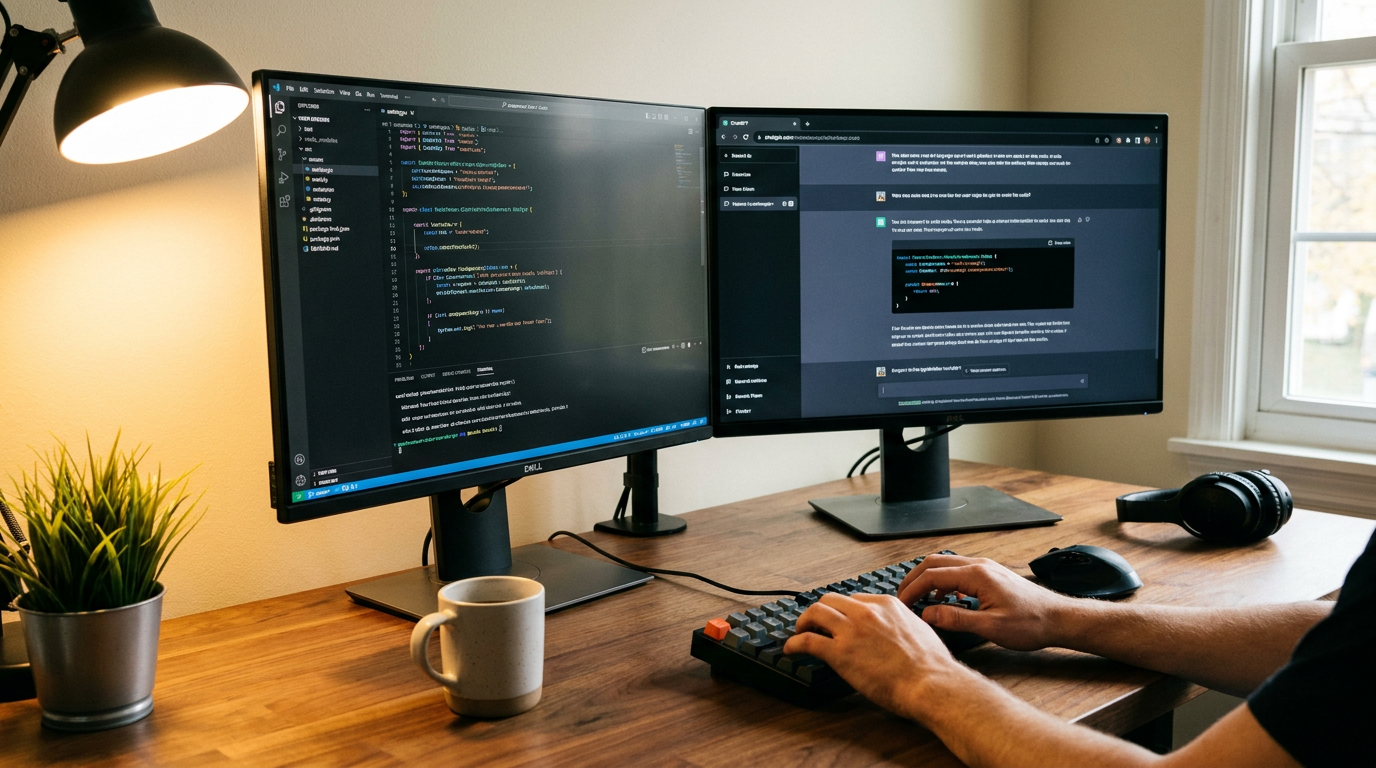
Tools like Cursor have structurally transformed programming practice by rethinking the environment in which code is written. Built as an AI-native code editor, Cursor deeply integrates machine learning into every interaction. Rather than sprinkling AI functionality over an existing editor, the platform is built around a true teammate model. Developers can highlight a function, open a chat interface, and ask the AI to optimize performance, rewrite logic, or explain confusing legacy code. The AI responds instantly, drafting inline suggestions that help engineers move forward without breaking their state of flow. This deep integration ensures that AI assistance is not an afterthought, but the primary mechanism for interacting with the codebase.[5][6]

The technical mechanism behind this leap in capability is deep codebase indexing and context awareness. Modern AI assistants do not simply guess the next word based on generic training data; they analyze the relationships between thousands of components within a specific repository. By indexing an entire project, the AI understands architectural patterns, naming conventions, and file dependencies. When a developer asks for a new feature, the tool generates code that integrates seamlessly with the existing system, respecting the established style and structure. This contextual awareness is what elevates these platforms from simple code generators to genuine development partners capable of maintaining consistency across massive enterprise applications.[1][4]
Beyond AI-assisted editors, the industry is witnessing the rapid rise of fully autonomous coding agents like Devin and Windsurf's Cascade. These systems operate on an "agentic workflow," meaning they can independently plan and execute multi-step development tasks without constant human intervention. Unlike traditional coding assistants that operate strictly within an IDE and respond only to explicit prompts, autonomous agents can create their own task plans. When assigned a complex objective—such as migrating a database or building a new authentication flow—the agent breaks the project down into sequential steps, executing them one by one while maintaining a persistent memory of its progress. This agentic leap represents a fundamental shift in AI capabilities, moving from reactive assistance to proactive problem-solving.[3][5]
Beyond AI-assisted editors, the industry is witnessing the rapid rise of fully autonomous coding agents like Devin and Windsurf's Cascade.
The execution loop of an autonomous agent is remarkably similar to that of a human engineer. When given a prompt, the agent navigates the codebase, writes the necessary logic, and generates corresponding unit tests. Crucially, if a test fails or a terminal error occurs, the agent does not simply stop and wait for human help. It reads the error logs, analyzes the stack trace, formulates a hypothesis for the failure, and writes a patch to fix the bug. It iterates through this debugging loop autonomously until the feature works as intended. This ability to self-correct and learn from immediate feedback loops allows engineering teams to hand off entire feature tickets to AI agents with confidence.[3][4]
For professional software engineers, the productivity case for adopting these tools is overwhelmingly clear. Studies and industry reports consistently indicate that developers using AI coding assistants complete tasks up to 55 percent faster than those who do not. These gains are particularly pronounced when dealing with repetitive tasks, such as generating boilerplate code, integrating standard APIs, or writing comprehensive test suites. By offloading the mechanical and tedious aspects of programming to AI, engineers are freed to focus their cognitive energy on higher-level system design, complex architectural decisions, and ensuring that the software aligns with overarching business objectives. The concept of the "AI-native developer" has emerged to describe professionals who have integrated these tools so deeply into their workflow that AI assistance is fundamental to how they operate, rather than an occasional helper.[7]

However, the most transformative impact of these tools lies in their democratizing potential. Natural language programming is lowering the barrier to entry for software creation, allowing non-technical team members, designers, and domain experts to build functional prototypes and complete applications simply by describing what they want. Through conversational interfaces, individuals who have never written a line of Python or JavaScript can orchestrate the creation of complex digital tools. This phenomenon, sometimes referred to colloquially as "vibe coding," empowers a much broader audience to participate in the digital economy, shifting the power of creation from a specialized few to anyone with a clear vision and logical thinking skills.[2][7]
This accessibility shift is blurring the boundary between designing software and writing software. In traditional development, a product manager or designer would create a specification, hand it off to an engineering team, and wait weeks for a functional prototype. Today, that same product manager can use an AI agent to generate a working application in an afternoon. We are moving toward a future where creating a custom business application, an internal dashboard, or a personal utility tool is as accessible as creating a complex spreadsheet is today. This democratization fosters rapid prototyping and allows organizations to iterate on ideas at an unprecedented velocity.[1][2]
Despite these rapid advancements, the rise of AI-native development does not eliminate the need for human expertise. Complex system architecture, novel problem-solving, and nuanced product decisions still require human judgment. AI tools excel at executing well-defined tasks and identifying established patterns, but they often struggle with subtle architectural bugs or highly novel edge cases that fall outside their training data. The most productive developers use AI as a powerful collaboration tool rather than a complete dependency, maintaining the ability to critically evaluate AI-generated outputs and step in when the machine's logic falters. The skillset of the modern engineer is shifting away from memorizing syntax and toward prompt engineering, system orchestration, and rigorous code review.[6][7]

Security and governance also remain critical considerations in the era of intent-based development. As AI agents generate increasingly large volumes of code, the risk of introducing subtle vulnerabilities or relying on outdated dependencies grows. To mitigate these risks, enterprise development teams are integrating advanced software composition analysis (SCA) and secure code remediation tools directly into their AI workflows. These guardrails monitor AI-generated implementations in real-time, detecting known vulnerabilities and ensuring that the autonomous agents adhere to strict security protocols and compliance standards before any code is merged into production. Without these automated checks, the sheer speed of AI generation could easily overwhelm traditional manual security reviews, leading to fragile or compromised systems.[4]
Ultimately, the role of the software creator is undergoing a profound evolution. The industry is transitioning from an era where value was measured by the ability to write flawless syntax to one where value is defined by the ability to orchestrate intelligent systems. By delegating the mechanical aspects of coding to artificial intelligence, human creators are empowered to focus on what they do best: understanding user needs, designing elegant architectures, and solving complex, real-world problems. The democratization of software development ensures that the next generation of digital innovation will be driven not just by those who know how to code, but by anyone who knows what needs to be built.[1][6]
How we got here
2021
GitHub Copilot launches, introducing AI-powered code autocomplete to the mainstream.
2023
Large language models begin assisting developers with complex debugging and code explanation.
2024
AI-first IDEs like Cursor gain traction, integrating AI deeply into the development environment.
2025
Autonomous coding agents like Devin demonstrate the ability to plan and execute multi-step engineering tasks.
2026
Agentic workflows and natural language programming become standard infrastructure, democratizing app creation.
Viewpoints in depth
AI-Native Developers
Professionals who view AI as a massive productivity multiplier.
For AI-native developers, the value of these tools lies in their ability to eliminate the tedious aspects of programming. By offloading boilerplate generation, API integration, and unit testing to AI, engineers can operate at a much higher level of abstraction. This camp argues that AI does not replace the engineer; rather, it elevates them to the role of a system architect who spends more time thinking about business logic and less time fighting with syntax errors.
Non-Technical Creators
Domain experts who view AI as a democratizing force for software creation.
This perspective celebrates the lowering of the technical barrier to entry. Non-technical creators argue that the best software is often envisioned by those closest to the problem—doctors, teachers, or small business owners—who traditionally lacked the coding skills to build solutions. Natural language programming allows these domain experts to bypass the syntax learning curve entirely, empowering them to build functional prototypes and custom tools simply by describing their intent.
Security & Architecture Experts
Specialists focused on the risks and limitations of AI-generated code.
While acknowledging the speed benefits, security and architecture experts warn against over-reliance on autonomous agents. They point out that AI tools can confidently generate code that looks correct but contains subtle architectural flaws or security vulnerabilities. This camp advocates for strict guardrails, emphasizing that human oversight, rigorous code review, and automated software composition analysis (SCA) are more critical than ever when code is being generated at unprecedented velocities.
What we don't know
- How the proliferation of AI-generated code will impact the long-term maintainability of massive legacy systems.
- Whether natural language programming will completely replace traditional syntax for complex, high-performance computing tasks.
- How intellectual property laws will adapt to software architectures generated entirely by autonomous agents.
Key terms
- Intent-Based Development
- A programming paradigm where the user describes the desired outcome in natural language, and the AI generates the underlying code.
- Agentic Workflow
- A process where an AI system autonomously plans a series of steps, uses tools, evaluates results, and iterates to complete a complex task.
- Codebase Indexing
- The process by which an AI tool scans and maps an entire software project to provide context-aware suggestions.
- Natural Language Programming
- The use of everyday human language to instruct computers, bypassing traditional programming syntax.
- Software Composition Analysis (SCA)
- Automated tools that inspect code to identify open-source components and detect known security vulnerabilities.
Frequently asked
What is an autonomous AI coding agent?
An AI system that can independently plan, write, test, and debug code across multiple files to complete a complex task, rather than just autocompleting single lines.
Will AI coding tools replace software engineers?
No, but they are shifting the engineer's role from writing manual syntax to orchestrating systems, designing architecture, and validating AI-generated outputs.
Can non-programmers build apps with these tools?
Yes, modern natural language programming interfaces allow users to generate functional applications simply by describing their intent in plain English.
How do these tools understand my specific project?
Advanced tools index your entire codebase, allowing the AI to understand your architectural patterns, naming conventions, and file relationships to provide context-aware suggestions.
Sources
Source coverage
7 outlets
3 viewpoints surfaced






[1]Factlen Editorial TeamNon-Technical Creators
Synthesis by Factlen editorial team
Read on Factlen Editorial Team →[2]ResearchGateNon-Technical Creators
Discovering the Syntax and Strategies of Natural Language Programming with Generative Language Models
Read on ResearchGate →[3]SourceForgeNon-Technical Creators
AI Coding Assistants and Autonomous Agents in 2026
Read on SourceForge →[4]CheckmarxSecurity & Architecture Experts
AI Developer Tools: Security and Lifecycle Integration
Read on Checkmarx →[5]CrossoverAI-Native Developers
The AI Tools Reshaping Software Engineering
Read on Crossover →[6]AitudeAI-Native Developers
What AI Engineers Actually Do in 2026
Read on Aitude →[7]IdeawareAI-Native Developers
The Rise of the AI Native Developer
Read on Ideaware →


Every angle. Every day.
Get ai stories with full source coverage and perspective breakdowns delivered to your inbox.