
How 'Coral IVF' and Heat-Tolerant Breeding Are Buying Time for the Great Barrier Reef
Australian scientists are scaling up in-vitro fertilization and selective breeding to deploy millions of heat-resistant baby corals, offering a vital lifeline to the world's largest reef system.
By Factlen Editorial Team
- Marine Innovators
- Argue that active, scalable technological intervention is now mandatory to prevent ecosystem collapse.
- Climate Policy Advocates
- Emphasize that restoration technologies are temporary treatments, and only rapid emissions reductions can provide a permanent cure.
- Conservation Optimists
- Focus on the empowering narrative that human ingenuity can actively repair environmental damage.
What's not represented
- · Traditional Owners (First Nations peoples whose sea country encompasses the reef)
- · Commercial fishing operators adapting to shifting reef zones
Why this matters
While climate change remains an existential threat to ocean ecosystems, these rapidly advancing interventions prove that targeted human ingenuity can actively rebuild biodiversity. This technology not only protects a critical natural wonder but also safeguards the $6.4 billion coastal economy and 64,000 jobs that depend on it.
Key points
- Scientists are using 'Coral IVF' to capture coral spawn and rear them safely in floating nurseries.
- Researchers are selectively breeding corals and their symbiotic algae to withstand higher ocean temperatures.
- New 'larval seedboxes' developed by CSIRO have increased coral settlement rates by up to 56 times.
- By restoring just 3% of highly connected reefs, ocean currents can drive the recovery of 50% of the ecosystem.
- The program aims to deploy 1.2 million heat-tolerant corals annually by 2031 to buy time against climate change.
For decades, the global narrative surrounding the Great Barrier Reef has been dominated by a sense of managed decline and ecological despair. As global ocean temperatures steadily rise due to climate change, the world’s largest coral ecosystem has endured repeated mass bleaching events, including consecutive severe episodes in 2024 and 2025. These intense marine heatwaves place immense physiological stress on the delicate organisms that build the reef, leading many international observers to fear that the entire 2,300-kilometer system was on an irreversible path toward functional extinction. The sheer scale of the damage seemed to dwarf any localized conservation efforts.[2][5]
But beneath the surface, a profound shift in marine conservation philosophy is currently taking place. Rather than merely monitoring the reef’s degradation and documenting its losses, a massive coalition of Australian scientists, engineers, and conservationists has pivoted to active, large-scale medical intervention for the ocean. This represents a fundamental departure from traditional conservation, which historically focused on simply protecting areas from human interference and letting nature heal itself. Today, researchers acknowledge that nature can no longer keep pace with the speed of anthropogenic climate change, necessitating direct human assistance to ensure the ecosystem's survival.[6]
At the absolute forefront of this ambitious effort is the Reef Restoration and Adaptation Program (RRAP), a collaborative initiative that is currently pioneering two major scientific breakthroughs: "Coral IVF" and the selective breeding of heat-tolerant corals. Together, these rapidly advancing technologies are transitioning reef restoration from a boutique, small-scale laboratory experiment into an industrialized, highly coordinated lifeline. By combining marine biology with advanced robotics and predictive oceanography, the program aims to deploy resilient corals at a scale never before attempted in human history.[1][2]
To fully understand the mechanics of Coral IVF, one must first understand how these complex organisms reproduce in the wild. Once a year, typically a few days after the November or December full moon, the Great Barrier Reef undergoes a spectacular synchronized mass spawning. Triggered by lunar cycles and water temperatures, millions of corals simultaneously release tiny bundles of eggs and sperm into the water column. It is an underwater blizzard of genetic material, designed to overwhelm predators through sheer volume and ensure that at least a fraction of the offspring survive to build new colonies.[2][5]

In the wild, however, this natural reproductive process is highly inefficient and increasingly vulnerable. The microscopic coral larvae are entirely at the mercy of ocean currents, hungry predators, and increasingly hostile, warming water conditions. As marine heatwaves degrade the overall health of adult corals, the viability of their spawn also plummets. Coral IVF intervenes directly in this reproductive bottleneck, acting as a biological multiplier to ensure that a vastly higher percentage of these vulnerable embryos survive their perilous first week of life.[2]
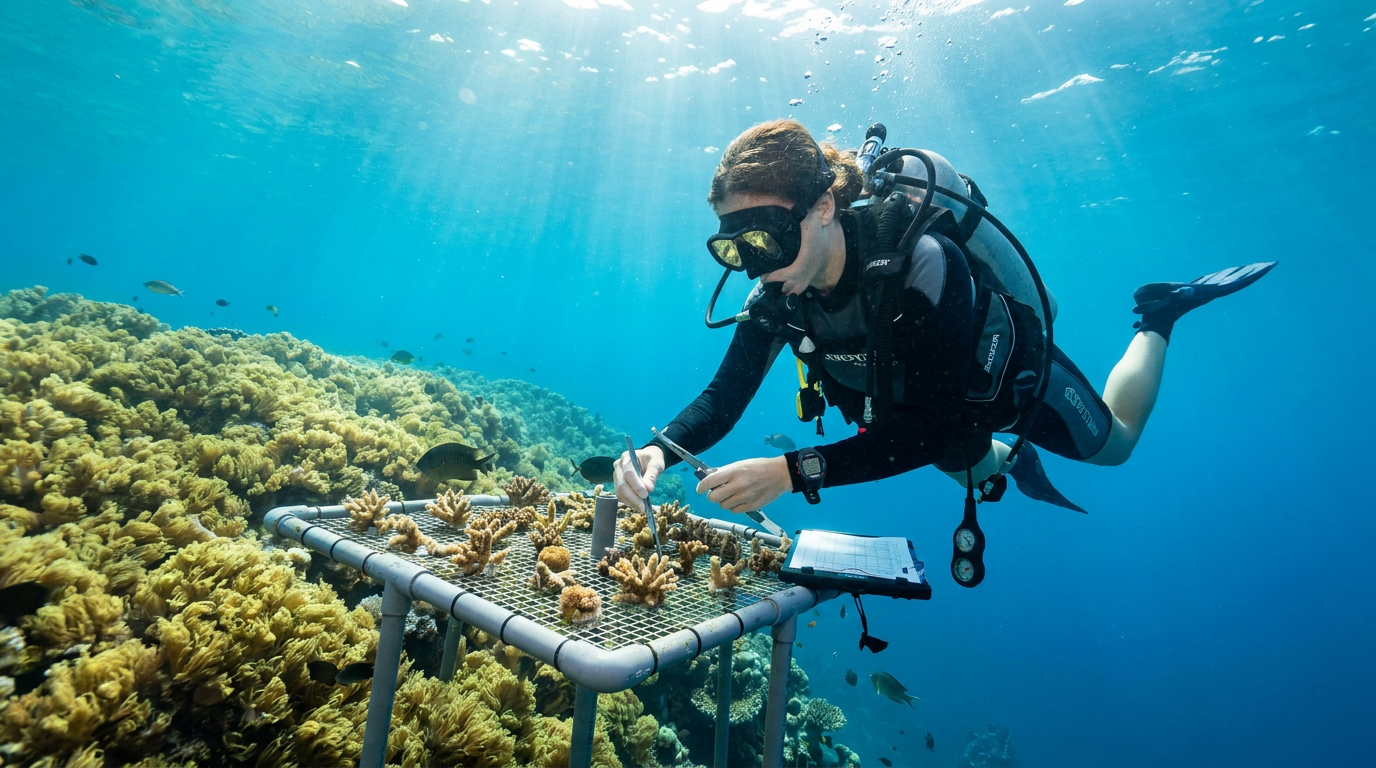
During the mass spawning event, researchers carefully capture the floating spawn from healthy, resilient reefs and transfer them into specially designed floating larval pools. Inside these protected, mesh-lined enclosures, the fertilization rate skyrockets compared to the open ocean. The coral babies are reared safely in these floating nurseries for five to seven days, closely monitored by marine biologists until they are robust enough to settle. Once they reach this crucial developmental milestone, they are carefully dispersed onto degraded reef sites to begin forming new colonies.[2][5]
Yet, simply planting more corals is not enough if the ocean continues to warm at its current trajectory. A newly planted coral is just as vulnerable to the next marine heatwave as the one it replaced. This is exactly where the science of selective breeding enters the equation. Scientists at the Australian Institute of Marine Science (AIMS) are actively breeding bespoke corals specifically designed to withstand the marine heatwaves of the future, accelerating the natural evolutionary process to keep pace with a rapidly changing climate.[1][4]
Yet, simply planting more corals is not enough if the ocean continues to warm at its current trajectory.
The selective breeding process involves identifying specific coral colonies that have naturally survived severe bleaching events, particularly those sourced from the naturally warmer northern sections of the Great Barrier Reef. By deliberately crossing these highly resilient parents in controlled aquaculture facilities, researchers are producing generations of offspring with significantly higher thermal tolerance. It is essentially a targeted breeding program, much like those used in agriculture for centuries, but applied to the foundational architects of the marine ecosystem.[1]

The biological innovation extends even beyond the coral animal itself. Corals rely on a vital symbiotic relationship with microscopic algae called zooxanthellae, which live inside their tissues and provide them with their primary food source and vibrant colors. Researchers are now using laboratory evolution techniques to create heat-evolved strains of this specific algae. By inoculating young corals with these "super-symbionts," scientists are engineering partnerships that refuse to break down and bleach when water temperatures spike, creating a dual layer of thermal resilience.[2]
While the biological breakthroughs are staggering, the next monumental hurdle is physical deployment. Historically, coral restoration required scuba divers to manually plant individual coral fragments onto the reef structure—a painstaking, resource-intensive process that is far too slow and expensive to save a reef the size of Italy. To make a meaningful ecological impact, scientists needed a way to move from planting thousands of corals to planting millions, requiring a complete reimagining of how marine restoration is physically executed on the seafloor.[4]
To solve this logistical bottleneck, Australia’s national science agency, CSIRO, working alongside Southern Cross University, developed an innovative delivery mechanism known as "larval seedboxes." These small, clear, rectangular containers are designed to safely deliver concentrated doses of lab-reared coral larvae directly to the seafloor. By protecting the larvae during the crucial settlement phase and preventing them from being washed away by strong currents, the seedboxes ensure that the microscopic corals actually attach to the reef structure where they are needed most.[3]
Early field trials of the seedbox technology in the Whitsundays and Lizard Island have yielded truly staggering results, recording coral settlement rates up to 56 times higher than natural background levels. Coupled with the development of semi-automated robotics and specialized deployment vessels under the Boats4Corals program, this technology allows a small team of researchers to effectively seed thousands of square meters of degraded reef in a single afternoon. It represents the critical leap from artisanal conservation to industrialized ecological repair, proving that mass deployment is physically possible.[3]

The strategic brilliance of the Great Barrier Reef Foundation's program lies in its application of advanced oceanography. The initiative operates on a highly leveraged "3% for 50%" model. Because the reef is a vast, interconnected network of ocean currents, scientists do not actually need to manually plant corals across the entire 344,400 square kilometer marine park. By using sophisticated predictive modeling to identify highly connected "source reefs," scientists only need to actively restore about 3% of the total ecosystem.[4]
Once these strategic hub reefs are successfully repopulated with heat-tolerant, selectively bred corals, the ocean’s natural currents will take over and do the heavy lifting. During future mass spawning events, these newly established resilient hubs will release their own heat-adapted spawn, which will be carried by the tides to surrounding, harder-to-reach areas. This natural dispersal mechanism effectively drives the recovery of half the entire reef system without requiring any further human intervention, making the logistics and economics of large-scale marine restoration suddenly viable on a global scale.[4]

The scale of the current ambition is entirely unprecedented in the history of marine biology. By the end of 2025, the Coral IVF program had already successfully planted over 2.1 million baby corals across targeted sections of the Great Barrier Reef. But this is only the beginning of the scale-up phase. By 2031, the overarching goal of the consortium is to achieve the capacity to deploy 1.2 million heat-tolerant, surviving corals every single year, fundamentally altering the survival trajectory of the ecosystem.[2][4]
However, despite the immense promise of these scientific breakthroughs, researchers and conservationists remain unequivocal about the limits of this technology. Coral IVF and selective breeding are highly effective medical treatments, but they are not a permanent cure for the underlying disease. They are explicitly designed to buy the reef a crucial window of time—perhaps a few decades of borrowed resilience—while the global economy undertakes the massive structural transition required to move away from fossil fuels and halt the warming of the oceans.[4][5]
If global greenhouse gas emissions are not drastically reduced in the coming years, no amount of genetic engineering, floating nurseries, or robotic deployment can save the reef from a fundamentally hostile, boiling ocean. The ultimate survival of these ecosystems depends entirely on stabilizing the Earth's climate. But for now, these remarkable scientific breakthroughs prove that humanity is not entirely powerless in the face of ecological collapse. By combining cutting-edge marine biology with a steadfast refusal to surrender, researchers are offering a tangible, deeply uplifting blueprint for actively regenerating the natural world.[6]
How we got here
2020
Reef Restoration and Adaptation Program (RRAP) launches to research scalable interventions.
2024
First pilot studies of CSIRO's larval seedboxes show massively increased settlement rates.
2025
Great Barrier Reef Foundation reaches milestone of 2.1 million baby corals planted.
2031
Target date to achieve the deployment of 1.2 million heat-tolerant corals annually.
Viewpoints in depth
Marine Innovators
Scientists and engineers focused on scaling technological interventions to prevent ecosystem collapse.
For the marine biologists and engineers at AIMS and CSIRO, the era of passive conservation is over. They argue that because climate change has already fundamentally altered the ocean's baseline, human intervention is now a mandatory requirement for the reef's survival. Their focus is entirely on scaling up—moving from successful laboratory experiments to industrialized, robotic deployment that can match the sheer geographic scale of the Great Barrier Reef.
Climate Policy Advocates
Environmental policy experts who warn against over-relying on technological fixes.
While celebrating the success of Coral IVF, climate advocates and organizations like the IISD caution against 'techno-optimism'—the dangerous assumption that human engineering can simply innovate our way out of the climate crisis. They stress that selective breeding and floating nurseries are merely buying time. If these breakthroughs are used by policymakers as an excuse to delay the phase-out of fossil fuels, the resulting ocean acidification and extreme temperatures will eventually overwhelm even the most heat-resilient super-corals.
Coastal Economies
Local industries and communities whose livelihoods depend on a living reef.
For the tourism operators, fisheries, and coastal communities of Queensland, coral restoration is an economic lifeline. The Great Barrier Reef supports an estimated 64,000 jobs and contributes $6.4 billion annually to the Australian economy. For this camp, the success of the Boats4Corals program and the training of local tourism operators to assist in Coral IVF during the spawning season represents a vital transition, turning those who rely on the reef into active participants in its medical care.
What we don't know
- Whether heat-evolved symbiotic algae will maintain their enhanced thermal tolerance over decades in wild, fluctuating ocean conditions.
- Exactly how the complex, multi-species interactions of the reef will adapt to an influx of selectively bred, heat-dominant coral strains.
- If the scaled-up deployment target of 1.2 million corals per year will be sufficient to outpace the accelerating frequency of marine heatwaves.
Key terms
- Coral IVF
- A technique where coral eggs and sperm are collected during mass spawning and reared in protected floating pools to maximize fertilization.
- Zooxanthellae
- Microscopic algae that live inside coral tissue, providing the coral with its primary food source and vibrant color.
- Mass Spawning
- An annual synchronized event where millions of corals simultaneously release reproductive bundles into the ocean.
- Larval Seedbox
- A specialized container developed by CSIRO to safely deliver concentrated doses of coral larvae directly to the seafloor.
Frequently asked
What is coral bleaching?
When corals are stressed by unusually warm water, they expel the symbiotic algae living in their tissues, turning white and risking starvation.
Does Coral IVF create genetically modified corals?
No. It uses selective breeding of naturally occurring heat-tolerant corals, accelerating natural adaptation rather than introducing foreign DNA.
Can this technology save the entire Great Barrier Reef?
Not on its own. Scientists emphasize that Coral IVF buys crucial time, but long-term survival requires a global reduction in greenhouse gas emissions.
How do scientists know which corals are heat-tolerant?
Researchers identify corals that have naturally survived severe bleaching events, often sourcing them from the naturally warmer northern sections of the reef.
Sources
Source coverage
6 outlets
3 viewpoints surfaced





[1]Australian Institute of Marine Science (AIMS)Marine Innovators
Selective breeding and artificial selection for heat-tolerant corals
Read on Australian Institute of Marine Science (AIMS) →[2]Great Barrier Reef FoundationMarine Innovators
What is Coral IVF and how is it scaling up?
Read on Great Barrier Reef Foundation →[3]CSIROMarine Innovators
Larval seedboxes trial yields unprecedented coral settlement rates
Read on CSIRO →[4]Good Good GoodConservation Optimists
How scientists are breeding heat-tolerant corals to save the Great Barrier Reef
Read on Good Good Good →[5]International Institute for Sustainable DevelopmentClimate Policy Advocates
Restoring the Great Barrier Reef: Can Coral In Vitro Fertilization Buy Time?
Read on International Institute for Sustainable Development →[6]Factlen Editorial TeamConservation Optimists
Synthesis by Factlen editorial team
Read on Factlen Editorial Team →
Every angle. Every day.
Get world stories with full source coverage and perspective breakdowns delivered to your inbox.