
Humanoid Robot Maker Agility Robotics Goes Public at $2.5 Billion Valuation
The creator of the Digit bipedal robot is merging with a SPAC to become the first publicly traded U.S. humanoid robotics company, signaling a shift from lab demos to commercial scale.
By Factlen Editorial Team
- Automation Integrators
- Focus on deploying humanoids to solve chronic physical labor shortages and increase warehouse efficiency.
- Financial Realists
- Welcome the shift from private venture capital hype to public market scrutiny, demanding proof of unit economics.
- Manufacturing Partners
- View humanoids as a scalable industrial platform requiring massive supply chain backing.
What's not represented
- · Warehouse Workers
- · Labor Unions
Why this matters
As the first pure-play humanoid robotics firm to hit Wall Street, Agility's public financials will finally provide independent benchmarks for the real-world cost and ROI of AI-powered physical labor, moving the industry beyond venture capital hype and into practical logistics.
Key points
- Agility Robotics is merging with a SPAC to go public at a $2.5 billion valuation.
- The deal is expected to generate over $620 million, including a $200 million investment led by Foxconn.
- Agility will become the first publicly listed, pure-play humanoid robotics company in the U.S.
- The company's Digit robot is already deployed in nine customer facilities, logging over 65,000 operational hours.
- Public quarterly filings will soon provide the industry's first audited financial benchmarks for humanoid robot operations.
The humanoid robotics industry is officially moving from viral video demonstrations to Wall Street. Agility Robotics, the Oregon-based creator of the bipedal warehouse robot Digit, announced Wednesday that it will go public through a merger with a special-purpose acquisition company (SPAC).[1][2]
The deal with Churchill Capital Corp XI values Agility at a $2.5 billion pre-money equity valuation and is expected to generate more than $620 million in gross proceeds. Once the transaction closes later this year, Agility will trade on the Nasdaq under the ticker AGLT, becoming the first publicly listed, pure-play humanoid robotics company in the United States.[1][4][6][7]
Unlike many of its competitors whose robots primarily exist in controlled laboratory environments, Agility has already crossed the threshold into commercial deployment. The company's flagship robot, Digit, is currently operating in nine customer facilities, accumulating more than 65,000 hours of real-world operation.[3][5][6]

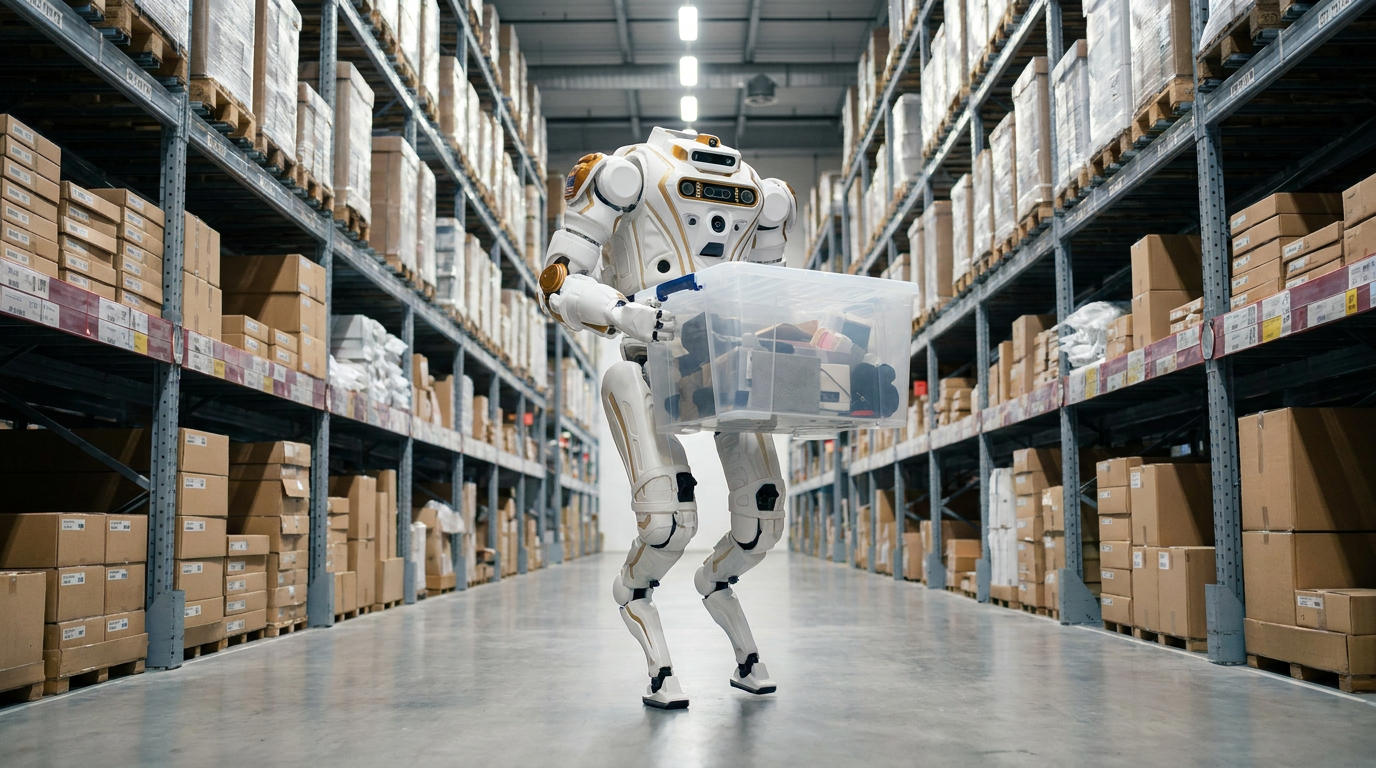
Digit is specifically designed for the repetitive, physically taxing work of modern logistics. Standing 5-foot-9, the robot features distinctive backward-bending, bird-like legs that provide superior stability and a headless design that maximizes sensor coverage. It is built to navigate spaces designed for humans, such as narrow warehouse aisles and stairs, without requiring companies to retrofit their facilities.[1][3][7]
Major logistics and manufacturing players are already utilizing the platform. Amazon, which is also a strategic investor, has tested Digit in its fulfillment centers, while GXO Logistics recently announced that the robot had successfully moved more than 100,000 totes at a facility in Georgia. Other early adopters include Toyota Motor Manufacturing Canada, auto-parts giant Schaeffler, and Latin American e-commerce leader Mercado Libre.[2][3][6][7]
Major logistics and manufacturing players are already utilizing the platform.
The capital injection from the SPAC merger will fuel Agility's transition into mass production. The $620 million in expected proceeds includes $420 million from Churchill XI's trust and a $200 million private investment in public equity (PIPE) led by Taiwanese electronics manufacturing giant Foxconn.[1][3]

Foxconn's lead role in the PIPE is viewed as a critical signal that humanoid robotics is entering a scale-manufacturing phase. Agility is already operating RoboFab, a manufacturing facility in Salem, Oregon, designed to produce up to 10,000 robots annually once fully scaled.[3][5][6]
The funds will also support the rollout of Digit v5, the next generation of the platform. The updated model boasts a 50-pound lifting capacity—a 40 percent increase from its predecessor—and can operate for up to 22 hours on a single charge. Agility CEO Peggy Johnson noted that the company already has more than $300 million in multi-year pre-orders for the new model.[1][4][6]
Agility's public debut will serve as a watershed moment for the broader humanoid robotics sector, which has been fueled by massive private valuations. Competitors like Figure AI recently reached a $39 billion private valuation, while Apptronik and Chinese rival Unitree continue to raise substantial venture capital.[4][7]

By entering the public markets, Agility will be required to file quarterly financial reports, exposing the true cost, revenue, and utilization metrics of warehouse humanoids for the first time. Industry analysts note that this transparency will provide independent benchmarks for warehouse operators evaluating humanoid pilots, shifting the industry narrative from vendor promises to audited financial realities.[3][4]
The push toward humanoid automation comes as the logistics and manufacturing sectors grapple with chronic labor shortages. Agility's leadership emphasizes that Digit is intended to take over the "worker bee" tasks—repetitive, physically demanding jobs that suffer from high turnover and injury rates—allowing human workers to shift to more strategic roles.[2][6][7]
While the SPAC route—a mechanism that boomed in 2021 before cooling significantly—carries a mixed track record, Agility's executives argue it pairs their technical expertise with the financial acumen of Churchill sponsor Michael Klein. With all existing shareholders rolling 100 percent of their equity into the combined company and accepting a 180-day lockup, the deal is structured to signal long-term confidence in the physical AI revolution.[1][4][5]
How we got here
2015
Agility Robotics spins out of Oregon State University's robotics laboratory.
April 2022
Agility raises a $150 million Series B round, bringing in Amazon's Industrial Innovation Fund as an investor.
2023
Amazon and GXO Logistics begin testing the Digit bipedal robot in live warehouse environments.
2024
Agility opens RoboFab in Salem, Oregon, a manufacturing facility designed to produce up to 10,000 robots annually.
June 2026
Agility announces plans to go public via a $2.5 billion SPAC merger, becoming the first U.S.-listed pure-play humanoid company.
Viewpoints in depth
Automation Integrators
Focus on deploying humanoids to solve chronic physical labor shortages and increase warehouse efficiency.
For logistics giants and third-party operators, humanoid robots represent a plug-and-play solution to persistent workforce deficits. Because bipedal robots are designed to navigate human-centric environments—climbing stairs, reaching shelves, and walking down narrow aisles—they can be integrated into existing facilities without the need for billion-dollar infrastructure redesigns. Integrators view platforms like Digit not as replacements for human judgment, but as "worker bees" that absorb the repetitive, injury-prone tasks of lifting and sorting, thereby stabilizing supply chains.
Financial Realists
Welcome the shift from private venture capital hype to public market scrutiny, demanding proof of unit economics.
Market analysts and institutional investors note that the humanoid robotics sector has been sustained by massive private valuations and glossy promotional videos. By entering the public markets, companies will be forced to file quarterly financial reports that expose the true cost per hour of operating a robot, maintenance overhead, and actual revenue. This camp argues that public transparency is exactly what the industry needs to separate viable commercial tools from expensive science projects, establishing independent ROI benchmarks for the first time.
Manufacturing Partners
View humanoids as a scalable industrial platform requiring massive supply chain backing.
Hardware manufacturers and supply chain experts emphasize that designing a robot is only half the battle; producing them at scale is the true bottleneck. The involvement of global manufacturing titans like Foxconn signals that the industry is transitioning from boutique lab assembly to mass production. This perspective focuses on the logistics of sourcing components, establishing dedicated facilities like RoboFab, and driving down the per-unit cost of humanoids through economies of scale, much like the automotive industry.
What we don't know
- How quickly Agility can drive down the per-hour operating cost of its robots to achieve target margins.
- Whether public market investors will sustain the high valuations previously set by private venture capital.
- How the broader labor market and unions will respond as humanoid deployments scale from pilots to full fleets.
Key terms
- SPAC (Special Purpose Acquisition Company)
- A publicly traded shell company created specifically to pool funds and merge with a private company, taking it public without a traditional IPO.
- Pure-play company
- A publicly traded company that focuses its efforts and resources entirely on one specific line of business—in this case, humanoid robotics.
- PIPE (Private Investment in Public Equity)
- A mechanism where institutional investors buy shares directly from a public company below market price, often used to raise additional capital during a SPAC merger.
- Bipedal robot
- A robot designed to walk on two legs, allowing it to navigate environments built for humans, such as stairs and narrow aisles.
- Unit economics
- The direct revenues and costs associated with a single unit of a product—in this context, the hourly operating cost of a robot compared to a human worker.
Frequently asked
What does Agility Robotics' Digit robot actually do?
Digit is designed for repetitive physical labor in warehouses, such as picking up, moving, and sorting heavy storage totes. It acts as a "worker bee" to transfer goods between autonomous carts and conveyor belts.
Why build a robot with legs instead of wheels?
Bipedal robots can navigate spaces already designed for humans, including stairs, uneven terrain, and tight aisles. This allows companies to deploy them without spending millions to redesign their existing warehouse infrastructure.
How much is Agility Robotics worth?
The SPAC merger with Churchill Capital Corp XI values Agility Robotics at a pre-money equity valuation of $2.5 billion.
Are these robots replacing human workers?
Companies deploying Digit currently use them to fill chronic labor shortages and handle repetitive, injury-prone tasks, allowing human workers to shift to roles requiring judgment and dexterity.
Sources
Source coverage
7 outlets
3 viewpoints surfaced







[1]Business InsiderFinancial Realists
Humanoid robot maker Agility Robotics is going public at a $2.5 billion valuation via a SPAC
Read on Business Insider →[2]AP NewsManufacturing Partners
Agility Robotics heads to Wall Street in a $2.5B bet on warehouse humanoids
Read on AP News →[3]The ConveyorAutomation Integrators
Agility Robotics goes public at $2.5B valuation
Read on The Conveyor →[4]ForbesFinancial Realists
The Humanoid Robot Industry Faces Public Market Scrutiny As Agility Robotics Goes Public
Read on Forbes →[5]Tech Funding NewsManufacturing Partners
Agility Robotics goes public at a $2.5B valuation, and its humanoid robots are already working in warehouses
Read on Tech Funding News →[6]The Robot ReportAutomation Integrators
Agility Robotics to go public via SPAC at $2.5B valuation
Read on The Robot Report →[7]GeekWireFinancial Realists
'Digit' maker Agility Robotics to go public in $2.5B deal — here's what the filings say about its finances
Read on GeekWire →
Every angle. Every day.
Get business stories with full source coverage and perspective breakdowns delivered to your inbox.