
The Science of Extreme Heat Travel: How Europe's Historic Sites Are Adapting to the 2026 Heat Dome
As a record-breaking heat dome forces emergency closures at the Louvre and Eiffel Tower, European cities are rapidly engineering climate-resilient adaptations to protect travelers and centuries-old infrastructure.
By Factlen Editorial Team
- Urban Planners
- Focused on mitigating the urban heat island effect through city-wide infrastructure changes.
- Heritage Conservationists
- Focused on protecting the architectural integrity of centuries-old structures while adapting them to modern climate extremes.
- Tourism Operators
- Focused on maintaining economic viability and visitor safety amid shifting seasonal weather patterns.
What's not represented
- · Local residents displaced by tourism
- · Outdoor municipal workers
Why this matters
As extreme heat becomes the new normal for European summers, understanding how historic cities are adapting—and how to adjust your own travel habits—is essential for safely experiencing the continent's cultural landmarks.
Key points
- The June 2026 heat dome forced emergency closures at the Louvre, Eiffel Tower, and Uffizi Galleries.
- Historic European buildings, designed to trap heat for winter, lack the electrical capacity for heavy modern air conditioning.
- Europe is warming at twice the global average, exacerbating the urban heat island effect in dense city centers.
- Cities are responding by depaving concrete, installing reflective pavements, and mapping shaded 'cool itineraries'.
- Travelers are increasingly shifting to shoulder-season visits or adopting early-morning and late-evening sightseeing schedules.
The June 2026 European heat dome has triggered a cascade of unprecedented closures across the continent's most iconic cultural landmarks. In Paris, the Eiffel Tower and the Louvre Museum have been forced to implement emergency early closures, while Florence's renowned Uffizi Galleries suspended all ticket sales following a complete failure of its localized climate control system. These disruptions highlight a growing collision between modern climate extremes and historic infrastructure, forcing the global travel industry to fundamentally rethink how it operates during the peak summer season.[1][2][7]
As temperatures across France, Italy, and Spain shattered historical records—with Paris surpassing 40.3 degrees Celsius (105.6 degrees Fahrenheit)—the tourism sector is confronting the physical limitations of centuries-old buildings. The meteorological driver behind this crisis is an "Omega block," a massive heat dome that acts like a lid on a pot, trapping hot air from Northern Africa beneath a high-pressure system. This stationary weather pattern prevents cooler Atlantic air from moving in, causing temperatures to compound day after day and creating severe, inescapable heat stress across Western Europe.[3][5][9]
For travelers and heritage managers alike, the challenge is fundamentally structural. Unlike modern commercial facilities built with advanced HVAC systems, thermal insulation, and reflective glass, Europe's historic city centers feature buildings that were engineered centuries ago specifically to trap heat and keep occupants warm during long, harsh winters. Their thick stone walls provide immense thermal mass, which slowly absorbs the sun's radiation throughout the day and continues to radiate that heat into the interior spaces long after the sun has set.[4][7]

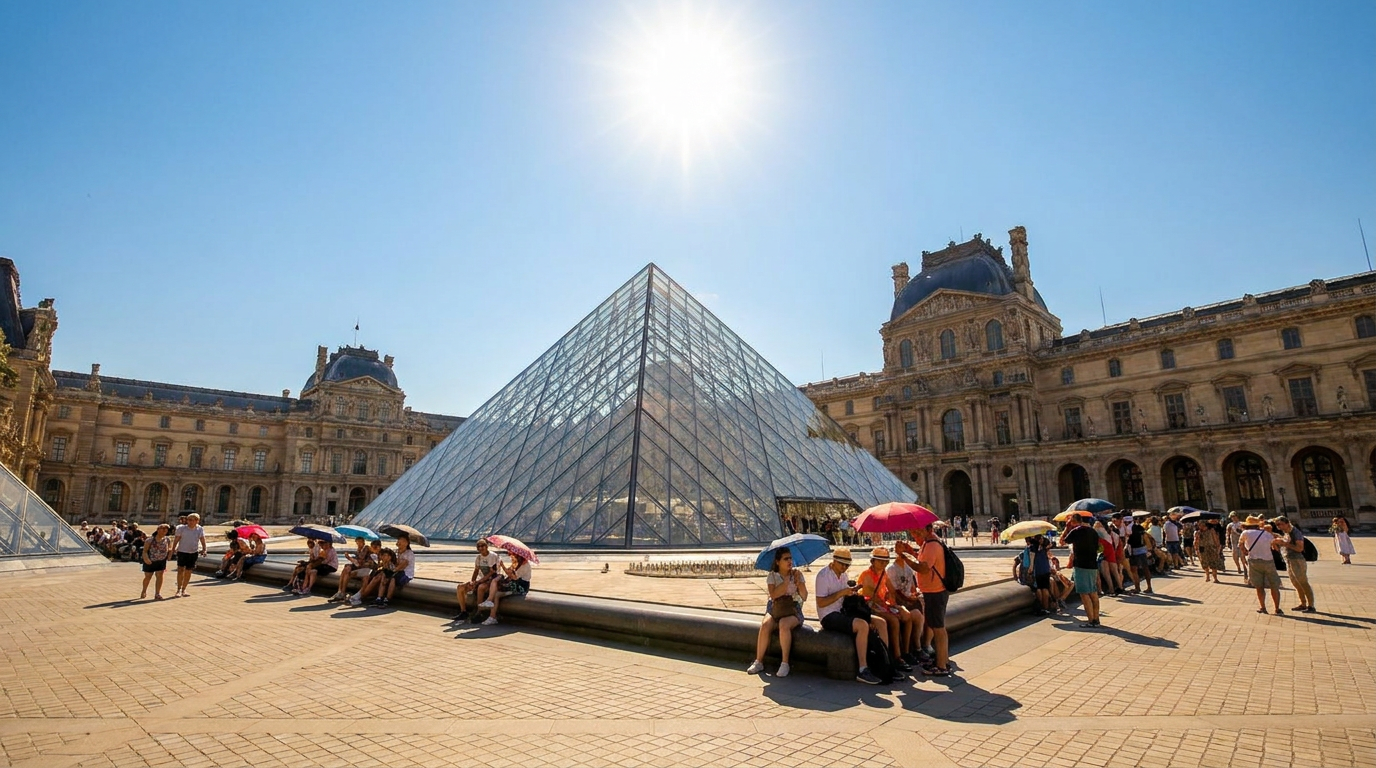
The Louvre faces uniquely complex thermal dynamics that complicate traditional cooling efforts. While the original stone palace offers some natural thermal regulation, the iconic glass pyramid entrance acts as a massive greenhouse, trapping solar radiation. Museum officials noted that heat buildup inside the structure intensifies dramatically toward the end of the day. When combined with the sheer volume of peak-season visitors generating additional body heat and moisture, the internal environment quickly becomes hazardous for both staff and guests. These compounding factors ultimately forced curators to implement unprecedented early closures to prevent mass heat exhaustion.[6][7]
In Florence, the Uffizi Galleries experienced a catastrophic mechanical breakdown when its cooling water pumps overheated under the relentless strain. The Renaissance-era building, like many of its contemporaries, lacks the modern electrical grid capacity required to support heavy, continuous air conditioning loads during prolonged temperature spikes. Upgrading these systems is not merely a matter of cost; installing heavy modern ductwork and high-capacity electrical lines often requires destructive structural modifications that threaten the very architectural integrity the museum exists to preserve.[1][7]
The Eiffel Tower presents an entirely different engineering challenge for Parisian authorities. Constructed completely of puddle iron, the 330-meter structure absorbs immense amounts of solar radiation throughout the long summer days. The metal physically expands in extreme heat, and the ambient temperature on the exposed observation decks becomes dangerously high. With no natural shade and limited capacity for artificial cooling at such altitudes, operators were forced to curtail afternoon access. This decision was made to protect thousands of daily visitors from direct exposure to the blistering sun and the superheated metal surfaces of the tower itself.[2][5]
The Eiffel Tower presents an entirely different engineering challenge for Parisian authorities.
Beyond individual buildings, the broader urban environment significantly exacerbates the crisis through the well-documented "urban heat island" effect. European city centers are dense concentrations of heat-absorbing concrete, asphalt, and glass, often lacking sufficient green spaces, expansive tree canopies, or natural cooling wind corridors. According to the World Meteorological Organization, temperatures in these urban cores can be several degrees higher than in surrounding rural areas. This phenomenon effectively turns historic plazas and narrow cobblestone streets into localized ovens during the peak of the afternoon, trapping heat that fails to dissipate even overnight.[3][8]
The scale of this architectural challenge across the continent is immense. Europe boasts some of the oldest city centers globally, with approximately 42 percent of its urban buildings constructed prior to 1950. Rapidly retrofitting this aging infrastructure is incredibly difficult, heavily regulated by strict heritage protection laws, and prohibitively expensive for local governments. However, faced with the stark reality that climate change has made European heatwaves significantly hotter and more frequent, municipalities are no longer waiting for the next crisis. Instead, they are actively shifting from reactive emergency responses to proactive climate resilience engineering.[4][8]

A massive wave of urban adaptation is currently underway across the continent. The European Union's Covenant of Mayors reports that 85 percent of local adaptation plans now explicitly prioritize urban heat management. In southern France, the city of Marseille has launched an aggressive campaign to depave concrete plazas and replant native, drought-resistant trees in its historic center. To help residents and tourists navigate the city safely during heatwaves, urban planners have mapped out shaded "cool itineraries" that connect naturally ventilated streets, public parks, and municipal water features.[4]
Other historic cities are experimenting with advanced materials that do not require altering their classic architectural aesthetics. Rethymno, a historic city on the island of Crete, has successfully lowered surface temperatures in its public squares by replacing traditional dark asphalt with compressed soils, cool pavements, and highly reflective road paint. Meanwhile, Toulouse is testing modular, temporary canvas shading structures in historic plazas where planting deep-rooted trees is structurally impossible due to underground transit lines and ancient catacombs. These interventions aim to restore pedestrian thermal comfort without permanently scarring the cityscape.[4]

For the global travel industry, these extreme thermal events are forcing a fundamental rewrite of the traditional summer vacation playbook. Tour operators are increasingly shifting their flagship itineraries to the "shoulder seasons" of spring and autumn, acknowledging that July and August are becoming structurally unviable for intensive sightseeing. For travelers who must visit during the summer, experts are recommending "siesta-style" schedules—exploring outdoor sites exclusively in the early morning or late evening, and reserving the peak afternoon hours for rest.[1][7]
Technology is also playing a crucial role in traveler adaptation and daily safety. Visitors are increasingly relying on real-time heat-risk maps and municipal smartphone applications that identify air-conditioned public spaces, free drinking water fountains, and the most heavily shaded transit routes. In Switzerland, several cities have even opened air-conditioned cinemas free of charge during peak daytime hours to provide immediate, accessible relief. These digital tools and civic initiatives are proving essential for both vulnerable local populations and overheated tourists trying to navigate the urban core safely.[3][4][9]

Ultimately, the 2026 heat dome serves as a powerful catalyst for the necessary evolution of European tourism. While the temporary closure of iconic sites like the Louvre or the Uffizi is undoubtedly disruptive to individual travel plans, it reflects a vital paradigm shift across the industry. Authorities are increasingly prioritizing human safety and long-term structural preservation over uninterrupted commercial operations. They are recognizing that the old models of mass summer tourism, which relied on endless queues under the midday sun, are simply no longer sustainable in a rapidly warming world.[2][7]
As Europe continues to warm at roughly twice the global average rate, the integration of climate-resilient engineering, smart urban planning, and highly flexible travel strategies will be absolutely essential. The future of exploring the continent's historic treasures will depend not just on preserving the architectural past, but on actively designing and adapting for a significantly hotter future. Travelers who embrace these adaptations—shifting their schedules, utilizing digital heat maps, and supporting sustainable urban initiatives—will find that Europe remains as captivating as ever, provided they respect and adapt to the new meteorological reality.[1][8]
How we got here
August 2003
A historic European heatwave causes over 70,000 casualties, prompting the first wave of modern urban heat planning.
July 2022
Europe experiences record-breaking summer temperatures, accelerating the adoption of municipal climate adaptation plans.
June 24, 2026
Paris records a peak temperature of 40.3°C, forcing the Eiffel Tower and Louvre to implement emergency early closures.
June 25, 2026
Florence's Uffizi Galleries suspends ticket sales following a catastrophic failure of its cooling water pumps.
Viewpoints in depth
Heritage Conservationists
Focused on protecting the architectural integrity of centuries-old structures while adapting them to modern climate extremes.
Conservationists argue that retrofitting historic landmarks like the Uffizi or the Louvre requires a delicate balance. Installing heavy, modern HVAC systems often requires destructive structural modifications and massive electrical grid upgrades that these buildings were never designed to support. Instead, this camp advocates for passive cooling techniques, such as UV-blocking window films, improved natural cross-ventilation, and strict visitor capacity limits to reduce internal thermal loads without altering the building's historical fabric.
Urban Planners
Focused on mitigating the urban heat island effect through city-wide infrastructure changes.
City planners emphasize that individual building adaptations are insufficient if the surrounding urban environment remains a heat trap. They advocate for aggressive 'depaving' initiatives, replacing asphalt with permeable, light-colored surfaces, and expanding urban tree canopies. This perspective views the heat crisis as an opportunity to fundamentally redesign European city centers, prioritizing pedestrian thermal comfort and green infrastructure over vehicular traffic.
Tourism Operators
Focused on maintaining economic viability and visitor safety amid shifting seasonal weather patterns.
The travel industry is increasingly recognizing that the traditional peak summer season in Southern and Western Europe is becoming structurally unviable. Operators are pushing for a strategic shift toward 'shoulder season' travel in spring and autumn. For inevitable summer visits, they are restructuring itineraries to mimic local 'siesta' cultures—scheduling indoor or shaded activities exclusively in the early morning or late evening, and relying heavily on real-time heat-risk data to protect guests.
What we don't know
- Whether major cultural institutions will permanently alter their summer operating hours in the coming years.
- How the structural integrity of centuries-old buildings will hold up to repeated, prolonged thermal expansion.
Key terms
- Heat Dome
- A meteorological phenomenon where a persistent high-pressure system traps hot air over a region, causing temperatures to build up over several days.
- Urban Heat Island Effect
- A condition where densely built urban areas experience significantly higher temperatures than surrounding rural areas due to heat-absorbing materials like concrete and asphalt.
- Omega Block
- A specific atmospheric blocking pattern that resembles the Greek letter Omega, known for causing prolonged periods of extreme, stagnant weather such as heatwaves.
- Cool Itineraries
- Mapped pedestrian routes in cities designed to maximize shade, natural ventilation, and access to public water features during extreme heat.
- Thermal Mass
- The ability of a material, such as the thick stone walls of historic buildings, to absorb, store, and release heat energy.
Frequently asked
Why do historic European buildings trap so much heat?
Most historic European structures were engineered centuries ago to retain heat during long, harsh winters. They feature thick stone walls that absorb solar radiation and lack the electrical capacity to support heavy modern air conditioning systems.
What is an Omega block heat dome?
An Omega block is a stationary high-pressure weather system that acts like a lid, trapping hot air over a specific region for days or weeks. It prevents cooler air from moving in, causing temperatures to compound daily.
How are European cities adapting to extreme heat?
Cities are implementing 'cool itineraries' with shaded walkways, replacing dark asphalt with reflective pavements, planting more trees, and installing modular shading structures in historic public squares.
Should I cancel my summer trip to Europe?
Travelers do not necessarily need to cancel, but they should adapt. Experts recommend shifting activities to the early morning or late evening, staying hydrated, and using municipal heat-risk maps to locate air-conditioned public spaces.
Sources
Source coverage
9 outlets
3 viewpoints surfaced









[1]SkiftTourism Operators
A deadly heat wave is disrupting tourism across Europe
Read on Skift →[2]Gulf NewsTourism Operators
Europe Heatwave Shuts Eiffel Tower and Louvre as Record Temperatures Grip Continent
Read on Gulf News →[3]World Meteorological OrganizationUrban Planners
Europe swelters under record-breaking late June heatwave
Read on World Meteorological Organization →[4]Energy CitiesUrban Planners
Rethinking our cities' design faced with extreme heat
Read on Energy Cities →[5]The CooldownTourism Operators
Paris closes the Eiffel Tower and Louvre early as France's record heat wave kills dozens
Read on The Cooldown →[6]Earth.orgHeritage Conservationists
Europe Swelters: Historic Sites Vulnerable to Climate Change
Read on Earth.org →[7]Deep ArrivalHeritage Conservationists
Europe Heat Dome Forces Top Tourist Attraction Closures
Read on Deep Arrival →[8]EuropeumUrban Planners
Europe Taking the Heat: Cities, People and Ecosystems
Read on Europeum →[9]The Express TribuneTourism Operators
Western Europe remained in the grip of an intense and deadly heatwave
Read on The Express Tribune →

Every angle. Every day.
Get travel stories with full source coverage and perspective breakdowns delivered to your inbox.