
The Science of Vertical Farming: How AI-Integrated Hydroponics Is Turning Kitchens Into Year-Round Farms
Miniaturized sensors and machine learning are moving vertical farming from industrial warehouses into residential kitchens. New AI-powered hydroponic systems allow consumers to grow high-density produce year-round using 95% less water than traditional agriculture.
By Factlen Editorial Team
- Urban Agriculture Advocates
- Focus on the environmental and food-security benefits of decentralized farming.
- Smart Home Enthusiasts
- Value the automation, aesthetics, and data-driven nature of the appliances.
- Traditional Soil Farmers
- Emphasize the biological complexity of soil and the high cost of tech-driven farming.
What's not represented
- · Municipal water authorities managing urban infrastructure
- · Commercial grocery chains facing potential shifts in produce demand
Why this matters
By automating the complex chemistry of hydroponics, these systems allow anyone to produce nutrient-dense food at home regardless of climate or outdoor space. This decentralizes food production, cuts grocery bills, and drastically reduces the water and carbon footprint of household produce.
Key points
- AI-integrated hydroponics allow consumers to grow high-density crops indoors year-round.
- Vision-based AI cameras monitor plant health and automatically adjust light and water.
- Closed-loop systems use up to 95% less water than traditional open-field agriculture.
- Vertical tower designs can cultivate up to 30 large plants in just two square feet of floor space.
- High upfront costs and reliance on continuous electricity remain the primary barriers to adoption.
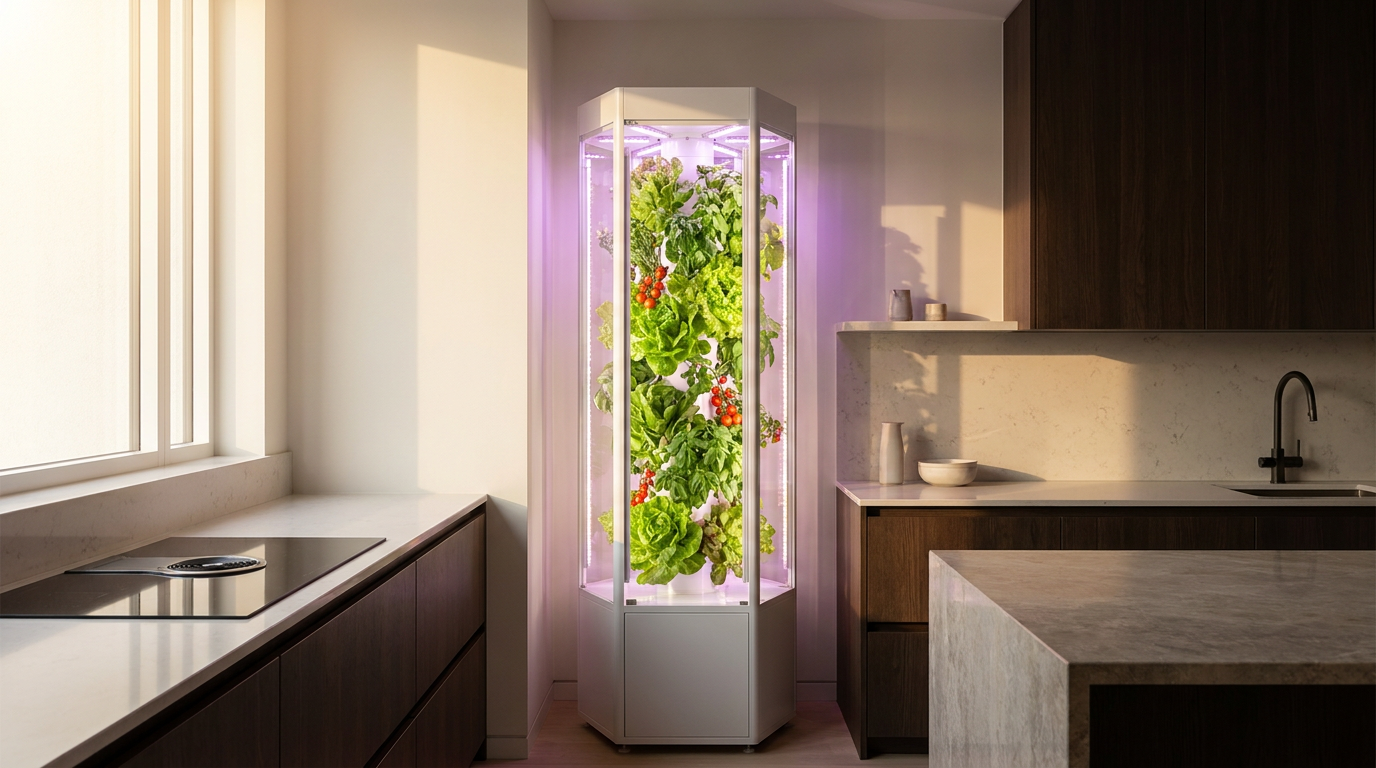
For decades, vertical farming was an industrial endeavor. Massive warehouses bathed in purple LED light promised to revolutionize agriculture by stacking crops and eliminating soil. But in 2026, the most disruptive vertical farms are no longer housed in repurposed industrial parks—they are sitting next to refrigerators in suburban kitchens and city apartments. Driven by miniaturized sensors and machine learning, consumer-grade hydroponic systems have transformed from novelty herb gardens into high-yield, year-round food engines.[2][7]
The foundation of this shift is hydroponics, a soil-free cultivation method that suspends plant roots directly in nutrient-rich water. By removing soil from the equation, hydroponics eliminates soil-borne diseases and pests, drastically reducing the need for pesticides. Traditional agriculture relies on roots expending energy to search for nutrients in the dirt. In a hydroponic system, the exact mineral balance is delivered directly to the root zone, allowing the plant to redirect its energy entirely into rapid vegetative growth and fruit production.[3][4]
But hydroponics itself is not new. What has catalyzed the current boom in residential vertical farming is the integration of artificial intelligence and the Internet of Things (IoT). Until recently, maintaining a hydroponic system required a meticulous, almost scientific approach to monitoring pH levels, water temperature, and nutrient concentrations. Today, AI-driven operating systems act as digital agronomists, automating the complex chemistry that once deterred casual home growers.[2][6]

At the center of these smart systems are vision-based AI assistants. Using onboard cameras and environmental sensors, these digital coaches monitor the microclimate of the indoor garden 24/7. They track humidity, ambient temperature, and water levels in real time. More importantly, machine learning algorithms can visually identify individual plant species and assess their health. If a basil plant needs more airflow or a lettuce head is showing signs of calcium deficiency, the system pushes a specific, actionable alert to the user's smartphone.[1][2]
Lighting is another critical variable that AI has mastered. Plants do not just need light; they need specific spectrums of light at different stages of their growth cycle. Modern indoor systems utilize spectrum-tuned LED arrays that mimic the natural progression of the sun. Automated 'sunrise' and 'sunset' modes gradually increase and decrease light intensity, optimizing the photosynthetic process and regulating the plants' circadian rhythms. This precision lighting ensures that crops can thrive indoors, regardless of the season or the amount of natural light entering the home.[1][3]
The spatial efficiency of these systems is a primary driver of their adoption in urban environments. By growing vertically, these towers maximize yield per square foot. Advanced consumer models can cultivate up to 30 large plants—ranging from leafy greens and herbs to cherry tomatoes and strawberries—in just two square feet of floor space. This high-density growth allows apartment dwellers to produce a meaningful percentage of their weekly produce without sacrificing valuable living space.[1][2]
The spatial efficiency of these systems is a primary driver of their adoption in urban environments.
Beyond convenience and space, the environmental mathematics of hydroponic vertical farming are compelling. Traditional open-field agriculture is notoriously thirsty, accounting for roughly 70% of global freshwater withdrawals. In contrast, smart hydroponic systems utilize a closed-loop water cycle. The water is continuously pumped from a base reservoir up through the vertical tower, cascading down over the roots before returning to the tank. This recirculation means these systems use up to 95% less water than conventional soil farming.[1][5]

Nutrient delivery has also been refined for the home user. Instead of mixing raw chemical salts, modern growers use stabilized liquid fertilizers—often enhanced with organic microbial components—that are automatically dosed by the system's pumps. These nutrient libraries are synced with the AI, which calculates the exact dosage required based on the specific crops being grown and their current growth stage. This prevents nutrient lockout and ensures that the plants are absorbing the maximum possible nutrition.[4][6]
The nutritional profile of hydroponically grown produce often rivals or exceeds that of store-bought equivalents. Because the food is harvested mere steps from where it is consumed, it does not suffer the nutrient degradation that occurs during the days or weeks of transportation and cold storage typical of the commercial supply chain. Consumers are increasingly drawn to this 'zero-mile' food model, which guarantees peak freshness and flavor.[2][7]
Despite the technological leaps, the transition to AI-integrated home farming is not without friction. The initial capital expenditure remains a significant barrier. Premium vertical tower systems can cost upwards of $900, with additional recurring costs for seed pods, liquid nutrients, and premium app subscriptions that unlock the most advanced AI features. For some consumers, the economics of replacing a $3 head of grocery store lettuce with a high-tech appliance take years to pencil out.[1][7]

Furthermore, these systems are entirely dependent on continuous electricity. While the LED lights and water pumps are highly efficient, a prolonged power outage can quickly devastate a hydroponic crop, as the roots will dry out without the automated irrigation cycles. The embodied carbon of manufacturing the plastic towers and electronic components also offsets some of the environmental benefits, meaning the systems must be used consistently for years to achieve a true net-positive ecological impact.[3][5]
Yet, the trajectory of the technology suggests these hurdles will diminish. As manufacturing scales and sensor costs continue to fall, smart hydroponics are becoming more accessible. The integration of these systems into the broader smart home ecosystem—where they can communicate with home batteries or solar panels to optimize energy use—is already underway.[1][6]
Ultimately, the rise of the AI-integrated kitchen farm represents a fundamental shift in how consumers interact with their food. It transforms the passive act of buying produce into an active, albeit highly automated, process of cultivation. By bringing the farm into the living room, this technology is quietly decentralizing the food grid, one head of lettuce at a time.[5][7]
How we got here
2010s
Commercial vertical farming scales up in repurposed industrial spaces using LED technology.
2020
Early consumer hydroponic systems gain popularity, but require manual nutrient and pH management.
2024
Vision-based AI and machine learning are integrated into premium consumer models to automate plant care.
2026
Smart indoor hydroponics become a mainstream smart home appliance, driven by falling sensor costs and improved AI.
Viewpoints in depth
Urban Agriculture Advocates
Focus on the environmental and food-security benefits of decentralized farming.
Advocates for urban agriculture view smart hydroponics as a critical tool for food resilience. By moving production to the point of consumption, these systems eliminate the carbon emissions associated with cold-chain transportation and reduce agricultural water waste. They argue that as climate change makes traditional farming more volatile, empowering city dwellers to grow their own calories is a necessary step toward a decentralized, secure food grid.
Traditional Soil Farmers
Emphasize the biological complexity of soil and the high cost of tech-driven farming.
Proponents of traditional and regenerative agriculture caution that hydroponics cannot fully replicate the complex microbiome of living soil. They argue that the 'terroir'—the unique flavor profile imparted by regional soil and climate—is lost in sterile indoor environments. Furthermore, they point out that the high upfront cost and reliance on continuous electricity make these systems a luxury appliance rather than a scalable solution for global food insecurity.
Smart Home Enthusiasts
Value the automation, aesthetics, and data-driven nature of the appliances.
For the tech-forward consumer, AI hydroponics are the ultimate smart home integration. This camp values the 'set it and forget it' nature of vision-based AI and automated dosing, which removes the steep learning curve traditionally associated with indoor gardening. They view these towers not just as food producers, but as living, data-driven centerpieces that enhance the aesthetic and air quality of the modern home.
What we don't know
- Whether the embodied carbon of manufacturing the plastic towers and electronics offsets the emissions saved from reduced food transportation.
- How quickly the cost of premium AI-integrated systems will drop to become accessible to lower-income households.
- The long-term impact of relying on subscription-based software to manage household food production.
Key terms
- Hydroponics
- A method of growing plants without soil, using mineral nutrient solutions in an aqueous solvent.
- Aeroponics
- A variation of hydroponics where plant roots are suspended in the air and misted with a nutrient solution.
- Closed-Loop System
- An irrigation method where water is continuously recirculated rather than draining away, drastically reducing waste.
- Spectrum-Tuned LEDs
- Grow lights designed to emit specific wavelengths of light optimized for different stages of plant photosynthesis.
- Nutrient Lockout
- A condition where plants cannot absorb nutrients from the water, often caused by incorrect pH levels.
Frequently asked
Do I need natural sunlight to use a smart hydroponic system?
No. These systems rely entirely on built-in, spectrum-tuned LED lights that provide all the necessary energy for photosynthesis, allowing them to operate in windowless rooms.
What kind of maintenance is required?
Most AI-integrated systems require only about 15 minutes of maintenance per week, which typically involves refilling the water reservoir and adding liquid nutrients when prompted by the app.
Can I grow root vegetables like carrots or potatoes?
No. Hydroponic tower systems are designed for leafy greens, herbs, and above-ground fruiting plants like tomatoes and strawberries. Root vegetables require deep physical media to develop.
What happens if the power goes out?
Because the systems rely on electric pumps to deliver water to the roots, a prolonged power outage can cause the plants to dry out and die if manual watering is not applied.
Sources
Source coverage
7 outlets
3 viewpoints surfaced







[1]SmartHomeExplorerSmart Home Enthusiasts
Best Smart Indoor Hydroponic Garden Systems 2026
Read on SmartHomeExplorer →[2]GearBrainSmart Home Enthusiasts
Smart, sustainable gardening made simple with AI-powered indoor hydroponics
Read on GearBrain →[3]FarmonautTraditional Soil Farmers
Vertical farming hydroponics in 2025: an expert guide
Read on Farmonaut →[4]InHydroUrban Agriculture Advocates
Smart Farming with AI: How AI-Powered Hydroponics is Redefining Agriculture
Read on InHydro →[5]World Economic ForumUrban Agriculture Advocates
Vertical farming and water security
Read on World Economic Forum →[6]BIO520Smart Home Enthusiasts
Smart Hydroponics: Revolutionising Urban Agriculture with AI and IoT
Read on BIO520 →[7]Factlen Editorial Team
Synthesis by Factlen editorial team
Read on Factlen Editorial Team →
Every angle. Every day.
Get home stories with full source coverage and perspective breakdowns delivered to your inbox.