
How the Internet is Finally Labeling AI Content: The Multi-Layered Approach
As AI-generated media floods the web, tech giants and regulators are abandoning flawed 'AI detectors' in favor of a multi-layered provenance system. By combining cryptographic metadata and invisible watermarks, a new standard is emerging to verify what is real and what is synthetic.
By Factlen Editorial Team

- The Provenance Coalition
- Tech giants and standards bodies arguing that built-in cryptographic metadata is the only scalable way to build trust.
- Independent Forensics Experts
- Security analysts who warn that self-labeling standards are insufficient against malicious actors.
- Hardware Manufacturers
- Camera and smartphone makers focused on proving the authenticity of real-world captures.
What's not represented
- · Open-source AI developers who argue that mandatory watermarking stifles innovation and is fundamentally unenforceable on decentralized models.
Why this matters
As AI-generated media becomes indistinguishable from reality, the ability to verify what you are looking at is critical for trusting the news, avoiding scams, and protecting democratic elections. The new multi-layered provenance standard ensures that users no longer have to guess if an image is real—the file itself will carry the cryptographic proof.
Key points
- The tech industry is shifting from AI detection to AI provenance, focusing on proving a file's origin rather than guessing if it is fake.
- A multi-layered approach combining C2PA cryptographic metadata and SynthID invisible watermarking is becoming the global standard.
- Google and OpenAI have partnered to embed these dual signals into their generative AI outputs ahead of the EU AI Act's August 2026 deadline.
- Hardware makers like Samsung and Sony are integrating C2PA directly into cameras to cryptographically prove when a photo is real.
- Because bad actors can use open-source models to bypass these labels, independent forensic detection remains a necessary backup.
The internet is drowning in synthetic media, and the initial defense strategy—AI detection tools—is losing the arms race. As generative models become flawless, guessing whether an image or video is real based on pixel patterns is no longer reliable. Instead, the tech industry and global regulators are pivoting to a fundamentally different approach: provenance. Rather than trying to catch fakes after they are released, the new standard focuses on proving the origin of digital files at the exact moment of creation.[3][8]
This shift is being accelerated by the European Union's AI Act. Starting August 2, 2026, Article 50 of the legislation imposes strict transparency obligations, requiring organizations that deploy AI systems to technically mark and label AI-generated content. With the deadline looming, the world's largest AI developers have realized that no single technology can solve the authenticity problem alone, prompting a massive overhaul of how digital media is packaged.[6]
In May 2026, a landmark consensus emerged when OpenAI and Google announced a unified, multi-layered approach to content provenance. The strategy abandons the idea of a "silver bullet" and instead stacks three distinct technologies: cryptographic metadata, invisible watermarking, and independent forensics. By combining these layers, the industry aims to create a resilient web of trust that can survive the chaotic nature of internet sharing.[1][2][5]
The foundation of this new trust layer is C2PA, or the Coalition for Content Provenance and Authenticity. C2PA acts as a digital "nutrition label" for media. Instead of guessing if a file is AI-generated, C2PA embeds a cryptographically signed manifest directly into the file's code. This manifest records exactly who created the content, which tool was used, and the full history of any edits applied.[3][4]

Because C2PA relies on established cryptography—including SHA-256 hashing and X.509 digital signatures—it is highly tamper-evident. If a bad actor alters the image, the cryptographic signature breaks, alerting the viewer that the file has been manipulated. By early 2026, the C2PA coalition had grown to over 6,000 members, establishing it as the undisputed global standard for metadata provenance across the tech and media landscape.[4]
However, C2PA has a structural vulnerability: metadata is fragile. When a user takes a screenshot of an image, or when a file is uploaded to a social media platform that aggressively strips metadata to save server space, the C2PA credential is lost. The image itself remains visible, but its verifiable history is wiped clean, leaving viewers in the dark about its true origins.[3][5]
However, C2PA has a structural vulnerability: metadata is fragile.
To solve this fragility, the industry is deploying its second layer of defense: invisible watermarking. Google's SynthID technology has become the dominant standard here, having already watermarked over 100 billion images and videos. Unlike a visible logo stamped in the corner of a photo, SynthID alters the actual pixel values or audio waveforms at a level completely imperceptible to the human eye or ear.[2][7]
The May 2026 partnership saw OpenAI integrate Google's SynthID into images generated by ChatGPT and the DALL-E API, creating a powerful synergy. While a watermark cannot carry the rich, detailed edit history that C2PA provides, it is incredibly durable. SynthID survives screenshots, aggressive compression, and format changes. If the C2PA metadata is stripped away, the SynthID watermark remains embedded in the pixels as a resilient backup signal.[1][3]
This multi-layered system is now being woven directly into the fabric of the web. Google is rolling out C2PA and SynthID verification natively into the Gemini app, Chrome browser, and Google Search, allowing users to instantly check a file's origins without needing third-party tools. Meanwhile, Meta has begun labeling camera-captured media with Content Credentials across Instagram and Facebook, normalizing the presence of provenance data in everyday social feeds.[2]

The provenance push isn't just about labeling AI; it is equally about proving what is real. Hardware manufacturers are now baking C2PA cryptography directly into silicon. The Samsung Galaxy S25 and Google's Pixel 10 are among the first consumer smartphones to sign photos with Content Credentials natively in the default camera app. Professional camera makers like Sony, Nikon, and Leica have implemented similar hardware-level signing for photojournalists.[2][4]
When a photo is taken on these devices, the hardware cryptographically seals the file, proving it originated from a physical camera sensor and has not been altered by generative AI. In a digital ecosystem flooded with synthetic media, the ability to definitively prove that a photograph is an unaltered capture of reality is rapidly becoming a premium feature for both consumers and professionals.[4][8]
Despite this unprecedented coordination, the system is not foolproof. Open-source AI models, which can be run locally on personal computers, do not inherently apply C2PA metadata or SynthID watermarks. Bad actors utilizing these unregulated models can still generate and distribute unmarked deepfakes, easily bypassing the voluntary guardrails established by Big Tech and rendering self-labeling mandates difficult to enforce.[6][7]

This gap necessitates the third layer of the authenticity stack: independent forensics and statistical pattern recognition. Because self-labeling legislation like the EU AI Act cannot reliably constrain rogue actors, independent detection platforms are required to analyze the statistical anomalies in AI-generated media that lack credentials. These forensic tools act as the final safety net when cryptographic signatures and watermarks are absent.[7]
Ultimately, the internet of 2026 is transitioning to a "provenance-first" mindset. Users, journalists, and platforms are being trained to look for cryptographic proof of origin before trusting a piece of media. In the near future, the absence of a Content Credential won't necessarily prove a file is fake, but it will serve as the first major red flag that the content cannot be trusted at face value.[5][8]
How we got here
Jan 2021
The Coalition for Content Provenance and Authenticity (C2PA) is founded to create an open standard for digital provenance.
Oct 2023
US Executive Order 14110 directs federal agencies to develop watermarking and content authentication frameworks.
May 2026
Google and OpenAI announce a major partnership to integrate SynthID watermarking alongside C2PA metadata in AI-generated images.
Aug 2026
Article 50 of the EU AI Act takes effect, mandating transparency and labeling for AI-generated content.
Viewpoints in depth
The Provenance Coalition
Tech giants and standards bodies arguing that built-in cryptographic metadata is the only scalable way to build trust.
Organizations like Google, OpenAI, and the C2PA steering committee believe that the responsibility for transparency lies at the point of creation. By embedding cryptographic manifests and invisible watermarks into media the moment it is generated, they argue we can create a default state of trust on the web. In their view, AI detection is a losing battle against increasingly sophisticated models, making proactive labeling the only sustainable solution.
Independent Forensics Experts
Security analysts who warn that self-labeling standards are insufficient against malicious actors.
Forensic experts and independent detection firms point out a critical flaw in the C2PA and SynthID ecosystem: it relies on voluntary compliance. Bad actors generating deepfakes for political disinformation or financial fraud will simply use open-source models that do not apply these labels. Therefore, this camp argues that while provenance is useful for honest creators, robust independent statistical pattern recognition remains essential for catching the most dangerous synthetic media.
Hardware Manufacturers
Camera and smartphone makers focused on proving the authenticity of real-world captures.
For companies like Sony, Nikon, and Samsung, the AI revolution is an opportunity to reassert the value of physical photography. Rather than focusing on labeling what is fake, their approach is to cryptographically seal what is real. By integrating C2PA signing directly into the camera sensor and silicon, they aim to create a verifiable chain of custody from the moment light hits the lens, ensuring that photojournalists and everyday users can prove their images are untouched by AI.
What we don't know
- It remains unclear how aggressively social media platforms will enforce the display of Content Credentials, as many currently strip metadata during the upload process to save server space.
- The effectiveness of the EU AI Act's transparency mandate on open-source, decentralized AI models is still untested, raising questions about enforcement against rogue developers.
Key terms
- Content Credentials
- A digital 'nutrition label' based on the C2PA standard that shows who created a file, when it was made, and what tools were used.
- SynthID
- An invisible watermarking technology developed by Google DeepMind that imperceptibly alters pixels or audio waves to identify AI-generated media.
- Cryptographic Manifest
- A secure, tamper-evident record embedded in a file's code that breaks if the file is altered by an unauthorized party.
- Provenance
- The verifiable history and origin of a digital file, tracing it from its creation through any subsequent edits.
Frequently asked
Can someone just screenshot an AI image to remove the label?
Yes, taking a screenshot strips the C2PA metadata. However, invisible watermarks like SynthID are designed to survive screenshots, providing a backup method for identifying the image's origin.
Does this mean all deepfakes will be caught?
No. Bad actors can use unregulated, open-source AI models that do not apply Content Credentials or watermarks, which is why independent forensic tools are still necessary.
How do I check if an image has Content Credentials?
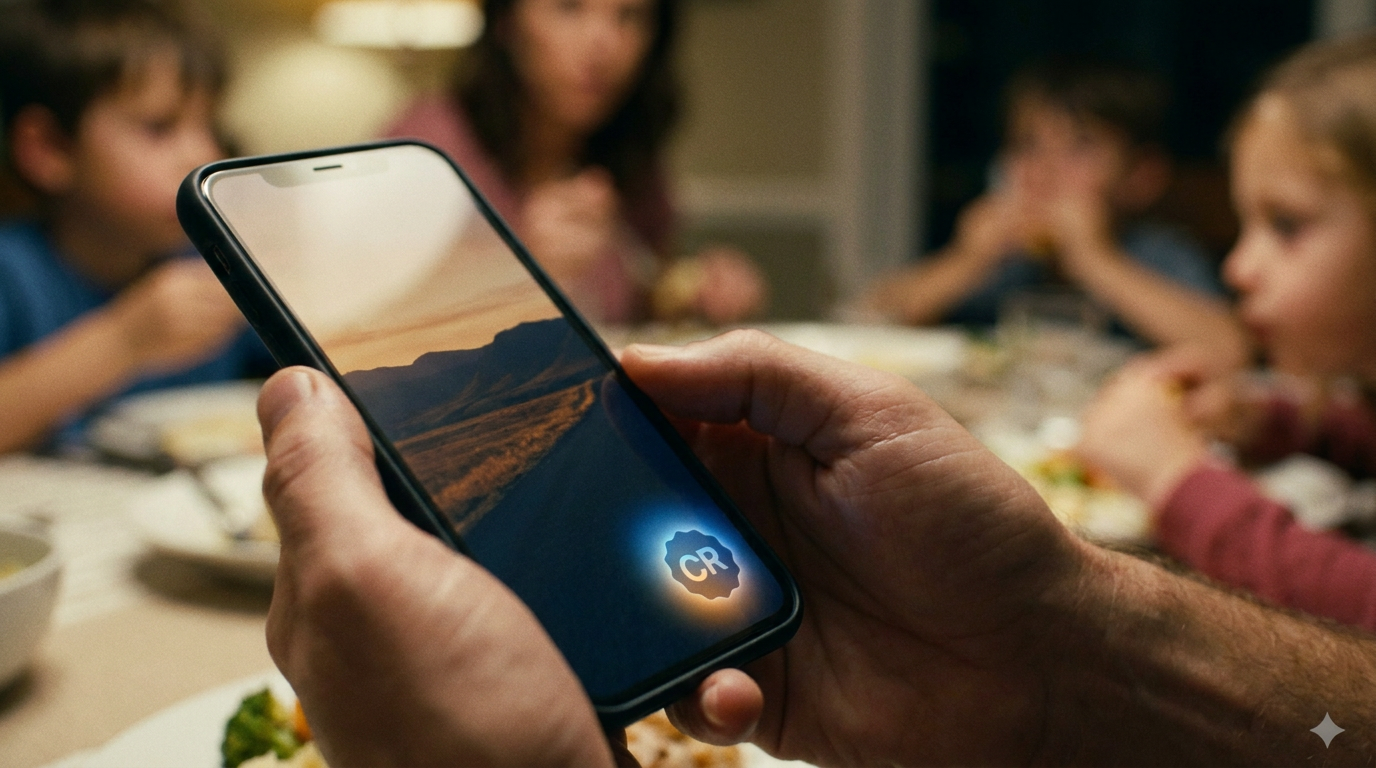
Platforms like Google Chrome and Instagram are beginning to natively display a 'CR' (Content Credentials) badge on supported images, which you can click to view the file's history.
Is this only for AI-generated images?
No. Hardware manufacturers are building C2PA into digital cameras and smartphones to cryptographically prove when an image is a real, unaltered photograph.
Sources
Source coverage
8 outlets
3 viewpoints surfaced








[1]OpenAIThe Provenance Coalition
Helping people understand the origin of AI-generated content through Content Credentials and SynthID
Read on OpenAI →[2]GoogleThe Provenance Coalition
Making it easier to understand how content was created and edited
Read on Google →[3]C2PAThe Provenance Coalition
C2PA Content Credentials vs Invisible Watermarking vs AI Detection
Read on C2PA →[4]TrueScreenIndependent Forensics Experts
C2PA Adoption in 2026: From OpenAI to Google, from Sony to Nikon
Read on TrueScreen →[5]EyeSiftIndependent Forensics Experts
C2PA Deepfake Detection 2026: Verify Images with Content Credentials, SynthID and Forensics
Read on EyeSift →[6]AFIPIndependent Forensics Experts
Why Regulation Needs Forensics: The EU AI Act and Content Provenance
Read on AFIP →[7]PangramIndependent Forensics Experts
AI Watermarking: Why Big Tech is Betting on AI Provenance, and Losing
Read on Pangram →[8]Factlen Editorial TeamHardware Manufacturers
Synthesis by Factlen editorial team
Read on Factlen Editorial Team →


Every angle. Every day.
Get ai stories with full source coverage and perspective breakdowns delivered to your inbox.