
How Quick-Entry Bindings Are Revolutionizing Snowboarding and Keeping Aging Riders on the Mountain
Modern step-in snowboard bindings have solved the mechanical flaws of the 1990s, driving a massive sales surge. The technology is eliminating the sport's biggest physical friction point, helping both beginners and older riders stay on the slopes longer.
By Factlen Editorial Team
- Accessibility Advocates
- Focus on how quick-entry systems reduce physical strain and lower the barrier to entry.
- Equipment Innovators
- Highlight the engineering breakthroughs that bridged the gap between convenience and high performance.
- Traditionalists & Core Riders
- Value the infinite adjustability, lighter weight, and proven reliability of classic strap bindings.
What's not represented
- · Backcountry splitboarders who require specialized touring bindings
- · Snowboard rental shop technicians managing fleet maintenance
Why this matters
The mechanical evolution of snowboard bindings is eliminating the sport's biggest physical barrier. By removing the need to constantly sit down and strap in, this technology is extending the longevity of older riders and making the sport significantly more accessible to beginners.
Key points
- Modern quick-entry bindings have solved the performance issues that plagued 1990s step-in designs.
- Burton's Step On system uses a three-point cleat connection requiring specialized boots.
- Nidecker's Supermatic offers a drop-in reclining highback that works with any standard snowboard boot.
- The convenience of step-in technology is helping retain an aging demographic of snowboarders.
- Traditionalists still favor strap bindings for their lighter weight and infinite adjustability in deep powder.
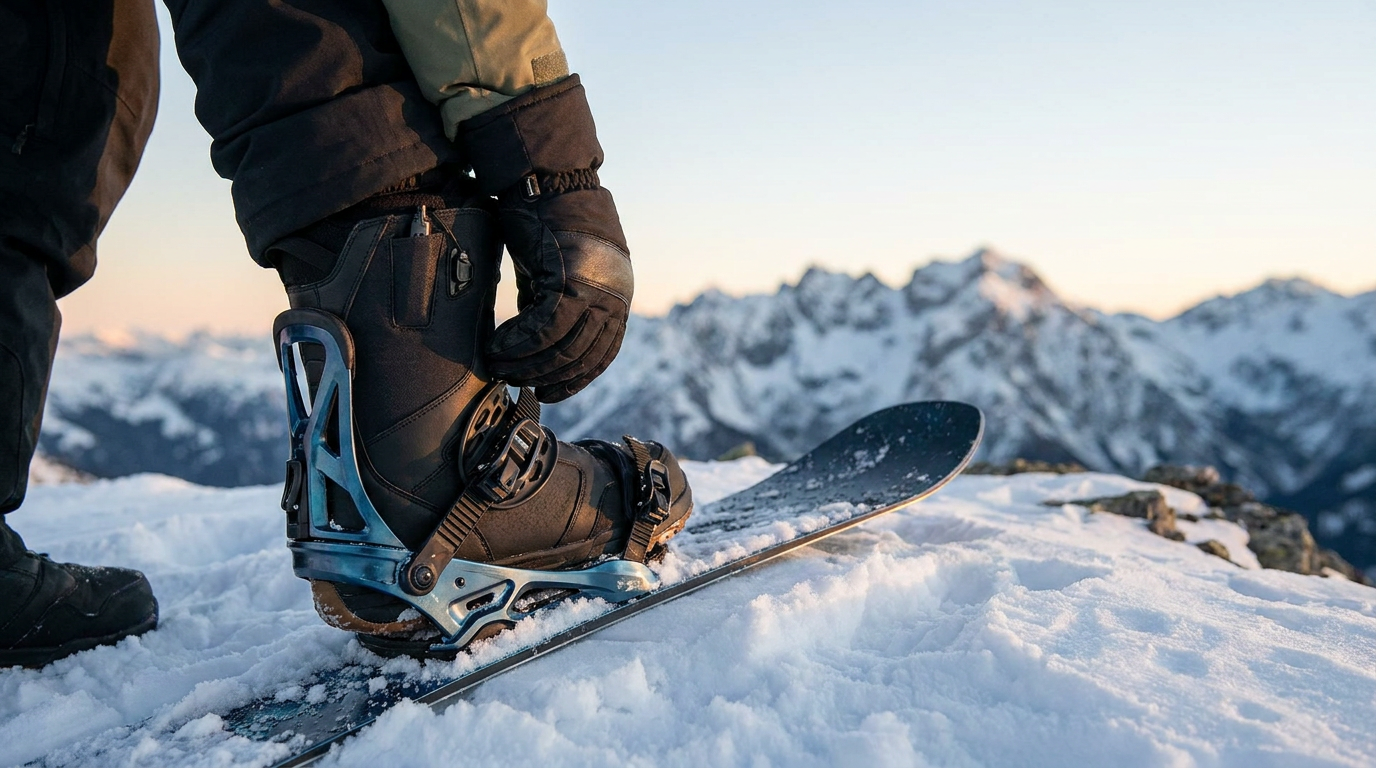
The ritual of snowboarding—sitting in the snow, ratcheting straps, and battling cold fingers—has defined the sport since its inception. While skiers simply click into their bindings and glide away from the lift, snowboarders have historically accepted the "strap-in tax" as the unavoidable price of admission. For decades, the classic two-strap system seemed untouchable, offering a locked-in feel and infinite adjustability that riders trusted. But that acceptance is rapidly fading. A mechanical revolution in quick-entry binding technology is sweeping the winter sports industry, fundamentally altering how riders interact with their equipment and who gets to participate in the sport.[6]
This is not the industry's first attempt at eliminating straps. In the late 1990s and early 2000s, several brands introduced step-in systems that ultimately failed. Those early iterations required stiff, uncomfortable boots, created a dead zone underfoot that ruined board feel, and were notoriously unreliable when clogged with ice or powder. Modern engineering, however, has finally cracked the code. Today's automatic bindings deliver the rapid convenience of a step-in system without sacrificing the high-performance power transfer and lateral flex that core riders demand.[4][8]
The market data reflects a massive behavioral shift among winter athletes. Sales of step-on bindings have surged by an estimated 300 percent since 2017, vastly outpacing the growth of traditional equipment. This surge is injecting new momentum into the broader U.S. skiing and snowboarding market, which was valued at over $5.5 billion in 2023 and is projected to grow steadily at a 5 percent compound annual growth rate through 2030. Premium, technology-driven gear is leading this charge, proving that riders are willing to invest heavily in convenience.[2][7]

The modern breakthrough began when Burton Snowboards reimagined the concept from the ground up. Instead of trying to mimic traditional straps, Burton's "Step On" system eliminated them entirely. The mechanism relies on a proprietary three-point connection: two toe hooks and one heel cleat integrated directly into a specialized boot. By moving the connection points to the sides and rear of the boot, Burton preserved the natural flex of the snowboard beneath the rider's foot.[3][8]
The user experience is remarkably intuitive. When a rider steps into the Burton baseplate, the heel cleat engages with an audible click, followed by the toe cleats locking into place as weight is applied forward. The connection is immediate and secure, transferring energy directly from the boot to the board with zero lag. To exit the binding, the rider simply pulls a quick-release lever located on the heel cup, lifts their heel, and steps out, allowing for seamless transitions at the top and bottom of the chairlift.[3][8]
However, Burton's closed ecosystem requires riders to purchase specific, compatible boots, which can be a barrier for those who already own footwear they love. Recognizing this gap in the market, Swiss brand Nidecker introduced the "Supermatic" in 2022, taking a completely different engineering approach. The Supermatic was designed as a fully automatic, dual-entry binding that works universally with any standard snowboard boot from any brand.[4][8]
Nidecker's "Drop IN Technology" utilizes a reclining highback and a specialized heel pedal. The rider slides their boot into the binding from the back; as they step down, the heel pedal triggers a mechanism that causes the highback to snap up and lock securely into the riding position. Because the system uses traditional ankle and toe straps that remain pre-adjusted to the rider's preference, the Supermatic delivers the exact feel, pressure distribution, and responsiveness of a classic binding.[4][8]
Nidecker's "Drop IN Technology" utilizes a reclining highback and a specialized heel pedal.
German manufacturer CLEW has also captured significant market share with a unique hybrid solution. Their system splits the binding into two distinct pieces: the highback and ankle strap remain attached to the rider's boot, while the baseplate stays mounted to the snowboard. Riders simply step down to click the two pieces together. This approach offers a blend of traditional strap feel and rapid entry, appealing to riders who want the best of both worlds without committing to a single boot brand.[5]

This technological leap is doing more than just saving time in the lift line; it is actively reshaping the sport's demographics. Over the last two decades, the average age of a U.S. snowboarder has shifted dramatically, rising from 19 to 27. The sport now boasts a massive, growing cohort of riders in their 30s, 40s, and 50s who learned to ride during the snowboarding boom of the 1990s and are now looking for ways to extend their longevity on the mountain.[1][7]
For these aging riders, the physical toll of constantly bending over, sitting down in the snow, and standing back up can shorten a day on the slopes and lead to lower back fatigue. Quick-entry systems eliminate this repetitive physical strain entirely. By preserving energy for actual riding rather than equipment management, automatic bindings are keeping older snowboarders in the sport longer and making full-day resort sessions significantly more enjoyable.[6][8]
The technology is equally transformative for beginners. Learning to snowboard is notoriously punishing, characterized by frequent falls and exhaustion. The added frustration of managing ratchets with cold, gloved hands often deters newcomers from sticking with the sport. By simplifying the entry process, step-in bindings lower the initial barrier to entry, allowing instructors to focus entirely on teaching edge control and balance rather than troubleshooting equipment.[6][8]

Despite the overwhelming momentum and positive reception, the transition to automatic bindings is not without its skeptics and mechanical trade-offs. Traditionalists and core park riders point out that quick-entry systems often carry a noticeable weight penalty. The Nidecker Supermatic, for instance, requires a burlier baseplate to house its automatic locking mechanisms and rollers, making it heavier than a minimalist, traditional strap binding.[4][8]
Deep powder and extreme backcountry conditions present another edge case for the technology. While modern systems are rigorously tested for all environments, riders using Burton's Step On must be diligent about clearing packed snow from the baseplate to ensure the heel cleat engages fully into its second, secure riding position. Nidecker's dual-entry design mitigates this slightly, allowing riders to bypass the automatic step-in mechanism and use the ratchets manually if they find themselves stuck in waist-deep snow on a steep incline.[3][4]
Yet, the industry's overall trajectory is unmistakable. Major boot and binding manufacturers are recognizing that the demand for convenience is permanent. Brands like ThirtyTwo and Bataleon are now licensing quick-entry technologies for their upcoming 2025 and 2026 product lines, signaling that automatic bindings are no longer a niche luxury, but a new foundational standard for the industry.[9]
As the technology continues to evolve with the integration of lighter carbon composites and increasingly refined locking mechanisms, the traditional strap-in ritual may soon become a relic of snowboarding's past. By removing the sport's most persistent physical friction point, equipment innovators have ensured that for millions of riders, the future of snowboarding is as simple as step, click, and ride.[6][8]
How we got here
Late 1990s
Early step-in binding systems launch but fail to gain traction due to poor board feel and snow-clogging issues.
2017
Burton revolutionizes the market with the launch of the modern Step On system.
2022
Nidecker introduces the Supermatic, the first fully automatic binding compatible with any boot.
2025
Major boot brands begin licensing quick-entry technology, signaling a permanent industry shift.
Viewpoints in depth
Accessibility Advocates
Focus on how quick-entry systems reduce physical strain and lower the barrier to entry.
This camp argues that the true value of step-in bindings lies in their demographic impact. By eliminating the repetitive strain of bending and ratcheting, these systems allow aging riders to stay on the mountain longer and prevent lower back fatigue. Furthermore, they argue that simplifying the gear makes snowboarding far more approachable for beginners, who often cite equipment frustration as a primary reason for quitting the sport early.
Equipment Innovators
Highlight the engineering breakthroughs that bridged the gap between convenience and high performance.
Innovators emphasize that modern automatic bindings are a masterclass in mechanical engineering, entirely divorced from the flawed step-in designs of the 1990s. They point to innovations like Nidecker's Drop IN Technology and Burton's three-point cleat system, which maintain the natural flex of the board while delivering instantaneous power transfer. For this group, the integration of carbon composites and dual-entry versatility represents the pinnacle of modern winter sports gear.
Traditionalists & Core Riders
Value the infinite adjustability, lighter weight, and proven reliability of classic strap bindings.
Traditionalists remain cautious about adopting fully automatic systems, primarily due to the added mechanical complexity and weight. They argue that standard ratcheting straps offer infinite micro-adjustments that step-in systems cannot easily replicate. Additionally, core backcountry riders express concerns about the reliability of automatic locking mechanisms in extreme conditions, noting that clearing packed ice and deep powder from a complex baseplate is far more difficult than simply strapping in.
What we don't know
- Whether traditional strap bindings will eventually be phased out entirely or remain a niche choice for backcountry purists.
- How the added mechanical complexity of automatic bindings will hold up over a decade of heavy use compared to simple ratchets.
Key terms
- Highback
- The vertical plate at the rear of a snowboard binding that supports the rider's lower calf and transfers power to the heel edge.
- Baseplate
- The bottom frame of the binding that mounts directly to the snowboard and houses the footbed.
- Dual-Entry
- A binding design that allows riders to use an automatic step-in mechanism or traditional ratcheting straps interchangeably.
Frequently asked
Do I need special boots for step-in bindings?
It depends on the system. Burton's Step On requires compatible boots with built-in cleats, while Nidecker's Supermatic and CLEW bindings work with any standard snowboard boot.
Are quick-entry bindings safe in deep powder?
Yes, modern systems are rigorously tested for all conditions. However, clearing snow from the binding base is crucial for systems like Burton Step On to ensure the cleats lock securely.
Do step-in bindings sacrifice performance?
Early 2000s models did, but current iterations offer the same locked-in responsiveness and power transfer as traditional strap bindings, with some riders even reporting faster edge-to-edge transitions.
Sources
Source coverage
9 outlets
3 viewpoints surfaced









[1]Snowsports Industries AmericaAccessibility Advocates
24-25 Season Participation Preview
Read on Snowsports Industries America →[2]Grand View ResearchEquipment Innovators
U.S. Skiing And Snowboarding Market Report 2030
Read on Grand View Research →[3]Burton SnowboardsEquipment Innovators
Burton Step On® Bindings: The Complete Guide
Read on Burton Snowboards →[4]NideckerEquipment Innovators
Nidecker Supermatic Technology
Read on Nidecker →[5]Boardsport SOURCEEquipment Innovators
Clew Snowboard Bindings F/W 2026/27 Preview
Read on Boardsport SOURCE →[6]Factlen Editorial TeamAccessibility Advocates
Synthesis by Factlen editorial team
Read on Factlen Editorial Team →[7]WifiTalentsAccessibility Advocates
Snowboard Industry Statistics | 2026 Market Report
Read on WifiTalents →[8]Lines Snow BoutiqueTraditionalists & Core Riders
Why the Nidecker Supermatic Changed the Conversation on Automatic Snowboard Bindings
Read on Lines Snow Boutique →[9]Whitelines SnowboardingTraditionalists & Core Riders
Best Quick Entry Snowboard Bindings For 2025-2026
Read on Whitelines Snowboarding →
Every angle. Every day.
Get sports stories with full source coverage and perspective breakdowns delivered to your inbox.