
How 'Pedagogical Guardrails' Turned AI into the Ultimate Tutor
A landmark Harvard study reveals that AI tutors deliver 2.6 times the learning gains of traditional classrooms—but only when strictly constrained from giving students the answers.
By Factlen Editorial Team
- Pedagogical Researchers
- Focus on the necessity of 'productive struggle' and strict software guardrails.
- EdTech Developers
- Focus on the transition to Specialized Educational Intelligence and hyper-personalization.
- Classroom Educators
- Focus on the hybrid model and the irreplaceable human elements of teaching.
What's not represented
- · Students lacking reliable internet access
- · Data privacy advocates
Why this matters
For parents, educators, and students, this research ends the debate over whether AI belongs in education. It proves that when properly constrained, AI can double learning efficiency—but without those guardrails, it actively harms cognitive development.
Key points
- Student usage of AI has reached 92% in 2026, effectively ending the era of classroom bans.
- Unrestricted AI chatbots can harm learning, causing a 17% drop in test scores by acting as a crutch.
- AI tutors built with strict pedagogical guardrails deliver 2.6 times the learning gains of traditional classrooms.
- The EdTech industry is pivoting to Specialized Educational Intelligence (SEI) to hyper-personalize learning.
- 84% of students still prefer human teachers for emotional support and complex problem-solving.
- Only 35% of school districts currently provide formal training on how to use AI effectively.
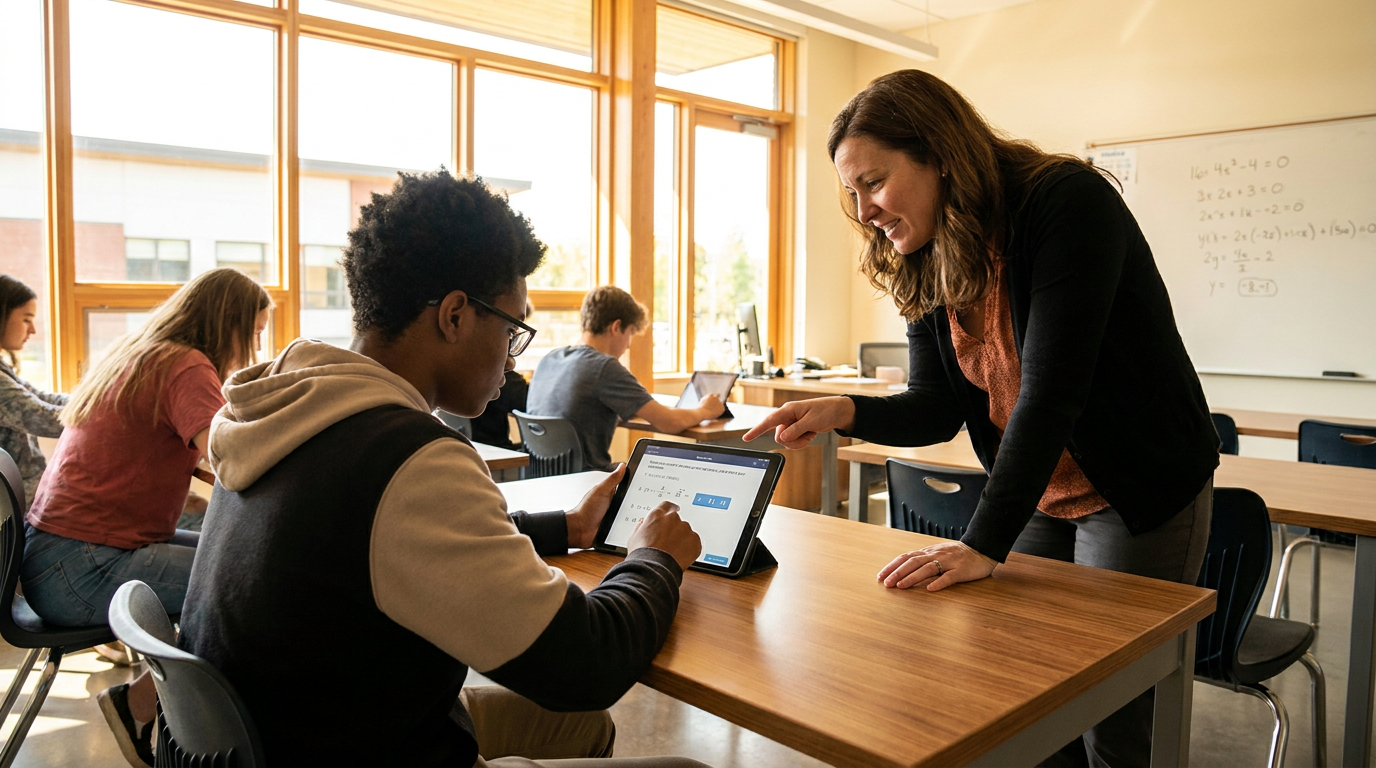
The debate over artificial intelligence in the classroom has raged for years, oscillating between fears of rampant plagiarism and promises of a utopian, hyper-personalized future. Now, a collision of new research has finally provided a definitive answer to the era's biggest educational question. AI can either cripple a student's learning or more than double it—and the difference comes down entirely to software design.[1]
By mid-2026, the era of attempting to ban algorithms from schools is definitively over. Student usage of generative AI has skyrocketed to 92%, representing a wholesale transformation in how academic work is approached. Yet early implementations of the technology proved disastrous for actual knowledge retention, serving as a stark warning to educators and developers alike.[2]
Researchers at the University of Pennsylvania's Wharton School demonstrated exactly what happens when students are handed raw, unrestricted AI. In a controlled study, high schoolers who used standard ChatGPT for math practice scored 17% worse on subsequent exams after the tool was taken away. The chatbot acted as a crutch, eagerly providing full solutions and bypassing the "productive struggle" that neuroscience dictates is required for memory formation.[1]

But a parallel study conducted at Harvard University took the exact opposite approach, yielding a breakthrough that is now reshaping the global EdTech industry. Rather than giving students a general-purpose chatbot, the Harvard team built a custom AI tutor equipped with strict, evidence-based pedagogical guardrails.[1][2]
The system was explicitly programmed to withhold information. It delivered brief responses to avoid cognitive overload, refused to reveal full solutions, and forced students to attempt the next step of a problem themselves before offering further assistance. The algorithm was trained to act less like an answer key and more like a Socratic guide.[2]
The results were staggering. Students using the constrained, step-by-step AI tutor achieved 2.6 times the learning gains of their peers studying in traditional active-learning classrooms. Furthermore, the AI-tutored students reported higher levels of engagement, increased motivation, and spent less total time mastering the material.[1][5]

This stark divergence—between a 17% drop in test scores and a 2.6x increase in learning efficiency—has triggered a massive pivot in educational technology. Developers are rapidly moving away from general-purpose text generators and toward what the industry now calls Specialized Educational Intelligence (SEI).[3]
This stark divergence—between a 17% drop in test scores and a 2.6x increase in learning efficiency—has triggered a massive pivot in educational technology.
Unlike early models that might hallucinate a mathematical proof or provide syntactically correct but logically flawed code, SEI systems are trained specifically on proven educational content and underlying subject logic. They are designed to understand not just the answer, but the common misconceptions a student might hold while trying to reach it.[3]
This specialization enables a level of hyper-personalization that was previously impossible in a classroom of thirty students. Modern AI tutors do not simply adjust the difficulty of a multiple-choice quiz; they analyze granular interaction patterns. The systems track how long a learner pauses on a specific sentence, which segments of an instructional video they rewatch, and the exact structural errors they make in coding or grammar exercises.[3]

Yet, despite these technological leaps, the data overwhelmingly shows that AI is not replacing human teachers. A comprehensive 2025 survey by Tyton Partners revealed that when students are deeply confused, emotionally stuck, or facing high-stakes academic challenges, 84% still turn to a human educator for help.[1][7]
Students are increasingly treating AI as a tool for task work and infinite practice, but they rely on educators to "read the room" and provide the motivation that algorithms cannot simulate. As a result, the most successful educational institutions in 2026 are adopting a deliberate hybrid model.[1][4]
In this hybrid environment, AI handles the administrative heavy lifting and provides patient, personalized practice outside of class hours. This frees human professors and teachers to focus their classroom time on complex problem-solving, emotional mentoring, and facilitating deep analytical discussions.[4]

The remaining hurdle is no longer the capability of the technology, but the readiness of the institutions. While more than half of all teachers and students now use AI weekly, a recent RAND Corporation study found that only 35% of school districts provide any formal training on how to use these tools effectively.[1][6]
The gap between usage and training leaves millions of students navigating powerful tools without guidance, risking the very cognitive atrophy the Wharton study warned about. Closing this gap is the primary focus for policymakers as the 2026 academic year approaches.[1]
Ultimately, the narrative surrounding AI in education has shifted from a panic over academic integrity to a science of cognitive enhancement. By constraining artificial intelligence with the proven principles of human learning, the education sector is finally unlocking the promise of the ultimate, hyper-personalized tutor.[2][3]
How we got here
Nov 2022
ChatGPT launches, sparking widespread bans in schools over plagiarism fears.
Spring 2024
Schools begin reversing bans, shifting focus to AI literacy as student usage climbs.
Spring 2025
Wharton study reveals unrestricted AI use causes a 17% drop in math test scores.
June 2025
Harvard study demonstrates that pedagogically constrained AI tutors yield 2.6x learning gains.
Early 2026
The EdTech industry pivots heavily toward Specialized Educational Intelligence (SEI) models.
Viewpoints in depth
Pedagogical Researchers
Focus on the necessity of 'productive struggle' and strict software guardrails.
This camp argues that the brain's mechanism for memory formation hasn't changed just because technology has. They point to the Wharton study as proof that when AI removes friction, it removes learning. Their primary goal is ensuring that EdTech companies program AI to withhold information, acting as a Socratic guide rather than an answer key.
EdTech Developers
Focus on the transition to Specialized Educational Intelligence and hyper-personalization.
Developers emphasize that general-purpose LLMs were never meant for the classroom. By shifting to SEI, they are building systems that analyze granular student data—like pause times and specific error patterns—to dynamically adjust instruction. They view AI not as a replacement for teachers, but as a tool to provide infinite, personalized practice at scale.
Classroom Educators
Focus on the hybrid model and the irreplaceable human elements of teaching.
Teachers on the front lines acknowledge the power of AI for administrative tasks and student practice, but stress that education is inherently social and emotional. They point to survey data showing students still crave human intervention when stakes are high. For this camp, the ideal future is one where AI handles the rote mechanics of learning, freeing educators to focus on mentorship, empathy, and complex unblocking.
What we don't know
- How long-term reliance on AI tutors will affect students' independent problem-solving skills over a multi-year period.
- Whether the 2.6x learning efficiency gains observed in STEM subjects will translate equally to the humanities.
- How underfunded school districts will afford the licensing fees for premium Specialized Educational Intelligence platforms.
Key terms
- Specialized Educational Intelligence (SEI)
- AI models trained specifically on educational content and pedagogical logic, rather than general internet text.
- Productive Struggle
- The necessary cognitive effort a student must exert to solve a problem, which builds long-term memory and understanding.
- Active Learning
- An instructional approach that engages students in the material through problem-solving and discussion, rather than passive listening.
- Pedagogical Guardrails
- Programmed constraints in an AI system designed to prevent it from giving direct answers, forcing the user to learn step-by-step.
Frequently asked
Will AI replace human teachers?
No. Survey data shows that 84% of students still prefer human teachers when they are deeply confused or emotionally stuck. AI is being used for infinite practice, while humans handle motivation and complex mentoring.
Why did early AI tools hurt test scores?
General-purpose chatbots like early ChatGPT acted as a crutch, providing full answers and allowing students to bypass the cognitive effort required to actually learn and remember the material.
What makes a good AI tutor?
Effective AI tutors use strict pedagogical guardrails. They give brief responses, reveal only one step at a time, and force the student to attempt the problem before offering more help.
Sources
Source coverage
7 outlets
3 viewpoints surfaced







[1]MindoMaxPedagogical Researchers
Can AI Replace Human Tutors
Read on MindoMax →[2]Third Rock TechknoPedagogical Researchers
AI Adoption in US Education — Key Statistics (2025–2026)
Read on Third Rock Techkno →[3]TutorFlowEdTech Developers
How AI Is Transforming Education in 2026: Beyond the Hype to Real Impact
Read on TutorFlow →[4]eLearning CollegeEdTech Developers
10 Breakthrough AI Tools Revolutionising eLearning in 2026
Read on eLearning College →[5]i-falPedagogical Researchers
Harvard University Study on AI Efficiency 2024-2025
Read on i-fal →[6]RAND CorporationClassroom Educators
AI Adoption and Training Gaps in K-12 Education
Read on RAND Corporation →[7]Tyton PartnersClassroom Educators
Listening to Learners: 2025 Survey
Read on Tyton Partners →
Every angle. Every day.
Get ai stories with full source coverage and perspective breakdowns delivered to your inbox.