
How Next-Generation Geothermal Energy is Unlocking 24/7 Clean Power
Enhanced Geothermal Systems (EGS) are adapting advanced drilling techniques to tap into the Earth's heat almost anywhere, providing a crucial missing piece for a fully renewable grid.
By Factlen Editorial Team
- Clean Energy Optimists
- View EGS as the critical missing piece for a 100% renewable grid, solving the intermittency problem of wind and solar.
- Energy Transition Planners
- Focus on the economic and logistical benefits, particularly the ability to transition oil and gas workers into clean energy jobs.
- Environmental Cautious
- Support clean energy but warn that scaling EGS requires strict oversight of induced earthquakes and heavy initial water usage.
What's not represented
- · Local communities near proposed drilling sites
- · Water rights regulators in arid regions
Why this matters
While solar and wind are cheap, they only generate power when the sun shines or the wind blows. Next-generation geothermal promises 'firm' clean energy that runs around the clock, potentially solving the grid reliability problem without relying on fossil fuels or massive battery storage.
Key points
- Next-generation geothermal uses fracking techniques to unlock clean, 24/7 power almost anywhere on Earth.
- The technology solves the intermittency problem of solar and wind without relying on fossil fuels or massive batteries.
- Drilling costs have plummeted by nearly 50% in recent years, making the technology increasingly commercially viable.
- The industry offers a direct transition path for oil and gas workers, utilizing their existing skills in drilling and geoscience.
- Scaling the technology requires careful management of induced earthquake risks and initial water consumption.
The renewable energy transition has a massive, intermittent blind spot. Solar panels and wind turbines have plummeted in cost, dominating new power installations globally. Yet, grid operators face a daily existential dread: what happens when the sun sets and the wind stops blowing? As extreme weather events increasingly stress aging infrastructure, the need for reliable, round-the-clock electricity has never been more urgent.[2][6]
Historically, the answer to this intermittency has been to burn natural gas or, more recently, to deploy massive lithium-ion battery banks. But batteries remain expensive for long-duration storage, and natural gas emits carbon. The holy grail of the energy transition is "firm" clean power—electricity that is carbon-free, dispatchable, and available 24 hours a day, seven days a week.[1][4]
Enter next-generation geothermal energy, specifically Enhanced Geothermal Systems (EGS). While humanity has harnessed the Earth's subterranean heat for over a century, traditional geothermal power was geographically constrained. It required a rare trifecta: naturally occurring heat, underground fluid, and highly permeable rock, found almost exclusively in volcanic regions like Iceland or California's Geysers.[3][4]
EGS fundamentally changes the math by engineering the subsurface conditions that nature failed to provide. If a region has hot, dry rock beneath the surface—which is virtually everywhere if you drill deep enough—EGS technology can create a synthetic geothermal reservoir, unlocking vast swaths of the planet for clean energy production.[7]

The mechanism relies heavily on techniques pioneered, ironically, by the fossil fuel industry. During the shale boom of the 2010s, oil and gas companies perfected horizontal drilling and hydraulic fracturing. EGS companies are now repurposing these exact tools, turning the technology that accelerated climate change into a weapon to fight it.[2][5]
The process begins by drilling a well thousands of feet straight down into hot, impermeable granite, then turning the drill bit to run horizontally. High-pressure water is injected into the well to create tiny, interconnected fractures in the rock, vastly increasing its permeability and creating a massive underground radiator.[4][7]
A second well, known as the production well, is drilled nearby to intersect these newly created fractures. Cold water is pumped down the injection well, travels through the fractured hot rock—absorbing massive amounts of thermal energy—and is pushed up the production well to the surface.[3][7]
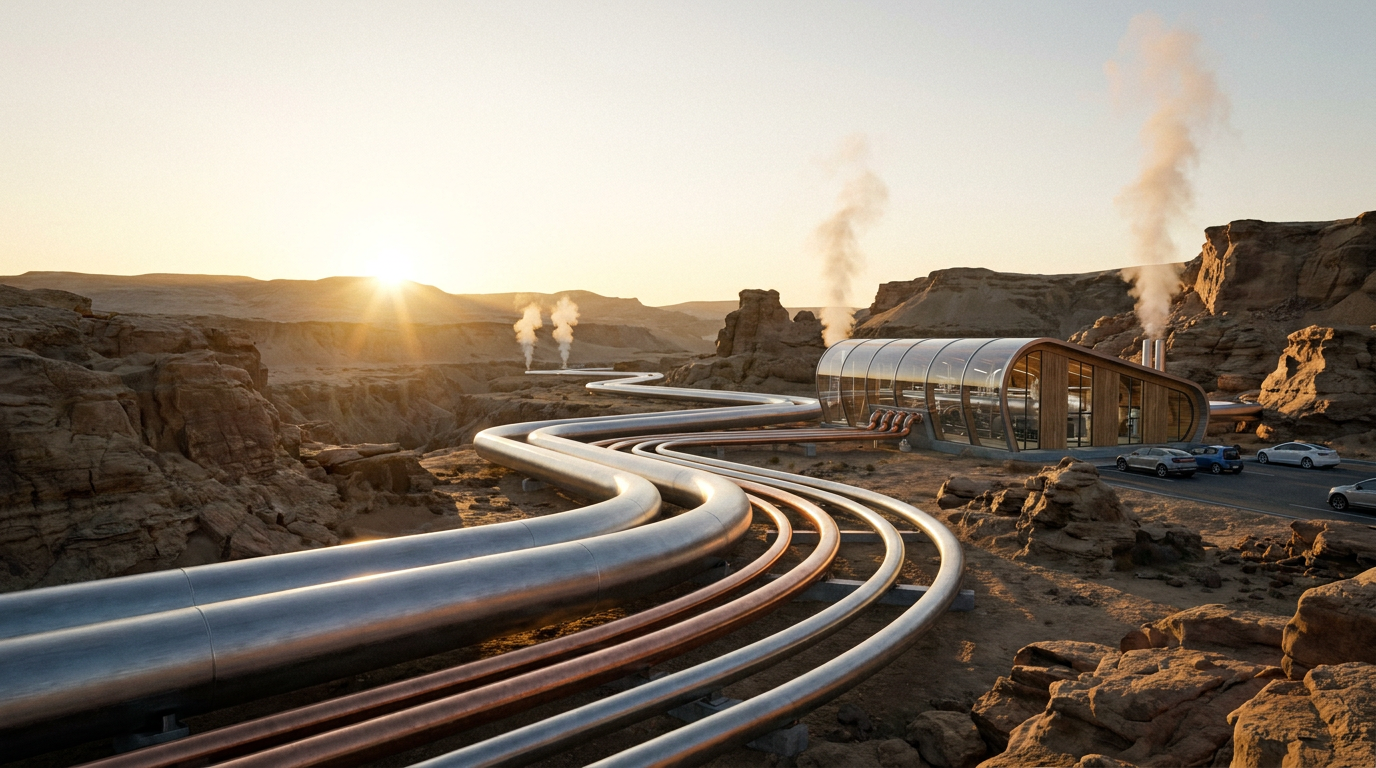
At the surface, this superheated fluid passes through a heat exchanger, driving a turbine to generate electricity before the cooled water is reinjected into the ground in a continuous, closed-loop system. The result is a zero-carbon power plant that operates flawlessly regardless of weather conditions or time of day.[1][4]

The result is a zero-carbon power plant that operates flawlessly regardless of weather conditions or time of day.
The commercial viability of EGS has accelerated dramatically in recent years. Startups like Fervo Energy have moved beyond theoretical models, proving the concept with successful commercial pilots in Nevada and Utah. These early facilities are already delivering continuous carbon-free electricity to local grids and corporate buyers.[1][3]
Since these initial breakthroughs, the industry has rapidly transitioned from pilot projects to utility-scale deployments. The U.S. Department of Energy's Frontier Observatory for Research in Geothermal Energy (FORGE) initiative has served as a critical testing ground, allowing researchers to refine drilling techniques and share open-source data with the private sector.[4][5]
Cost reduction remains the central hurdle for EGS. Drilling deep into hard, abrasive granite is notoriously expensive and wears out drill bits rapidly. However, recent data indicates that drilling times and costs have fallen by nearly 50% since 2021, mirroring the rapid cost declines seen in early solar and wind deployments.[2][6]
Beyond the technological and economic milestones, next-generation geothermal offers a unique socioeconomic benefit: a seamless transition for the oil and gas workforce. The roughnecks, petroleum engineers, and geophysicists who built the fossil fuel economy possess the exact skill sets required to scale EGS.[5][8]

This workforce transferability has garnered bipartisan political support in regions historically resistant to renewable energy mandates. Fossil fuel hubs in Texas, Oklahoma, and the Dakotas are increasingly viewing geothermal not as a threat to their livelihoods, but as a lucrative pivot that preserves high-paying industrial jobs.[2][5]
Despite the immense promise, EGS is not without environmental and technical uncertainties. The most prominent concern is induced seismicity. Injecting high-pressure fluid into fault lines can trigger minor earthquakes, a phenomenon that famously derailed an early EGS project in Basel, Switzerland, two decades ago.[3][8]
Modern EGS operators employ advanced seismic monitoring and carefully map subsurface stress fields to avoid critical fault lines. While recent projects have successfully managed this risk, scaling the technology to thousands of wells globally will require flawless execution, transparent data sharing, and rigorous regulatory oversight.[4][8]

Water usage is another critical variable. Although EGS operates as a closed-loop system, the initial fracturing process and the filling of the reservoir require millions of gallons of water. In arid regions like the American West, where geothermal potential is highest, securing water rights presents a significant logistical and political challenge.[1][8]
To mitigate this, researchers are exploring alternative working fluids, such as supercritical carbon dioxide, which could simultaneously sequester greenhouse gases while generating power. While still in the experimental phase, this dual-purpose approach highlights the ongoing innovation within the sector.[4][7]

The International Energy Agency projects that to achieve net-zero emissions by 2050, the world will need a massive injection of firm clean power to balance the grid. Next-generation geothermal is increasingly viewed not just as a niche alternative, but as a foundational pillar of the future energy mix.[6]
If the current trajectory of cost reductions and technological refinement holds, Enhanced Geothermal Systems could unlock terawatts of clean energy. By tapping into the heat beneath our feet, the energy transition may finally decouple human progress from both carbon emissions and the whims of the weather.[2][6]
How we got here
1970s
Early experiments in hot dry rock geothermal energy begin in New Mexico, but struggle with high costs and technical limits.
2006
An early EGS project in Basel, Switzerland, is suspended after fluid injection triggers noticeable earthquakes.
2010s
The shale gas boom rapidly advances horizontal drilling and hydraulic fracturing technologies.
2023
Fervo Energy successfully completes a commercial EGS pilot in Nevada, proving the viability of repurposing oil and gas tech for geothermal.
2026
Drilling costs drop significantly as utility-scale EGS projects begin integrating into major power grids.
Viewpoints in depth
Grid Operators & Utilities
Focused on the reliability and stability that geothermal brings to a renewable-heavy grid.
For the entities responsible for keeping the lights on, the energy transition has been a balancing act of managing cheap but erratic wind and solar power. Grid operators view EGS as the ultimate stabilizer. Because geothermal plants can run at 100% capacity around the clock, they provide the 'baseload' power traditionally supplied by coal or nuclear plants. Furthermore, modern geothermal facilities can be designed to ramp up or down flexibly, perfectly complementing the peaks and valleys of solar generation without the massive capital expenditure required for grid-scale battery storage.
Oil & Gas Transition Workforce
View the geothermal boom as an economic lifeline that utilizes their existing industrial expertise.
The fossil fuel industry faces an existential threat from decarbonization, but EGS offers a rare, direct pivot. The mechanics of drilling deep into the earth, managing subsurface pressures, and fracturing rock are identical whether the goal is extracting methane or harvesting heat. Industry advocates and labor unions highlight that scaling EGS will require thousands of roughnecks, petroleum engineers, and rig operators. This dynamic has transformed geothermal into a politically unifying climate solution, offering high-paying industrial jobs in regions that have historically opposed renewable energy mandates.
Environmental Risk Analysts
Support the carbon-free output but demand rigorous oversight of seismic and water-use impacts.
While acknowledging the climate benefits of zero-carbon firm power, environmental watchdogs caution against a 'drill everywhere' gold rush. Their primary concern is induced seismicity; altering underground pressure near unknown fault lines can trigger earthquakes, a risk that requires expensive, continuous monitoring to mitigate. Additionally, while EGS plants recycle water during operation, the initial fracturing process requires millions of gallons. In the drought-prone American West—where geothermal potential is highest—analysts argue that water rights and local ecological impacts must be strictly regulated before the technology scales globally.
What we don't know
- Whether the cost of deep granite drilling will fall low enough to compete directly with cheap natural gas in all markets.
- How frequently unexpected seismic activity might halt operations at newly established EGS sites.
- If alternative working fluids, like supercritical CO2, can be successfully commercialized to eliminate water usage.
Key terms
- Enhanced Geothermal Systems (EGS)
- A technology that creates artificial geothermal reservoirs by injecting fluid into hot, impermeable rock deep underground.
- Firm Power
- Electricity generation that is guaranteed to be available at any given time, regardless of weather conditions.
- Horizontal Drilling
- A technique where a well is drilled vertically and then steered horizontally to expose more of the rock formation to the wellbore.
- Induced Seismicity
- Minor earthquakes or tremors caused by human activity, such as injecting high-pressure fluids into the earth.
- Closed-Loop System
- An engineering design where the working fluid is continuously recycled through the system without being discharged into the environment.
Frequently asked
What is the difference between traditional geothermal and EGS?
Traditional geothermal requires naturally occurring hot water and permeable rock, limiting it to volcanic areas. EGS (Enhanced Geothermal Systems) artificially creates permeability by injecting fluid into hot, dry rock, allowing plants to be built almost anywhere.
Can geothermal energy cause earthquakes?
Yes, the fluid injection process can trigger minor seismic events, known as induced seismicity. Modern operators use advanced monitoring and avoid major fault lines to keep these tremors below the threshold of human perception.
Does EGS use a lot of water?
Creating the initial underground reservoir requires millions of gallons of water. However, once operational, the plant runs as a closed-loop system, continually recycling the same fluid with minimal ongoing water loss.
Why is geothermal called 'firm' power?
Unlike solar or wind, which depend on weather and time of day, geothermal plants generate electricity consistently 24/7, providing a reliable baseline of power for the grid.
Sources
Source coverage
8 outlets
3 viewpoints surfaced








[1]Canary MediaClean Energy Optimists
Next-gen geothermal is finally ready for the grid
Read on Canary Media →[2]Bloomberg GreenClean Energy Optimists
The Fracking Boom's Unexpected Climate Legacy: Cheap Geothermal
Read on Bloomberg Green →[3]MIT Technology ReviewClean Energy Optimists
How engineered geothermal systems work—and why they matter
Read on MIT Technology Review →[4]U.S. Department of EnergyEnergy Transition Planners
Enhanced Geothermal Systems (EGS) Fact Sheet
Read on U.S. Department of Energy →[5]ReutersEnergy Transition Planners
From crude to clean: Oil workers find new life in geothermal boom
Read on Reuters →[6]International Energy AgencyEnergy Transition Planners
Geothermal Power Deployment and Grid Reliability
Read on International Energy Agency →[7]Fervo EnergyEnergy Transition Planners
Pioneering Next-Generation Geothermal Technology
Read on Fervo Energy →[8]The GuardianEnvironmental Cautious
The hidden costs of the geothermal gold rush: Water and tremors
Read on The Guardian →
Every angle. Every day.
Get environment stories with full source coverage and perspective breakdowns delivered to your inbox.