
Haptic Suits and 'Vibro-DJs' Become Standard at Major Summer Music Festivals, Transforming Access for Deaf Fans
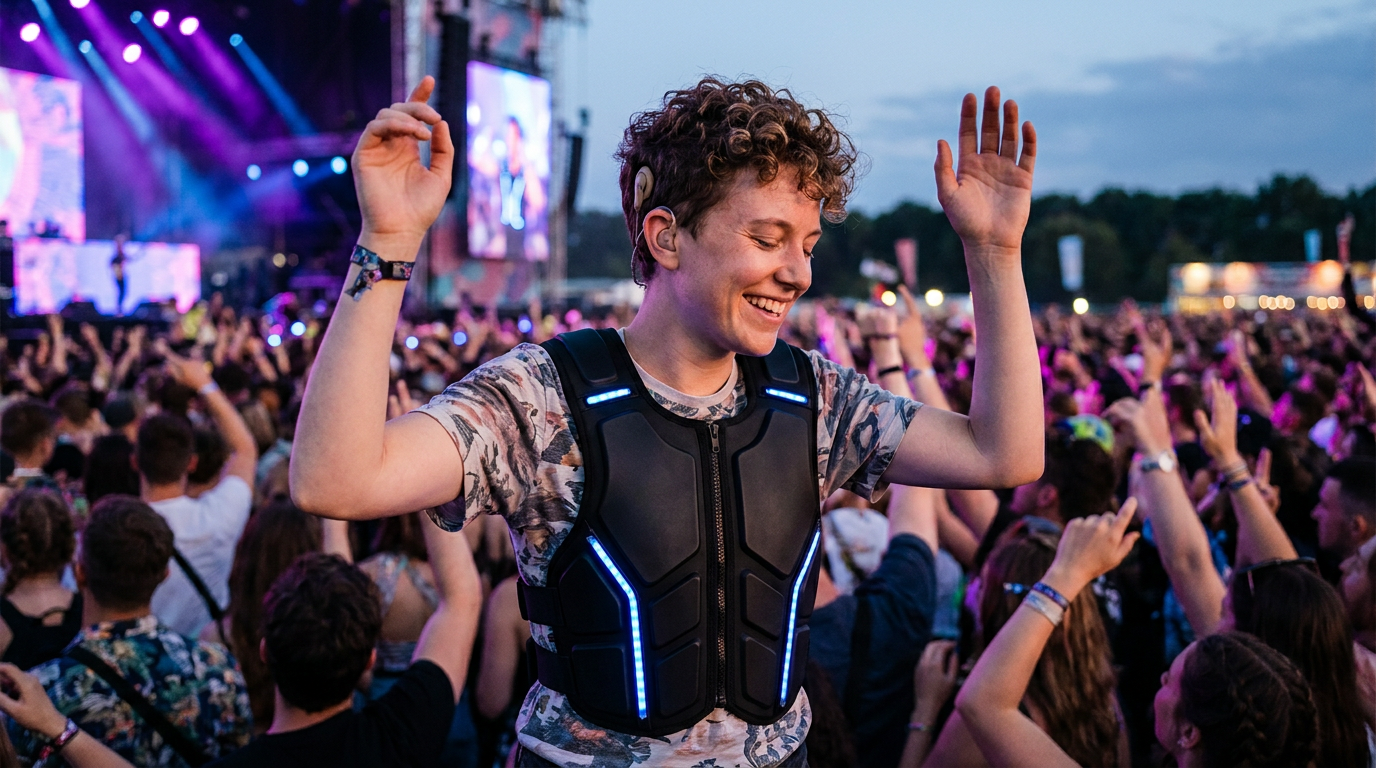
Wearable haptic technology that translates live music into high-fidelity, full-body vibrations has officially become a standard accessibility feature at major 2026 music festivals.
By Factlen Editorial Team
- Deaf and Hard-of-Hearing Fans
- Value the emotional and physical inclusion, moving beyond just ASL interpreters to actually feeling the distinct instruments.
- Accessibility Technologists
- Focus on zero-latency transmission, 5G integration, and the complex mapping of frequencies to 24 different body points.
- Live Event Producers
- See this as the new standard for ADA compliance and community building, recognizing the immense demand sparked by early adopters.
What's not represented
- · Independent venue owners struggling to afford the technology
- · Hearing fans advocating for commercial access to the suits
Why this matters
This breakthrough transforms live music from an exclusively auditory event into a universal, multi-sensory experience. By standardizing haptic technology, the live entertainment industry is proving that profound accessibility can fundamentally elevate an art form for everyone.
Key points
- Major 2026 summer music festivals have standardized wearable haptic suits for deaf and hard-of-hearing attendees.
- The technology uses 24 distinct vibration points to map different instruments to specific areas of the body.
- Audio experts known as Vibro-DJs actively mix the haptic feedback in real-time to match the emotional nuance of the music.
- Zero-latency wireless transmission ensures the physical vibrations perfectly sync with the live audio.
- The push for haptic inclusion gained massive momentum following high-profile deployments on Coldplay's global tours.
The summer festival season of 2026 has introduced a profound shift in how audiences experience live music, fundamentally redefining the concept of a concert for thousands of attendees. Across major global stages—from sprawling outdoor fields in Europe to intimate amphitheaters in North America—wearable haptic suits have officially transitioned from experimental prototypes to standard accessibility offerings. For decades, the live entertainment industry operated on the assumption that music was an exclusively auditory art form, leaving deaf and hard-of-hearing fans to navigate a landscape that was not built for them. Today, that paradigm has been shattered. Festival organizers are now deploying fleets of sophisticated wearable technology that translates audio signals into high-resolution, full-body physical sensations. This transition marks a monumental victory for inclusive design, ensuring that the rhythm, emotion, and communal energy of a live performance are universally accessible.[7]
To understand the magnitude of this technological leap, one must look at the historical workarounds the deaf community employed to participate in live music. Long before wireless haptic vests existed, passionate deaf music fans—most notably the "Deafheads" who devotedly followed the Grateful Dead throughout the 1980s—pioneered their own methods of feeling the music. Concert attendees would frequently stand barefoot on the venue floor, positioning themselves as close to the massive subwoofers as possible to absorb the heavy bass vibrations traveling through the ground. Others would hold inflated balloons between their fingertips, using the thin rubber surface as a rudimentary acoustic membrane to capture the higher-frequency sound waves that filled the air. While these methods fostered a strong sense of community, they offered a muddled, low-resolution physical experience that could not distinguish between a guitar solo and a kick drum.[3][7]
Those analog workarounds have now been entirely replaced by precision engineering, led prominently by the innovators at Not Impossible Labs. Their flagship "Music: Not Impossible" ecosystem was built from the ground up in collaboration with deaf musicians and technologists. The hardware consists of a lightweight, breathable torso harness paired with specialized bands that strap securely to the user's wrists and ankles. Unlike early vibrating backpacks that simply buzzed monotonously to the beat of a bass drop, this modern haptic suit features 24 distinct points of vibration. This complex array of actuators allows users to experience up to 3,900 different frequencies across five octaves, transforming the human skin into a high-fidelity canvas for musical expression.[1][6]

The sensory mapping of these haptic suits is highly specific and meticulously designed to mimic the acoustic spread of a live symphony or rock band. Audio engineers have mapped different frequency ranges to specific areas of the body to create a distinct physical vocabulary for the music. Heavy bass lines and booming cellos reverberate deeply in the lower back and torso, providing a grounding rhythm. Sweeping violins and rhythm guitars stimulate the ribcage, while brass horns pulse across the shoulders. Piercing vocal solos and high-hat cymbals tingle through the wrists and ankles. By distributing the haptic feedback across so many locations, concertgoers can feel each instrument as a unique sensation, allowing them to mentally separate the strumming of an acoustic guitar from the crash of a drum kit.[3][6]
The push for haptic inclusion gained massive mainstream visibility and crucial momentum during Coldplay's recent record-breaking global tours, which served as a high-profile testing ground for the technology. Lead singer Chris Martin, inspired by a suggestion from his partner Dakota Johnson, introduced SUBPAC vests to deaf fans in the audience. The SUBPAC was originally utilized by studio producers like Finneas O'Connell to physically feel bass frequencies while mixing tracks, but Coldplay recognized its immense potential as a live accessibility tool. By pairing these bass-delivering vests with dedicated sign language interpreters at every tour stop, the band proved that the demand for physical audio was immense. The overwhelming emotional response from fans who could finally experience a concert on the same level as their hearing peers prompted a wave of innovation across the broader live events industry.[2][7]
Lead singer Chris Martin, inspired by a suggestion from his partner Dakota Johnson, introduced SUBPAC vests to deaf fans in the audience.
Delivering a truly musical haptic experience requires more than just strapping a subwoofer to a fan's chest and turning up the volume; it requires the real-time artistry of a specialized technician known as a "Vibro-DJ." Audio experts like Patrick Hanlon actively mix the haptic feedback during a live performance, working from a dedicated console alongside the traditional sound engineers. The Vibro-DJ ensures that the vibrational patterns complement the emotional nuance of the soundscape, modulating the intensity so that a delicate acoustic ballad feels fundamentally different from a heavy electronic dance drop. "It engages the body," Hanlon explained during a recent deployment, noting that the ultimate goal is to provide a "3D-surround experience" that bypasses the ears entirely and paints a physical picture of the music.[3][4]

To make this multi-sensory illusion work seamlessly, technologists had to solve the critical engineering challenge of latency. If a fan feels the vibration of a snare drum even a fraction of a second after the drummer hits it, the rhythm is ruined, the visual disconnect is jarring, and the immersion is completely broken. Using custom wireless platforms and advanced algorithms, the haptic data now streams perfectly in sync with the master live audio. This zero-latency transmission ensures that the physical sensation hits the wearer's skin at the exact millisecond the sound wave leaves the stage monitors, creating a flawless synchronization between sight, sound, and touch.[1][6]
Furthermore, recent iterations of the technology have begun incorporating the communal energy of the crowd into the haptic mix, addressing a crucial missing element of the deaf concert experience. Telecommunications companies like Vodafone have debuted 5G-enabled suits equipped with receptors that capture ambient crowd noise—the collective clapping, the roar of applause, the chanting—and feed it back to the wearer as distinct, real-time vibrations. This holistic approach allows a deaf concertgoer to not only feel the artist's performance but also the shared atmosphere of the festival grounds. Feeling the physical vibration of fifty thousand people cheering simultaneously bridges the gap between the stage and the audience, fostering a profound sense of belonging.[5][7]

For the deaf and hard-of-hearing community, the impact of this technology is profoundly transformative, shifting the paradigm from mere ADA accommodation to genuine artistic inclusion. Users have described the experience as deeply moving, allowing them to perceive the subtleties and emotional arcs of a musical composition in their bodies for the very first time. Instead of relying solely on visual cues or the broad vibrations of a venue floor, deaf fans can now engage with the intricate layers of a song. Advocates note that while sign language interpreters remain essential for conveying lyrics and stage banter, the haptic suits provide the missing instrumental context, allowing the deaf community to experience the full spectrum of a live performance.[4][6]
While the technology was designed specifically to dismantle barriers for disabled fans, its undeniable success has sparked widespread interest among hearing concertgoers who crave a more immersive, multi-sensory live event. Industry analysts predict that haptic feedback will eventually become a premium upgrade for all festival attendees, much like VIP viewing decks or immersive light shows. However, the current priority remains firmly on accessibility. As the 2026 festival season hits its peak, the presence of haptic fleets signals a new era of radical inclusivity. By transforming sound waves into tactile art, these innovators have proven that music is a universal language meant to be felt by everyone, regardless of their ability to hear.[6][7]
How we got here
1980s
Deaf music fans, known as 'Deafheads,' pioneer early physical listening methods by standing barefoot near Grateful Dead subwoofers.
2018
Not Impossible Labs hosts an early live test of their haptic suits with rock band Greta Van Fleet.
2022
Coldplay introduces SUBPAC vests and sign language interpreters to their global stadium tour, bringing haptic tech to the mainstream.
2025
Major European promoters begin integrating haptic suits into massive outdoor rock festivals.
Summer 2026
Haptic suits and dedicated Vibro-DJs become a standardized accessibility requirement at top-tier global music festivals.
Viewpoints in depth
The Deaf Community's View
Haptic technology represents a shift from mere accommodation to genuine artistic inclusion.
For decades, accessibility at live music events meant providing a clear sightline to an ASL interpreter. While crucial for understanding lyrics, this visual accommodation left the actual musicality—the swell of a cello, the distortion of a guitar—entirely absent. The deaf community views haptic suits as a revolutionary bridge to the art form itself. By translating sound waves into a high-fidelity physical vocabulary, these devices allow deaf fans to experience the emotional arc of a composition, fostering a profound sense of belonging in spaces that historically excluded them.
The Technologists' View
The challenge lies in eliminating latency and expanding the sensory bandwidth of the human skin.
Engineers and audio technologists approach haptic suits as a complex problem of data transmission and sensory mapping. The human ear is incredibly sensitive to timing, and the skin is no different; a delay of even a few milliseconds between a visual drum hit and a physical vibration shatters the illusion. Technologists are focused on perfecting zero-latency wireless networks and expanding the frequency range of the actuators, pushing the boundaries of how much acoustic data the human nervous system can process through touch.
The Live Music Industry's View
Haptic inclusion is becoming a mandatory standard for major festivals, driven by fan demand and high-profile artist advocacy.
For festival organizers and tour promoters, the rapid adoption of haptic suits represents both a logistical challenge and a massive opportunity. Early deployments by massive acts like Coldplay proved that the demand for physical audio was not a niche novelty, but a deeply felt need. The industry now views these systems as essential infrastructure, budgeting for fleets of haptic vests and dedicated Vibro-DJs alongside traditional lighting and sound rigs, recognizing that true accessibility is now a baseline expectation for modern live events.
What we don't know
- Whether smaller, independent music venues will be able to afford the necessary infrastructure to support haptic fleets.
- How quickly the technology will be commercialized and made available for hearing concertgoers seeking multi-sensory experiences.
Key terms
- Haptic feedback
- The use of advanced technology to stimulate the sense of touch and motion, translating digital or audio signals into physical vibrations.
- Vibro-DJ
- A specialized audio technician who actively mixes and modulates haptic feedback during a live performance to match the emotional nuance of the music.
- Zero-latency transmission
- A wireless data transfer process that occurs with virtually no delay, ensuring that physical vibrations perfectly sync with live audio.
- Actuator
- A mechanical component within the haptic suit that physically vibrates against the skin at specific frequencies to simulate sound.
Frequently asked
How do haptic suits translate music into vibration?
The suits use 24 distinct actuators spread across the torso, wrists, and ankles to deliver up to 3,900 different frequencies, mapping specific instruments to different parts of the body.
Do deaf concertgoers still use sign language interpreters?
Yes. Sign language interpreters remain essential for conveying lyrics, stage banter, and the specific meaning of a song, while the haptic suits provide the instrumental and rhythmic context.
Can hearing people use these haptic suits?
Absolutely. While designed for the deaf community, hearing concertgoers have shown immense interest in the technology for its ability to provide a deeply immersive, multi-sensory live music experience.
Is there a delay between the sound and the vibration?
No. Modern haptic systems utilize custom wireless platforms and zero-latency transmission to ensure the physical vibrations hit the wearer's skin at the exact millisecond the sound is played.
Sources
Source coverage
7 outlets
3 viewpoints surfaced







[1]Not Impossible LabsAccessibility Technologists
Introducing Music: Not Impossible
Read on Not Impossible Labs →[2]CBS NewsLive Event Producers
Coldplay incorporates haptic vests for deaf fans
Read on CBS News →[3]TechXploreDeaf and Hard-of-Hearing Fans
Vibrating vests translate music for deaf concertgoers
Read on TechXplore →[4]WNYC StudiosDeaf and Hard-of-Hearing Fans
Haptic Suits break down barriers at concerts
Read on WNYC Studios →[5]Vodafone UKAccessibility Technologists
Vodafone unveils 5G-enabled haptic suits
Read on Vodafone UK →[6]Hackster.ioAccessibility Technologists
Music: Not Impossible haptic wearables
Read on Hackster.io →[7]Factlen Editorial TeamLive Event Producers
Synthesis by Factlen editorial team
Read on Factlen Editorial Team →
Every angle. Every day.
Get entertainment stories with full source coverage and perspective breakdowns delivered to your inbox.