
Global Solar Adoption Shatters Forecasts as Renewables Overtake Coal
Driven by plummeting costs and energy security concerns, global solar capacity reached a record 3 terawatts in early 2026, fundamentally reshaping the global power grid.
By Factlen Editorial Team
- Clean Energy Analysts
- Focus on the unstoppable economic momentum and cost curves of renewables.
- Grid Operators & Planners
- Focus on the logistical challenges of integrating intermittent power and the need for storage.
- Industry Advocates
- Focus on deployment milestones and policy barriers like permitting and tariffs.
What's not represented
- · Fossil Fuel Producers
- · Local Communities near Mega-Projects
Why this matters
The accelerated deployment of cheap, renewable energy directly impacts global electricity prices and grid reliability. For consumers and businesses, this transition signals a shift toward more predictable energy costs, while highlighting the urgent need for infrastructure upgrades to support an electrified future.
Key points
- Renewables overtook coal as the world's largest source of electricity in 2025, capturing a 33.8% share of global generation.
- The world added a record 664 gigawatts of solar capacity in 2025, pushing the global fleet past the 3-terawatt milestone.
- Solar and wind generation are projected to eclipse global nuclear output in 2026.
- Surging electricity demand from AI data centers is complicating the transition, requiring massive grid modernization.
- A slight dip in solar installations is expected in 2026 due to policy shifts, but long-term economic momentum remains robust.
For the first time in over a century, the global energy mix has crossed a historic and irreversible threshold. In 2025, renewable energy sources officially overtook coal as the largest single source of electricity worldwide, capturing a remarkable 33.8% share of total global generation. This milestone was driven largely by an unprecedented and accelerating surge in solar photovoltaic (PV) deployment, marking a definitive pivot in the global energy transition. The sheer scale of this solar expansion continues to shatter institutional forecasts that have historically underestimated the technology's growth curve. According to the Global Solar Market Outlook 2026-2030, the world added a staggering 664 gigawatts (GW) of new solar capacity in 2025 alone, pushing the boundaries of what energy analysts thought physically possible in a single calendar year.[4][8][9]
To put the magnitude of this buildout into perspective, the total global solar fleet officially surpassed the 3-terawatt milestone in early 2026. This means the world's total solar capacity has effectively tripled in just four years, transforming what was once a niche alternative energy source into the foundational pillar of the modern electricity grid. The evidence supporting the dominance of this transition is robust and multi-faceted. Solar generation rose by 636 terawatt-hours (TWh) in 2025, which stands as the largest single-year increase of any power source in recorded history. This massive influx of clean energy was not just a supplementary addition; it met three-quarters of the world's total electricity demand growth for the entire year, proving that renewables can scale fast enough to meet rising global energy appetites.[8][9]
The momentum of this deployment is geographically diverse, extending far beyond a single dominant market. While China remains the undisputed heavyweight—installing a staggering 382 GW in 2025 to account for 57% of the global total—other nations are rapidly accelerating their own deployments. India surged to become the world’s second-largest solar market, achieving a 49% year-over-year increase to surpass the United States in annual installations. Meanwhile, the European Union utilized aggressive solar expansion as a strategic geopolitical shield, deploying the technology rapidly to insulate its economy from the volatility of imported fossil fuels following recent global supply shocks. This shift underscores how solar adoption is increasingly driven by national security imperatives rather than purely environmental goals.[8]

As the deployment scales globally, historical milestones continue to fall at an accelerating rate. Forecasts from industry analysts indicate that the combined generation of wind and solar power will officially eclipse global nuclear output by the end of 2026. In the United States, the Energy Information Administration (EIA) projects a similar changing of the guard; by the summer of 2026, solar is expected to generate 147 billion kilowatt-hours. This surge will allow solar to surpass wind to become the leading source of renewable generation during the critical peak summer months, fundamentally altering how the American grid operates during periods of high air-conditioning demand.[2][6][9][10]
Why do institutional forecasts consistently underestimate this explosive growth? The underlying mechanism is rooted in Wright’s Law, an economic principle dictating that for every cumulative doubling of manufacturing production, costs fall by a consistent and predictable percentage. As global deployment scales up, manufacturing efficiencies in polysilicon production and module assembly improve dramatically. This drives prices down, which in turn spurs even more demand in a continuous, virtuous cycle of adoption. Because many traditional energy models fail to account for these compounding cost reductions, they consistently project linear growth for a technology that is actually scaling exponentially.[1]

Why do institutional forecasts consistently underestimate this explosive growth?
Looking ahead, the trajectory suggests an even more profound reshaping of the energy landscape. BloombergNEF’s New Energy Outlook 2026 models this continuous growth, projecting that solar will become the world’s single largest source of electricity within the next six years. This forecast is underpinned by a major supply glut in manufacturing, continuous technological advances in cell efficiency, and plummeting module prices that make solar the cheapest form of bulk electricity in most global markets. The International Energy Agency (IEA) corroborates the sheer dominance of this technology, predicting that solar will account for nearly 80% of the 4.6 terawatts of renewable energy expected to be added globally between 2025 and 2030.[1][3]
However, this rapid expansion of power supply is currently colliding with a massive and unexpected new demand driver: Artificial Intelligence. The proliferation of AI and the massive data centers required to train and run these models are fundamentally altering electricity consumption patterns across the globe. Global data center capacity reached 84 GW in 2025, consuming roughly 1.9% of total global electricity demand, and that figure is climbing rapidly. By 2050, BloombergNEF forecasts that data center demand will more than double to 1,114 TWh, representing a full tenth of all electricity consumed worldwide.[1][6][9]
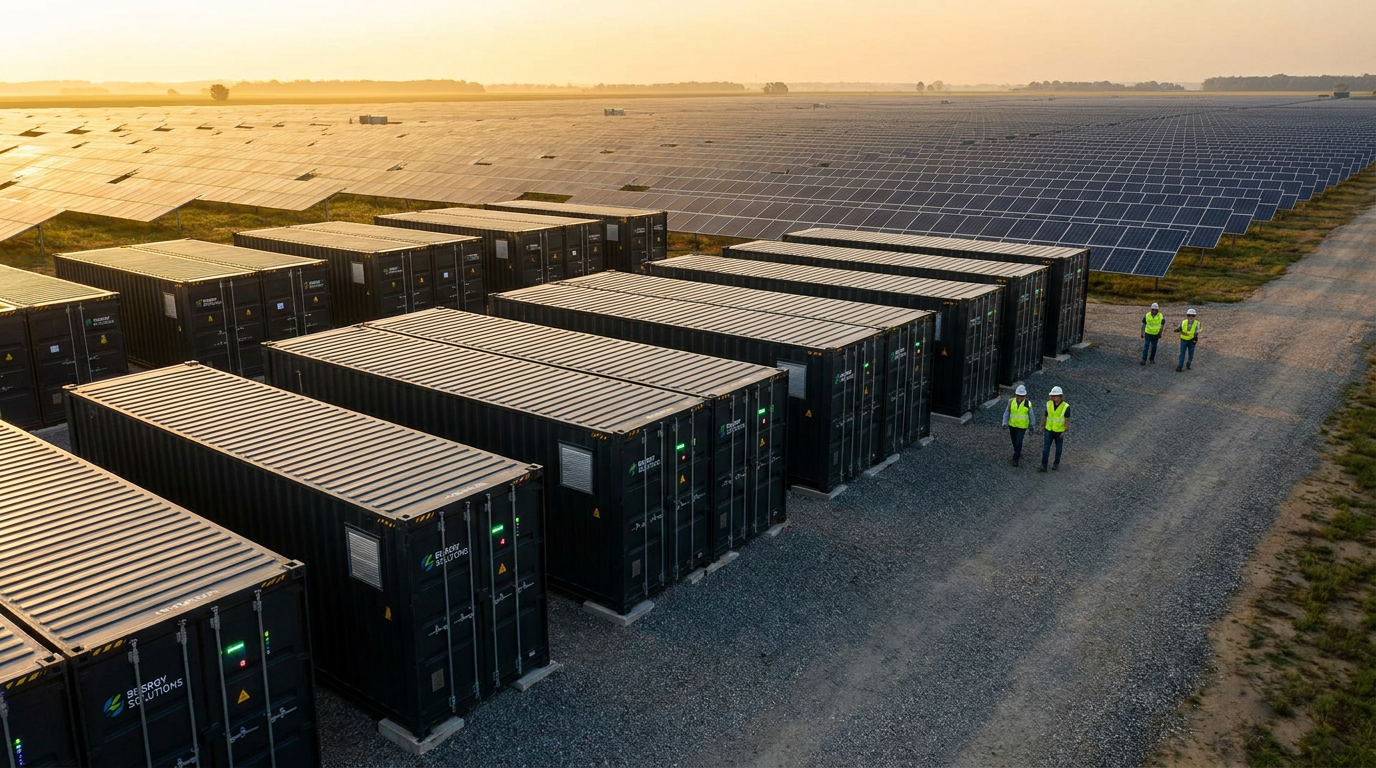
This creates a complex dual dynamic for the energy sector: AI is driving extraordinary growth in raw power consumption, while simultaneously enabling the smarter, predictive grid management software required to handle intermittent renewable sources. The primary weakness in the bullish solar narrative, however, lies in the physical constraints of the grid itself. While generation capacity is skyrocketing, interconnection queues and high-voltage transmission infrastructure are lagging severely behind. Because the sun does not always shine, grid operators are being forced to mandate massive buildouts of battery energy storage systems (BESS) and explore long-duration storage solutions to maintain baseline stability.[3][4][7][9]

To address this intermittency at a systemic level, alternative clean technologies must scale alongside solar. DNV’s 2026 Energy Transition Outlook highlights that clean hydrogen production will need to grow 100-fold from today's levels to mitigate emissions from hard-to-electrify heavy industries and provide seasonal grid stability. Until long-duration storage becomes economically viable at a massive scale, the risk of curtailment—where fully functional solar farms are forced to shut off because the grid cannot absorb their excess power—remains a critical bottleneck. Furthermore, the evidence for uninterrupted linear growth is complicated by geopolitical realities and protectionist trade policies. The IEA recently trimmed its 2025–2030 renewable forecast by 5%, anticipating a temporary 8% contraction in global solar installations in 2026 due to shifting subsidies and tariff restrictions.[3][7][8]
Despite these near-term regulatory and infrastructural headwinds, the underlying macro-economics remain a powerful and irreversible catalyst. Wood Mackenzie estimates that the global energy transition presents an astonishing $130 trillion to $175 trillion investment opportunity between now and 2060. Capital remains highly available for these projects, though institutional investors are increasingly demanding capital discipline, focusing on resilient, scalable platforms rather than pursuing growth at any cost. Furthermore, national energy security has become inextricably linked to renewable adoption. BloombergNEF notes that Asian economies with high fossil fuel import liabilities have the most to gain economically by accelerating their transition to domestically generated solar and wind, effectively decoupling their economies from volatile global commodity markets.[1][5][9]

Ultimately, the data from early 2026 reveals a renewable energy sector that has decisively moved past its visionary, early-adopter phase and entered a period focused strictly on industrial-scale execution. The conversation in boardrooms and government ministries has shifted from debating the viability of clean energy to solving the logistical challenges of capital deployment, supply chain resilience, and grid modernization. While significant hurdles in permitting, transmission capacity, and trade policy remain, the fundamental evidence presented across multiple institutional forecasts is clear. The relentless cost curves of solar and battery technologies have permanently altered the global power landscape, establishing a highly economic foundation for a cleaner, more resilient, and increasingly electrified global economy.[1][9]
How we got here
2023-2024
Global solar capacity expands rapidly, driven by energy security concerns following geopolitical shocks and fossil fuel price volatility.
2025
Renewables officially overtake coal as the largest source of electricity worldwide, with a record 664 GW of solar added.
Early 2026
The total global solar fleet surpasses the 3-terawatt milestone, having tripled in just four years.
Summer 2026
Solar is forecast to surpass wind as the leading source of renewable generation in the United States during peak summer months.
2030
Solar is expected to account for nearly 80% of all new renewable energy capacity added globally over the preceding five years.
Viewpoints in depth
Clean Energy Analysts
Focus on the unstoppable economic momentum and cost curves of renewables.
Financial and energy analysts emphasize that the transition is no longer driven primarily by environmental policy, but by raw economics. As solar and battery manufacturing scales, Wright's Law dictates that costs will continue to fall, creating a virtuous cycle of adoption. This camp argues that temporary policy hurdles or tariff disputes are mere speed bumps in a macro trend where renewables simply outcompete fossil fuels on price, particularly for nations seeking to reduce their reliance on imported energy.
Grid Operators & Planners
Focus on the logistical challenges of integrating intermittent power and the need for storage.
For those managing the physical infrastructure of the electricity grid, the sheer volume of new solar capacity is a double-edged sword. This perspective highlights the growing mismatch between rapid generation buildouts and sluggish transmission upgrades. Grid operators warn that without massive investments in battery energy storage systems (BESS), long-duration storage like clean hydrogen, and modernized interconnection queues, the grid will face increasing instability and forced curtailment of clean energy.
Industry Advocates
Focus on deployment milestones and policy barriers like permitting and tariffs.
Solar manufacturers and developers celebrate the record-breaking installation numbers but remain highly focused on regulatory friction. This camp points to the anticipated slight dip in 2026 installations as evidence that inconsistent government policies—such as shifting subsidies, trade tariffs, and slow permitting on federal lands—can artificially constrain growth. They advocate for streamlined regulatory frameworks to ensure the industry can meet the aggressive targets required for global decarbonization.
What we don't know
- Whether global transmission grid upgrades can accelerate fast enough to prevent widespread curtailment of new solar capacity.
- The exact impact of evolving trade tariffs and protectionist policies on the global supply chain for solar panels and batteries.
- How quickly long-duration energy storage technologies, such as clean hydrogen, can reach commercial viability to support a fully decarbonized grid.
Key terms
- Wright's Law
- An economic principle stating that for every cumulative doubling of production volume, the cost of a technology falls by a consistent percentage.
- Curtailment
- The forced reduction of electricity generation—often from wind or solar farms—because the power grid cannot absorb or store the excess energy being produced.
- Intermittency
- The characteristic of renewable energy sources like wind and solar that do not generate power continuously, depending instead on weather conditions.
- Battery Energy Storage Systems (BESS)
- Large-scale battery installations used to store excess electricity generated by renewables for use during periods of high demand or low generation.
Frequently asked
Why are renewable energy forecasts often wrong?
Historically, institutional forecasts have underestimated the pace of cost reductions in solar and battery manufacturing. As production scales up, economies of scale drive prices down faster than anticipated, leading to higher-than-expected adoption rates.
Will solar power overtake other energy sources?
Yes. In 2025, renewables collectively overtook coal as the world's largest source of electricity. Forecasts project that solar alone will become the single largest source of global electricity within the next six years.
How is AI affecting the energy transition?
AI is a dual force: the proliferation of data centers is driving a massive surge in electricity demand, but AI technologies are also enabling smarter, more efficient grid management to handle intermittent renewable energy.
Why might solar installations dip slightly in 2026?
A temporary contraction is expected in 2026 largely due to evolving policy timelines, trade restrictions, and permitting delays in major markets like China and the United States, before growth resumes in 2027.
Sources
Source coverage
10 outlets
3 viewpoints surfaced










[1]BloombergNEFClean Energy Analysts
New Energy Outlook 2026
Read on BloombergNEF →[2]Utility DiveIndustry Advocates
Solar expected to surpass wind as top US renewable power source by summer 2026
Read on Utility Dive →[3]PV MagazineIndustry Advocates
IEA cuts 2025–30 renewables forecast by 5%, citing lower solar additions
Read on PV Magazine →[4]SolarPower EuropeIndustry Advocates
Global Solar Market Outlook 2026-2030
Read on SolarPower Europe →[5]Wood MackenzieClean Energy Analysts
Energy transition outlook 2026: A $175 trillion opportunity
Read on Wood Mackenzie →[6]DeloitteClean Energy Analysts
2026 Energy Industry Outlook
Read on Deloitte →[7]DNVGrid Operators & Planners
Energy Transition Outlook 2026: Hydrogen to 2060
Read on DNV →[8]IndexBoxIndustry Advocates
Global solar photovoltaic installations reached a new record in 2025
Read on IndexBox →[9]Horton InternationalIndustry Advocates
Status of the Energy Transition in 2025 and Outlook for 2026
Read on Horton International →[10]U.S. Energy Information Administration (EIA)Grid Operators & Planners
Short-Term Energy Outlook - Summer 2026
Read on U.S. Energy Information Administration (EIA) →
Every angle. Every day.
Get data analysis stories with full source coverage and perspective breakdowns delivered to your inbox.