
Dolly Parton's Imagination Library Surpasses 314 Million Books as Landmark Study Proves Literacy Impact
The global childhood literacy program has reached a massive distribution milestone, backed by new research showing enrolled children experience a six-fold increase in vocabulary development.
By Factlen Editorial Team
- Early Education Researchers
- Focusing on the empirical data proving the program's cognitive benefits.
- State Policymakers
- Viewing the program as a highly efficient public-private education investment.
- Philanthropy Analysts
- Highlighting the structural difference between this initiative and typical celebrity charity.
What's not represented
- · Publishing industry executives managing the wholesale supply chain
- · Families in regions not yet covered by local affiliates
Why this matters
Early childhood literacy is one of the strongest predictors of lifelong academic and economic success. By providing free books during the critical birth-to-five developmental window, this infrastructure is actively closing the education gap before children even enter kindergarten.
Key points
- Dolly Parton's Imagination Library has officially gifted over 314 million books to children worldwide.
- A landmark study of 86,000 caregivers proves the program significantly boosts early literacy skills.
- Enrolled children demonstrated a six-fold increase in vocabulary development after receiving just 10 books.
- The program operates via a public-private partnership, with states like Ohio funding statewide coverage.
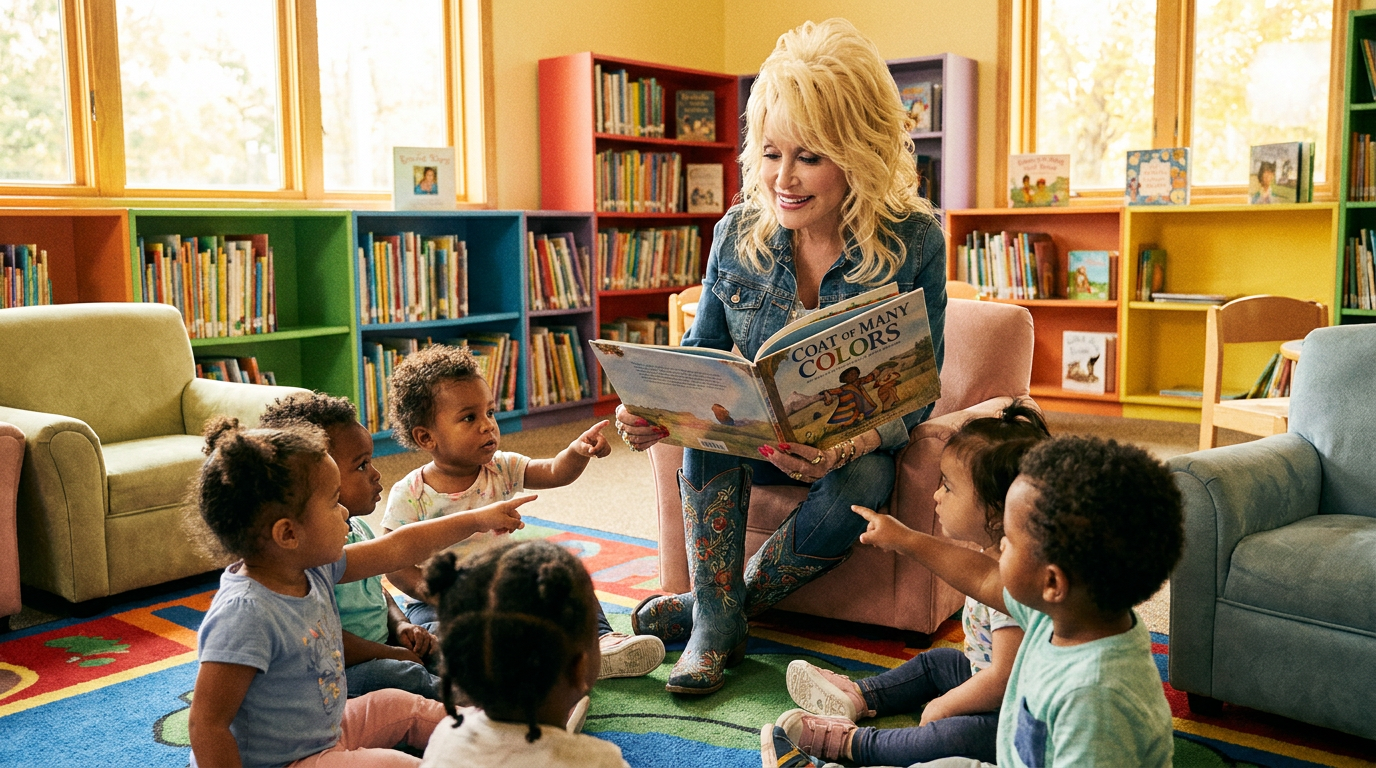
Dolly Parton is widely celebrated for her decades of chart-topping country music, but her most enduring legacy is quietly arriving in millions of mailboxes every month. As of June 2026, Parton's Imagination Library has officially gifted more than 314 million free books to children worldwide. The milestone coincides with the release of the largest-ever international study on shared reading, which confirms that the country icon's philanthropic infrastructure is fundamentally altering the landscape of early childhood education.[1][7]
The premise of the Imagination Library is remarkably simple: any registered child from birth to age five receives one high-quality, age-appropriate book in the mail every month, completely free of charge to the family. What began in 1995 as a localized effort in Parton's native Sevier County, Tennessee, has ballooned into a global logistical marvel. Today, the program ships over 3.4 million books monthly across the United States, Canada, the United Kingdom, Australia, and the Republic of Ireland.[3][7]
While the sheer volume of books distributed is staggering, educators and researchers have long sought to quantify the program's exact impact on childhood development. This spring, a landmark study led by researcher Dr. Claire Galea provided the definitive answer. Surveying more than 86,000 caregivers across five countries, the research represents the largest dataset ever collected on shared book reading.[5][7]
The findings, published in coordination with the Dollywood Foundation, reveal that the Imagination Library acts as a powerful catalyst for cognitive development. According to the data, children need to receive just ten books from the program to demonstrate a measurable leap in emergent literacy skills. Enrolled children showed a six-fold increase in vocabulary development and a seven-fold increase in phonological awareness compared to their non-enrolled peers.[1][5]

Beyond raw academic metrics, the study highlighted a profound shift in household behavior. Families receiving the monthly book deliveries were found to be nine times more likely to read together four or more days per week. Furthermore, the children themselves became highly engaged participants; they were 15 times more likely to actively respond and join in during reading sessions, transforming a passive listening exercise into an interactive learning experience.[6][7]
Beyond raw academic metrics, the study highlighted a profound shift in household behavior.
The program's success relies heavily on a unique public-private partnership model. While the Dollywood Foundation manages the centralized database, book selection, and wholesale purchasing, local affiliates and state governments provide the funding to cover wholesale and mailing costs. This collaborative structure has allowed the Imagination Library to achieve statewide coverage in numerous regions, transforming it from a private charity into a core component of public education infrastructure.[3][6]
Ohio stands as the largest statewide participant in the United States, currently serving nearly 420,000 children every month. Governor Mike DeWine and First Lady Fran DeWine recently celebrated the state's milestone of gifting over 25 million books since establishing their statewide partnership in 2019. State officials point to the new global research as validation for their continued legislative funding, noting that kindergarten readiness scores have noticeably improved in participating districts.[6]
The program's footprint is equally pronounced overseas. In the United Kingdom, the Imagination Library has gifted over seven million books since its launch in 2007. Local councils, such as Wandsworth in London, have integrated the program into their early years strategies. Wandsworth recently hosted special story-time events to mark the National Year of Reading and celebrate Parton's 80th birthday year, highlighting the enrollment of over 6,500 local families.[2]

Philanthropy analysts frequently cite the Imagination Library as the gold standard for celebrity giving. Unlike one-off donations or short-lived awareness campaigns, Parton's initiative is a sustained, 30-year logistical operation that addresses a systemic issue with a highly targeted, evidence-based intervention. By focusing entirely on early literacy—a critical determinant of future academic and economic success—the program delivers an outsized return on investment.[4]
The inspiration for the massive undertaking remains deeply personal for Parton. She originally launched the charity in honor of her father, Robert Lee Parton, a hardworking farmer who never learned to read or write. Parton has often remarked that despite his intelligence, her father's illiteracy remained a lifelong source of insecurity. The Imagination Library was designed to ensure that the next generation would not face the same barriers.[3][4]

As the Imagination Library looks toward its next hundred million books, the focus is shifting toward deepening engagement and reaching historically underserved rural and urban populations. The foundation is expanding its community outreach efforts, working with local coalitions to ensure that families who might lack a permanent mailing address can still access the program through community centers and local libraries.[1][7]
For the millions of families currently enrolled, the arrival of the monthly book remains a cherished ritual. The simple act of a child receiving a package addressed specifically to them fosters a sense of ownership and excitement around reading. As the latest research proves, that initial spark of excitement is successfully translating into a lifelong foundation for learning, proving that a single book can indeed change the trajectory of a child's life.[5][7]
How we got here
1995
The Imagination Library is launched in Sevier County, Tennessee, to benefit the children of Dolly Parton's home county.
2000
The program becomes available for national replication, allowing communities across the United States to adopt the model.
2007
The initiative expands internationally for the first time, launching operations in the United Kingdom.
Spring 2026
The program surpasses 314 million books gifted globally, coinciding with the release of a landmark international literacy study.
Viewpoints in depth
Early Education Researchers
Focusing on the empirical data proving the program's cognitive benefits.
Educational researchers emphasize that the birth-to-five window is the most critical period for brain development. By analyzing the 86,000-caregiver dataset, researchers found that the mere presence of physical books in the home fundamentally alters family dynamics. They argue that the program's true success lies not just in the books themselves, but in how they prompt caregivers to engage in consistent, interactive reading routines that build phonological awareness.
State Policymakers
Viewing the program as a highly efficient public-private education investment.
For state and local governments, the Imagination Library represents a turnkey solution to early education challenges. Because the Dollywood Foundation absorbs the overhead of the database, book selection, and wholesale negotiation, states only need to fund the direct cost of the books and mailing. Policymakers argue this is one of the most cost-effective interventions available to boost kindergarten readiness scores across entire populations.
Philanthropy Analysts
Highlighting the structural difference between this initiative and typical celebrity charity.
Industry analysts frequently contrast the Imagination Library with standard celebrity philanthropy, which often relies on one-off galas or short-term awareness campaigns. They point out that this program operates more like a global logistics company, requiring decades of sustained infrastructure building. Analysts view it as the gold standard for how public figures can leverage their wealth and platform to create permanent, systemic change.
What we don't know
- Long-term high school graduation rates of the earliest Imagination Library cohorts compared to non-enrolled peers.
- How the program will adapt its delivery logistics to better serve transient families without permanent mailing addresses.
Key terms
- Emergent literacy
- The early skills, knowledge, and attitudes that a child develops about reading and writing before they can actually read.
- Phonological awareness
- The ability to recognize and manipulate the spoken parts of sentences and words, a crucial foundational skill for learning to read.
- Public-private partnership
- A collaborative funding and operational model between a government agency and a private entity, such as a non-profit foundation.
Frequently asked
Who is eligible to receive books from the Imagination Library?
Any child from birth until their fifth birthday is eligible, provided they live in a community where a local affiliate has partnered with the program.
How much does the program cost for participating families?
The program is completely free for families. There are no registration fees or shipping costs for the monthly book deliveries.
How are the books selected for the children?
A blue-ribbon panel of early childhood literacy experts selects age-appropriate books each year, ensuring the themes and vocabulary match the child's specific developmental stage.
Sources
Source coverage
7 outlets
3 viewpoints surfaced







[1]NPREarly Education Researchers
Dolly Parton's Imagination Library hits 314 million books, backed by landmark literacy study
Read on NPR →[2]BBC NewsState Policymakers
Dolly Parton's book charity celebrates UK milestone and global research
Read on BBC News →[3]The TennesseanPhilanthropy Analysts
How Dolly Parton's Imagination Library reached 314 million children worldwide
Read on The Tennessean →[4]Entertainment TonightPhilanthropy Analysts
Dolly Parton's literacy program celebrates massive 2026 milestone
Read on Entertainment Tonight →[5]Publishers WeeklyEarly Education Researchers
New study proves impact of Imagination Library on early literacy
Read on Publishers Weekly →[6]State of Ohio Press OfficeState Policymakers
Governor DeWine Celebrates Imagination Library Research and Ohio Milestones
Read on State of Ohio Press Office →[7]The Dollywood FoundationEarly Education Researchers
International Study Reaffirms Impact of Dolly Parton's Imagination Library
Read on The Dollywood Foundation →

More in entertainment
See all 58 stories →Music Economy
Global Music Revenues Hit Record $31.7 Billion as Vinyl Boom Meets 'Green Note' Sustainability
7 sources

Handheld PCs
Steam Deck OLED vs. ROG Ally X: Which Handheld Gaming PC Wins in 2026?
7 sources
Early Literacy
Dolly Parton's Imagination Library Hits 314 Million Books as Landmark Study Proves Massive Literacy Boost
7 sources

Creator Economy
Why Top Internet Creators Are Abandoning Algorithms to Build Their Own Streaming Apps
7 sources

Every angle. Every day.
Get entertainment stories with full source coverage and perspective breakdowns delivered to your inbox.