
Do Smart Rings Actually Improve Sleep? An Evidence-Based Review
As smart rings from Oura, Samsung, and Ultrahuman dominate the 2026 wearable market, clinical studies reveal exactly where their sleep-tracking algorithms succeed and where they fall short.
By Factlen Editorial Team
- Everyday Consumers
- General users who prioritize comfort, battery life, and cost-effectiveness over clinical-grade data precision.
- Clinical Sleep Researchers
- Medical professionals who value polysomnography and view consumer wearables as useful for longitudinal trends but not diagnostic tools.
- Biohackers & Quantified Selfers
- Data-driven consumers who value actionable daily readiness scores, detailed stage breakdowns, and continuous physiological monitoring.
What's not represented
- · Individuals with severe insomnia
- · Medical insurance providers
Why this matters
With smart rings costing upwards of $300, understanding the clinical accuracy of their sensors ensures you aren't over-optimizing based on flawed data, allowing you to choose the right device for your actual health goals.
Key points
- Smart rings from brands like Oura, Samsung, and RingConn have become mainstream tools for tracking nightly sleep and daily recovery.
- Clinical studies show these devices are highly accurate (over 95%) at detecting when you are asleep versus awake.
- Differentiating between specific sleep stages (like REM and deep sleep) remains challenging, with accuracy hovering around 76% to 79%.
- Finger-worn rings often provide cleaner heart rate data than wrist-worn watches due to the proximity of blood vessels to the skin's surface.
- The market is increasingly divided between premium subscription models (Oura) and robust, fee-free alternatives (Samsung, RingConn).
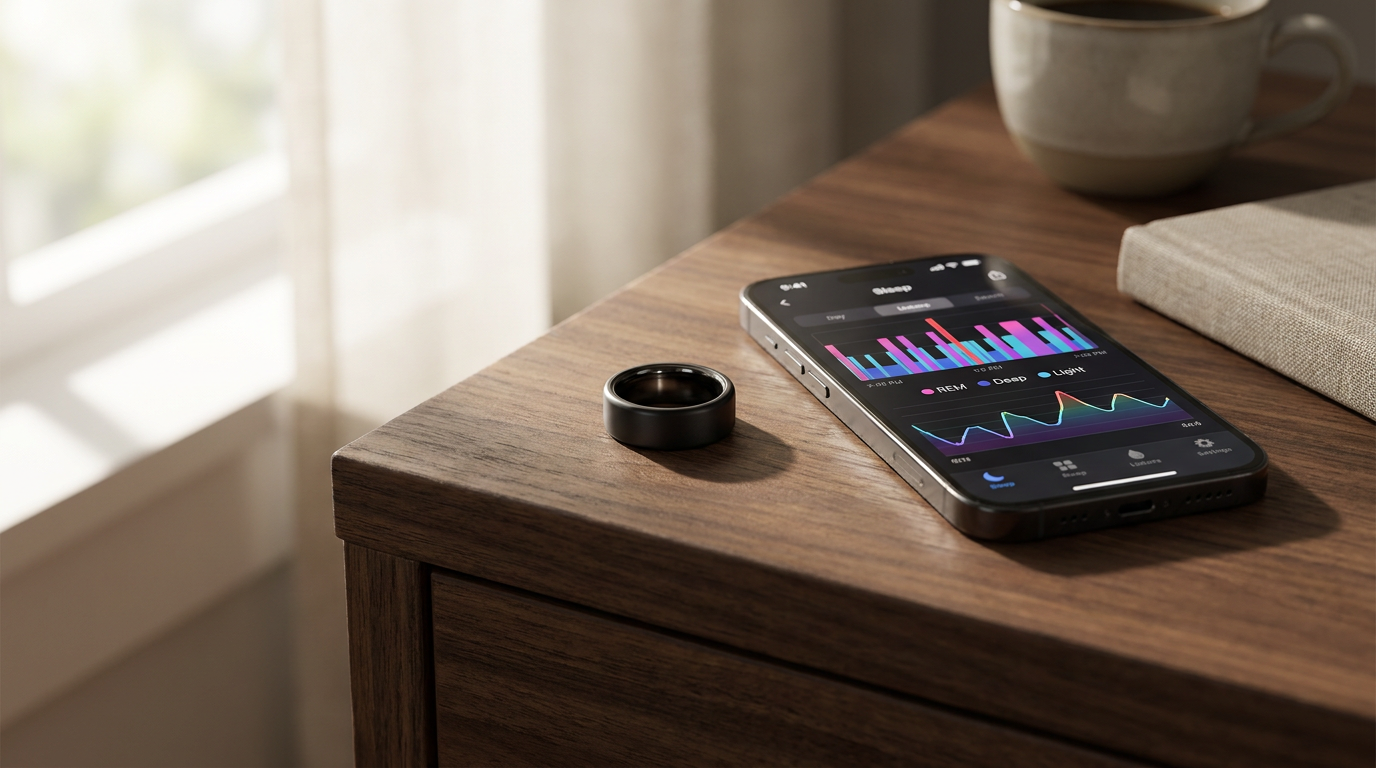
The smart ring market has exploded by 2026, transitioning from a niche biohacker accessory to a mainstream consumer health staple. Devices like the Oura Ring 4, Samsung Galaxy Ring, and Ultrahuman Ring Air promise to decode our nightly rest without the bulk and distraction of a traditional smartwatch. For millions of users, these lightweight titanium bands have become the ultimate bedside companion, dictating morning readiness scores, guiding workout intensity, and influencing daily lifestyle habits. As the hardware becomes increasingly sophisticated, the wearable industry is aggressively marketing these devices as medical-grade sleep laboratories that fit seamlessly onto your index finger.[3][4]
But as consumers increasingly rely on these devices to optimize their health and well-being, a critical question remains: what does the clinical evidence actually say about their accuracy? To separate marketing claims from physiological reality, we must look beyond standard tech reviews and examine peer-reviewed validation studies. By comparing consumer smart rings against polysomnography—the clinical gold standard for sleep monitoring that utilizes brainwave tracking—researchers are painting a clearer picture of exactly where these algorithms succeed and where they fall short. Understanding this data is essential for anyone looking to invest hundreds of dollars into a wearable sleep tracker.[8]
The primary claim made by wearable manufacturers is that their devices can accurately track total sleep time. Peer-reviewed validation studies consistently show that consumer sleep trackers excel at this fundamental task of basic sleep detection. A 2024 study published in the journal Sensors compared leading wearables against in-lab polysomnography. The researchers found that for simply detecting whether a user was asleep or awake, the sensitivity was 95 percent or higher across the board for devices like the Oura Ring and Apple Watch.[2][7]
A massive 2025 systematic review published in MDPI, which analyzed data from nearly 100,000 participants across various clinical studies, echoed these impressive findings. The review noted that the continuous photoplethysmography (PPG) sensors and accelerometers embedded in modern smart rings achieve between 93 percent and 96 percent sensitivity for sleep detection. For the average consumer looking to ensure they are getting their recommended eight hours of rest, the baseline total sleep time reported by these rings is highly reliable and scientifically validated.[1]

However, the scientific consensus shifts when evaluating the second major claim: sleep stage classification. While smart rings know exactly when you are sleeping, they struggle significantly to determine how you are sleeping. When tasked with four-stage classification—differentiating between wakefulness, light sleep, deep sleep, and rapid eye movement (REM) sleep—accuracy drops. Because consumer rings rely on heart rate, temperature, and movement rather than direct brainwave activity, they are essentially making highly educated algorithmic guesses about your sleep architecture.[7][8]
The Sensors study found that sensitivity for specific sleep stages ranged widely from 50 percent to 86 percent depending on the device and the specific stage being measured. The Oura Ring currently holds the strongest published evidence base among consumer rings, achieving roughly 76 percent to 79 percent accuracy for sleep staging in healthy adults. Conversely, other devices often overestimate light sleep while simultaneously underestimating the restorative deep sleep phases, which can lead to unnecessary anxiety for users obsessing over their nightly metrics.[1][2]
Beyond the software algorithms, there is emerging evidence that the physical form factor of a ring offers distinct physiological advantages over wrist-worn trackers like the Apple Watch or Fitbit. The finger lacks the dense hair, tattoos, and varied skin characteristics that can sometimes interfere with optical sensors on the wrist. Furthermore, the arteries in the finger are closer to the surface, providing a cleaner and more consistent photoplethysmography signal for tracking heart rate variability throughout the night. Reviewers also consistently note that rings are significantly more comfortable to wear overnight, leading to higher long-term adherence among users who find smartwatches bulky or distracting in bed.[1][3][6]

The finger lacks the dense hair, tattoos, and varied skin characteristics that can sometimes interfere with optical sensors on the wrist.
A crucial component of modern sleep tracking is the measurement of Heart Rate Variability (HRV) during the night. HRV is a physiological marker of the autonomic nervous system, indicating how well the body is recovering from physical and mental stress. Clinical reviews demonstrate that smart rings are exceptionally accurate at capturing HRV, with some studies showing a near-perfect correlation to electrocardiogram (ECG) readings. This high-fidelity cardiovascular data is what allows devices like the Ultrahuman Ring Air and Oura Ring to generate highly accurate morning readiness scores, guiding users on whether to push hard in a workout or take a rest day.[1][5]
The reliance on actigraphy—the tracking of physical movement via accelerometers—is both a strength and a weakness for smart rings. While the miniaturized accelerometers are incredibly sensitive to the micro-movements associated with different sleep cycles, they are easily fooled by restless partners, pets in the bed, or simply reading a book while lying perfectly still. Sleep researchers note that while consumer devices are rapidly approaching the accuracy of medical-grade actigraphy watches used in clinical trials, they still require the user to practice good sleep hygiene to generate the most accurate data possible.[7][8]
Despite the clinical data focusing heavily on sensor accuracy, consumer purchasing decisions in 2026 are largely driven by software ecosystems and subscription models. The Oura Ring 4 remains the industry benchmark for detailed, AI-driven health insights, offering the most polished and scientifically backed companion app on the market. However, accessing this comprehensive data requires an ongoing monthly subscription fee, a pricing model that has frustrated a growing segment of the wearable market. This friction has opened the door for major tech companies and agile startups to capture market share by offering robust hardware without the recurring financial burden.[4][6]
In response to subscription fatigue, competitors like the Samsung Galaxy Ring and RingConn Gen 2 have surged in popularity by offering robust tracking with zero ongoing fees. The Galaxy Ring integrates seamlessly into the broader Samsung ecosystem, making it a default choice for Android users seeking a frictionless experience. Meanwhile, RingConn has pushed the boundaries of hardware efficiency, offering an unprecedented 12 days of battery life compared to the standard five to eight days, making it a favorite for users who despise daily charging routines.[3][5]

Looking toward the future, the next frontier for smart ring evidence is the validation of blood oxygen (SpO2) monitoring and sleep apnea detection. Devices like the RingConn Gen 2 are already rolling out features designed to detect breathing disturbances overnight. While early clinical data shows promise in identifying severe drops in blood oxygen, medical professionals caution that these consumer wearables are not yet cleared to officially diagnose obstructive sleep apnea. However, they serve as an excellent early warning system, prompting users to seek professional medical evaluation when consistent breathing irregularities are detected over multiple nights.[1][3]
When evaluating the transparent uncertainty in the current evidence base, the most significant gap is how these devices perform on individuals who actually suffer from sleep disorders. The vast majority of validation studies are conducted on healthy adults with normal sleep architectures. When tested on individuals with severe insomnia or sleep apnea, smart rings tend to overestimate total sleep time and sleep efficiency. This occurs because the algorithms often misinterpret lying perfectly still while awake as actual light sleep.[1][7]
Ultimately, while smart rings cannot replace clinical polysomnography for diagnosing medical disorders, the scientific consensus confirms they are highly effective tools for tracking longitudinal sleep trends. By establishing a personal baseline over several weeks, users can accurately measure how specific lifestyle changes—such as reducing late-night alcohol consumption, altering workout times, or adjusting bedroom temperature—impact their overall rest and recovery. For the everyday consumer, this continuous, frictionless monitoring provides empowering, actionable insights that far outweigh the minor algorithmic inaccuracies in exact sleep stage classification. When used as a behavioral guide rather than a flawless medical diagnostic tool, smart rings represent a genuine breakthrough in personal health management.[1][8]
How we got here
2015
Oura launches its first-generation smart ring via Kickstarter, introducing the concept of finger-based sleep tracking to early tech adopters.
2021
Oura releases the Gen3 ring, significantly upgrading its sleep staging algorithms and solidifying its dominance in the consumer wearable market.
Mid-2024
Samsung officially enters the market with the Galaxy Ring, bringing mainstream tech competition and subscription-free tracking to Android users.
2025-2026
Clinical validation studies confirm that leading smart rings achieve over 95% accuracy for basic sleep detection, validating their use in broad health tracking.
Viewpoints in depth
Clinical Sleep Researchers
Medical professionals who value polysomnography and view consumer wearables as useful for longitudinal trends but not diagnostic tools.
For clinical sleep researchers, the gold standard remains in-lab polysomnography, which directly measures brainwave activity (EEG) to definitively determine sleep stages. From this perspective, consumer smart rings are impressive feats of miniaturization but remain fundamentally limited because they rely on proxy metrics like heart rate and movement. Researchers emphasize that while rings are excellent for tracking broad behavioral trends over months, their algorithmic guesses regarding deep and REM sleep should not be used to diagnose conditions like insomnia or sleep apnea.
Biohackers & Quantified Selfers
Data-driven consumers who value actionable daily readiness scores, detailed stage breakdowns, and continuous physiological monitoring.
This camp views smart rings as essential tools for optimizing human performance. Rather than worrying about absolute clinical accuracy against an EEG, biohackers focus on the relative consistency of the data. If a smart ring consistently measures a drop in Heart Rate Variability (HRV) after a late meal or intense workout, that data is highly actionable regardless of whether the exact minute-count of REM sleep is perfectly accurate. For these users, the value lies in the software's ability to synthesize complex biometric data into a single, intuitive morning readiness score.
Everyday Consumers
General users who prioritize comfort, battery life, and cost-effectiveness over clinical-grade data precision.
For the average consumer, the decision to purchase a smart ring is driven less by peer-reviewed validation studies and more by lifestyle friction. This perspective heavily favors devices that are comfortable to wear 24/7, require infrequent charging, and do not lock basic health data behind recurring monthly paywalls. Everyday users are generally satisfied with basic sleep duration tracking and step counting, making devices like the subscription-free Samsung Galaxy Ring or the long-lasting RingConn highly appealing alternatives to the more data-dense Oura ecosystem.
What we don't know
- How accurately smart rings perform on individuals with severe sleep disorders like insomnia, as most validation studies are conducted on healthy adults.
- Whether the algorithms used by subscription-free competitors can eventually match the peer-reviewed accuracy of Oura's mature sleep staging models.
- How long the internal batteries of newer smart rings will maintain their charge capacity after multiple years of continuous daily use.
Key terms
- Polysomnography (PSG)
- A comprehensive, in-lab sleep study that measures brain waves, oxygen levels, heart rate, and breathing, considered the medical gold standard for sleep tracking.
- Photoplethysmography (PPG)
- An optical sensor technology used in wearables that shines light into the skin to measure changes in blood volume, allowing the device to track heart rate.
- Heart Rate Variability (HRV)
- The measure of the specific changes in time between successive heartbeats, used by wearables to determine physical recovery and nervous system stress.
- Actigraphy
- The continuous measurement of physical activity and movement using a wearable accelerometer, heavily relied upon to determine when a user falls asleep.
Frequently asked
Do smart rings track sleep better than smartwatches?
While the underlying sensors are similar, studies suggest rings often provide cleaner data because the finger has blood vessels closer to the surface and less hair than the wrist. Additionally, rings are generally more comfortable to wear in bed, leading to more consistent nightly use.
Can a smart ring diagnose sleep apnea?
No. While newer devices can track blood oxygen drops and breathing disturbances that indicate potential sleep apnea, they are not FDA-cleared diagnostic tools. They should be used as an early warning system to prompt a visit to a doctor.
Is the Oura Ring subscription worth it?
It depends on your goals. Oura offers the most scientifically validated sleep staging and the most polished app experience. However, if you only want basic sleep duration and readiness scores, subscription-free options like the Samsung Galaxy Ring offer excellent value.
Why does my ring say I got less deep sleep than I actually did?
Smart rings cannot read brain waves, so they estimate sleep stages based on heart rate and movement. Algorithms often struggle to differentiate between light sleep and deep sleep, sometimes miscategorizing restorative sleep phases.
Sources
Source coverage
8 outlets
3 viewpoints surfaced








[1]MDPIClinical Sleep Researchers
Smart ring in clinical medicine: a systematic review
Read on MDPI →[2]National Institutes of HealthClinical Sleep Researchers
Accuracy of Consumer Sleep Tracking Devices Compared to Polysomnography
Read on National Institutes of Health →[3]TechRadarEveryday Consumers
Best smart ring 2026: the best from Oura, Samsung, RingConn and more
Read on TechRadar →[4]ForbesBiohackers & Quantified Selfers
The Best Smart Rings Of 2026, Tested And Reviewed
Read on Forbes →[5]MashableBiohackers & Quantified Selfers
Oura Ring vs Galaxy Ring vs Ultrahuman: Which is the best smart ring?
Read on Mashable →[6]WareableEveryday Consumers
Best smart ring 2026: Top options tested and rated
Read on Wareable →[7]Sleep FoundationClinical Sleep Researchers
How Accurate Are Sleep Trackers?
Read on Sleep Foundation →[8]Factlen Editorial TeamEveryday Consumers
Synthesis by Factlen editorial team
Read on Factlen Editorial Team →
Every angle. Every day.
Get shopping stories with full source coverage and perspective breakdowns delivered to your inbox.