
Community Land Trusts Evolve to Tackle Housing and Food Deserts Simultaneously
Once focused solely on single-family homes, the community land trust model is expanding in 2026 to include mixed-use developments and cooperative grocery stores, giving neighborhoods permanent control over their local economies.
By Factlen Editorial Team
- Community Organizers
- Argue that housing and food access are human rights best managed through democratic, local ownership.
- Urban Policy Researchers
- Focus on the structural benefits of CLTs, such as long-term affordability, anti-displacement, and equitable economic development.
- CLT Homeowners
- Value the tangible benefits of reduced housing costs, gradual wealth-building, and neighborhood stability.
What's not represented
- · Traditional real estate developers who may view CLTs as removing valuable land from the open market.
- · Corporate grocery chains evaluating why they struggle to maintain profitability in the same neighborhoods where co-ops succeed.
Why this matters
As corporate consolidation and speculative real estate price out vulnerable populations, these community-owned models offer a proven, scalable blueprint for residents to permanently secure their housing and local food access.
Key points
- Community Land Trusts (CLTs) are expanding beyond single-family homes into large-scale mixed-use developments.
- Neighborhoods are increasingly anchoring these trusts with community-owned grocery cooperatives to eliminate food deserts.
- The bifurcated ownership model permanently removes land from the speculative market, ensuring perpetual affordability.
- Residents in shared-equity homes successfully build wealth by leveraging drastically reduced monthly housing costs.
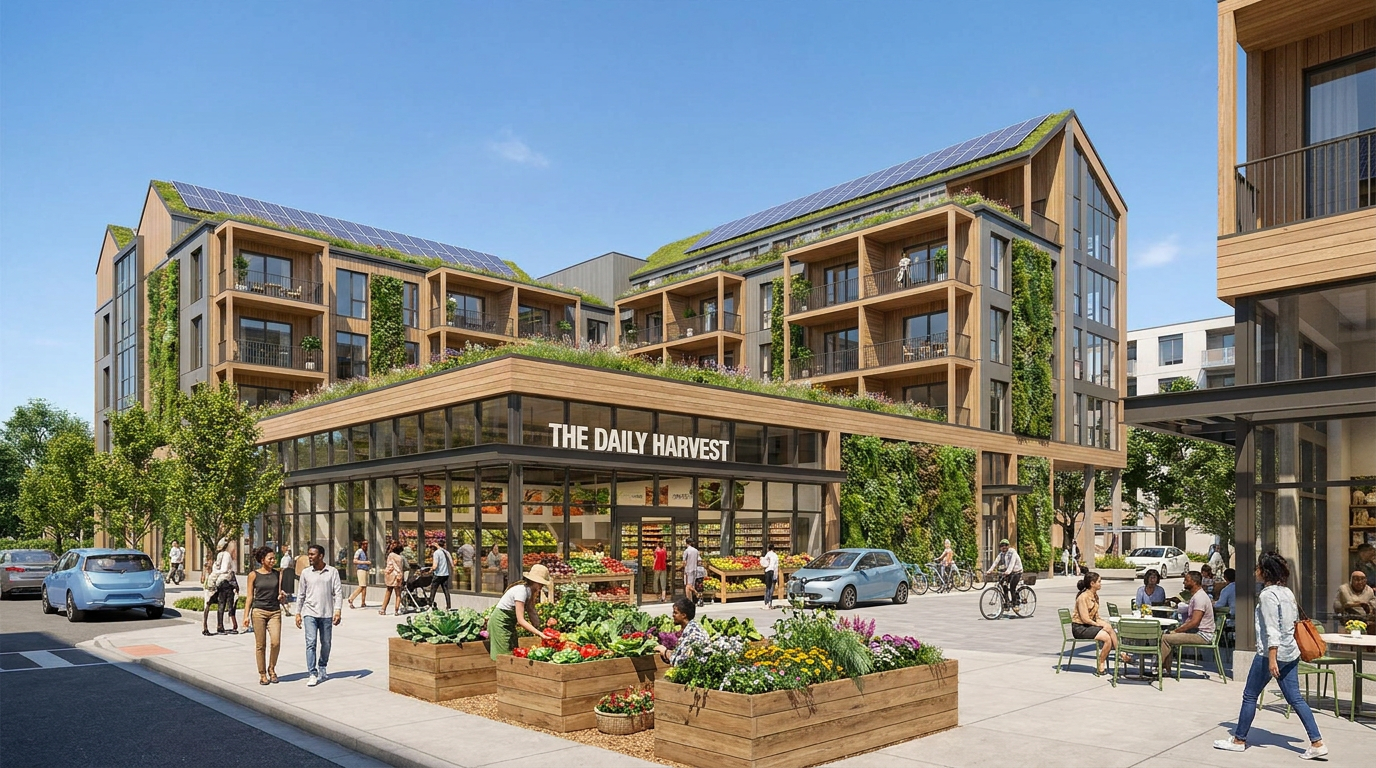
For decades, the Community Land Trust (CLT) model was a quiet, steady force in affordable housing, primarily focused on helping low- and moderate-income families purchase single-family homes. But in 2026, the model is undergoing a massive evolution. Across North America, neighborhood coalitions are scaling up their ambitions, transforming the CLT framework from a tool for individual homeownership into a mechanism for entire neighborhood ecosystems. These new trusts are acquiring apartment buildings, launching community-owned grocery cooperatives, and designing mixed-use hubs that insulate vulnerable communities from speculative real estate markets.[7]
At its core, a community land trust operates on a bifurcated ownership model that fundamentally changes how real estate functions. A non-profit organization, governed democratically by local residents and community stakeholders, owns the land itself in perpetuity. The buildings on that land—whether they are single-family houses, multi-unit apartments, or commercial storefronts—are owned or leased by individuals and businesses. This structure permanently removes the underlying land from the speculative market, ensuring that even as the surrounding neighborhood gentrifies and property values skyrocket, the housing and commercial spaces remain affordable for future generations.[2][4]
The Avanzando San Ysidro Community Land Trust in Southern California exemplifies this new, expansive approach. Breaking ground as a bold 103-unit development, the project merges affordable residential housing with commercial spaces and climate-resilient design. Rather than simply providing shelter, the Avanzando project was designed through extensive community engagement—including creative methods like local Lotería games—to ensure the development directly addresses the specific cultural and economic needs of the San Ysidro neighborhood, proving that affordable housing can be both beautiful and deeply integrated into the community fabric.[1]
A critical component of this 2026 evolution is the strategic integration of food security into the land trust model. Many urban and rural neighborhoods facing severe housing affordability crises are simultaneously classified as food deserts, where residents must travel an hour or more just to access fresh, nutritious food. To combat this dual threat, community organizers are increasingly anchoring their land trusts with cooperatively owned grocery stores, ensuring that basic necessities are controlled by the people who rely on them.[5]

In Southeast Raleigh, North Carolina, the Fertile Ground Food Cooperative is a prime example of this synergy. After a major corporate grocery chain abandoned the predominantly Black neighborhood, residents rallied to raise millions of dollars to build their own community-owned grocery store and community center. By operating independently of traditional corporate chains, the cooperative ensures that profits circulate locally, local farmers have a dedicated marketplace, and residents have voting rights to determine the store's future, transforming a neighborhood vulnerability into a collective asset.[6]
Academic research into these community-owned markets reveals that their success hinges heavily on their foundational priorities. Studies indicate that while some co-ops focus primarily on high-end organic products, the most transformative models take a social justice approach. These stores prioritize affordable fresh produce and anchor their ownership within low-wealth communities, effectively turning a basic neighborhood necessity into an engine for equitable economic development and local wealth-building, proving that community ownership can out-compete extractive corporate models when properly supported.[5]
Academic research into these community-owned markets reveals that their success hinges heavily on their foundational priorities.
The roots of this movement stretch back to the civil rights era, specifically the 1961 Albany Movement in Georgia. Frustrated by systemic racism and economic exclusion, Black organizers like Charles Sherrod sought to create a new model of community control over land, leading to the creation of the first community land trusts. Today's organizers view modern CLTs as a direct continuation of that legacy—a daily, relational practice rooted in collective responsibility and resistance against displacement that honors the original vision of those civil rights pioneers.[4]
This ethos of collective resistance is vividly illustrated by the Bay Area Community Land Trust (BACLT) in California. Faced with the constant threat of eviction and displacement in a hyper-commodified housing market, tenant leaders known as the "South Berkeley Neighbors" organized to reclaim their housing. Backed by a recent $10 million investment, the BACLT empowers residents to participate in shared governance and ongoing political education, treating housing not as an individual asset to be traded, but as a human right preserved for neighborhood cohesion.[4]

The model is proving equally resilient north of the border. In Toronto, the Parkdale Neighbourhood Land Trust (PNLT) has meticulously built an enduring community institution in one of the city's most rapidly gentrifying areas. Starting with the acquisition of a community garden funded by 188 individual donors, the PNLT has since expanded to purchase multi-unit residential buildings, including a 15-unit rooming house, ensuring that the city's most vulnerable residents are not priced out of their own neighborhood as luxury developments encroach on their historic borders.[2]
Critics of the community land trust model sometimes argue that it limits the wealth-building potential traditionally associated with homeownership, since resale prices are strictly capped to maintain affordability for the next buyer. However, long-term data and resident testimonies tell a markedly different story. Because homeowners within a CLT benefit from significantly reduced upfront purchase prices and lower ongoing housing costs, they are able to save substantial amounts of money and build wealth through other avenues, avoiding the crushing debt that often accompanies private-market mortgages.[3]
The Cooper family's experience with the Community Home Trust in North Carolina highlights this dynamic. After purchasing a CLT home and living there for years, the family earned steady equity—typically around 1% per year in their program. More importantly, the drastically reduced mortgage allowed them to plant financial seeds that eventually funded a down payment on a home in the private market, all while their original house was passed on to a new family at an affordable rate, perfectly illustrating the model's dual benefit.[3]

Acquiring land in highly competitive, hyper-commodified urban markets requires substantial, flexible funding and the careful navigation of intricate, often outdated zoning laws. Successful trusts cannot rely on goodwill alone; they often depend on a sophisticated patchwork of philanthropic grants, community share offers, and increasingly, strategic partnerships with local municipal governments willing to champion alternative housing models. Without this multi-tiered financial support, competing against cash-rich private developers is nearly impossible for grassroots organizations.[2]
Recognizing the stabilizing power of these organizations, forward-thinking city governments are beginning to treat community land trusts as vital civic infrastructure rather than fringe experiments. By transferring vacant, city-owned lots directly to land trusts or providing crucial pre-development funding, municipalities are helping to lower the massive financial barriers to entry for community organizers. This public-sector support is proving essential in transitioning CLTs from isolated neighborhood projects into comprehensive, city-wide strategies for equitable urban development. When cities align their resources with community-led initiatives, the pace of affordable housing creation accelerates dramatically.[2][7]
As 2026 unfolds, the convergence of community land trusts and cooperative commercial enterprises represents a profound and necessary shift in urban development. By reclaiming the land beneath their feet and the grocery aisles in their own neighborhoods, residents are proving that the most effective, enduring solutions to the housing and food crises do not come from outside corporate developers, but from the ground up. This localized approach offers a sustainable blueprint for communities determined to secure their own futures.[7]
How we got here
1961
The Albany Movement in Georgia lays the groundwork for the first community land trusts as a tool for civil rights.
2005
The Cooper family purchases the 100th home sold by the Community Home Trust, demonstrating the model's long-term viability.
2016
Parkdale Neighbourhood Land Trust makes its first acquisition, a community garden in Toronto.
Late 2025
Avanzando San Ysidro CLT breaks ground on a 103-unit mixed-use development.
2026
CLTs nationwide increasingly integrate community-owned grocery stores to combat food deserts.
Viewpoints in depth
Community Organizers' view
Housing and food access must be decoupled from speculative markets to protect vulnerable neighborhoods.
For grassroots organizers, the expansion of the CLT model is a necessary defense against systemic displacement. They argue that treating land and food access as commodities inevitably prices out the very people who built the neighborhood. By establishing democratic, shared-governance structures, organizers believe communities can reclaim their right to remain in their homes and dictate their own economic futures, drawing direct inspiration from the civil rights movement's early land stewardship efforts.
Urban Policy Researchers' view
CLTs provide a structurally sound mechanism for long-term urban affordability and equitable development.
Researchers and urban planners focus on the math and policy mechanisms behind the movement. They point to data showing that CLTs effectively insulate housing stock from market volatility, ensuring that public or philanthropic investments in affordability are never lost to future gentrification. Furthermore, researchers emphasize that when community-owned grocery stores anchor these developments, they create a multiplier effect—circulating capital locally and providing stable, living-wage jobs in areas historically starved of investment.
CLT Homeowners' view
Shared-equity models provide a crucial stepping stone for financial stability and wealth generation.
For the residents living within these trusts, the theoretical benefits translate into immediate, life-changing stability. While critics often focus on the capped resale value of CLT homes, residents emphasize the profound impact of drastically reduced monthly housing costs. This affordability allows families to pay down debt, invest in education, and save for future transitions to the private market, all while enjoying the security of a permanent, well-maintained home.
What we don't know
- How quickly municipal governments will adapt their zoning laws to accommodate these complex, mixed-use community developments.
- Whether traditional financial institutions will standardize mortgage products for shared-equity homes, which currently require specialized lending.
Key terms
- Community Land Trust (CLT)
- A non-profit organization that owns land on behalf of a community, ensuring buildings on it remain permanently affordable.
- Food Desert
- An urban or rural area where residents have limited access to affordable, fresh, and nutritious food.
- Shared Equity Model
- A homeownership structure where the buyer purchases the house at a below-market price and agrees to limit their return on investment upon resale to keep it affordable for the next buyer.
- Worker Cooperative
- A business owned and self-managed by its workers, ensuring profits and decision-making remain democratic.
Frequently asked
How do community land trusts keep housing affordable?
The trust retains ownership of the land while selling or leasing the building to a resident. By removing the land's cost from the purchase price and capping resale profits, the home remains affordable in perpetuity.
Can you build wealth while living in a CLT home?
Yes. While the equity gained upon resale is capped (often around 1% per year), the significantly lower monthly housing costs allow residents to save money and build wealth through other investments.
Why are CLTs building grocery stores?
Many neighborhoods facing housing crises also lack access to fresh food. By building community-owned grocery cooperatives on trust land, residents can eliminate food deserts and keep economic profits circulating locally.
Sources
Source coverage
7 outlets
3 viewpoints surfaced







[1]Policy & Innovation CenterUrban Policy Researchers
Avanzando San Ysidro Community Land Trust Case Study
Read on Policy & Innovation Center →[2]University of British ColumbiaUrban Policy Researchers
From the Ground Up: How Parkdale Built a Community Land Trust
Read on University of British Columbia →[3]Community Home TrustCLT Homeowners
The unique value of community land trust homeownership
Read on Community Home Trust →[4]American Bar AssociationCommunity Organizers
Rising Together: Reclaiming Housing, Reimagining Power
Read on American Bar Association →[5]Scholars Strategy NetworkUrban Policy Researchers
Which type of community-owned grocery store will be most successful?
Read on Scholars Strategy Network →[6]Pro Food MakerCommunity Organizers
Fertile Ground Food Cooperative is building a community-owned grocery store
Read on Pro Food Maker →[7]Factlen Editorial TeamUrban Policy Researchers
Synthesis by Factlen editorial team
Read on Factlen Editorial Team →
Every angle. Every day.
Get community stories with full source coverage and perspective breakdowns delivered to your inbox.