
Archaeologists Uncover 5,000-Year-Old 'Prototype' for Stonehenge's Solstice Alignment
A newly analyzed site featuring two massive wooden poles perfectly aligned with the solstice sun predates Stonehenge's famous stone circle by 500 years, revealing a much deeper history of prehistoric astronomy.
By Factlen Editorial Team
- Field Archaeologists
- Focuses on the physical excavation data, the chalk-packed pits, and the tangible artifacts that reveal how Neolithic people lived and celebrated.
- Archaeoastronomers
- Emphasizes the mathematical precision of the site and the sophisticated celestial knowledge possessed by prehistoric communities.
- Heritage Preservationists
- Highlights the tension between modern development and ancient history, noting the irony that the site is now buried under modern housing.
What's not represented
- · Modern Druid and Pagan communities who actively worship at Stonehenge today
Why this matters
This discovery fundamentally rewrites the timeline of prehistoric astronomy in Britain. It proves that the sophisticated celestial knowledge required to build Stonehenge was already deeply embedded in the local culture centuries before the iconic stones were ever raised.
Key points
- Archaeologists discovered a 5,000-year-old solstice-aligned monument three miles from Stonehenge.
- The structure consisted of two massive wooden poles set 120 meters apart.
- Digital reconstructions prove the poles aligned with the solstice sun to within one degree.
- The site predates the raising of Stonehenge's famous stones by 500 years.
- Artifacts suggest large groups gathered at the site for ceremonial feasting.
- The discovery proves sophisticated astronomical knowledge existed long before Stonehenge was completed.
Just days before thousands gather to watch the summer solstice sunrise at Stonehenge, archaeologists have unveiled a monumental discovery that pushes the region's astronomical traditions back by half a millennium. Located near the village of Bulford, roughly three miles from the world-famous stone circle, researchers have identified the earliest known solstice-aligned structure in the Wiltshire landscape.[2][3]
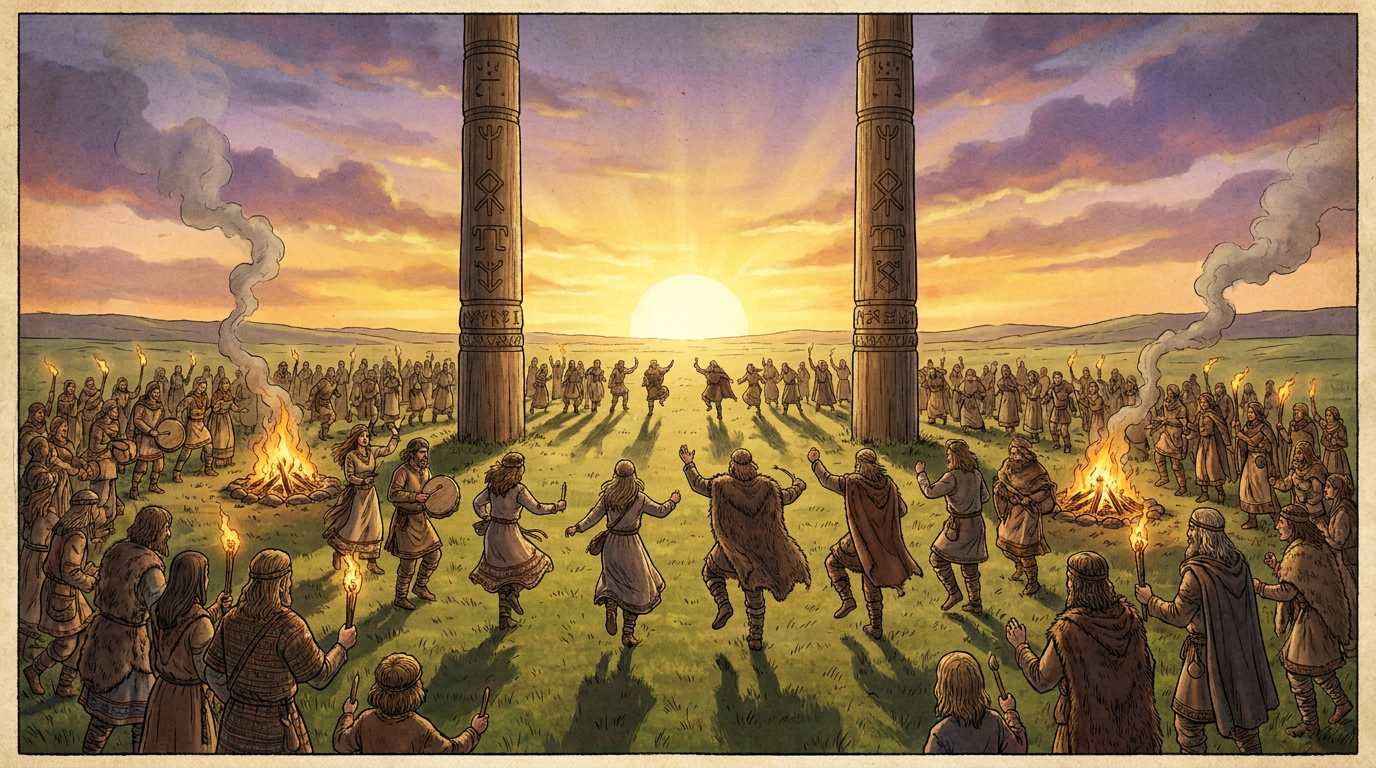
The site, which has been radiocarbon dated to approximately 2950 BC, predates the iconic sarsen stones of Stonehenge by 500 years. Instead of massive boulders, this earlier monument relied on timber. Excavators found evidence of two massive wooden poles, set exactly 120 meters apart, that functioned as a precise astronomical viewing station.[2][4]
The discovery was born from a routine, albeit massive, archaeological survey. Between 2015 and 2017, Wessex Archaeology conducted excavations across a 13-hectare site ahead of a Ministry of Defence project to build new housing for troops returning from Germany. The team uncovered 48 Neolithic pits scattered across the landscape.[6][7]
At first glance, the site appeared to be a standard collection of ancient rubbish pits. However, two specific postholes stood out. Unlike the others, which were filled with typical settlement debris, these two large pits were deliberately packed with chalk rubble—a clear indication that they were designed to support immense weight, such as towering wooden posts.[2][7]

The breakthrough came during the post-excavation analysis. Dr. Phil Harding, a veteran archaeologist and former presenter on the television show Time Team, was reviewing the site plan when he noticed the peculiar orientation of the two large postholes. Drawing a simple line between them with a pencil and ruler, he realized the axis sat roughly 50 degrees off direct north.[2][6]
That specific angle is no coincidence in the Salisbury Plain; it is the exact trajectory of the midsummer sunrise. Harding recognized immediately that the wooden poles, which likely stood three to four meters high, would have created a "gunsight" alignment pointing directly at the rising sun on the longest day of the year, and the setting sun on the shortest.[2][5]
To verify this pencil-and-paper hypothesis, the team brought in Dr. Fabio Silva, a skyscape archaeologist. Because the Earth's axial tilt and celestial mechanics shift slightly over millennia, the sky today does not look exactly as it did 5,000 years ago. Silva used digital models to reconstruct the ancient horizon and the exact position of the sun in 2950 BC.[3][4]
To verify this pencil-and-paper hypothesis, the team brought in Dr.
The digital reconstruction confirmed Harding's suspicion with stunning precision. The 120-meter gap between the two posts aligned with the Neolithic summer solstice sunrise and winter solstice sunset to within a single degree of accuracy. The structure was undeniably a deliberate, highly engineered solar observatory.[3][4]
The surrounding 46 pits provided crucial context about how this observatory was used. Excavators pulled pottery, animal bones, worked flints, and charcoal from the earth. The concentration and type of debris suggest that large groups of people gathered at the Bulford site for short, intense periods of ceremonial feasting—exactly the kind of activity expected during a solstice festival.[1][6]
Among the debris, archaeologists found a breathtaking piece of symbolic art. Inside a smaller pit aligned with the viewing station, they discovered an extremely rare, disc-shaped flint knife. The stone had been expertly knapped into a perfect circle, which researchers believe was deliberately deposited as a physical representation of the sun disc.[1][7]

The dating of the Bulford site places it squarely in the earliest phase of Stonehenge's history. While the giant trilithon stones were not erected until around 2500 BC, the initial circular earthworks—the ditch and bank that form the outer ring of Stonehenge—were being dug at the exact same time the Bulford poles were standing.[2][6]
This chronological overlap has profound implications. Experts argue it is inconceivable that the people feasting at the Bulford timber alignment were unaware of the earthworks being constructed just three miles away. It is highly plausible that the two sites were built and utilized by the exact same community of early Britons.[6]
The Bulford discovery suggests that Stonehenge was not a sudden, isolated stroke of architectural genius. Instead, it was the monumental culmination of a deep, pre-existing culture of sky-watching. The wooden poles served as an early prototype, proving that the local population had already mastered the complex geometry required to track the solar cycle.[3][5]

Because timber rots, archaeologists suspect that a similar wooden alignment may have originally stood at the Stonehenge site itself before being replaced by the permanent sarsen stones. Unfortunately, the massive later construction phases at Stonehenge likely obliterated any trace of such early wooden postholes.[4][6]
Today, the Bulford site is no longer visible. The post pits have been swallowed by the modern Ministry of Defence housing development. As Dr. Harding noted, one of the most significant astronomical viewing stations in British history is now likely sitting quietly beneath someone's living room floor.[2][7]
How we got here
2950 BC
The Bulford timber alignment is constructed and used for solstice ceremonies.
2950 BC
The earliest phase of Stonehenge (the circular ditch and bank) is excavated.
2500 BC
The massive sarsen stones and trilithons are erected at the main Stonehenge site.
2015–2017
Wessex Archaeology excavates the Bulford site ahead of Ministry of Defence housing construction.
June 2026
The discovery of the Bulford solstice alignment is publicly announced.
Viewpoints in depth
The Field Excavators
Focuses on the physical evidence pulled from the earth and what it reveals about Neolithic life.
For the archaeologists on the ground, the thrill of the Bulford discovery lies in the tangible remnants of human activity. The 48 pits uncovered across the 13-hectare site paint a vivid picture of a bustling, temporary festival ground. The presence of animal bones and pottery indicates that large groups of people traveled to the site specifically to feast and celebrate. The discovery of the chalk-packed postholes and the perfectly round flint sun-disc provides hard, physical evidence that these gatherings were highly organized and deeply symbolic, anchoring abstract astronomical concepts in physical architecture.
The Skyscape Astronomers
Focuses on the mathematical precision of the site and its implications for prehistoric science.
Skyscape archaeologists view the Bulford site as a masterpiece of early engineering and observational astronomy. By digitally rolling back the celestial clock 5,000 years, researchers proved that the 120-meter alignment was not a coincidence, but a calculated "gunsight" accurate to within a single degree. This level of precision requires decades, if not centuries, of careful observation of the horizon. It demonstrates that Neolithic Britons possessed a sophisticated, multi-generational scientific tradition long before they developed the logistical capacity to move the massive stones of Stonehenge.
The Heritage Preservationists
Focuses on the bittersweet reality of modern archaeology and the loss of ancient sites to development.
While the discovery is a triumph of modern archaeological analysis, it also highlights the constant friction between preserving history and accommodating modern infrastructure. The Bulford excavation was a rescue dig, conducted solely because the Ministry of Defence needed to build housing for returning soldiers. Today, the 5,000-year-old post pits that once framed the solstice sun are permanently buried beneath a modern residential neighborhood. For preservationists, the site is a stark reminder of how much invisible history lies beneath our feet, and how easily it can be paved over.
What we don't know
- Whether a similar wooden prototype originally stood at the exact site of Stonehenge before the stones were erected.
- The exact rituals or ceremonies that took place around the wooden poles beyond communal feasting.
- Where the massive wooden poles were sourced from and how they were transported to the Bulford site.
Key terms
- Solstice
- The two times in the year when the sun reaches its highest or lowest point in the sky at noon, marking the longest and shortest days.
- Radiocarbon dating
- A scientific method for determining the age of an object containing organic material by measuring the decay of radioactive carbon isotopes.
- Skyscape archaeology
- A sub-discipline of archaeology that studies how ancient cultures understood and integrated the sky, stars, and celestial events into their monuments and societies.
- Sarsen stones
- The massive sandstone blocks used to construct the main, iconic outer circle and inner horseshoe at Stonehenge.
Frequently asked
Can I visit the Bulford solstice site?
No, the site is not accessible to the public. It is located on Ministry of Defence land, and the post pits are now buried underneath a modern housing development.
How do we know the poles were aligned with the sun?
Skyscape archaeologists used digital models of the landscape and the night sky from 2950 BC to prove the postholes line up with the summer solstice sunrise to within one degree of accuracy.
Did the same people build both sites?
Radiocarbon dating shows the Bulford site was active at the exact same time the earliest earthworks at Stonehenge were being dug, making it highly likely the communities were connected or even the same people.
Sources
Source coverage
7 outlets
3 viewpoints surfaced







[1]The New York TimesHeritage Preservationists
In Ancient Pits Near Stonehenge, Scientists See Hints of Solstice Ritual
Read on The New York Times →[2]The GuardianField Archaeologists
Wessex Archaeology suspect they have uncovered a prototype for world-famous Stonehenge site in Wiltshire
Read on The Guardian →[3]ForbesArchaeoastronomers
5,000-Year-Old Stonehenge Prototype Revealed Days Before The Solstice
Read on Forbes →[4]Live ScienceArchaeoastronomers
Evidence of two ancient wooden posts aligned with the summer and winter solstices has been discovered near Stonehenge
Read on Live Science →[5]CNNHeritage Preservationists
New discovery may have been Stonehenge prototype
Read on CNN →[6]The IndependentField Archaeologists
Archaeologists unearth 5,000-year-old 'prototype' for Stonehenge solstice stones
Read on The Independent →[7]ITV NewsField Archaeologists
'Career highlight': Archaeologists uncover 5,000-year-old Stonehenge 'prototype'
Read on ITV News →


Every angle. Every day.
Get science stories with full source coverage and perspective breakdowns delivered to your inbox.